
REDTIGER F7N TOUCH
4.3Editor score
4K front resolution
STARVIS 2 image sensor
Touchscreen and voice control
Our expert guide compares the best Dash CAM for Off Roading options, covering 4K recording, night vision, parking surveillance, GPS, durability, and ease of
A dash cam for off-roading must do more than record a smooth highway drive. It should capture rocky trails, dust, forest roads, sudden weather changes, low-light crossings, and wide views of the terrain around your vehicle. Resolution, field of view, night performance, secure mounting, and reliable power management are especially important when roads are uneven and conditions change quickly.
We compared the listed specifications, recording channels, sensor technology, viewing angles, storage support, parking features, connectivity, installation requirements, and practical trade-offs of ten leading dash cams. The guide covers front-and-rear systems, three-channel models, and multi-camera 360-degree designs, while distinguishing between native, upscaled, and high-resolution recording modes.
Each review explains what makes the model relevant to off-road driving and where its design may be less suitable. The ROVE R2-4K Dual stands out as a well-rounded trail companion, while the IIWEY N6, Vantrue N4S, and other multi-channel systems offer broader coverage. Product features and availability can change, so confirm current specifications and pricing before purchasing.
4.3Editor score

4.5Editor score

4.4Editor score
The comparison below highlights channel count, front-camera resolution, low-light technology, navigation data, parking surveillance, storage, and connectivity. These characteristics matter most when a trail requires broad visual evidence, dependable nighttime recording, and a system capable of operating through a rough or changing off-road environment.



The ROVE R2-4K Dual is a balanced front-and-rear recorder for off-road drivers who want detailed road footage without carrying a bulky multi-camera system. Its 4.5 rating reflects a generally strong feature set, and the combination of a Sony STARVIS 2 IMX675 sensor, wide F1.5 front aperture, HDR, and upscaled 4K front recording gives it a useful foundation for wooded trails, desert roads, and changing daylight.
We may earn a commission when you buy through this link, at no additional cost to you.
The front camera records at 2.5K and upscales to 2160P, while the rear camera captures 1080P. Although the front output is not native 4K, the stated design aims to preserve more detail than a conventional 1080P dash cam. The STARVIS 2 sensor is particularly relevant after dark, when headlights, deep shadows, and dust can reduce visibility. Built-in GPS adds valuable context by recording routes, locations, speed, and compass direction.
ROVE includes a 128GB microSD card, and the system supports larger cards up to 1TB. Parking surveillance offers time-lapse, motion detection, and collision detection, with event locking and a one-minute recording after an incident. The hardwire kit is not included, so full-time parking operation requires another purchase. Thermal protection is a sensible off-road-oriented feature, although every installation still needs secure cable routing and sound vibration control.
This is the strongest general recommendation for off-road use because it combines front-and-rear evidence, low-light capability, navigation data, app-based file management, and storage expansion without becoming excessively complex. Choose the ROVE if you need a dependable two-camera trail recorder and can distinguish upscaled 4K from native 4K. It is less appropriate for drivers requiring a cabin camera or fully simultaneous 360-degree coverage.
A wide field of view helps capture the road edge, rock formations, passing vehicles, and approaching obstacles. The STARVIS 2 sensor and HDR work together to balance bright skies with shaded trail sections, while the included card means the system is ready for continuous loop recording after setup.
Integrated GPS records route, location, speed stamps, and compass direction. On unfamiliar off-road routes, that information can provide essential context for retracing a path or documenting where an event occurred.
We may earn a commission when you buy through this link, at no additional cost to you.
The IIWEY N6 is built for drivers who want more than conventional front-and-rear coverage. Its four-channel arrangement records the front, rear, and both sides simultaneously, giving off-road users a near-360-degree picture of the vehicle and its immediate surroundings. The 4.4 rating indicates a well-received system with a broad feature set and flexible mounting angles.
We may earn a commission when you buy through this link, at no additional cost to you.
The front and rear cameras use 170-degree views, while the side cameras offer 150-degree coverage and can be adjusted. Eight infrared lights assist the cabin-oriented night recording, and Vision Enhance technology is intended to improve plate and lane visibility. Dual-band Wi-Fi 6 supports transfer speeds up to approximately 20MB/s through the mobile app, making it practical to retrieve and share large off-road clips.
This model is also appropriate for SUVs, trucks, and other large vehicles, making its broad field of vision a major advantage. Built-in GPS logs speed and route, while seamless loop recording and G-sensor emergency locking preserve key events. The included 128GB card provides a useful starting point, though actual retention depends on resolution and the number of active channels.
The main compromise is installation complexity. Because the N6 is wired and lacks a built-in battery, a hardwire kit is needed for parking mode, and that accessory is sold separately. It is a strong choice for expedition-style recording, but drivers wanting a simple two-camera setup should consider the ROVE instead. For maximum visual coverage, however, the N6 is hard to overlook.
Side-facing channels can reveal another vehicle entering from a blind area, a passerby near a trailhead, or movement beside the vehicle. Adjustable angles also make the system more flexible than a fixed front-and-rear arrangement.
Loop recording, a 128GB card, and built-in GPS support extended travel without constant card management. The 48-hour parking option is useful at remote campsites, although permanent power installation is required.
We may earn a commission when you buy through this link, at no additional cost to you.
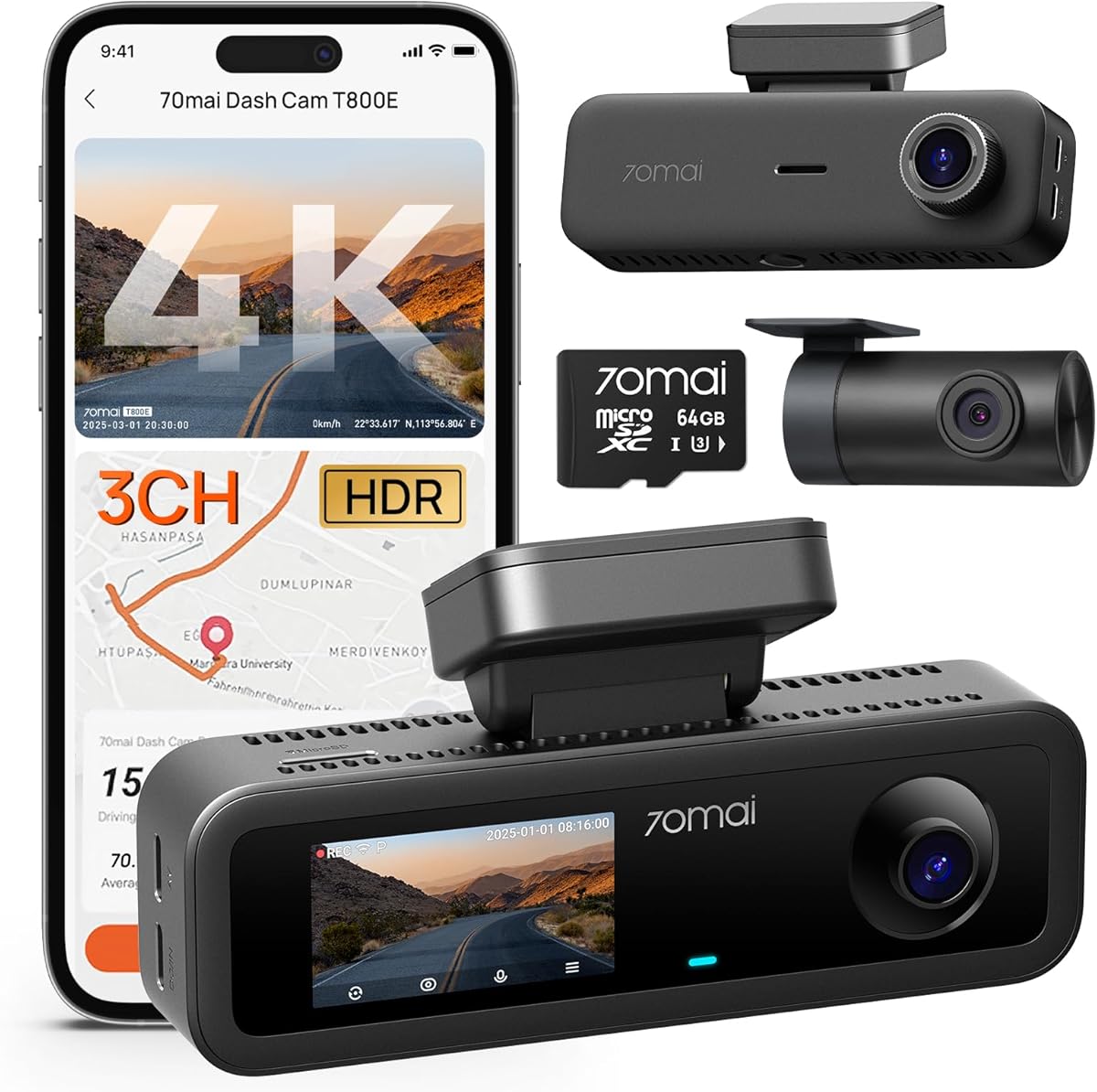
The 70mai T800E is a three-channel dash cam that records the road, rear window, and passenger compartment. Its 4.5 rating and combination of 4K front video, 1080P rear and interior channels, GPS, and parking surveillance make it a strong fit for overland trips, shared vehicles, and drivers who want evidence from every major direction.
We may earn a commission when you buy through this link, at no additional cost to you.
Ultra-wide lenses and an F1.55 front aperture support visibility in difficult conditions. HDR and 3D noise reduction are intended to improve low-light clarity, while switchable infrared recording gives the interior camera an advantage in complete darkness. That feature can be useful for observing passengers, gear, or cabin activity without adding another specialized camera.
Wi-Fi 6 supports transfers up to 10MB/s through the 70mai app, and voice control allows hands-free operation for taking photos, starting recording, and locking footage. Five-mode GPS captures location, speed, and route information. A 64GB card is included, and the camera supports cards up to 512GB for longer journeys where constant loop recording is expected.
The supercapacitor is specified for operation from 14°F to 140°F, making it a meaningful consideration for exposed vehicles in hot deserts or cold mountain regions. Parking monitoring requires a compatible UP06 or UP03 hardwire kit, and 4G connectivity is not supported. Overall, the T800E balances cabin visibility, strong front resolution, and thermal resilience well for off-road use.
The switchable IR mode can clarify cabin footage when ambient light is minimal. It also allows the driver to turn infrared off when unnecessary, giving useful control over image character and storage use.
A supercapacitor is generally preferable to a lithium battery for a vehicle-mounted camera exposed to large temperature changes. The specified operating range supports use across demanding seasonal environments.
We may earn a commission when you buy through this link, at no additional cost to you.
The REDTIGER F7NP combines 4K front recording with a 1080P rear channel and a 170-degree front lens. Its 4.1 rating is lower than several alternatives in this guide, but the underlying specification remains attractive for off-road drivers who want detailed forward footage, a broad view, and dependable low-light performance.
We may earn a commission when you buy through this link, at no additional cost to you.
The STARVIS 2 sensor, F1.5 aperture, six-layer optical lens, WDR, and HDR form a capable low-light package. This matters on night trails, in tunnels, and beneath dense tree cover. The included card and seamless loop recording simplify initial setup, while the G-sensor protects footage associated with abrupt impacts that may occur on rough roads.
Built-in 5.8GHz Wi-Fi supports downloads at up to 20MB/s through the Redtiger Cam app. GPS data is also available, allowing route, speed, and location information to supplement visual evidence. Time-lapse and G-sensor parking modes are offered, but a hardwire kit is required for continuous parking operation.
The supercapacitor improves reliability in hot conditions and long parking periods, and the system is backed by an 18-month guarantee. The main drawback is its lower customer rating relative to the more highly rated models here. Still, the F7NP is a straightforward front-and-rear choice for off-road users who prioritize sensor quality, a wide lens, and fast file transfer over cabin coverage.
The 170-degree front field of view captures a broad section of the trail, including roadside obstacles and nearby vehicles. High front resolution is especially useful when the road surface or landscape contains fine visual details.
The STARVIS 2 sensor, wide aperture, WDR, and HDR work together to improve visibility in dark conditions. This combination is more relevant to off-road travel than resolution alone when many trails lack continuous lighting.
We may earn a commission when you buy through this link, at no additional cost to you.
The AProX HD Three-Channel system records 4K from the front, 4K from the rear, and 1080P from the cabin. It holds the highest listed rating in this roundup at 4.8, making it an especially compelling specification-led choice for off-road owners who want high resolution in both exterior directions.
We may earn a commission when you buy through this link, at no additional cost to you.
Viewing angles are 170 degrees at the front and 150 degrees at the rear and cabin, offering a broad picture of the trail and vehicle interior. WDR supports challenging lighting, while four IR lights help the cabin camera record in darkness. A 3.18-inch laminated screen reduces reflections and provides an easy way to review status or adjust settings.
Dual-band Wi-Fi 6 can transfer video at up to 20MB/s through the TERUNSOUL app, with OTA firmware updates available. Built-in GPS records speed and location directly into recordings. A 128GB card is included, and support extends to 512GB, which is helpful when recording three channels at high resolution.
The system offers time-lapse parking monitoring and collision detection, but a hardwire kit is needed. Keeping all three channels active may also increase power consumption, storage use, and heat. Even so, the combination of dual 4K exterior recording, cabin night vision, fast connectivity, and a three-year guarantee makes this one of the strongest specifications in the guide.
Recording 4K from both the front and rear gives unusual resolution flexibility for an off-road setup. It can help preserve fine environmental details and provides strong footage from both directions without settling for a 1080P rear channel.
Fast dual-band Wi-Fi and a 128GB starting card make the high-resolution system easier to manage. The app also supports firmware updates, reducing the need to repeatedly remove and insert the memory card for routine adjustments.
We may earn a commission when you buy through this link, at no additional cost to you.
The REDTIGER F7N TOUCH delivers the central functions off-road drivers tend to prioritize: 4K forward recording, 1080P rear coverage, a STARVIS 2 sensor, built-in GPS, and fast wireless transfers. Its 4.3 rating is solid, and the touchscreen adds convenient control for locking clips, enabling Wi-Fi, and taking still images.
We may earn a commission when you buy through this link, at no additional cost to you.
A 170-degree front lens offers a broad trail view, while the rear camera uses a 140-degree lens. WDR, HDR, and the F-series night-vision features are intended to maintain clarity through darkness, tunnels, and sudden changes in light. Voice commands reduce the need to handle the device while driving, which is helpful on rough roads where touching controls may be distracting.
The built-in 5.8GHz Wi-Fi supports download speeds up to 20MB/s through the Redtiger Cam app. GPS stamps routes, speed, and location into footage, while seamless loop recording overwrites the oldest files. The G-sensor automatically protects an associated clip when it detects a sudden movement or impact.
Parking monitoring includes time-lapse and G-sensor modes, although permanent parking use requires a separately sold hardwire kit. The absence of a cabin channel keeps the system simpler and easier to route through an off-road vehicle. For drivers seeking a capable two-camera setup without paying for a full three-channel system, this is a practical and well-equipped choice.
The touchscreen provides direct access to common functions, while voice commands allow basic actions without handling the camera. That combination can be useful when the driver needs to concentrate on uneven trails or navigating difficult terrain.
High-speed 5.8GHz Wi-Fi reduces the waiting involved in moving high-resolution footage to a phone. This is particularly helpful after an incident or when reviewing a long route from the passenger seat.
We may earn a commission when you buy through this link, at no additional cost to you.
The REDTIGER F17 gives off-road users the option of recording three channels or concentrating resolution on the front and rear. Its 4.4 rating and STARVIS 2-equipped front camera place it among the stronger general-purpose systems reviewed, while the 150-degree front, 160-degree cabin, and 155-degree rear views provide broad coverage.
We may earn a commission when you buy through this link, at no additional cost to you.
In three-channel mode, the camera records 4K at the front and 1080P inside and behind the vehicle. Alternatively, turning off the cabin channel enables 4K front and 1080P rear recording. That flexibility is valuable because some off-road drivers prioritize trail detail, while others want to document passengers, passengers' equipment, or cabin activity.
Dual-band Wi-Fi supports quick transfers through the REDTIGER app, and the system can replay three channels together while presenting GPS information. HDR, WDR, and the STARVIS 2 IMX675 sensor are designed to improve low-light output and dynamic range. Parking monitoring includes time-lapse and collision detection across the available cameras.
A supercapacitor supports reliability in extreme temperatures, and the product includes an 18-month guarantee. The supplied 64GB card may fill quickly with three high-resolution channels, so a larger card could be worthwhile for extended trips. The hardwire kit remains necessary for parking mode. Overall, the F17 is adaptable and well suited to off-road users who want resolution control.
The ability to disable the cabin channel is a meaningful advantage in a vehicle used for different purposes. It lets a driver prioritize 4K front detail or 2.5K dual-channel capture without maintaining a fixed three-camera configuration.
Front, rear, and cabin channels can collectively show what happened outside and inside the vehicle. For overland travel or shared rides, that broader context is often more useful than a single forward-facing view.
We may earn a commission when you buy through this link, at no additional cost to you.
The PRUVEEO 360 Four-Channel records the front, rear, left, and right sides at 1080P simultaneously. Its 4.2 rating reflects a capable multi-camera approach, and the complete exterior view is especially relevant for off-road vehicles that may approach obstacles from an angle not covered by a conventional two-camera setup.
We may earn a commission when you buy through this link, at no additional cost to you.
Three of the cameras have adjustable viewing angles, allowing users to direct more attention toward a specific side of the vehicle or toward the cabin. An F1.8 cabin lens and four infrared lights support low-light recording. Built-in Wi-Fi provides phone access, while integrated GPS maps speed, location, and route information.
Time-lapse parking mode compresses an hour of activity into one minute, conserving storage while the vehicle is stationary. Loop recording automatically replaces older footage, and collision locking protects incident clips. The included 128GB card helps with immediate setup, although four active channels can fill it relatively quickly during a long expedition.
The camera has no internal battery, eliminating a common source of heat and long-term reliability concerns inside a parked vehicle. Parking mode still requires a separately sold ACC hardwire kit. The main limitation is that every channel is 1080P, so this system prioritizes coverage and flexibility over the higher resolution found in several three-channel competitors.
Left and right channels can document another vehicle, trail user, obstacle, or unexpected movement alongside the vehicle. This is useful on narrow tracks where the side of the road is poorly defined.
Time-lapse mode condenses long parked periods while still creating a visual record. A hardwired ACC connection is necessary, and drivers should confirm their vehicle's wiring arrangement before installation.
We may earn a commission when you buy through this link, at no additional cost to you.
The Vantrue N4 Pro S is the most premium-oriented system in the guide, combining three STARVIS 2 sensors with 4K, 2.5K, and 1080P recording. Its 4.4 rating and extensive feature set make it a compelling choice for serious off-road drivers, expedition vehicles, and owners who want an adaptable three-camera system.
We may earn a commission when you buy through this link, at no additional cost to you.
The front, rear, and interior cameras offer 155-degree, 165-degree, and 160-degree views respectively. PlatePix technology and triple HDR are designed to improve plate recognition and balance exposure, including under headlights and nighttime backlight. The rotating 360-degree rear camera can monitor traffic or pivot inward toward cargo, passengers, luggage, or pets.
A front-and-rear mode records 4K plus 2.5K and is stated to reduce heat by 30 percent compared with triple recording. That makes it attractive for long hot-weather trips. Buffered parking mode can preserve ten seconds before a detected motion or impact, while the system supports up to 1TB of storage and more than 37 hours of continuous triple-channel 4K recording.
The 5GHz Wi-Fi, precision GPS, voice control, supercapacitor, and 18-month warranty complete a sophisticated package. No memory card is included, so a suitable U3 card must be selected. Installation and cable routing also require more care than a simple two-camera setup. For users who value image quality and flexibility over cost and simplicity, this is the top premium recommendation.
The rotating rear module is unusually useful for off-road travel, where equipment or passengers may be as important as the road behind. It can alternate between traffic monitoring and inward-facing cargo or cabin views.
The lower-resolution dual-channel mode reduces heat relative to recording all three sensors continuously. On remote trails, fewer active channels and less thermal load can support steadier operation during long journeys.
We may earn a commission when you buy through this link, at no additional cost to you.
The Vantrue N4S uses three STARVIS 2 sensors to record 2.7K at the front, 1440P inside, and 1440P at the rear. Its 4.3 rating reflects a capable three-channel system with a particular emphasis on night vision, temperature tolerance, and flexible installation.
We may earn a commission when you buy through this link, at no additional cost to you.
The 158-degree front, 165-degree cabin, and 160-degree rear lenses provide broad coverage. HDR and PlatePix technology work with the sensors to improve details and license plate visibility on dark roads. PlatePix is listed as improving plate sharpness by a factor of two, which may help in unlit trail encounters where vehicle identification matters.
A magnetic mount, static-cling film, and cable clips create a tool-free installation, while the rotating rear camera can face traffic or pivot inward toward cargo and pets. The supercapacitor is specified to operate from -4°F to 140°F, providing useful reassurance for extreme cold and heat.
Four parking modes include motion detection with ten seconds of pre-event recording, collision detection, and lower-bitrate or frame-rate options. The camera supports 1TB microSD cards, although none are included, and offers 5GHz Wi-Fi plus OTA updates. Compared with the N4 Pro S, it trades some front resolution for broad three-channel capability and a strong temperature specification.
Three STARVIS 2 sensors provide consistent low-light capability across front, cabin, and rear channels. This is important on remote routes where the only illumination may come from headlights, reflectors, or brief flashes of light.
Magnetic mounting and included cable clips simplify setup while reducing the need for permanent adhesive in some positions. The rotating rear module then adds flexibility without changing the entire camera arrangement.
We may earn a commission when you buy through this link, at no additional cost to you.
The right off-road dash cam depends on trail visibility, vehicle layout, climate, routing needs, and the amount of wiring you are willing to install. Resolution should be considered alongside sensor quality, field of view, heat management, and whether cabin or side-facing coverage matters more than simple front-and-rear recording.
Choose the highest practical resolution that your storage, power, and mounting arrangement can support. Also verify whether a listed 4K mode is native or upscaled.
Prioritize the directions you actually need: front and rear, cabin, both sides, or a flexible rotating rear view.
For frequent night driving, favor a capable low-light sensor, wide aperture, HDR or WDR, and optional cabin IR.
Choose a supercapacitor or strong heat management for exposed vehicles, and check parking-mode power requirements before installation.
Choose a card with enough capacity for your trip and use locking to preserve important clips before the loop overwrites them.
Confirm that GPS and fast Wi-Fi are included if you plan to review evidence or retrace routes away from your vehicle.
Budget for a compatible hardwire kit and confirm your vehicle's power configuration before expecting parking surveillance to work.
Plan the complete cable path, test the mounting surface, and leave enough slack for suspension movement and uneven trails.
Begin with a complete installation check. Clean the mounting surfaces, choose a location that does not obstruct the driver's view, and route cables away from airbags, sharp edges, hinges, and moving suspension components. Secure the rear or side cameras where they will not be exposed to branches. Confirm that every connector is fully seated, then inspect the front lens and remove any protective film before recording.
Format a compatible memory card in the dash cam when the manufacturer recommends it, insert it in the correct orientation, and verify that the camera recognizes it. Set the date and time, enable GPS if available, adjust the recording resolution, and confirm the storage limit for locked event files. Test each channel by reviewing short daytime and nighttime clips on the phone or computer. Check for vibration, glare, blocked views, and any red lines caused by protective film.
During a trip, rely on loop recording but transfer and back up important clips before the card fills. Use the app to connect only while safely parked, and avoid prolonged operation of a wired camera in a hot cabin. Inspect mounts, connectors, and cables after severe weather or rough terrain, and allow the system to cool if it becomes excessively warm.
Models with STARVIS 2 sensors and a wide aperture are strong choices for dark trails. The ROVE R2-4K Dual, REDTIGER F7NP, F7N TOUCH, F17, and both Vantrue systems specify STARVIS 2 sensors. Consider HDR, WDR, and cabin IR as additional benefits, while recognizing that no dash cam can guarantee readable footage in complete darkness without external illumination.
Not necessarily. A front-and-rear system is often sufficient if your primary concern is documenting the trail and what follows the vehicle. Four-channel models add left and right views, which can help on narrow trails or at campsites. The additional cameras also require more wiring, power, storage, and attention during installation.
It can be useful when fine details matter, such as distant terrain, road signs, or vehicle identification. However, sensor quality, HDR, aperture, lens clarity, and low-light processing also influence the result. A capable 1080P system with good night performance may sometimes be more practical than a higher-resolution model that consumes more storage or generates more heat.
The IIWEY N6 and PRUVEEO system are designed for wired operation without an internal battery. That approach reduces some heat concerns while the vehicle is parked. A suitable car charger can support daily recording, while parking mode generally requires a separately sold hardwire kit connected to the appropriate vehicle circuit.
The answer depends on resolution and the number of active cameras. High-resolution three-channel systems can fill a 64GB card quickly, while the included 128GB cards provide a more comfortable starting point. For multi-day journeys, select a card within the camera's supported capacity range and transfer important footage before loop recording overwrites it.
No. Most parking surveillance features require a separate compatible hardwire kit, and the product descriptions generally list it as not included. Confirm the correct kit for the selected model and verify the vehicle's ACC or constant-power configuration before installation.
Follow the manufacturer's operating guidance because each model has different thermal limits. Several products use supercapacitors and include heat-related protections, but a windshield-mounted camera can still become very hot. Park in shade when possible, inspect for overheating after a long drive, and disconnect power if the device becomes excessively hot.
Yes. GPS can record location, speed, route, and time, providing useful context when roads are not marked. It can also help a driver retrace a route or document an incident's location. Accuracy can vary beneath dense tree cover, in deep canyons, or where satellite signals are obstructed, so footage and route data should be considered complementary evidence.
The ROVE R2-4K Dual is the most balanced overall recommendation, combining upscaled 4K front recording, a STARVIS 2 sensor, GPS, and front-and-rear coverage in a relatively straightforward package. The REDTIGER F7N TOUCH stands out as a capable value option, while the Vantrue N4 Pro S represents the premium choice for users who want three sensors, a rotating rear camera, and extensive storage support.
The right model depends on the type of trail and the evidence you want. Choose a wide multi-camera system for narrow routes, remote camps, cabin monitoring, or complete exterior visibility. Favor strong low-light specifications for night travel, adequate card capacity for long journeys, and a supercapacitor or proven heat management for extreme climates. Installation planning is as important as the camera itself.
Before purchasing, confirm the current channel configuration, native or upscaled resolution, included accessories, hardwire requirements, and supported memory-card capacity. Product specifications, firmware, bundle contents, and pricing can change over time. Checking the current listing and manufacturer instructions will help ensure that the selected dash cam fits both your vehicle and your off-road recording priorities.