
6-Way Marine Fuse Block
4.8Editor score
Six individually protected circuits
Red LED fault indicators
PBT housing with protective cover
Includes blade fuses and hardware
This guide compares Fuse Block for Marine Applications products, covering capacity, corrosion resistance, ignition protection, diagnostics, and ease.
A marine fuse block organizes and protects the many electrical circuits found on a boat, from navigation lighting and bilge pumps to radios and battery chargers. A useful model combines secure circuit distribution, corrosion-resistant components, environmental protection, and enough capacity for the loads connected to it.
The products in this guide were compared using their stated circuit counts, maximum current ratings, fuse formats, grounding options, diagnostic features, enclosure design, and stated marine suitability. The list includes six- and twelve-way blade-fuse panels, a high-amp terminal fuse block, and purpose-built Blue Sea Systems models for different electrical demands.
Each review explains the practical advantages, limitations, and best-fit installation for that model. Ratings and product details reflect the supplied marketplace information, while prices change over time and should be checked on the linked listing. The top selections represent budget, overall, and premium choices.
4.8Editor score

4.8Editor score

4.7Editor score
This side-by-side comparison highlights the major differences among ten marine-capable fuse blocks, including circuit quantity, fuse type, total capacity, grounding arrangements, diagnostics, weather protection, and suitability for high-current equipment.




The WUPP 12 Volt Fuse Block combines six protected circuits, a negative grounding bus, and individual red diagnostic LEDs in a compact package designed for 12- to 24-volt DC systems. Its 4.7 rating reflects a generally positive response, and its most distinctive feature is the ability to identify a failed branch circuit without checking every blade fuse individually.
We may earn a commission when you buy through this link, at no additional cost to you.
The electrical ratings allow up to 100 amps total and 30 amps per circuit across a 12-to-32-volt operating range. Nickel-plated copper busbars and fuse pieces are specified for conductivity and corrosion resistance, which is especially relevant in humid boats and saltwater-exposed installations. A flame-retardant PBT base adds structural strength and heat resistance, while the damp-proof cover helps protect the interior from splashes and accidental contact.
The built-in indicators are convenient, but the stated diagnostic system may produce a small residual voltage even when a fuse is intact because of the LED circuitry. That behavior is described as expected rather than a leakage fault, although highly sensitive diagnostic instruments may detect it. The six-circuit limit also means owners with many independent loads may need a larger panel or a separate distribution block.
This is a strong choice for a boat with several smaller electrical loads that benefit from fast fault location. It is especially appealing when the installer wants a complete ground bus, labeled circuits, spare fuses, and a protective cover in one package. For larger boats or high-current propulsion accessories, a higher-amp terminal fuse block may be more appropriate.
Each fused load has an indicator that illuminates when its fuse blows or a short occurs. This reduces troubleshooting time and makes it easier for owners to match a failed circuit to a specific device.
Nickel-plated copper contacts and a PBT housing address conductivity, corrosion resistance, insulation, and heat resistance. The protective cover further reduces exposure to damp conditions and loose wiring.
We may earn a commission when you buy through this link, at no additional cost to you.
The Blue Sea Systems ST Blade Fuse Block is a six-circuit distribution panel with an integrated negative bus and a 4.8 rating. It combines familiar ATO and ATC blade-fuse compatibility with a compact layout, making it one of the most versatile choices for organizing a broad range of low- and moderate-current marine circuits.
We may earn a commission when you buy through this link, at no additional cost to you.
The block supports up to 100 amps total and 30 amps per circuit. Its clear insulating cover uses a secure push-button latch, includes integrated storage for spare fuses, and provides recessed areas for circuit labels. Tin-plated copper buses and durable fuse clips are designed to resist corrosion and maintain conductivity in automotive or marine environments.
Compared with LED-equipped panels, this model does not offer immediate visual fault identification. Owners must inspect the fuses or use another test method when a circuit stops working. It also does not include the blade fuses, so those must be selected separately according to the protected load and the vessel's wiring design.
This is the most balanced overall recommendation for a boat needing six conventional branch circuits, dependable bus construction, and compact organization. It is particularly useful for lighting, pumps, small electronics, and accessory circuits where standardized blade fuses are desirable and operators are comfortable checking fuse continuity.
Combining branch circuits, inline fuse positions, and ground connections in one block reduces wiring clutter. The layout is useful in compartments where loose fuses and separate holders would be difficult to inspect or maintain.
The push-button cover latch keeps the enclosure closed without making fuse access difficult. Recessed labeling areas and built-in spare-fuse storage help keep service information and replacement parts close at hand.
We may earn a commission when you buy through this link, at no additional cost to you.
The Blue Sea Systems MRBF Terminal Fuse Block is designed for high-current marine circuits and has a 4.7 rating. Unlike multi-circuit panels intended to feed numerous small accessories, this compact block protects a major feed such as a DC main, inverter, windlass, or bow thruster.
We may earn a commission when you buy through this link, at no additional cost to you.
It supports terminal fuse ratings from 30 to 300 amps, with maximum operating capacity listed at 300 amps per block and 58 volts DC. The mounting stud uses a 5/16-inch thread, while the insulating cap helps prevent accidental shorts. Weatherproof construction makes it suitable for small open-cockpit boats and other harsh environments.
The block becomes ignition protected when paired with appropriate MRBF fuses, an important distinction for installations where gasoline vapors or other flammable gases may be present. However, those fuses are sold separately, and the installation still needs suitable terminals, correct wire sizing, and a properly selected fuse rating. It does not replace a multi-circuit accessory panel.
This premium model is the strongest choice when a boat needs protected high-current power for an inverter, thruster, windlass, or primary DC distribution. Owners should choose the correct MRBF fuse for the cable and load, confirm clearances around the block, and follow the vessel's applicable installation standards.
The 30-to-300-amp fuse range gives the installer flexibility for major electrical feeds. This makes the block more appropriate than a small blade-fuse panel for windlasses, thrusters, inverters, and DC main protection.
When installed with MRBF fuses, the assembly can meet ignition-protection needs. That feature is valuable around engines, fuel systems, and compartments where an ordinary non-ignition-protected device may be unsuitable.
We may earn a commission when you buy through this link, at no additional cost to you.
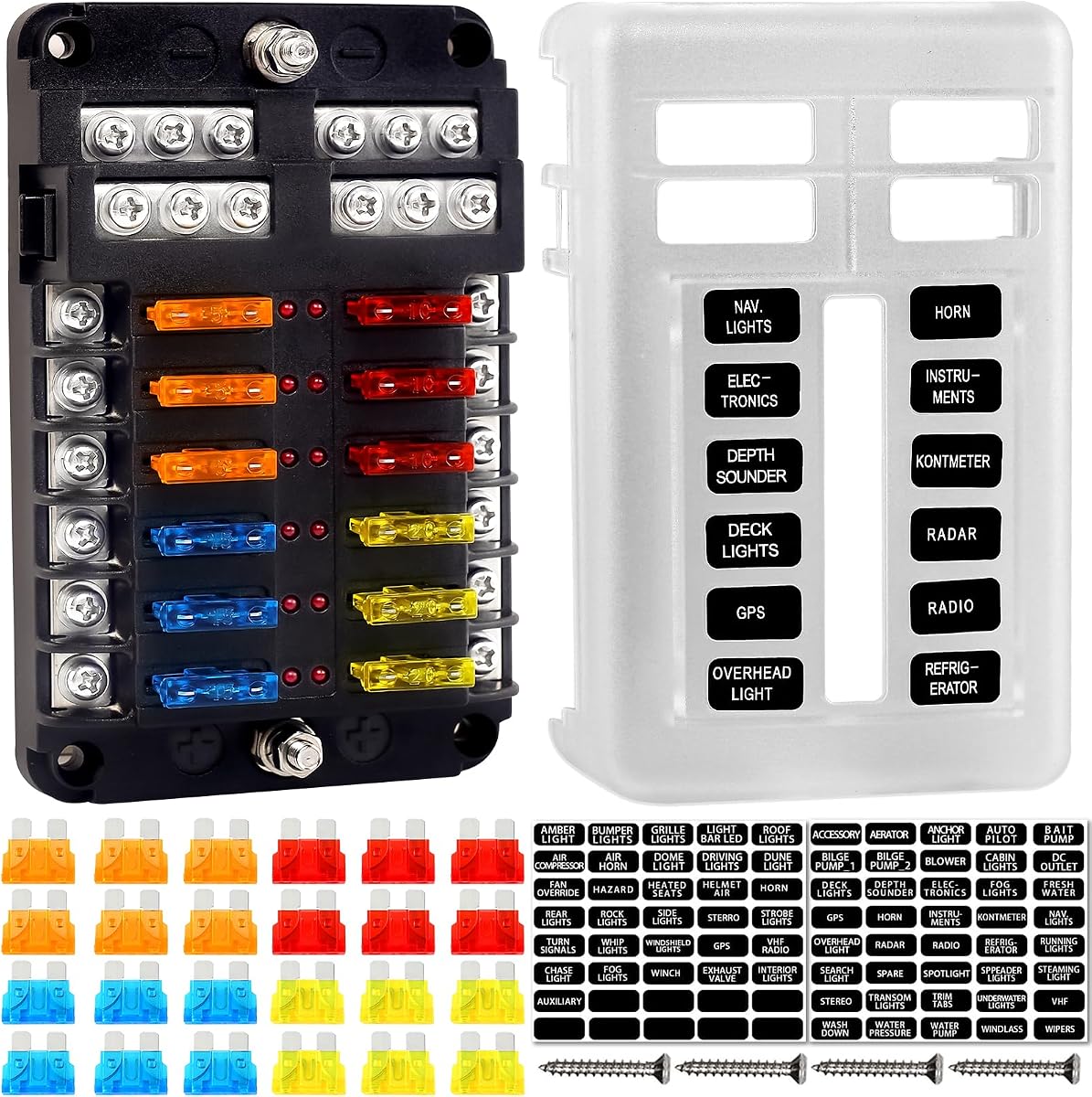
The 6-Way Marine Fuse Block is an approachable six-circuit panel with a 4.8 rating, individual LED warning lights, and support for common middle-size ATO and ATC blade fuses. It is aimed at boat owners who want a straightforward way to organize several low-voltage accessory circuits.
We may earn a commission when you buy through this link, at no additional cost to you.
Its listed maximum operating voltage is 32 volts DC, with up to 30 amps per circuit and 100 amps per panel. The fire-resistant PBT housing is described as mechanically strong, well insulated, and resistant to heat and flame. Twelve blade fuses, four screws, and two tip stickers are included, making the package more installation-ready than many bare blocks.
Its main limitation is the number of circuits. Six branches may be sufficient for a modest electrical system, but they become restrictive on a larger boat with navigation equipment, pumps, lighting, audio, chargers, and multiple accessory circuits. The protective cover also needs to be positioned so wires can enter and exit without creating strain or pinching.
This is the best budget pick for a smaller boat or a targeted retrofit. It combines accessible fault diagnosis with a negative connection beside each positive terminal and enough included accessories to complete a basic installation. Buyers should verify that the lead wire sizes and mounting arrangement suit their hull or electrical compartment.
A red LED beside each branch illuminates when the corresponding fuse blows. This makes fault isolation quicker and is especially helpful when several accessories share a common power panel.
The package includes twelve blade fuses, mounting screws, and identification stickers. These accessories reduce the need to source basic consumables before installing the block.
We may earn a commission when you buy through this link, at no additional cost to you.
The DaierTek 12 Way Fuse Block provides twelve independently protected circuits and a 4.6 rating. Its larger branch count makes it more appropriate than a six-way panel for boats with a substantial collection of lighting, pumps, electronics, and accessory loads.
We may earn a commission when you buy through this link, at no additional cost to you.
Maximum operating voltage is listed at 32 volts DC, with 30 amps allowed per circuit and 100 amps across the panel. Each branch has a red LED that illuminates when its fuse blows. A push-lock protective cover helps organize the wiring and limit interference from loose conductors, while the positive and negative sides support a cleaner panel layout.
The package includes two power terminals, 24 device terminals, identification stickers, and 30A, 25A, 20A, 15A, 10A, and 5A fuses with six of each type. That broad fuse assortment is useful during initial setup, though owners should select ratings based on actual load calculations rather than simply using the largest fuse that fits.
This panel is a good fit for larger accessory systems that need more branch positions but remain within a 100-amp total limit. It is less appropriate for very high-current equipment, which should use a separate appropriately rated protection device. Correct wire sizing, strain relief, cover positioning, and environmental sealing remain installer responsibilities.
Twelve dedicated fuse positions reduce the need for multiple inline holders. This simplifies circuit mapping and creates a central location for inspecting and replacing blade fuses.
Included power terminals, device terminals, screws, labels, and a range of fuse ratings provide a broad starting point. These parts simplify panel assembly while still requiring correct sizing for each device.
We may earn a commission when you buy through this link, at no additional cost to you.
The Cyrico 12-Circuit Fuse Block combines twelve branch circuits, LED fault indicators, a negative bus, and a protective cover in one package. Its 4.7 rating places it among the stronger twelve-way panels in the group, while the enclosure is described as offering dust and splash protection.
We may earn a commission when you buy through this link, at no additional cost to you.
The housing uses PBT and PC materials for insulation, heat resistance, flame resistance, and mechanical strength. Nickel-plated copper busbars and fuse clips support conductivity and corrosion resistance. Each circuit is rated for up to 30 amps, while the complete panel is limited to 100 amps, so high-current loads should not all be connected at their individual maximums.
Twist-lock screws are designed for quick installation, while self-tapping screws are included for mounting. The cover helps manage nearby wiring and reduce dust and splash exposure, but it should not be interpreted as permitting prolonged submersion or eliminating the need for correct marine sealing. The package also includes extra blade inserts and circuit stickers.
This is an appealing option for a boat retrofit requiring many small protected circuits and immediate visual fault feedback. It works well for lighting, refrigeration, fans, chargers, warning equipment, and similar accessories. Installers should verify wire gauge, terminal torque, and fuse selection for each branch before energizing the system.
A dedicated LED and labeling position for each circuit make a twelve-load installation easier to troubleshoot. This is useful as an accessory panel grows and multiple devices depend on the same central distribution point.
PBT and PC construction provides a balance of mechanical strength, insulation, and heat resistance. Nickel-plated copper components add conductivity and corrosion resistance in demanding environments.
We may earn a commission when you buy through this link, at no additional cost to you.
The 12-Way LED Fuse Block is a comprehensive twelve-circuit panel with a 4.8 rating. It is distinguished by a broad installation kit that includes 36 blade fuses, 24 heat-shrink terminals, heat-shrink tubing, insulation sleeves, an installation manual, and a marine-grade tin-plated copper main terminal.
We may earn a commission when you buy through this link, at no additional cost to you.
The panel operates at 12 to 24 volts DC and is rated for 100 amps total with a maximum of 30 amps per circuit. Red LEDs identify blown branch fuses, and a push-lock protective cover helps organize nearby wires and reduce exposure to dust, corrosion, and shorts. The stated protection reaches IP53, covering protection against limited spray and other ingress conditions rather than severe water exposure.
The extensive accessory package can make a new installation more convenient, especially for owners who already have the correct wire and mounting hardware. Conversely, the number of included parts may be unnecessary for a modest retrofit. IP53 should also be understood as water resistance rather than unrestricted exposure to waves, washdown, or standing water.
This model is a strong choice for a new 12-to-24-volt accessory system that wants diagnostics, a ground bus, and most consumables included. It offers the flexibility of a large panel without moving into high-amp terminal-fuse territory. Correct circuit protection remains essential, and the selected fuse must match both the load and the cable.
Fuses, crimp-style terminals, heat-shrink tubing, insulation sleeves, labels, and instructions cover many of the small parts needed for panel assembly. This reduces separate purchasing when the wiring method matches the supplied accessories.
The push-lock cover and IP53 rating offer meaningful resistance to splashes, dust, and accidental shorts. Additional marine-grade sealing may still be needed in compartments exposed to direct washdown or severe weather.
We may earn a commission when you buy through this link, at no additional cost to you.
The Nilight 50055F is a compact six-circuit screw fuse block with a 4.7 rating, an integrated negative bus, and individual red LED warnings. It supports middle-size ATC and ATO fuses and is marketed for marine boats, vehicles, buses, ships, tankers, and other low-voltage systems.
We may earn a commission when you buy through this link, at no additional cost to you.
Maximum operating voltage is listed at 32 volts DC, with capacity up to 100 amps for the panel and 30 amps for each circuit. The PBT housing is described as mechanically strong, insulated, heat resistant, and flame resistant. Its insulating cover opens easily for maintenance and is stated to satisfy ABYC and USCG requirements, while the negative bus simplifies return connections.
The product includes a protective cover, several fuses, four screws, and two stickers. As with other blade-fuse panels, the total capacity is shared across the block, so installers should not assume each circuit can simultaneously draw 30 amps. The six-circuit format may also become limiting as more accessories are added.
This model works well for smaller boats and targeted accessory upgrades where visual diagnostics and a negative bus are priorities. It is a sensible alternative to the WUPP and generic six-way panels for owners who value a clearly stated standards-oriented cover design and straightforward fuse access.
The easy-open insulating cover allows routine inspection and replacement while protecting the panel during normal operation. Recessed or labeled positions help keep circuit identification organized.
Six dedicated positions consolidate smaller loads without the footprint or complexity of a twelve-way panel. This makes the block suitable for space-conscious installations and modest electrical systems.
We may earn a commission when you buy through this link, at no additional cost to you.
The Blue Sea Systems 5056 ST-Blade Water-Resistant Fuse Block is a compact four-circuit panel with a 4.7 rating. It supports ATO and ATC blade fuses as well as low-profile circuit breakers, and its water-resistant design accepts standard ring or spade terminals.
We may earn a commission when you buy through this link, at no additional cost to you.
The block operates at up to 32 volts DC, with an 80-amp total limit and 25 amps per circuit. It accepts one 8-to-4 AWG input and four 16-to-10 AWG load wires. The tin-plated copper bus and water-resistant enclosure are designed for convenient wiring and long-term conductivity, although fuses and breakers are sold separately.
Most importantly for this category, the supplied information explicitly states that this model is not ABYC compliant and is not intended for marine applications. Blue Sea directs marine users toward product number 5056100. As a result, despite its water-resistant construction, it should not be treated as a direct substitute for a marine-rated panel.
This product may be appropriate for a non-marine automotive installation or as part of a carefully assessed custom build, but the stated limitation makes it a poor primary recommendation for a boat. It is included to clarify an important distinction: water resistance alone does not establish marine suitability or regulatory compliance.
The block accepts standard ATO and ATC blade fuses and compatible low-profile breakers. That flexibility can simplify inventory and allow circuit protection to be changed as the installation evolves.
The product is explicitly not ABYC compliant and is not intended for marine use. Boaters should follow the manufacturer's direction to use the designated marine model instead.
We may earn a commission when you buy through this link, at no additional cost to you.
The Blue Sea Systems MEGA/AMG Fuse Block with Cover is a dedicated high-current protection device with a 4.6 rating. Unlike the multi-way panels in this guide, it is intended to protect a major circuit using a 100- to 300-amp MEGA or AMG fuse.
We may earn a commission when you buy through this link, at no additional cost to you.
The block accepts 5/16-inch M8 ring terminals and uses stainless steel studs for corrosion resistance, high torque, and reliable electrical contact. Molded studs secure the fuse in position. The insulating cover satisfies stated ABYC and USCG insulation requirements, and breakouts permit wire access in three directions for easier routing.
This is a single-circuit solution rather than an accessory distribution panel. It cannot replace a six- or twelve-way block for navigation lights, cabin circuits, pumps, audio, and numerous smaller loads. The appropriate fuse and cable still must be selected separately, and the assembly must be installed with suitable terminals and protection against unintended contact.
It is best suited to a boat with a large battery bank, inverter feed, heavy auxiliary circuit, or other high-current demand. Compared with the MRBF terminal block, it offers a different fuse format and mounting approach, giving owners another specialized option when matching their existing protection plan.
A 100-to-300-amp fuse range supports protection for substantial battery or auxiliary feeds. The block is best used where a branch-style blade fuse would be undersized or inappropriate.
The covered design satisfies stated insulation requirements, while cover breakouts support routing from three directions. Stainless steel studs and molded fuse seats help maintain a secure, corrosion-resistant connection.
We may earn a commission when you buy through this link, at no additional cost to you.
Choosing a marine fuse block requires matching the block to the vessel's voltage, wiring architecture, environmental conditions, and electrical loads. Capacity, circuit count, fuse format, grounding, diagnostics, and verified marine suitability deserve more attention than appearance or included accessories alone.
A water-resistant label is not the same as being designed and approved for marine service. Check whether the manufacturer states ABYC or USCG compliance, describes ignition protection where applicable, and identifies the environments in which the block can safely be installed. Some automotive panels resist splashes yet are not intended for a boat. For example, the Blue Sea 5056 model in this guide is explicitly not ABYC compliant and directs marine users to another part number.
Count the independent loads that need protection rather than estimating by boat length alone. Navigation lights, anchor lights, cabin lighting, bilge pumps, radios, refrigeration, fans, chargers, and audio systems may each require their own branch. Six-way panels suit smaller or focused systems, while twelve-way panels offer more room for expansion. A high-amp block handles one major feed and generally needs to be paired with a separate accessory panel.
The rating printed for each circuit is not the panel's total rating. Many six- and twelve-way blocks support 30 amps per fuse but only 100 amps across the complete unit. A terminal fuse block may range from 30 to 300 amps, while the four-circuit Blue Sea model has an 80-amp block limit. Calculate the connected load, conductor size, and intended simultaneous use before selecting a block.
Standard ATO and ATC blade fuses are convenient for many accessory circuits and are supported by most six- and twelve-way panels in this guide. MRBF, MEGA, and AMG formats serve higher-current feeds and require matching blocks, cable sizes, and terminals. Fuse format affects replacement availability, fault visibility, physical dimensions, and the type of equipment the block can protect.
A negative bus can reduce return wiring and create a cleaner installation, but not every electrical arrangement should be grounded through the fuse block. Some models include integrated negative positions, while others separate the positive and negative sides. Follow the vessel's wiring plan and the manufacturer's terminal arrangement, avoiding assumptions based on how a similar model is wired.
Individual LED indicators make it easy to identify a blown branch fuse without testing each position. They are especially valuable on a panel serving many similar-looking circuits. Cover labels and included stickers improve long-term troubleshooting after installation. Models without LEDs may still work well, but the owner will need to inspect fuses physically or use a multimeter to locate an interruption.
Marine fuse blocks may encounter spray, humidity, dust, condensation, accidental contact, and occasional direct washdown. Protective covers, sealed or latching housings, corrosion-resistant buses, and insulated fuse clips all improve resilience. Terms such as waterproof, damp-proof, water-resistant, and IP53 are not interchangeable. Review the stated rating and consider where the block will actually be mounted.
Check the block's supported wire sizes, terminal type, mounting-hole dimensions, and cover access before buying. Some panels accept ring terminals, some use screw terminals, and others require molded plug connections. Installation also requires correct fuse ratings, secure crimping or tightening, strain relief, weather-appropriate connections, and compliance with the boat's applicable electrical standards.
Begin by disconnecting the battery and isolating any power source feeding the installation. Mount the block in a dry, accessible location with the cover and terminals remaining reachable. Follow the boat's wiring diagram, connect the input and branch circuits with correctly sized conductors, tighten terminals to the manufacturer's instructions, and avoid placing bare conductors against conductive edges.
Install a correctly rated fuse in every populated branch position. The fuse should protect the cable and the connected device without being oversized merely to prevent nuisance opening. Use the supplied labels to identify each circuit, test every branch after power is restored, and confirm that the LED indicators and attached equipment behave as expected.
During routine maintenance, open the cover carefully, inspect for discoloration, loose terminals, corrosion, damaged insulation, and water intrusion, and replace any fuse with the same correct rating and type. Keep unused fuse positions properly covered, preserve spare fuses in the designated storage area, and periodically check that wire entries, mounts, and environmental seals remain secure.
The best fuse block for a boat depends on the number of protected circuits, total current, and equipment being served. Six- and twelve-way ATO or ATC panels work well for accessory circuits, while MRBF, MEGA, or AMG blocks protect major high-current feeds. The block should also be explicitly suitable for marine service and compatible with the vessel's voltage and wiring plan.
Not necessarily. A product called waterproof may only resist limited splash exposure and may not meet marine electrical requirements. Check for stated ABYC or USCG compliance, ignition protection where needed, and suitability for the exact mounting environment. Marine suitability is an important distinction when a panel is installed near an engine, fuel system, or open cockpit.
The required number depends on how many loads should operate independently. A small electrical system may need only a few protected branches, while navigation, lighting, pumps, refrigeration, audio, and charging equipment can quickly require twelve or more. Leave reasonable expansion room, but do not populate unused positions with unnecessary fuses.
No. The maximum fuse rating is a ceiling, not a default. Each fuse must match the load, the conductor size, and the equipment's requirements. A 30-amp fuse on a small lighting wire could permit damage before opening, while an oversized fuse may operate normally but still fail to protect weaker downstream wiring.
A blade fuse block distributes and protects multiple smaller accessory circuits using ATO, ATC, or similar fuses. A terminal fuse block protects one major high-current circuit with an MRBF, MEGA, or AMG fuse. Boats commonly need both types because cabin equipment and heavy electrical feeds have very different protection requirements.
An LED lights when the corresponding fuse blows, allowing a failed circuit to be identified quickly. This is especially helpful when many devices share one panel or when troubleshooting takes place in a confined compartment. The WUPP, generic six-way, DaierTek, Cyrico, 12-Way LED, and Nilight models in this guide offer this diagnostic feature.
Not necessarily. A negative bus provides a convenient termination point for ground returns associated with the panel, but the boat still needs a correctly designed primary grounding and bonding system. The appropriate connection method depends on the vessel's architecture, battery arrangement, and applicable marine electrical standards.
Inspect it during routine boat maintenance and whenever a circuit behaves unexpectedly. Check the cover, terminals, labels, fuse condition, mounting screws, wire entries, and signs of corrosion or moisture. Frequency should increase in saltwater, poorly drained compartments, or installations exposed to heavy spray and frequent vibration.
The Blue Sea Systems ST Blade Fuse Block is the strongest overall option for a conventional six-circuit accessory panel, combining a 4.8 rating, a negative bus, secure cover, and corrosion-resistant construction. The generic 6-Way Marine Fuse Block delivers the most budget-friendly diagnostic package, while the Blue Sea MRBF Terminal Fuse Block is the premium selection for high-current marine circuits.
Prioritize verified marine suitability before considering convenience features. Match the block's circuit count, fuse format, voltage, branch ratings, and total capacity to the loads, then confirm that wire sizes, terminal styles, mounting space, and cover access fit the installation. A well-chosen panel should provide clear protection without making future troubleshooting more difficult.
Finally, check current prices and availability on the linked product pages, as both can change over time. Review the latest manufacturer instructions, vessel wiring diagram, and applicable marine requirements before purchase or installation. With those checks completed, the selected block can provide a cleaner, safer, and easier-to-maintain electrical system.