
Camco PowerGrip 30AM/15AF
4.8Editor score
Compact molded adapter body
Non-slip removal grooves
ETL listed to standards
RV electrical adapters make it possible to connect an RV or camper to a differently configured power source, but choosing the wrong model can create fit, wattage, or safety problems. A useful adapter matches the correct plug, receptacle, amperage, and voltage while providing a secure connection for the environments where it will be used.
The products in this guide were compared using the information supplied for each listing, including connector standards, electrical ratings, wire construction, certification, weather resistance, grip design, indicators, dimensions, and intended applications. The list covers household-to-RV adapters, campground pedestal adapters, compact molded models, locking designs, and corded options for different amperage requirements.
Each review explains the product's strongest qualities, limitations, and most suitable use so readers can distinguish a basic connection aid from a feature-rich or purpose-built adapter. Ratings reflect the supplied listing data, while product availability and prices can change, so confirm current specifications and conditions before purchasing.
4.8Editor score

4.8Editor score

4.8Editor score
As an Amazon Associate we earn from qualifying purchases.
The side-by-side comparison highlights each adapter's connector arrangement, electrical limits, construction, and practical features, helping travelers match an adapter to their RV inlet and available power source.



The POWGRN RV 30 Amp to 110 Adapter Cord is a highly rated option for travelers who need to connect a 30-amp RV inlet to a standard 15-amp household receptacle. It carries a supplied rating of 4.8 and stands out for its 10-gauge pure copper wiring, ETL listing, ergonomic handles, and cold-weather flexibility.
We may earn a commission when you buy through this link, at no additional cost to you.
Its core electrical configuration is easy to understand: a 15-amp NEMA 5-15P male plug connects to the household side, while a 30-amp NEMA TT-30R female receptacle accepts a compatible RV cord. The listed 125-volt, 1,875-watt maximum provides a clear operating ceiling, and the 12-inch format keeps cable bulk to a minimum.
Outdoor durability is another meaningful strength. The supplied listing describes resistance to sunlight, rain, and freezing temperatures down to approximately -40 degrees Celsius, while the heavy-duty flame-retardant and heat-resistant PVC sleeve protects the conductor during storage and travel. The molded grips at both ends make repeated connection and removal more comfortable.
This is a strong general recommendation for a 30-amp RV that occasionally needs household power, particularly when a short adapter is easier to store than a full-length cord. Its main limitation is the twelve-inch lead, which works best when the RV inlet is reasonably close to a suitable outlet; it is also only a connector adapter, not a general-purpose voltage converter.
The opposing NEMA connectors make the intended direction straightforward, and the handles on both ends reduce the need to pull directly on the plug bodies. A 12-inch cord also avoids the excess cable that can snag, tangle, or take up valuable storage space.
The listed temperature tolerance, weather resistance, and heavy-duty protective sleeve make this adapter well suited to campsites, driveways, and outdoor storage. ETL listing adds a useful layer of reassurance for buyers comparing safety-oriented models.
We may earn a commission when you buy through this link, at no additional cost to you.
The RVGUARD 30 Amp to 110 Volt RV Adapter Cord is a feature-rich choice with a supplied rating of 4.8. It combines a standard household plug, a 30-amp RV receptacle, an LED power indicator, a disconnect handle, and full-product ETL/cETL certification in a practical 12-inch format.
We may earn a commission when you buy through this link, at no additional cost to you.
The adapter is rated for 15 amps, 125 volts, and 1,875 watts, using 10/3-gauge wiring. That makes it relevant for low-power appliances and battery charging during storage, as stated in the supplied information, while also serving as a convenient household-to-RV connection when the RV has a compatible 30-amp inlet.
The LED is the feature that sets this model apart from simpler molded adapters. It gives users immediate visual confirmation that power is present at the connection, which can be valuable when an outlet is behind an RV or otherwise difficult to inspect. The disconnect handle also keeps fingers away from the power source during unplugging.
Durability is handled with pure copper wiring under a heavy-duty, flame-retardant, UV-resistant polyvinyl sleeve. The entire product is described as ETL/cETL certified, rather than only its components, which is reassuring for buyers focused on outdoor electrical accessories. The main trade-off is that the short cord still needs a nearby outlet, and the indicator is an added element rather than a basic safety requirement.
The integrated LED removes the need to rely solely on the status of a distant receptacle or outlet. It is especially helpful for storage charging and connection checks in crowded campground spaces where visibility may be limited.
A dedicated disconnect handle provides leverage while keeping hands away from the electrical interface. Combined with the twelve-inch cord, it creates a practical adapter for travelers who want fewer loose cable loops.
We may earn a commission when you buy through this link, at no additional cost to you.
The Camco PowerGrip 30AM/15AF is a compact adapter with a supplied rating of 4.8 and a distinctive molded, cable-free design. It uses a 30-amp NEMA TT-30P male plug and a 15-amp NEMA 5-15R female receptacle, allowing a standard 15-amp accessory to connect to a 30-amp campground pedestal.
We may earn a commission when you buy through this link, at no additional cost to you.
Its 15-amp, 125-volt, 1,875-watt rating makes it useful for appropriately rated accessories rather than for drawing a full 30-amp RV load. The 14/3-gauge wiring and contoured body are designed for reliable connection, while non-slip grooves help users remove the adapter without wrestling with a tight-fitting plug.
The major advantage over corded models is portability. At approximately 2 3/8 by 2 by 2 5/8 inches, it takes up very little room and avoids the cable loop, strain relief, and storage demands of a short cord. It also avoids introducing an indicator light, making it a straightforward mechanical adapter.
This is an excellent choice for campers who need a 15-amp female connection at a 30-amp pedestal or who want a small, reliable adapter for compatible accessories. It is not a substitute for the household-to-30-amp RV direction used by several other picks, so buyers must verify both the RV inlet and the source connector before ordering.
The fully molded form is one of the easiest adapters to pack because it has no trailing cable to coil or snag. It can live in a small utility compartment and remain readily accessible when a campground connection is needed.
Non-slip grooves address the practical difficulty of separating a substantial 30-amp plug from a pedestal receptacle. Its ETL listing to CSA and UL standards strengthens its appeal for safety-conscious buyers.
We may earn a commission when you buy through this link, at no additional cost to you.
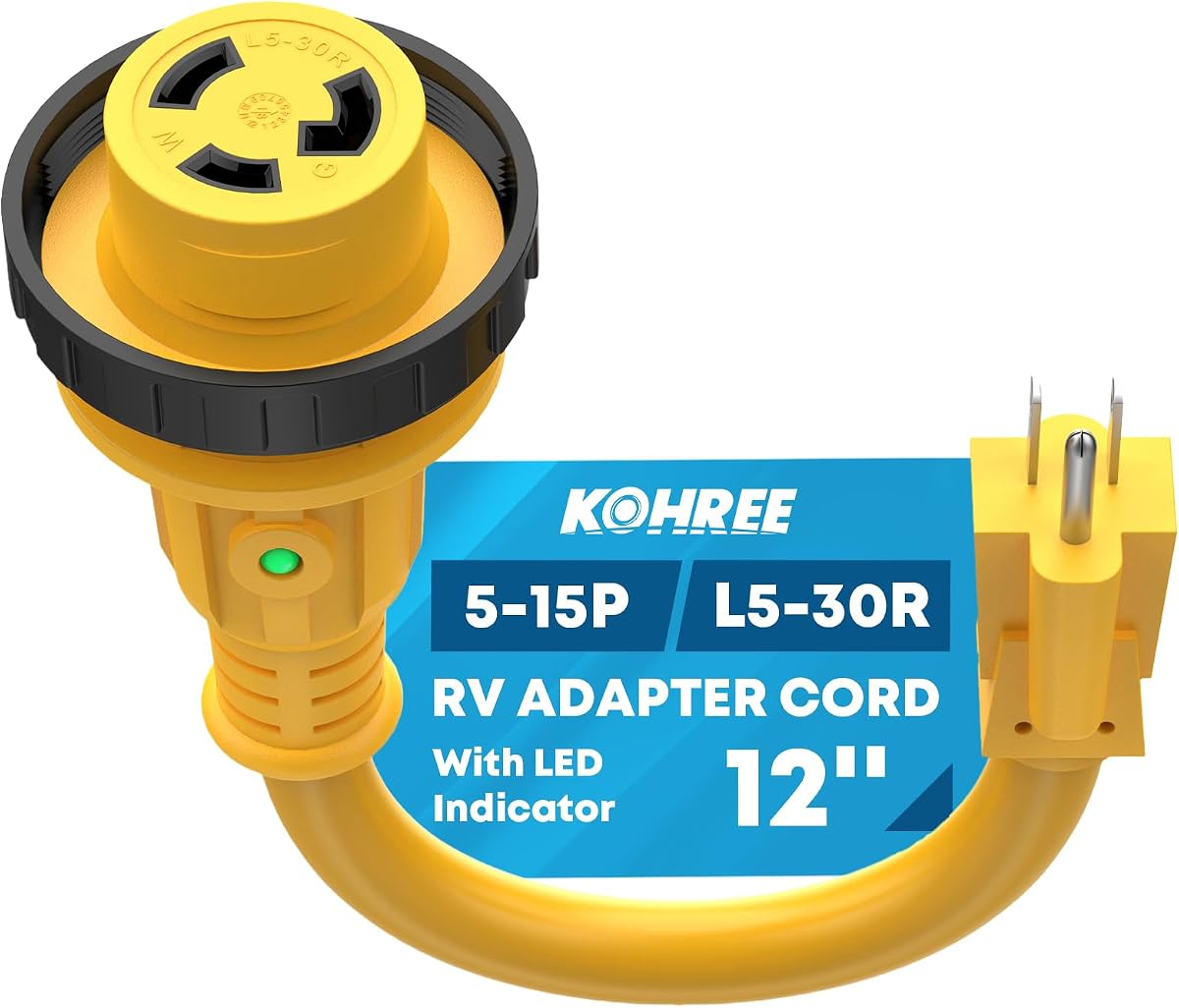
The Kohree RV Adapter Plug is a 4.8-rated household-to-RV adapter distinguished by its locking 30-amp female receptacle and green LED indicator. It is designed for an RV travel trailer with a compatible 30-amp twist-lock inlet that needs to operate from a 15-amp household outlet.
We may earn a commission when you buy through this link, at no additional cost to you.
Its listed wiring combines a 15-amp NEMA 5-15P male plug with a 30-amp NEMA L5-30R female connector, uses 10/3-gauge STW wire, and is rated for 125/250 volts and 1,875 watts. Buyers should note that the listed receptacle is L5-30R rather than the TT-30R found on several competing products.
The threaded ring is a meaningful advantage in outdoor use because it creates a weatherproof connection and helps prevent accidental separation. The green LED provides clear confirmation of power, while the molded heavy-duty polyvinyl body and pure copper wiring are intended to withstand regular travel use.
This is a compelling pick when the RV inlet matches the locking configuration and the fixed connection is desirable. It is less suitable for an RV with a conventional TT-30 inlet, and its short 12-inch cord means the household outlet must be close enough to avoid stretching the connection.
The threaded locking ring adds mechanical security compared with a simple push-fit adapter. That is particularly helpful around campsites where movement, vibration, or a slightly loose receptacle could otherwise create an unsafe condition.
The green indicator makes it easy to see whether the adapter is receiving power. It removes ambiguity when the receptacle or cord is positioned out of direct view.
We may earn a commission when you buy through this link, at no additional cost to you.
The POWGRN RV 50 Amp to 110 Adapter Cord is designed for an RV with a 50-amp NEMA 14-50R inlet that must connect to a 15-amp NEMA 5-15P household receptacle. It has a supplied rating of 4.6 and stands out for its heavy copper construction, ETL certification, ergonomic grips, and stated resistance to harsh outdoor conditions.
We may earn a commission when you buy through this link, at no additional cost to you.
Despite the 50-amp female connector, the 15-amp household plug limits the adapter to 15 amps, 125 volts, and 1,875 watts. That distinction is essential: the receptacle is designed to mate with the RV side, but the source connection determines the maximum available draw. It should not be treated as a way to operate high-draw 50-amp appliances from a standard household circuit.
The protective jacket is described as flame retardant, heat resistant, and capable of withstanding sunlight, rain, and freezing temperatures down to approximately -40 degrees Celsius. Ten-gauge pure copper wire supports conductivity, while molded handles on both ends improve connection and removal.
This adapter is a practical fit for travelers who need a physical 50-to-15 connection for limited-draw charging or selected RV systems. The trade-offs are the short cable and the significant amperage reduction imposed by the household side, so RV owners should inventory their actual loads before using it.
The NEMA 14-50R female end makes this model relevant to RVs whose wiring uses the larger 50-amp connection. Buyers should verify that their RV inlet uses this exact configuration rather than assuming all 50-amp receptacles are interchangeable.
The stated temperature range and outdoor-resistant jacket are particularly useful for outdoor storage and cold-weather travel. The copper conductor and protective sleeve also support dependable performance across repeated handling.
We may earn a commission when you buy through this link, at no additional cost to you.
The MECMO 30 Amp to 110 Volt RV Adapter is a straightforward solution for connecting a 30-amp NEMA TT-30R RV connection to a 15-amp NEMA 5-15P household outlet. Its supplied rating is 4.7, and the molded, lightweight construction makes it especially convenient for storage and travel.
We may earn a commission when you buy through this link, at no additional cost to you.
The adapter is rated for 125 volts and up to 1,875 watts, with a maximum load governed by the 15-amp household connection. It is presented as a practical solution for resolving connector incompatibility between a 30-amp RV and a common residential receptacle.
Unlike corded models, this product has no extended lead to manage, and it also lacks an LED indicator. That simplicity keeps the design light and compact, but it means the user must visually inspect the connection rather than receiving a visible powered-state signal.
The molded casing is shaped for a firm, comfortable grip, which helps when connecting or removing a substantial 30-amp plug. This is a good pick for users who prioritize portability and simplicity and already know that their RV uses a TT-30R configuration.
The direct molded design provides the required connector transition without extra cable length. It is easy to pack, easy to explain, and suitable for the common 15-amp household to 30-amp RV connection.
The contoured housing is intended to improve the grip when a user plugs into or removes the adapter. This is useful in tight spaces where the plug body is difficult to grasp.
We may earn a commission when you buy through this link, at no additional cost to you.
The RVGUARD 50 Amp to 30 Amp RV Adapter Cord is a 4.8-rated solution for campsites where a 50-amp pedestal must feed a RV with a 30-amp connection. It combines a 50-amp NEMA 14-50P male plug with a 30-amp NEMA TT-30R female receptacle in a 12-inch format.
We may earn a commission when you buy through this link, at no additional cost to you.
The listed rating is 125 volts and 3,750 watts, corresponding to the adapter's 30-amp side. It uses 10/3-gauge wiring and an LED indicator, allowing users to confirm that power is present after connecting the pedestal and RV cord.
Pure copper conductors are protected by a heavy-duty, flame-retardant, UV-resistant polyvinyl sleeve. Full-product ETL/cETL certification and the disconnect handle add practical safety features, while the short length avoids excess cable around the pedestal.
This is an excellent pick for 30-amp RVs at 50-amp campground pedestals, particularly for travelers who value clear power feedback. It cannot deliver the full capacity of a 50-amp RV connection, and users should ensure their RV's wiring and loads are appropriate for a 30-amp supply.
Many campground pedestals offer a 50-amp outlet even when a particular site is assigned to a smaller connection. This adapter provides the correct physical transition while keeping the RV-side limit at 30 amps.
The LED gives immediate confirmation of an energized connection, while the disconnect handle improves leverage and keeps fingers away from the plug interface during removal.
We may earn a commission when you buy through this link, at no additional cost to you.
The Vockjour 30 Amp to 110 RV Adapter Cord is a 4.8-rated household-to-RV adapter with a strong emphasis on environmental protection. Its 15-amp NEMA 5-15P plug and 30-amp NEMA TT-30R receptacle are rated for 125 volts and 1,875 watts, and the listing identifies the unit as ETL listed.
We may earn a commission when you buy through this link, at no additional cost to you.
The most notable specification is its IP65 waterproof rating, combined with claims of weatherproofing and corrosion resistance. It is also described as remaining flexible in freezing conditions and high heat, making it a compelling option for year-round travelers, outdoor storage, and exposed campsite power connections.
Comfortable grip handles and strain-relief construction at both ends support repeated use and help protect the cable from bending or pulling at the terminations. The 10-gauge pure copper cord and flexible PVC jacket are designed to support conductivity while minimizing voltage drop.
The absence of an LED means users must verify power by other means, and the 12-inch length may not be sufficient when the outlet is awkwardly positioned. Even so, the enhanced environmental rating makes this an attractive choice for users who prioritize weather resistance over visual status feedback.
An IP65 rating distinguishes this model from adapters described only as weather resistant. That makes it especially appealing for wet climates, exposed storage, and routine campsite use.
The stated temperature flexibility and strain-relief design address common weaknesses of short adapter cords. They are intended to reduce cracking, kinking, and connector strain during transport and use.
We may earn a commission when you buy through this link, at no additional cost to you.
This listing could not be evaluated on its merits because the supplied data contains no product title, rating, image, description, or specifications beyond its Amazon URL and ASIN. Without those details, it would be irresponsible to infer connector types, amperage, voltage, certification, or intended use.
We may earn a commission when you buy through this link, at no additional cost to you.
A prospective buyer should open the linked product page and verify the male plug, female receptacle, NEMA standards, maximum amperage, voltage, wattage, wire gauge, certification, and physical dimensions. The RV's inlet configuration and the available power source must be compared directly with those details.
It is also important to distinguish a physical adapter from a voltage converter. An adapter can change connector geometry, but it does not automatically increase the source capacity or change the voltage. Any load used through the connection must remain within the limits of the source and the adapter.
This entry is retained to preserve the supplied ten-product list, but it should not be selected on the basis of this guide alone. Consider it only if the current product page provides complete specifications, a suitable connector configuration, and evidence that it meets the electrical needs of the intended RV application.
The product page is the only available source for meaningful details. Review all listed dimensions and ratings there, and compare photographs with the connector on the RV before ordering.
A larger-looking plug does not necessarily mean greater usable power. The source receptacle, RV inlet, adapter rating, and equipment load all have to agree before the connection is appropriate.
We may earn a commission when you buy through this link, at no additional cost to you.
The final entry likewise lacks the information required for a responsible product review. The supplied source provides an ASIN and Amazon link, but no title, rating, image, description, connector arrangement, or electrical rating, so none of those attributes can be verified from the data provided.
We may earn a commission when you buy through this link, at no additional cost to you.
Before purchasing, open the listing and record the exact input and output connectors. Check the NEMA designation, amperage, voltage, wattage, and whether the item is only an adapter or also performs a conversion. These facts should be compared with the campground pedestal, RV inlet, and appliances that will be used.
Buyers should also look for an appropriate safety listing and examine whether the construction is suited to outdoor storage. A short molded adapter and a corded adapter offer different handling characteristics, and the right choice depends on where the connection will be made and how frequently it will be changed.
Because there is no product-specific evidence available, this listing cannot be endorsed as one of the strongest options. It may be worth considering only after the seller confirms that the connector direction, current rating, voltage, certification, and application all match the intended setup.
Confirm the connector geometry and electrical capacity directly with the current listing. A visual match alone is not enough because similar-looking RV connectors can have different amperage ratings.
Consider whether the intended use is a brief campsite connection, battery charging, or home power. Also decide between a compact molded unit and a corded design with grips, strain relief, or an LED.
We may earn a commission when you buy through this link, at no additional cost to you.
The correct RV electrical adapter depends on connector direction, amperage, voltage, and the environment in which it will be used. These factors determine whether an adapter fits safely, offers useful handling features, and supports the intended RV equipment.
Begin by identifying the connector on both ends of the proposed connection. A 15-amp NEMA 5-15P male plug can fit a household receptacle, while a 30-amp NEMA TT-30R female receptacle accepts a compatible RV cord. The Camco PowerGrip runs in the opposite direction, using a 30-amp TT-30P male plug and 15-amp 5-15R female receptacle. Adapters with the same amperities are not necessarily interchangeable because the physical configuration and purpose differ.
Choose the adapter whose male end matches the source and whose female end matches the RV or accessory connection. Check the full NEMA designation rather than relying only on the amperage number.
The adapter must support the intended load without exceeding the capacity of the source, the adapter, the RV wiring, and the equipment. A 15-amp household connection at 125 volts supports up to 1,875 watts, so a 30-amp or 50-amp RV receptacle does not make the source capable of supplying the RV's maximum amperage. Likewise, a 50-to-30-amp campground adapter has a 3,750-watt limit in the supplied data rather than the 6,250 watts associated with a full 50-amp circuit.
Treat the lowest-rated component as the controlling limit. If the connector physically fits but the load exceeds the source, the adapter is not suitable for that use.
Most household and RV power connections discussed here operate at 125 volts, while the Kohree model lists a 125/250-volt receptacle rating. A higher voltage marking may describe connector capability rather than indicate that the adapter changes voltage. None of the listed descriptions establishes that these products transform one voltage into another, so they should be treated as connector adapters rather than automatic voltage converters.
Confirm the voltage required by connected appliances and the rating of the source. Never assume that a physically compatible adapter changes the supply voltage.
Wire gauge helps determine how much current a cord can carry and how it behaves under load. The products in this guide commonly use 10/3 or 10-gauge wiring, while the Camco compact adapter uses 14/3-gauge conductors for its 15-amp accessory orientation. Pure copper is specified for most of the corded models and supports conductivity, while flexible PVC jackets protect the conductor.
Match conductor size to the stated current rating rather than choosing solely by appearance. For a fixed application, the listed gauge, insulation, and protective sleeve should all be considered.
Campsites, driveways, and outdoor storage can expose connections to rain, sunlight, cold, and wide temperature changes. The POWGRN models are described as resistant to outdoor conditions and temperatures down to approximately -40 degrees Celsius, while the Vockjour lists an IP65 waterproof rating and corrosion resistance. Other models emphasize UV-resistant or molded weather-resistant construction.
Prioritize products with specific environmental claims when the adapter will remain outdoors. In dry indoor use, connector fit, certification, and handling may matter more than an advanced ingress rating.
ETL, cETL, CSA, and UL references provide useful evidence that a product has been evaluated against recognized electrical standards, although the exact scope and version of the certification should be confirmed. The POWGRN adapters, RVGUARD models, Vockjour cord, Camco adapter, and Kohree product all include certification claims in the supplied data. Certification is especially valuable for an adapter expected to bridge household and RV power.
Look for a listing that clearly identifies the certified product rather than making a vague comparison to competitors. Certification does not make an incompatible or overloaded connection safe.
Molded adapters such as the MECMO and Camco models have no trailing cable, making them easy to pack and retrieve. Corded versions offer grips, strain relief, and some flexibility around obstacles, but their fixed length can be inconvenient. The Camco is particularly compact at approximately 2 3/8 by 2 by 2 5/8 inches, while the corded products are generally 12 inches long.
Consider available storage space, the distance to the outlet, and how often the adapter will be connected. A compact unit is ideal for a dedicated kit, while a short cord can be useful when the RV inlet is close to the power source.
RV plugs are substantial and can be difficult to remove, so molded grips, non-slip grooves, and disconnect handles improve handling. RVGUARD and POWGRN cords include grip features, while Camco uses contoured grooves. An LED, as offered by RVGUARD and Kohree, confirms that power is present, which is useful in obstructed spaces. Kohree additionally uses a threaded locking receptacle designed for a weatherproof connection.
Choose the handling feature that solves a real problem for your setup. A locking ring is valuable when movement is likely, while an indicator is convenient when visibility is poor, and a simple compact body may be enough for occasional use.
First, turn off the source and disconnect the RV from any other power source. Compare the adapter's male and female connectors with the outlet and RV inlet, then inspect the plug blades, receptacle slots, cord jacket, and molded bodies for damage. Do not use a cracked, discolored, warped, or wet connector. Confirm that the adapter's amperage, voltage, wattage, and connector standards match the planned connection.
Next, connect the adapter to the source and RV in the proper sequence, making sure each plug is fully seated. If the model uses a locking ring, turn it until secure. Look for the LED, if present, to confirm power after the RV system is switched on. Never force a plug, and do not route the adapter where it can be crushed, pulled, or exposed to standing water. Unplug it by its handle or body rather than by pulling on the cable.
For care, wipe the connector clean after use and allow it to dry fully before storage. Keep the adapter away from oil, fuel, solvent, and abrasive surfaces, and do not immerse it even when a product is described as waterproof. Store the cord loosely without sharp bends. Before each use, check for damaged insulation, blocked drainage openings, loose hardware, heat damage, or a missing protective cover, and replace the adapter if its condition is uncertain.
No. An adapter changes the physical connector configuration but does not increase the capacity of the source circuit. A 15-amp household outlet remains limited to 15 amps, even when it feeds an adapter with a 30-amp or 50-amp RV receptacle. All connected equipment must stay within the lowest rating among the source, adapter, RV wiring, and appliance.
Both are used with some 30-amp RV systems, but they have different physical configurations and should not be treated as automatically interchangeable. The TT-30R appears in the POWGRN, RVGUARD, MECMO, Vockjour, and Camco descriptions, while the Kohree adapter specifies L5-30R. Always check the connector marking on the RV inlet and the shape of the receptacle.
It can be used when the adapter is specifically designed for that direction, the household receptacle is grounded and appropriate, and the RV load remains within the adapter's listed limit. The relevant products are generally limited to 15 amps and 1,875 watts. They are intended for suitable lower-draw equipment and charging, not for bypassing appliance or RV-system requirements.
An LED provides visible confirmation that power is present at the adapter connection. This is useful when a receptacle is behind the RV, inside a storage compartment, or difficult to inspect. It improves awareness but does not verify that the connected load is appropriate or that every component is working correctly.
Only if its connectors, amperage, voltage, and application match the RV and power source. A 12-inch cord is most convenient when the inlet and outlet are close together. Excessive stretching, bending, or daisy-chaining can create unsafe conditions, and an adapter does not extend the safe reach of the source circuit.
A weather-resistant product is designed to tolerate specified outdoor exposure, while an IP65 rating denotes a defined level of protection against dust and water ingress under test conditions. Neither rating means the connector can remain submerged, and neither prevents damage from crushing, pinching, chemicals, or excessive heat. The product should still be stored dry when not in use.
An adapter's role is to bridge connector configurations, while a surge protector addresses power-quality conditions and may include additional circuit interruption or protection features. Whether one is required depends on the campground or source, the RV's built-in protection, and the equipment involved. Check the ratings and functions of each device rather than assuming an adapter provides surge protection.
Check that the plug blades and receptacle slots are clean and undamaged, the cable jacket has no cuts or cracks, the molded ends are secure, and the locking or disconnect features move properly. If the unit is wet, wait for it to dry before energizing it. Replace any adapter with heat damage, discoloration, corrosion, or a loose connection.
The POWGRN 30 Amp to 110 adapter stands out as the best overall option because it combines a clear household-to-RV configuration, substantial copper wiring, ETL listing, ergonomic grips, and stated cold-weather and outdoor resistance. The RVGUARD 30 Amp to 110 model is a strong alternative for buyers who prioritize the LED indicator, disconnect handle, and full-product certification, while the Camco PowerGrip is the most compact and budget-friendly molded option.
The right choice for everyone else depends on the actual connection: Kohree suits a compatible locking L5-30R configuration, the second POWGRN addresses a 50-amp RV inlet with a 15-amp household plug, MECMO offers a simple portable TT-30R solution, RVGUARD handles a 50-amp pedestal feeding a 30-amp RV, and Vockjour emphasizes environmental protection. Verify the connector shape, current, voltage, wattage, and certification before buying.
Finally, check current prices, availability, seller details, and the latest product specifications before purchasing, as all three can change. An adapter is only suitable when the source, connector, RV inlet, wiring, and intended load form a compatible and correctly rated system; a better-looking plug cannot overcome an electrical mismatch.


