
Yamaha MG10
4.6Editor score
Ten-input analog mixer
Discrete class-A preamps
One-knob channel compressors
Phantom power support
Explore the best mixer for live performance with 10 expert-reviewed options compared for channel count, effects, connectivity, recording, and portability.
A live performance mixer determines how instruments, vocals, backing tracks, and effects combine before they reach the audience. The right unit should make quick adjustments predictable, provide useful connectivity, and suit the size of your performance. Channel count, preamp quality, equalization, effects, outputs, and setup convenience all matter.
This guide compares ten mixers using their supplied specifications, customer ratings, and stated functions. It covers analog consoles, compact digital mixers, multitrack recorders, wireless-playback mixers, and a backing-track system designed to replace several separate pieces of stage equipment. The list is not a substitute for checking your venue, microphones, instruments, and output needs.
Each entry explains the most useful capabilities, the compromises to consider, and the performers most likely to benefit. The first three products are the overall picks, while the remaining reviews cover more specialized or less conventional choices. Prices and availability can change, so confirm current details on the linked product page before making a purchase.
4.6Editor score

4.5Editor score
5.0Editor score
The comparison below highlights the practical differences among all ten options, including their channel layouts, media connections, recording abilities, and stage-oriented features.


The Yamaha MG10 is a compact analog mixer built around ten standalone input channels, and its 4.6 customer rating reflects a strong combination of familiar operation and useful sound-shaping tools. It avoids unnecessary digital complexity while giving performers the essentials: clean preamps, three-band equalization, high-pass filters, and one-knob compressors. For rehearsals, small gigs, and straightforward live sets, it is unusually convincing.
We may earn a commission when you buy through this link, at no additional cost to you.
Its studio-grade discrete class-A D-PRE preamps use an inverted Darlington circuit, providing the mixer with a natural tonal character and a useful amount of headroom for instruments and microphones. Each of the six main mono channels has EQ, a high-pass filter, and a compressor, allowing a vocalist, guitarist, bassist, and drummer to be balanced without relying on external processors. The 48V phantom-power switch supports condenser microphones.
The principal trade-off is intentional: the MG10 has no USB, built-in effects, digital playback, or multitrack recording. It is a pure analog console, so performers must bring any effects they need, manage playback externally, and record through a separate system if required. That simplicity also has an advantage, because there are fewer menus and less to troubleshoot under stage conditions.
Choose the MG10 if you want a dependable small-performance mixer without paying for features you will not use. It is particularly suitable for singer-songwriters, rehearsal spaces, acoustic ensembles, and compact bands that need solid gain control and quick tonal adjustments. Among conventional live mixers in this guide, it offers the most balanced combination of build quality, signal features, and approachability.
Three-band EQ, high-pass filters, and one-knob compressors make it possible to shape vocals and instruments directly on the channel. This keeps routine live adjustments within reach without requiring menu-based processing.
The impact-resistant, powder-coated metal chassis is well suited to repeated transport between rehearsal, home, and small venues. Its standalone analog design also avoids dependence on computers, phones, or external media players during a performance.
We may earn a commission when you buy through this link, at no additional cost to you.
The Depusheng DX8 is an eight-channel analog mixer with a 4.2 rating and a remarkably thin 1.4-inch chassis. It combines XLR and quarter-inch connections, Bluetooth streaming, USB or flash-reader playback, and 48V phantom power. The result is a flexible compact console for mobile performers, karaoke hosts, rehearsals, and small events where carrying a full-size board would be inconvenient.
We may earn a commission when you buy through this link, at no additional cost to you.
Media controls are built into the surface, making it possible to connect a phone, stream music, or play files from a flash drive. At the same time, the mixer provides conventional three-band EQ on its channels, LED peak indicators, and a 10-segment stereo output meter. Those stage-oriented details can be more valuable than a large effects library when a performer needs dependable monitoring and fast source changes.
Its compactness creates compromises. The thin surface concentrates a broad collection of inputs, wireless functions, meters, EQ controls, and media buttons into a limited area, so it may not feel as immediately intuitive as a larger analog console. It also lacks a dedicated multitrack recording workflow despite offering USB connectivity, and its supplied specification does not detail the quality or format of that recording path.
The DX8 makes the most sense for a singer, mobile DJ, karaoke presenter, or small acoustic act that wants a low-profile mixer with several source options. Confirm that every required device connection is supported and that the control layout fits your hands before buying. It is a versatile compact option, though the Yamaha MG10 remains simpler for pure analog mixing.
Bluetooth, USB, flash-reader, and MP3 support let performers move between mobile playback and connected sources. Built-in playback controls reduce the need to reach for a phone between sets or tracks.
LED peak indicators and the 10-segment stereo output meter provide visual information that is valuable during live use. Monitoring these indicators can help performers identify overload or signal imbalances before they become a problem through the main output.
We may earn a commission when you buy through this link, at no additional cost to you.
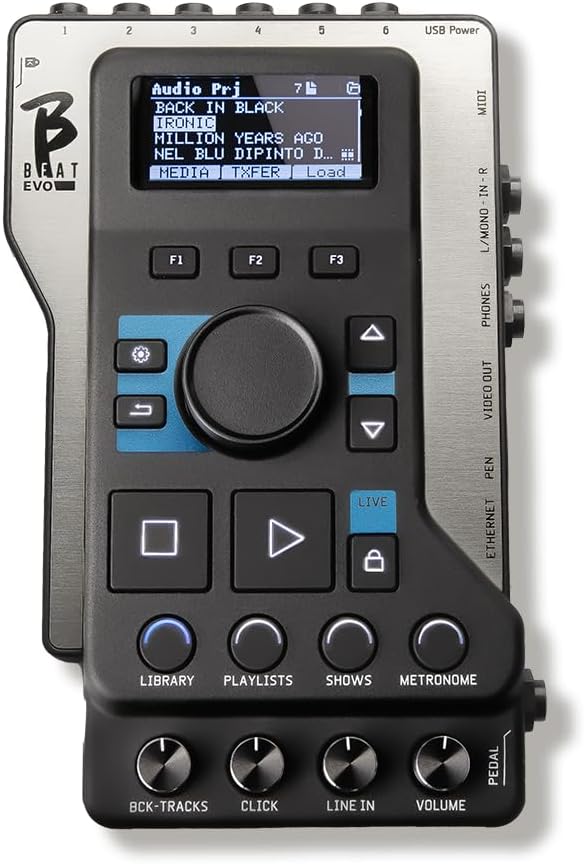
The M-Live B.Beat Evo is not simply another compact mixing console. It is a stage-oriented backing-track player with a 5.0 rating and a feature set designed to replace a laptop, sound card, conventional mixer, click system, and parts of a video workflow. It is the premium choice in this guide for solo musicians and ensembles that depend on tightly organized multitrack shows.
We may earn a commission when you buy through this link, at no additional cost to you.
It can run up to 16 mono or eight stereo tracks in WAV, MP3, OGG, AAC, or Stems formats, with 24-bit processing and a stated signal-to-noise ratio of 107 dB. Six balanced outputs allow stems or mixes to be distributed to monitors and the main system, while two line inputs and independent headphone monitoring offer additional routing options. Dedicated click detection is included for performers who need a reliable timing reference.
The tradeoff is specialization. The free PC and Mac app, Prompter App, playlists, show structure, footswitch operation, and synchronized media require more preparation than plugging microphones into a conventional analog mixer. Video support extends to MP4, MOV, AVI, and images, with HDMI output up to 1920×1080, but that capability is irrelevant to performers who only need a straightforward vocal and instrument mix.
Choose the B.Beat Evo if reliable show playback, click, monitoring, and multitrack control are central to your performances and you value an integrated system. It is especially compelling for solo artists, worship or theater performers, and touring musicians who want fewer boxes to carry. For basic live sound mixing, however, one of the analog consoles will be simpler and less specialized.
Playlists and shows are built in the free PC and Mac app, then controlled during performance through the mixer interface, Prompter App, and compatible footswitch. This supports a repeatable workflow from preparation through the actual show.
Up to 16 mono or eight stereo tracks can be balanced in real time through six balanced outputs. Dedicated click detection and independent headphone monitoring give performers greater control over timing and cues without relying on a laptop onstage.
We may earn a commission when you buy through this link, at no additional cost to you.
The Zoom LiveTrak L6max combines a twelve-channel mixer with a multitrack recorder and earns a 4.5 rating. It is designed for musicians and podcasters who want to monitor a performance live and capture isolated tracks at the same time. That combination makes it one of the most versatile products in the guide, particularly for rehearsal, streaming, and mobile recording.
We may earn a commission when you buy through this link, at no additional cost to you.
The input layout includes four combo inputs with Hi-Z support and eight line inputs across 12 channels. It can capture up to 14 tracks simultaneously to SD cards with capacity up to 2TB. Dual AD converters on channels one through four are designed to capture audio across a broad dynamic range, while real-time AI reduction is offered for hum, hiss, and background noise.
Live performers also gain four MIDI-clocked sound pads for samples, jingles, and effects, plus flexible power from AA batteries, USB bus power, or a mobile battery pack. These are meaningful stage advantages, although they introduce more setup and signal-flow decisions than a basic analog board. The advertised AI reduction should also be judged on the noise profile of the actual recording environment, since it is not a substitute for good microphone placement.
This is an excellent choice for a band that wants multitrack rehearsal captures, a streamer who also needs a live mix, or a mobile performer seeking a single box for mixing and recording. Choose it when the ability to record isolated sources is nearly as important as producing a live output. It offers greater workflow value than most conventional mixers, though the Yamaha MG10 remains the simpler option when recording is unnecessary.
The ability to capture up to 14 tracks while mixing changes the value of a rehearsal session. Musicians can revisit individual performances, but performers should still confirm input routing and storage availability before relying on it for a critical session.
MIDI-clocked sound pads make it possible to trigger samples and jingles in time with a performance. Battery, USB, and mobile-battery power options remove the need to remain close to a mains outlet, which is useful for mobile sessions and outdoor events.
We may earn a commission when you buy through this link, at no additional cost to you.
The 16-Channel 99 DSP Mixer is a broad, feature-filled console with a 4.6 rating. It offers 16 channels, Bluetooth and USB playback, 99 built-in DSP effects, and a seven-band graphic EQ in the master section. For bands, karaoke hosts, DJ events, and small venues that want many inputs and several onboard treatments, it presents a substantial amount of functionality.
We may earn a commission when you buy through this link, at no additional cost to you.
Every channel has independent gain, three-band EQ, a fader, and a dedicated mute button. Those controls make it possible to bring individual sources in and out quickly, while the master graphic EQ can address broader tonal problems across the final mix. The effects selection includes familiar choices such as reverb, delay, and ambience, reducing the need to carry external processors for common treatments.
Its size and feature density are the main drawbacks. A sixteen-channel surface is less convenient for a solo artist moving between locations, and the combination of channel controls, media display, effects, master EQ, monitor controls, and output sections creates a substantial learning curve. The stated Bluetooth range of 33 feet is useful, but it should not be mistaken for a guarantee of uninterrupted performance in a crowded wireless environment.
Choose this mixer when channel count, onboard effects, and quick muting matter more than minimalism. It is well suited to rehearsing a full ensemble, hosting karaoke, or mixing several sources in a compact event. The Yamaha MG10 offers a cleaner analog workflow for smaller lineups, while the MD-10 provides many of the same broad digital features with two fewer channels.
Sixteen independently controlled channels give a band room to separate multiple microphones, instruments, playback devices, and effects returns. Per-channel mute buttons are especially useful when a performer or playback source must be removed quickly.
The seven-band graphic EQ gives the engineer a broad way to refine the overall output after channel-level adjustments. A 99-effect library covers common time-based and spatial treatments without requiring a rack of external processors.
We may earn a commission when you buy through this link, at no additional cost to you.
The AVE-100 is a dedicated vocal effects processor with a 4.2 rating, rather than a conventional channel mixer. It gives singers pitch correction, harmony, reverb, delay, key detection, a loop recorder, and anti-feedback processing in a stage-oriented package. It is most compelling for solo vocalists, backing vocalists, and performers who want to create vocal layers without carrying several separate effects units.
We may earn a commission when you buy through this link, at no additional cost to you.
Its KeyLearn function can automatically detect the key of a backing track, helping performers select pitch correction and harmony more accurately. Unison, plus-third, and plus-sixth modes offer different arrangements, while effect pads provide direct access during a performance. The 6.35mm connection supports instruments and line-level sources in addition to the XLR microphone input with 48V phantom power.
The limitation is purpose. This is not a full mixer for combining a band, and it does not replace channel EQ, multiple auxiliary sends, or a conventional main output section. Its vocal results will also depend on the source, microphone, settings, and monitoring. The intelligent anti-feedback function may help reduce unwanted feedback, but performers still need sensible gain staging and a placement strategy that limits how much monitor signal reaches the microphone.
Choose the AVE-100 when vocal harmony, pitch support, and loop-based creativity are more important than multi-channel mixing. It is a smart addition to a compact vocal setup or a larger console with spare inputs. For full-band live mixing, begin with a conventional mixer and treat this unit as a specialized processor rather than a replacement.
Key detection can simplify the process of matching harmony to a backing track. This is useful for singers who need to move quickly between songs or perform sets without relying on an external tuner and manual pitch calculations.
Dedicated effect pads give performers direct access to common treatments while they are performing. Adjustable reverb, delay, and pitch correction can then be refined to suit the room and the character of the vocal.
We may earn a commission when you buy through this link, at no additional cost to you.
The FULUODE CT-80S is an eight-channel mixer with a 4.4 rating and a 1.57-inch chassis. It combines XLR and quarter-inch style performance connections with 48V phantom power, a three-band section per channel, reverb, and digital media playback. Its thin profile and LED display make it aimed at mobile karaoke, rehearsals, school events, meetings, and small live performances.
We may earn a commission when you buy through this link, at no additional cost to you.
MP3 and USB playback work with the built-in controls, while Bluetooth 5.0 provides a wireless route for music from a compatible phone. A large LED display shows song information, and the mixer can connect to a digital effector through the supplied peripheral connection. These conveniences are helpful for hosts and performers who do not want to manage a separate media player during an event.
There are some important limitations. The listed voltage is 110V with an American plug, so the product may not be directly suitable for use in regions with different mains standards unless appropriately handled. The display is protected by a film that can be removed, which is minor but worth noticing. Eight channels also place a firm limit on larger ensembles, and the product description provides fewer details about recording output quality than it does about playback.
Choose the CT-80S for a portable, media-friendly mixer aimed at karaoke, compact performances, and presentations in a compatible electrical environment. It is less suitable when a tour involves international power standards or when sophisticated direct recording is essential. The closely related CT-120S is worth considering when two additional channels would be valuable.
The low-profile chassis reduces the amount of space needed on a table or stand. Bluetooth, USB, and MP3 support give presenters and karaoke hosts several simple ways to bring in music.
The large LED display provides a clearer view of song information than a minimal console. This is useful for hosts who need to identify the active playback source without navigating a small menu.
We may earn a commission when you buy through this link, at no additional cost to you.
The 6-Channel Audio Interface Mixer is a compact analog console with a 4.3 rating. It offers four XLR inputs, two quarter-inch stereo inputs, Bluetooth, USB playback, three-band EQ, and 16 built-in DSP effects. It is a practical option for a solo singer, duo, rehearsal, podcast, or small venue where the number of simultaneous sources matters more than advanced recording.
We may earn a commission when you buy through this link, at no additional cost to you.
Four XLR inputs provide useful microphone capacity, while the quarter-inch channels support electric guitars, direct boxes, wireless microphones, and other instruments according to the supplied information. Channels one through four support 48V phantom power for condenser microphones. Three-band EQ and individual gain controls cover the usual tonal adjustments, and the effects section includes treatments such as delay and reverb.
The main limitation is scale. A six-channel console offers less flexibility than the Yamaha MG10 or the larger digital models, particularly when accommodating a full band or several playback sources. The description identifies 16-bit processing, and while Bluetooth and USB are convenient, it does not promise the same breadth of multitrack recording as a dedicated mixer-recorder. Users should verify exactly what is captured by the USB interface before relying on it for a production session.
Choose this mixer when portability, four real microphone inputs, and basic onboard effects are the priorities. It is a sensible fit for karaoke, small acoustic performances, rehearsal, and casual streaming. For a larger or more demanding live setting, a mixer with more channels, dedicated recording, or clearer signal-routing specifications may offer fewer compromises.
Four XLR channels support a useful collection of vocals, instruments, and direct inputs without requiring a larger console. Phantom power on the first four channels expands compatibility with condenser microphones.
Sixteen DSP effects, including delay and reverb, cover basic vocal and instrument treatments. Keeping common effects inside the mixer reduces the need for separate floor processors in a compact setup.
We may earn a commission when you buy through this link, at no additional cost to you.
The MD-10 is a ten-channel digital stage mixer with a 5.0 rating and a strong emphasis on effects, display feedback, and independent channel control. It is positioned for stage performances, studios, churches, clubs, conferences, and speech applications. For a performer who wants more processing and visual feedback than a basic analog mixer provides, it deserves close consideration.
We may earn a commission when you buy through this link, at no additional cost to you.
Each of the 10 channels has its own three-band equalizer, allowing instruments and microphones to be shaped independently. The 99-effect library includes hall, plate, room, delay, chorus, pitch shifter, and distortion treatments. A large LED screen displays effect parameters, while the master section adds a nine-band equalizer with real-time monitoring. These controls are more detailed than the simpler two- and three-band arrangements on some compact models.
The digital approach adds convenience and complexity. Bluetooth playback and direct lossless playback from a USB drive reduce media-cable friction, while the intelligent noise-reduction system is intended to reduce floor noise and hum. At the same time, a large LED, extended faders, numerous effects, and a wide EQ demand more attention than the surface of a straightforward analog mixer. The supplied information also does not state the power input or confirm international voltage compatibility.
Choose the MD-10 when a performer wants extensive onboard processing, clear parameter feedback, wireless playback, and more tone control than a basic console. It is well matched to rehearsals, small venues, presentations, and performers who enjoy shaping sounds with effects. If reliability through a minimal control path is the priority, the Yamaha MG10 remains a more straightforward alternative.
Hall, plate, room, delay, chorus, pitch shifting, and distortion cover a wide range of common performance treatments. The large LED display gives users visual parameter feedback when selecting or adjusting those effects.
Bluetooth and USB playback let performers bring tracks from a compatible phone or drive directly into the console. This simplifies setups for rehearsals, solo shows, and events where a separate media player would add another box to manage.
We may earn a commission when you buy through this link, at no additional cost to you.
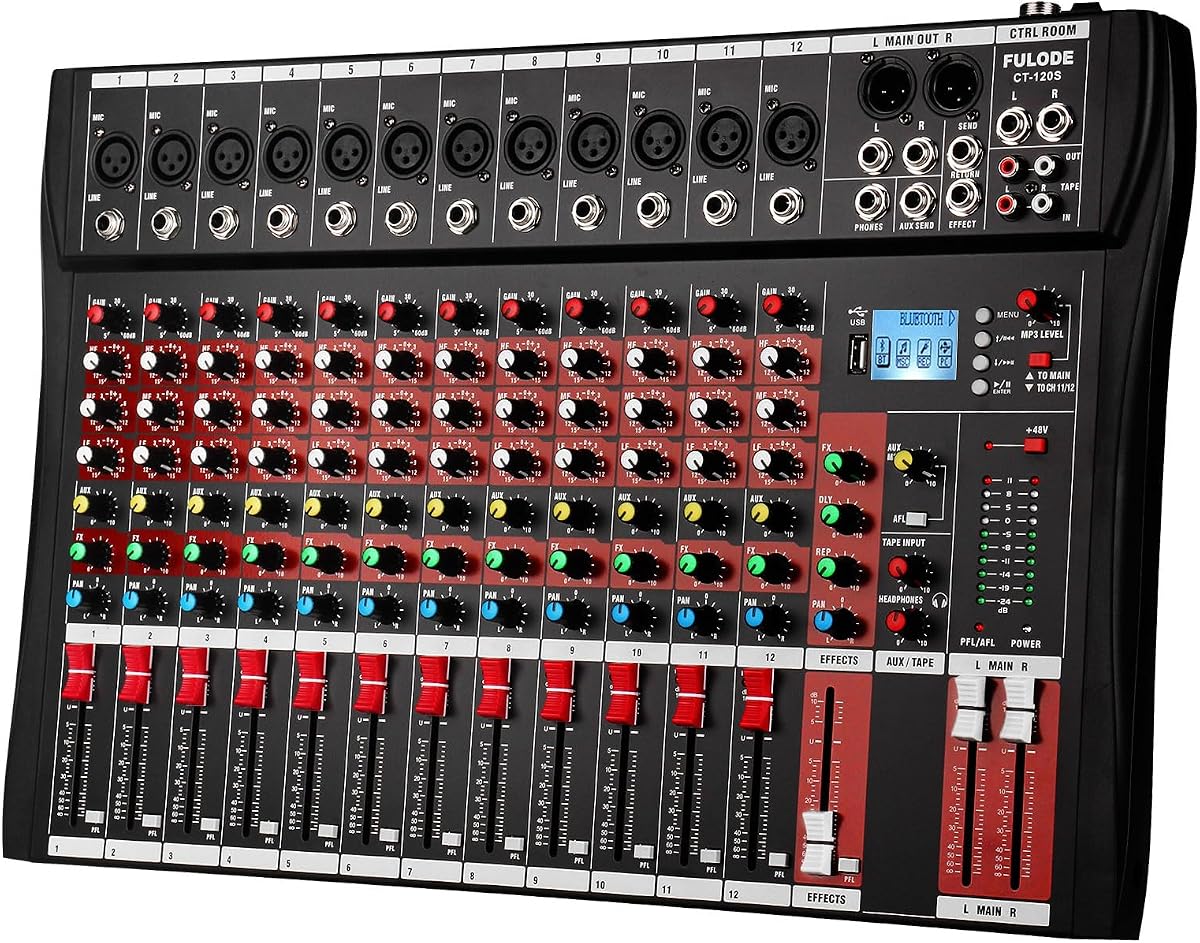
The FULUODE CT-120S is a slim twelve-channel mixer with a 4.4 rating. It offers three tone controls per channel, 48V phantom power, reverb, MP3 and USB playback, Bluetooth 5.0, and a large LED display. It sits between the eight-channel CT-80S and larger sixteen-channel consoles, making it a possible middle ground for medium-sized bands and busy karaoke events.
We may earn a commission when you buy through this link, at no additional cost to you.
The 12 inputs can accommodate wired or wireless microphones, instruments, and other line-level sources according to the supplied description. A large display presents song information, while a peripheral connection allows the board to work with a digital effector. MP3 and USB controls simplify playback, and Bluetooth offers a cable-free way to feed music from a phone.
Its trade-offs mirror those of the CT-80S. The specified 110V operation and American plug are important considerations outside compatible electrical environments, and the supplied information does not describe a detailed multitrack recording format despite mentioning USB recording. The display also arrives with a removable protective film. Most importantly, the three-band EQ is useful for general tone shaping but less granular than the 7- and 9-band master options in the larger digital mixers.
Choose the CT-120S when twelve inputs, wireless playback, and a low-profile body are the key requirements in a compatible electrical market. It is a reasonable fit for band rehearsals, school events, family karaoke, conferences, and small live programs. Compare it carefully with the Yamaha MG10 if analog simplicity is important, and with the MD-10 if a wider effects library and detailed master EQ are worth the added complexity.
The 1.57-inch chassis preserves a low-profile design despite offering two more inputs than the CT-80S. That balance can be useful for medium ensembles and event operators working with limited tabletop space.
Bluetooth 5.0, MP3, and USB playback cover several common ways to deliver music. The large display and onboard controls help users manage the active source without a separate player on the performance table.
We may earn a commission when you buy through this link, at no additional cost to you.
The right mixer depends on the number of sources, type of performers, need for recording or effects, portability requirements, and available outputs. Work through these factors before comparing models, because a feature-rich console is not automatically easier to use than a smaller analog mixer.
Begin with an honest inventory of microphones, instruments, direct boxes, playback devices, and effects returns. Do not count only active sources; leave room for stereo playback, a guest performer, or a spare input. A six-channel console may suit a solo act, while a full band may need ten or more channels. Also consider how many physical connections each channel supports, since some mixers reserve certain channels for stereo or USB playback.
A usable preamp provides enough clean gain for microphones or instruments without forcing the channel fader into an extreme position. The Yamaha MG10 specifically highlights discrete class-A D-PRE preamps, while the digital consoles in this guide emphasize gain controls on each channel. Condenser microphones require appropriate 48V phantom power, and instruments such as electric guitars may benefit from a Hi-Z input. Match the input specification to the source rather than assuming every quarter-inch connection behaves identically.
Three-band channel EQ is sufficient for many quick live adjustments, while seven- or nine-band master EQ offers broader control over the final output. Effects can be valuable for vocals, but the number of presets matters less than whether you can select and adjust them quickly. The M-Live B.Beat Evo and Zoom LiveTrak L6max emphasize performance pads or triggers, whereas the digital mixers provide larger built-in DSP libraries. Choose based on the sounds you need and the level of control you can operate confidently.
Bluetooth, USB, flash-reader, and MP3 functions can simplify a live set by reducing dependence on a phone or laptop. Check Bluetooth range and verify the file formats and storage media supported by the exact model. A wireless connection should be treated as a convenience rather than the only playback method for a critical performance. Keep a fallback source available, and note that a USB port for media playback does not necessarily mean the mixer can record multitrack audio.
Live mixing and multitrack recording have different technical requirements. The Zoom LiveTrak L6max can capture up to 14 tracks simultaneously, and the M-Live B.Beat Evo can play up to 16 mono or eight stereo tracks. Other mixers mention USB recording or USB audio interfaces without specifying the capture format, channel count, or quality. If isolated recordings are important, choose a device explicitly designed for that task. If the goal is only to feed a venue system, spend more attention on gain, EQ, effects, monitoring, and reliable outputs.
Consider the entire transport burden, not just the console weight. Compact 1.4-inch and 1.57-inch models can fit into small cases and set up quickly on crowded stages, but they may place many controls close together. Larger boards offer more spacing and channel capacity. The Yamaha MG10 has an impact-resistant, powder-coated metal chassis, while some of the digital models emphasize sealed controls and thin construction. Look for a stable surface, easy-to-read labels, and a chassis depth that suits the available stand or table.
A live mixer must send a clean mix to the main speakers and provide an intelligible monitor path for the performers. Look for balanced outputs, headphone monitoring, independent monitor controls, and a level meter that is visible from the operating position. The M-Live B.Beat Evo offers six balanced outputs, while several compact models rely on conventional main and monitor outputs. Confirm that the output count and connector format match your existing amplifier, powered speakers, stage box, or recording interface.
Electrical requirements can make a mixer unusable even when its features fit the performance. The FULUODE CT-80S and CT-120S are specified for 110V with an American plug, which deserves careful attention outside compatible regions. Feedback management depends on correct gain staging, EQ, microphone direction, and monitor placement, not just a dedicated anti-feedback processor. The AVE-100 includes intelligent anti-feedback, but that specialized vocal unit cannot replace a well-controlled main mixer.
Begin by placing the mixer on a stable, dry surface with enough room to reach every channel used during the show. Connect microphones and instruments with power off, confirm the output destination, and route the main mix and monitor feed. Set all channel gain controls and faders to their starting positions, then raise the master output only after the source levels are established. A written input list and marked fader positions are valuable for repeatable setups.
Build the mix from the quietest or most familiar source toward the more complex sounds. Set usable input gain first, use the high-pass filter when appropriate, and make moderate EQ changes. Add compression where a source needs a steadier level, then engage effects only after the dry mix is balanced. Keep the output meter visible and leave enough headroom to prevent clipping. During soundcheck, walk the room and test the monitor mix at the performers' actual positions.
After the performance, lower output and channel levels before disconnecting any cables. Remove cables without pulling on connected plugs, keep liquids away from the controls, and protect the unit from extreme heat, dust, and moisture. Clean the surface with a dry or lightly damp cloth appropriate to the finish, and do not spray cleaner directly onto knobs, jacks, or the display. Store accessories together, label media and show files, and update the settings for the next venue rather than assuming every room will sound the same.
A small band generally needs one mix for each microphone, instrument, or stereo playback source, plus a couple of spare inputs. The Yamaha MG10 is a strong choice when simple analog control and one-knob compressors are priorities. Performers that need multitrack rehearsal recordings may prefer the Zoom LiveTrak L6max instead.
Not always. USB can make recording, computer connection, or direct media playback more convenient, but it is not essential for every live show. The Yamaha MG10 is a strong choice when simple analog control and one-knob compressors are priorities. Performers that need multitrack rehearsal recordings may prefer the Zoom LiveTrak L6max instead.
An analog mixer routes and processes audio through physical signal paths, while a digital mixer uses internal digital processing and often adds displays, programmable effects, wireless playback, or USB functions. Analog units can be straightforward and dependable, while digital models provide more integrated features. Neither category is automatically better; workflow and reliability matter most.
A solo singer may need only two or three channels for a vocal, backing-track stereo return, and a spare input. A guitarist who also handles backing tracks can still keep the setup compact, while a soloist using several pedal outputs may need more. Always count the physical connections and leave room for expansion.
No. Phantom power is intended for compatible condenser microphones and should not be applied to ribbon microphones or certain other types unless their manufacturer explicitly allows it. Dynamic microphones generally do not require it. Check the microphone type and the mixer channel specification before engaging 48V.
Bluetooth can be convenient for backing tracks, but it should not be the only critical playback path. Wireless interference, device notifications, range, and connection changes can interrupt playback. For important performances, use a wired backup, verify the supported file formats, and test the complete playback route during soundcheck.
Built-in effects are useful for common reverb, delay, ambience, and other treatments without requiring extra processors. They are most valuable when they can be selected and adjusted quickly. Consider the number of effect sends, return controls, and whether the available sounds suit your music rather than choosing solely by preset count.
Check the power voltage and plug type, balanced and unbalanced outputs, connector compatibility, physical size, and whether every essential function is available without a computer. Pack a backup playback device and appropriate cables. Recheck gain, monitor levels, and effects at each new venue because acoustics and power systems can change.
The Yamaha MG10 is the strongest all-around choice for conventional live mixing, combining discrete class-A preamps, three-band EQ, one-knob compressors, a rugged chassis, and simple analog operation. The Zoom LiveTrak L6max is the stronger choice when live monitoring and simultaneous multitrack recording are equally important. The M-Live B.Beat Evo stands apart for performers who want an integrated backing-track, click, multitrack, and video system.
Prioritize the features your performance actually requires. Count sources, match input types, establish a reliable monitoring path, and avoid paying for complex controls that you will not be comfortable operating. Analog simplicity is valuable for focused live sets, while digital effects and wireless playback suit performers who want more integrated source management. Specialized products such as the AVE-100 should complement a general-purpose mixer rather than be expected to replace one.
Ratings and feature lists provide a useful starting point, but the final decision should reflect your venue, instruments, microphones, existing equipment, and operating experience. Confirm the latest specifications, compatibility, and current price directly on the linked product page before purchasing, since product details and market availability can change.