
HiLetgo 5pcs DHT11
4.5Editor score
Five sensor modules included
Single-wire digital output
3.3V to 5.5V operation
Our Arduino Temperature Sensor guide compares 10 top-rated digital, I2C, 1-Wire, waterproof, and humidity modules for accuracy, range, and ease of use.
Arduino temperature sensors make it possible to build precise monitors, environmental controls, cooling systems, and data-logging projects. A useful sensor should match the project’s environment, measurement range, communication method, and power constraints rather than simply offering the broadest specification sheet.
This guide compares ten temperature and temperature-humidity modules using their stated accuracy, ranges, voltage requirements, interfaces, mounting options, and included components. It covers beginner-friendly single-wire sensors, high-precision I2C modules, and waterproof 1-Wire probes for indoor, outdoor, and submerged use.
Each review highlights the strongest reasons to choose a model, along with its practical limitations and ideal applications. Ratings and specifications reflect the supplied product information, while product availability and prices can change, so readers should confirm current listing details before purchasing.
4.5Editor score

5.0Editor score

4.7Editor score
The table below compares the ten recommended modules by sensor type, measurement range, stated accuracy, and interface, making it easier to identify the right option for a new Arduino build.


The HiLetgo five-pack DHT11 is a straightforward, budget-conscious choice for Arduino projects that need both temperature and humidity readings. Its supplied rating is 4.5, and its standout quality is the combination of five ready-to-connect modules, cables, and a straightforward digital interface. The module measures temperature from 0 to 50°C and humidity from 20% to 90% RH according to the detailed listing, while the product title describes a humidity range up to 95%.
We may earn a commission when you buy through this link, at no additional cost to you.
Each module includes a bypass capacitor and pull-up resistor, so an Arduino can read the single-bus signal without requiring a complicated analog circuit. The stated temperature accuracy is ±2°C, humidity accuracy is ±5% RH, and resolution is 1°C and 1% RH. This level of performance is appropriate for classroom exercises, simple environmental monitors, and controls where occasional variation will not affect the result.
The compromises are clear. The limited 0 to 50°C operating range excludes freezer, boiling, or extreme outdoor monitoring, and the accuracy is considerably less refined than that of the AHT30, SHT31-D, or DHT22. The single-wire protocol also requires more deliberate sample timing than a straightforward I2C read, but established Arduino libraries simplify that process for most users.
Choose this pack when you need several inexpensive DHT11 modules, particularly for prototypes, indoor demonstrations, or a project focused on learning. It is a strong fit for Arduino-compatible boards using a 3.3V or 5V supply. For precision weather stations, cold environments, or applications requiring finer temperature readings, one of the higher-accuracy alternatives will be more appropriate.
Five modules make it possible to compare room zones, distribute readings across a model building, or keep spare boards available without ordering each one separately. The included cables also reduce the need for additional hookup accessories.
The three-pin arrangement provides power, ground, and digital output, while the on-board pull-up resistor simplifies the electrical setup. A compatible Arduino sensor library can handle the sensor’s digital reading sequence.
We may earn a commission when you buy through this link, at no additional cost to you.
The two-pack AHT30 module is an excellent general-purpose choice for Arduino projects that need accurate environmental readings. It carries a supplied rating of 5.0, and its most impressive specification is the stated temperature accuracy of ±0.3°C. Resolution is listed at 0.01°C for temperature and 0.024% RH for humidity, giving it a strong balance of precision and measurement detail.
We may earn a commission when you buy through this link, at no additional cost to you.
The module uses I2C communication, allowing it to share a bus with other compatible I2C devices. Its operating supply range of 2.0 to 5.5V is unusually accommodating, making it suitable for projects built around 3.3V or 5V Arduino-compatible boards. It also supports simultaneous online access to multiple I2C modules, and the supplied four-pin test lines streamline initial wiring.
The main consideration is that I2C setup is less direct than a three-pin analog or single-wire sensor. A project may need the correct library and, in a multi-sensor arrangement, different I2C addresses to prevent conflicts. The stated humidity accuracy is ±2% RH at 25°C, which is useful for room monitoring but should not be treated as laboratory-grade humidity measurement.
This is a strong recommendation for indoor climate monitors, smart-home prototypes, greenhouse controllers, and data loggers where temperature precision matters. It also suits users comfortable navigating I2C wiring and libraries. Choose it over a DHT11 when the difference between a 1°C and 0.01°C resolution is important to the project.
The ±0.3°C stated accuracy makes the AHT30 more appropriate for thermostatic control, comfort monitoring, and temperature-change logging than a basic DHT11. A high resolution also helps represent small changes clearly on a display or chart.
I2C keeps the wiring organized while allowing several supported devices to share common communication lines. It is a particularly good fit for Arduino projects that already use I2C displays, memory modules, or power-monitoring boards.
We may earn a commission when you buy through this link, at no additional cost to you.
The Teyleten SHT31-D three-pack brings a wide measurement envelope and strong temperature accuracy to Arduino projects. Its supplied rating is 4.7. The standout feature is its -40 to 125°C temperature range, which is substantially broader than the DHT11 and DHT22 options in this list, while still maintaining a stated accuracy of ±0.3°C.
We may earn a commission when you buy through this link, at no additional cost to you.
Humidity is measured across a 0 to 100% RH range, and the listing states an accuracy of ±2% RH. The module communicates through I2C and operates from 2.4 to 5.5V, giving it broad compatibility with common microcontroller systems. As a three-piece set, it is also more economical for projects that require measurements in multiple locations than purchasing three individual boards.
The trade-off is that the I2C interface is less universally understood than a simple one-wire DHT sensor. The sensor’s address may also need attention when several modules occupy the same bus. Additionally, the broad listed range describes capability, not guaranteed precision throughout the entire span; actual results will depend on conditions, installation, and the sensing environment.
Choose the SHT31-D when the project needs a combination of wide temperature coverage, fine temperature accuracy, and humidity monitoring. It is well suited to environmental test enclosures, climate monitoring, and multi-point Arduino installations. For compact single-point sensing, the AHT30 offers similarly strong temperature precision with a slightly lower minimum operating voltage.
A -40 to 125°C specification provides more room than common DHT11 modules for projects that move between cool and warm conditions. It is useful when the same sensor design must serve varied environments.
The three-pack supports distributed measurements without requiring three separate purchases. Each location can use the same I2C wiring approach, subject to managing bus addresses correctly.
We may earn a commission when you buy through this link, at no additional cost to you.
The Gikfun EK1183 pack is a practical choice when an Arduino project needs temperature measurements in damp, enclosed, or distant locations. It includes three one-meter DS18B20 probes and adapter boards, and the supplied rating is 4.4. The adapter’s on-board pull-up resistor allows it to connect directly to most microcontrollers, reducing setup complexity.
We may earn a commission when you buy through this link, at no additional cost to you.
The probes cover a listed -55 to 125°C measurement range and operate from 3.3 to 5V. Their color-coded leads—red for power, yellow for data, and black for ground—make the connections easier to identify. Potential applications include fish tanks, greenhouses, equipment monitoring, machinery, and thermostatic systems, where the sensor’s distance from the main board is valuable.
A critical detail is that the probe lead itself is rated only up to 85°C, even though the DS18B20 sensing specification extends to 125°C. That makes it unsuitable for applications where the cable or exposed connection may encounter higher heat. Users also need to account for the 1-Wire protocol and suitable library support.
This set is well suited to aquarium monitors, soil or greenhouse sensing, and multi-point temperature installations where waterproof probes are more useful than a small exposed board. It is less appropriate for extremely high-temperature measurements or for builders who want a simple three-wire analog sensor.
The one-meter leads make it practical to place the sensing tip in a tank, cabinet, pipe area, or growing bed while the controller remains elsewhere. This physical separation is a major advantage over fixed breakout boards.
The included adapter boards carry the pull-up resistor, making the data connection more convenient. This is helpful for beginners and for installations where a clean connection to the Arduino is more important than minimum component count.
We may earn a commission when you buy through this link, at no additional cost to you.
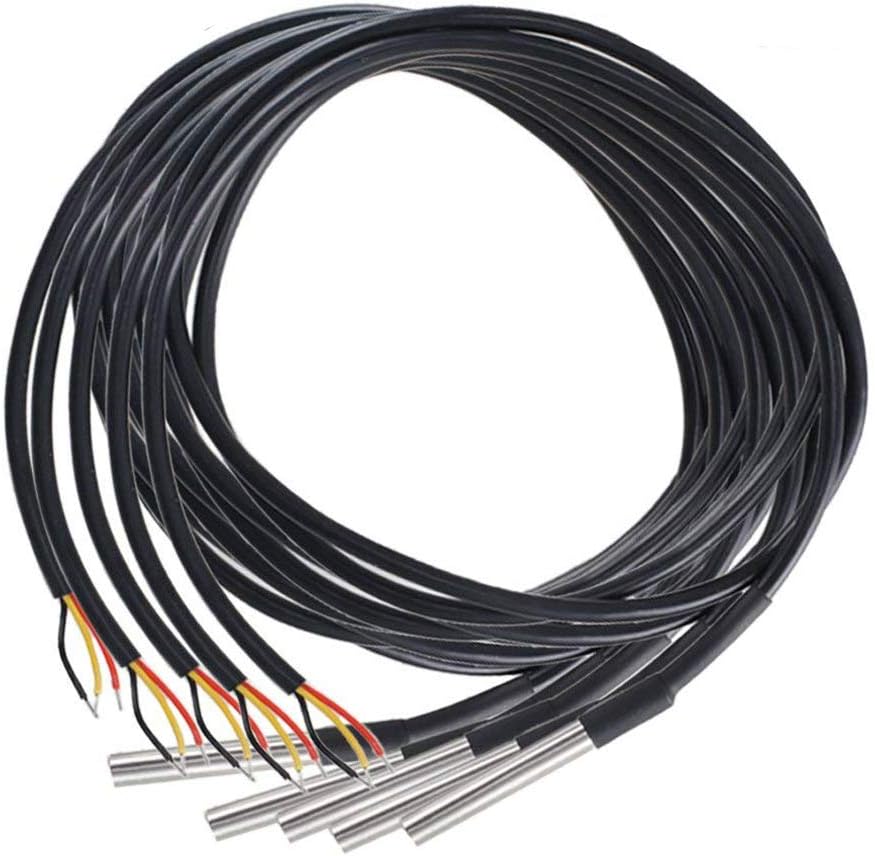
The WWZMDiB DS18B20 five-pack is designed for Arduino makers who need several temperature points and prefer having the necessary pull-up resistors in the box. Its supplied rating is 4.4. The probes use a waterproof construction intended for wet or moist environments, allowing them to be used in water tanks and other damp installations without the board itself needing direct exposure.
We may earn a commission when you buy through this link, at no additional cost to you.
The listed operating range is 3 to 5.25V, and the measurement range extends from -55 to 125°C with stated accuracy of ±0.5°C. The pack includes five 4.7K resistors for the 1-Wire data line. Red, yellow, and black leads identify power, data, and ground, while the listing states compatibility with Arduino, Raspberry Pi, ESP32, and STM platforms.
Users should distinguish the probe’s waterproof sensing section from the entire connection assembly. Wiring connections and exposed board areas still need protection from moisture, and the 5.25V supply limit should be respected even though many Arduino projects operate at 5V. The 1-Wire connection also requires suitable library support and careful identification of the data pin.
This is a good option for multi-point environmental logging, aquariums, plant-growing systems, and comparative temperature experiments. It is especially attractive when the included resistors will save a separate purchase. Projects that only need one indoor reading may find a smaller or higher-precision board module more convenient.
Including a 4.7K resistor with every sensor supports a consistent 1-Wire setup. This reduces the chance that one probe is overlooked when several locations are connected to the same Arduino.
Five probes make side-by-side or spatially distributed monitoring practical. Builders can compare shelf temperatures, water and air readings, or the performance of separate sections of a larger installation.
We may earn a commission when you buy through this link, at no additional cost to you.
The HiLetgo two-pack DHT11 is aimed at straightforward Arduino and Raspberry Pi learning projects. Its supplied rating is 4.3. The module combines temperature and humidity sensing in one digital output and includes an internal microcontroller, so the Arduino receives processed readings rather than needing separate analog measurements.
We may earn a commission when you buy through this link, at no additional cost to you.
Its single-wire arrangement keeps wiring to power, ground, and signal, while the simple communication protocol reduces programming effort when a suitable library is used. The listing states a 20% to 95% humidity range, a 0 to 50°C temperature range, ±5% humidity error, and ±2°C temperature error. The working voltage is 3.3 to 5V.
The limited range and relatively coarse resolution make this sensor less suitable for precise thermostatic control or monitoring where small temperature differences matter. The DHT11’s digital reading cycle also requires appropriate timing, and readings should not be requested continuously without allowing the sensor to refresh. As with any environmental module, enclosure design can influence what the sensor experiences.
This two-pack is a sensible choice for a first Arduino project, a classroom demonstration, or a simple two-location room monitor. Choose it when ease of use and a low-complexity combined reading are the priorities. For more accurate temperature control, the AHT30, SHT31-D, or DHT22 provides a stronger specification.
A combined digital module reduces both wiring and code complexity for beginners. The result is an approachable way to learn how an Arduino reads and displays environmental data.
The two-module format is useful for comparing two areas in a room or greenhouse. It also provides a spare if one module is damaged or reserved for a separate experiment.
We may earn a commission when you buy through this link, at no additional cost to you.
The DROK two-pack is a rugged option for projects where the sensing end will face moisture, corrosion, or continuous submersion. Its supplied rating is 4.9, the highest among the probe-oriented products in the list. The stainless steel probe is described as waterproof, corrosion-resistant, and rustproof, with a thermally conductive sealant surrounding the sensor.
We may earn a commission when you buy through this link, at no additional cost to you.
The stated measurement range is -55 to 125°C with ±0.5°C accuracy. It operates from 3.0 to 5.5V, making it suitable for common 3.3V and 5V Arduino-compatible platforms. The package includes two adapter boards, female-to-female jumper wires, and 4.7K resistors. Clearly separated red, yellow, and black leads simplify identification of power, data, and ground.
There is an important wiring nuance: although the adapter has an integrated pull-up resistor, the listing specifically recommends a 4.7K resistor between the yellow data wire and red power wire for optimal stability. Builders should follow the recommended arrangement rather than assuming every board configuration is identical. The electrical connection is not itself the intended waterproof portion.
Choose this set for aquarium monitoring, outdoor installations, and repeated measurements in wet or harsh conditions. It is a strong fit for users who value a durable probe and complete accessory set. If the project does not require submersion protection, a compact I2C module may be easier to install in a smaller enclosure.
The stainless steel housing provides a more robust sensing tip than a bare plastic module. It is better suited to projects where condensation, splashes, or regular exposure could quickly damage an exposed circuit board.
Adapter boards, jumper wires, and 4.7K resistors cover the principal connection needs. This makes the package convenient for both beginners and builders assembling several probes.
We may earn a commission when you buy through this link, at no additional cost to you.
The Gikfun EK1083 is a five-pack of approximately one-meter DS18B20 probes intended for multi-location Arduino temperature monitoring. Its supplied rating is 4.5. Each probe uses a single-bus interface, allowing multiple sensors to share the same data wiring when the project is configured correctly, and the one-meter length provides useful reach from the controller.
We may earn a commission when you buy through this link, at no additional cost to you.
The power range is 3.0 to 5.5V, and the red, yellow, and black leads identify VCC, data, and ground. The probes are described as waterproof digital thermal probes, making them suitable for applications such as greenhouses, fish tanks, machinery, consumer products, thermometers, and other thermally sensitive systems where the sensing tip is away from the main electronics.
The listing recommends placing a 4.7K resistor between data and VCC to make testing easier. A single resistor can generally support a properly designed 1-Wire network, but cable length, topology, and electrical conditions should be considered. Unlike several competing listings, this product information does not provide a specific accuracy figure, so buyers should not assume one based on the sensor family alone.
Choose this pack for distributed logging across five positions or for projects that benefit from having spare probes. It is a useful general-purpose 1-Wire option for Arduino projects that need cable length and some environmental protection. Those requiring documented accuracy specifications or adapter boards should examine the more explicitly specified alternatives.
The 1-Wire bus can reduce the number of data connections required when several probes share an Arduino. Correct addressing and pull-up placement remain essential for dependable readings.
Approximately one-meter cables allow the probe tip to reach tanks, cabinets, shelves, or growing areas. The length is valuable when the sensing location is physically separated from the controller.
We may earn a commission when you buy through this link, at no additional cost to you.
The HiLetgo DHT22/AM2302 is a capable middle ground between basic DHT11 modules and compact high-precision I2C sensors. Its supplied rating is 4.4. The main chip is the AOSONG AM2302, which combines temperature and humidity sensing with a single-bus digital output that supports bidirectional serial data.
We may earn a commission when you buy through this link, at no additional cost to you.
The module lists a -40 to 80°C temperature range with ±0.5°C accuracy. Humidity covers 0 to 100% RH with ±2% RH accuracy. Those figures make it much more capable than a DHT11 for projects that need finer room-temperature readings. A fixing screw hole is included, which is useful for securing the module inside an enclosure or on a stable surface.
The DHT22 still uses a digital single-bus arrangement, so a suitable Arduino library and appropriate sampling intervals are needed. The two-piece pack is smaller than the five-probe DS18B20 sets, and it does not provide a waterproof probe or extended cable. If a project requires more than two measurement points, the additional sensors must be sourced separately.
This module is a good choice for indoor climate monitors, home automation demonstrations, and thermostatic projects that benefit from improved temperature accuracy. It is also a familiar option for Arduino users moving up from DHT11. For the highest listed temperature precision, compactness, or multi-device I2C expansion, the AHT30 or SHT31-D offers a more advanced platform.
The ±0.5°C stated accuracy and broader -40 to 80°C range are well suited to ambient climate monitoring. These characteristics provide more meaningful data for room comfort and temperature-control experiments.
A built-in fixing hole simplifies physical placement, while the digital bus keeps the electrical connection uncomplicated. Together, these features make the module practical for enclosed prototypes.
We may earn a commission when you buy through this link, at no additional cost to you.
The HiLetgo five-pack DS18B20 provides a practical combination of quantity, probe length, and environmental protection. Its supplied rating is 4.5. The set contains five stainless steel temperature probes with one-meter cables, making it suitable for Arduino systems that need several distributed or submerged measurements.
We may earn a commission when you buy through this link, at no additional cost to you.
The listed measurement range extends from -55 to 125°C, and the operating supply is 3.0 to 5.5V. Each probe uses red for VCC, yellow for data, and black for ground. The package also provides a standard 1-Wire connection arrangement, which can be economical when several sensors share a common bus.
The listing recommends using a 4.7K resistor between data and VCC to simplify testing. That component is not described as included, so builders may need to obtain one separately. The probe enclosure is waterproof, but the board connections, resistor, and Arduino end of the cable should still be protected from moisture. The listing also does not state a specific accuracy figure.
Choose this pack for greenhouse, aquarium, appliance, cabinet, or general environmental logging where the sensing tips need more protection than an exposed breakout board. It is a versatile option for makers who already understand 1-Wire addressing. Projects needing tighter documented accuracy should look toward the DROK or WWZMDiB probe packages, which state ±0.5°C accuracy.
The five-probe format supports detailed spatial monitoring without requiring five separate purchases. It is useful for temperature mapping, comparative experiments, and multi-zone environmental control.
The stainless steel and waterproof probe design is well suited to tanks and moist areas. Protection is most useful when the cable joint and electronics are mounted above the wet area and protected from condensation.
We may earn a commission when you buy through this link, at no additional cost to you.
The right Arduino temperature sensor depends on the environment, required precision, wiring method, and number of measurement locations. These factors help separate simple learning modules from precision, rugged, and multi-point options.
Begin by deciding whether the project needs temperature alone or a combined environmental reading. DHT11, DHT22, AHT30, and SHT31-D modules include both temperature and humidity sensing, while the DS18B20 products focus specifically on temperature. Humidity adds value for room comfort, greenhouse control, and weather-related projects, but it also introduces a second measurement whose accuracy and environmental behavior should be considered.
Choose a combined module when relative humidity will influence your project, and a temperature-only probe when cost, cable length, or waterproof construction is the priority.
Accuracy determines how closely a reading reflects the true temperature, while resolution indicates the smallest reported change. The AHT30 and SHT31-D list ±0.3°C temperature accuracy, the DHT22 lists ±0.5°C, and the DHT11 lists ±2°C. Resolution also varies: the AHT30 offers 0.01°C, whereas the DHT11’s listed temperature resolution is 1°C.
Prioritize accuracy when the sensor controls equipment or records subtle changes. A basic DHT11 is sufficient when approximate environmental status matters more than precision.
The sensor’s rated range should comfortably cover every condition the project may encounter. The DHT11 is listed for 0 to 50°C, the DHT22 for -40 to 80°C, the AHT30 for -40 to 85°C, and the SHT31-D for -40 to 125°C. DS18B20 probes generally offer a listed -55 to 125°C range, although cable and connector temperature limits still apply.
Avoid choosing solely by the headline maximum. Consider the lowest expected temperature, the hottest exposed location, the probe’s material, and whether the electronics or cable will remain within its own limits.
DHT11 and DHT22 modules use a single-wire digital protocol, while the AHT30 and SHT31-D use I2C and the DS18B20 uses the Dallas 1-Wire interface. Single-wire sensors are familiar and use few pins, but they require suitable timing and libraries. I2C supports multiple devices on shared lines but may require address management. One-Wire is especially effective for multiple temperature probes.
Select the interface that matches your existing Arduino wiring and library knowledge. If several remote probes or other I2C peripherals are planned, verify address and bus compatibility before purchasing.
A bare DHT or I2C board is appropriate for dry indoor locations, but it is not intended for submersion. DS18B20 packages use waterproof or water-resistant probe tips, making them better for tanks, greenhouses, and damp equipment. Even with a waterproof probe, exposed connections should remain dry, and sealant or protected enclosures may be needed in high-humidity environments.
Use an exposed breakout module indoors and a suitable probe where liquid, condensation, or weather exposure is expected. Confirm whether only the sensing tip is protected and how the cable transitions from wet to dry areas.
Supply voltage must match both the sensor module and the Arduino board. The DHT11 modules listed here use 3.3 to 5V. The AHT30 accepts 2.0 to 5.5V, the SHT31-D accepts 2.4 to 5.5V, and the DS18B20 options operate around 3.0 to 5.5V. Some DS18B20 listings specify a lower maximum of 5.25V, so the selected model’s details should always be checked.
Use a common, regulated supply and avoid exceeding a module’s stated maximum. On 3.3V systems, verify that level shifting or pull-up arrangements are appropriate for the selected interface.
The package quantity often determines its practical value. Five-module DHT11 and DS18B20 packs suit projects comparing multiple areas, while the AHT30, SHT31-D, and DHT22 packs focus on one or two high-quality points. Adapter boards, jumper wires, and included resistors can further reduce assembly time when several sensors are connected to one controller.
Estimate the number of physical monitoring points before choosing. Buying a larger pack is helpful for spares and expansion, but extra sensors are unnecessary when the project only needs one reading.
A sensor can be accurate in specifications yet produce noisy results if installed poorly. Place the sensing element away from processors, voltage regulators, direct sunlight, heat-generating components, and rapidly moving air. Allow the sensor time to stabilize after environmental changes. For digital sensors, use the recommended reading interval rather than continuously requesting updates faster than the sensor can refresh.
Vent an enclosure gently, avoid trapping heat around the sensor, and secure cables so they do not pull on the probe. For data logging, record both the raw readings and the installation conditions to make later interpretation more reliable.
Begin by identifying the sensor’s pins and interface, then wire power and ground according to the product data. Connect DHT11 and DHT22 modules to a digital pin, use the designated SDA and SCL pins for I2C modules, and connect a DS18B20 data lead to a suitable digital pin. Respect the listed voltage range, install the recommended 4.7K pull-up resistor for a 1-Wire network when required, and double-check every connection before applying power.
Install the appropriate Arduino library, use the example sketch supplied with that library, and confirm that the serial output contains plausible readings before attaching the sensor to the final project. For a new installation, compare the displayed value with a trusted thermometer placed nearby. This comparison can reveal wiring faults, incorrect pin assignments, poor ventilation, or the effects of heat generated by nearby electronics.
Care for the sensor by keeping exposed boards dry, cleaning probe tips gently, and protecting solder joints and connections from moisture. Recalibrate or verify readings periodically, especially after relocation or substantial environmental changes. For waterproof probes, keep the cable joint and controller above wet areas, avoid flexing the sealed section sharply, and distinguish the probe’s operating range from any lower rating for its cable or sealant.
The DHT11 is simpler and less precise, with a listed temperature accuracy of ±2°C and 1°C resolution. The DHT22 offers a wider temperature range and finer accuracy, listed at ±0.5°C, making it better for room climate and temperature-control projects. Both use a single-bus digital output and provide combined temperature and humidity readings.
They are better suited to projects that prioritize compact size, fine temperature resolution, or multiple devices on a shared bus. The AHT30 lists ±0.3°C accuracy and 0.01°C resolution, but it requires an I2C library and correct address configuration. A DHT module may be easier for beginners because of its familiar single-wire connection.
The listed DS18B20 products have waterproof probe tips designed for wet environments or submersion. The electronics and connections at the controller end still need to remain dry, and the cable or connector may have a lower temperature rating than the sensing element. Secure the probe without damaging its sealed section.
Not necessarily. A 4.7K pull-up resistor is normally used on the shared 1-Wire data line, so several sensors on the same bus can generally share one correctly placed resistor. Adapter boards that already include the pull-up may simplify the connection, but the product instructions should be followed to avoid duplicate or unsuitable arrangements.
Use a voltage inside the selected module’s stated operating range and compatible with the Arduino board. Many options work at 3.3V or 5V, but the AHT30 and SHT31-D also specify lower minimum voltages, while some DS18B20 listings cap the maximum at 5.25V. Never exceed the module’s specified maximum.
A household thermometer may be placed in a different room or measure a different surface, while the Arduino sensor might be near a warm processor or enclosed in a poorly ventilated case. Accuracy specifications also describe a permitted error rather than identical readings in every installation. Compare the sensors in the same location after allowing both to stabilize.
The practical number depends on wiring length, topology, pull-up placement, library support, and how frequently readings are requested. The included five-packs are suitable for moderate multi-point installations, but long cables or many long branches can affect signal reliability. Follow the 1-Wire library guidance and use the recommended pull-up arrangement.
Place it where it can sense the intended air or surface without sitting directly beside a regulator, processor, display, or power converter that generates heat. Provide gentle airflow if the enclosure is sealed, and avoid direct sunlight or contact with hot components. The sensor should also remain accessible if calibration or inspection is needed.
The HiLetgo five-pack DHT11 stands out as a budget-friendly option for basic learning and multi-module indoor projects. The AHT30 is the strongest all-around choice when precision, compactness, and I2C flexibility matter, while the Teyleten SHT31-D provides a premium combination of broad environmental range, stated temperature accuracy, and a three-module pack.
For wet environments or distant measurement points, the DS18B20 families are more appropriate. Choose a package with included adapters and resistors for easier installation, such as the Gikfun, WWZMDiB, or DROK options, and select a larger quantity only when the project genuinely needs multiple measurement locations. In every case, match the sensor’s range, interface, and voltage to the build before ordering.
Finally, review the current listing details, included accessories, pin arrangement, and documentation before purchasing. Product contents and availability can change, and a compatible Arduino library is essential for reliable readings. With the correct hardware and careful installation, any of these sensors can support a useful and dependable Arduino temperature-monitoring project.