
48V(51.2V) 100Ah LiFePO4 Lithium Battery 5.12kWh 3U Rack Mount Server Battery
4.8Editor score
5.12kWh rack-mount capacity
Ten-layer 100A BMS protection
Bluetooth application monitoring
Compare the best 48V server rack LiFePO4 batteries for solar, off-grid, UPS, and backup power with expert guidance on safety, monitoring, and expansion.
A 48V server rack LiFePO4 battery combines the high energy density and long cycle life of lithium iron phosphate chemistry with the organization of a standard data-center enclosure. A capable unit gives home backup, solar, telecom, UPS, and off-grid installers a clean way to store energy without arranging numerous loose lead-acid batteries.
The products in this guide were compared using the specifications and feature information supplied for each listing. We focused on usable capacity, rack format, battery-management protection, inverter communications, monitoring options, temperature limits, parallel expansion, included accessories, safety certifications, warranty coverage, and customer ratings rather than promotional claims alone.
Each review explains the configuration most relevant to that model and identifies the trade-offs that may affect a particular installation. Ratings, certification details, and availability can change, while sellers frequently adjust configurations and accessories, so readers should confirm the current listing, compatibility, and installation requirements before purchasing.
4.8Editor score

5.0Editor score
4.7Editor score
The table below compares all ten 48V server rack LiFePO4 battery options by capacity, rack format, monitoring, and expansion. Most are 51.2V nominal units in standard 3U enclosures, while the ECO-WORTHY sets provide much larger installed capacities and a complete high-current rack solution.




The WT5100 combines a nominal 51.2V, 100Ah lithium iron phosphate configuration with a standard server-rack format, giving it broad relevance for residential energy storage, whole-home backup, solar systems, and daily off-grid use. Its supplied rating is 5.0, and the feature balance makes it a strong overall candidate for buyers who want serious capacity, local status information, and a generous expansion path without moving to a cabinet-scale installation.
We may earn a commission when you buy through this link, at no additional cost to you.
A particularly useful element is the integrated 100A BMS, which is described as protecting against overcharge, over-discharge, overcurrent, overheating, and short circuits. The battery also has an easy-to-read LCD and button controls for checking voltage, capacity, operating status, and other system information. CAN and RS485 communication provide a path to compatible solar inverters, allowing the battery to participate in closed-loop system management rather than operating only as an isolated power reserve.
The stated 5.12kWh capacity and 5.12kW maximum output should be matched carefully to the inverter and expected load profile. A 5.12kWh bank may deliver meaningful backup runtime, but it is not equivalent to an unlimited generator or a utility-scale installation. The listing also claims Grade A cells, more than 6,000 cycles, UL1973 certification, UL9540A testing, CEC listing, and a 10-year limited warranty. Those attributes strengthen its long-term proposition, although buyers should confirm what each certification statement covers for the exact configuration and application.
Expansion is another distinguishing feature: up to 63 batteries may be paralleled according to the listing, potentially reaching 315kWh. Such a large architecture requires careful electrical design, compatible equipment, appropriate conductor sizing, and a professional assessment of load, fault current, ventilation, and code compliance. For a single-battery home backup or a moderate solar installation, however, the WT5100 is a versatile and well-equipped choice. It suits buyers who prioritize documented safety, clear monitoring, and long-term support.
Its main caveat is that no rack-mount battery can remove the need for correct installation. Buyers must observe the manufacturer's wiring guidance, inverter communication settings, operating temperature restrictions, and local electrical requirements. Confirm that the enclosure, terminals, rack hardware, and included accessories are suitable for the planned system before ordering. With those checks completed, the WT5100 is an effective, flexible centerpiece for a professionally planned 48V energy-storage system.
The local LCD gives installers and owners a way to inspect voltage, capacity, and operating status without relying entirely on a phone or cloud service. CAN and RS485 interfaces add a more integrated option for supported inverters, although the exact protocol must be selected correctly in both the battery and inverter settings.
Starting with one 5.12kWh module leaves room to grow as backup, solar, or off-grid demands increase. The claimed support for as many as 63 parallel units makes the platform conceptually flexible, but every stage of expansion should be engineered around the inverter's limits and the installation site's electrical capacity.
We may earn a commission when you buy through this link, at no additional cost to you.
This 48V 100Ah 3U rack-mount battery offers a straightforward 5.12kWh power reserve with a 4.8 customer rating. It targets installers and users who want a standard rack footprint, a sizable 100A BMS, Bluetooth application monitoring, and broad device compatibility without moving to a multi-battery cabinet system. The listed applications include home backup, RV energy storage, off-grid systems, UPS equipment, and solar installations.
We may earn a commission when you buy through this link, at no additional cost to you.
Its defining selling point is the range of BMS protections. The supplied description identifies protection against overcharge, over-discharge, overcurrent, short circuits, high and low temperatures, equalization issues, overvoltage, undervoltage, and power-related faults. That level of stated protection is useful in installations where a battery receives substantial current from a charger, inverter, generator, or another battery during parallel operation. The battery management system also underpins stable operation across changing temperatures and operating conditions.
Remote monitoring is handled through a dedicated Bluetooth application. Users can view voltage, current, capacity, and temperature, review historical information, and check the battery's perceived health status. The lack of a specified local LCD may be a drawback for quick visual checks, but it does not prevent the battery from functioning as part of an automated solar or backup system. Compatibility with mainstream solar inverters and UPS units is also stated.
The listing claims more than 6,000 deep charge-discharge cycles, a lifespan of more than 10 years under normal conditions, UL9540A energy-storage safety certification, and CEC energy-efficiency certification. It supports parallel expansion of up to 15 batteries, which is ample for many residential, recreational, or small-commercial systems. As with every large lithium installation, expansion should remain within the limits of the inverter, charger, bus work, and local code.
This is a value-oriented recommendation for buyers who regard application-based monitoring and a 100A BMS as sufficient. It is particularly attractive for RV, cabin, off-grid, and backup installations where a single 5.12kWh module provides meaningful operating time. The main decision is whether remote-only monitoring meets your preference; if a local display is essential, one of the alternatives with an integrated screen may be a better fit. Otherwise, the core capacity and protection package is strong.
A 100A BMS with ten listed protection layers is valuable when solar, a generator, and an inverter may all contribute to charging and load management. The protections help the pack maintain safer operating limits, although they do not excuse the need for correctly rated wiring, breakers, fuses, and charge controls.
The Bluetooth application gives owners a convenient way to review operating data and historical trends. It is well suited to portable or remote installations where a local display would be difficult to access frequently, while protocol compatibility still needs confirmation with the chosen inverter.
We may earn a commission when you buy through this link, at no additional cost to you.
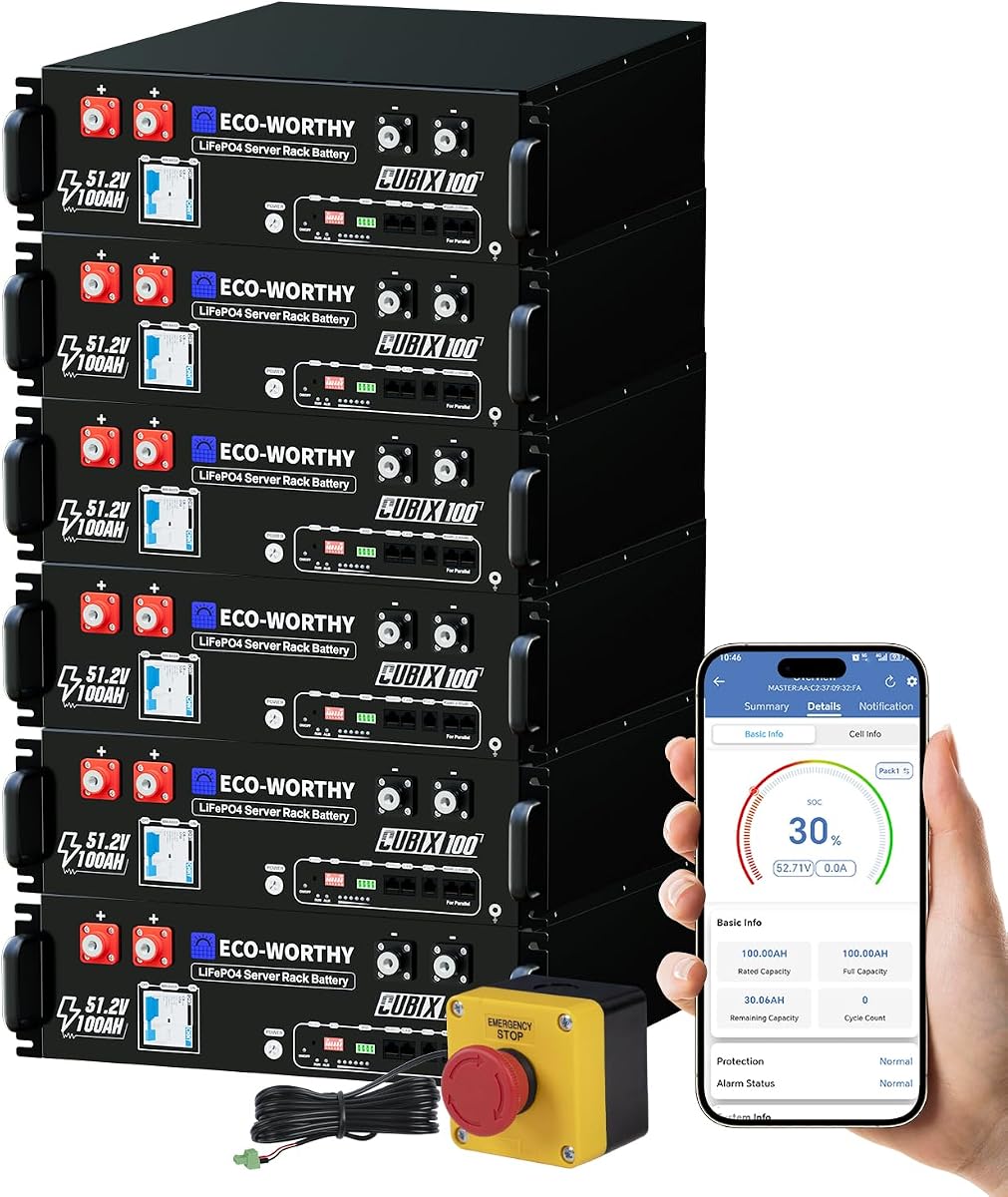
The ECO-WROETHY Cubix100 listing is a six-pack system rather than a single 100Ah module, producing a stated total capacity of 30.72kWh. With a 4.7 rating and listed UL9540, UL1973, and CEC credentials, it is the strongest premium option in this group for buyers seeking a substantial, integrated residential or light-commercial installation instead of a compact backup module.
We may earn a commission when you buy through this link, at no additional cost to you.
Its six individual 51.2V 100Ah units are designed for server-rack compatibility and vertical mounting, making efficient use of enclosure space. The listing says the system can serve whole-home off-grid needs and operate with leading integrated solar inverters through CAN and RS485 communication. Bluetooth and WiFi support adds local and remote status access through the ECO-WORTHY application, while the included accessory package is intended to simplify installation.
Expansion is unusually ambitious. The listing states that as many as 32 units can be paralleled for a maximum of 163.8kWh. That makes the architecture relevant to larger homes, rural properties, and small commercial projects, but such a system is firmly in the territory of professional electrical design. Inverter output, busbar ratings, conductor sizes, disconnects, protection, ventilation, and the authority having jurisdiction all become essential considerations.
The listing also emphasizes Grade A LiFePO4 cells, a 10-year limited warranty, and support for returns or replacement when a verified technical issue occurs within the stated period. It notes that the rapid-shutdown button would ship in September, while the product page also warns that transportation safety requirements may result in multiple packages arriving separately. That logistics notice is worth considering when planning a professional installation date.
This package is most appropriate for buyers who already have a clear system design and need significantly more storage than a single module offers. Its certifications and complete accessory approach can simplify procurement, but the size, weight, and electrical demands make it unsuitable for casual plug-and-play use. Installers should verify the current contents of the package, the availability of every required component, and the precise UL listing relevant to the final assembled system before accepting delivery.
Bundling six modules into a rack-oriented system provides a much larger energy reserve while keeping the installation visually organized. Vertical mounting uses rack space efficiently, but adequate support, ventilation, service clearance, and safe access to each battery remain necessary.
UL9540, UL1973, and CEC listing information can be important during permitting and inspection. Buyers should ask the seller for documentation tied to the exact model and configuration, then have the system evaluated by the local authority and a qualified installer.
We may earn a commission when you buy through this link, at no additional cost to you.
The WattCycle 51.2V 100Ah model combines a 5.0 rating with one of the more advanced feature sets in this comparison. It offers 5120Wh of nominal storage, a 100A intelligent BMS, a 3.2-inch touchscreen, Bluetooth application support, and communication through CAN, RS232, and RS485. The result is a strong fit for users who want a single rack module with detailed local controls and a broad range of integration options.
We may earn a commission when you buy through this link, at no additional cost to you.
Its listed 1C charging capability and 200A peak current for two seconds target applications where a motor, compressor, or other surge load may start while the battery is also supporting background demand. Sustained output is listed at 5120W, so the difference between continuous and short-duration peak capability should be reflected in the inverter and load design. The BMS reportedly provides more than 20 protections, including low-temperature cutoff and overheat protection.
Active balancing is another point of distinction. The stated maximum of 3A is intended to help keep cells at more even states of charge, reduce energy loss, and support long-term consistency. The battery uses BYD Grade A prismatic cells according to the listing and is enclosed in a metal structure with a sheet-metal casing designed for heat dissipation, wear resistance, and mechanical durability.
Smart control is unusually convenient for a rack battery. The LCD touchscreen presents voltage, current, capacity, and temperature, while the WattCycle application supports remote monitoring of individual or multiple units. Communication protocol selection makes the battery potentially useful with a broad range of inverter brands, but the selected protocol must match the inverter and be configured correctly in both devices.
The enclosure measures 19.09 by 17.72 by 5.24 inches and is described as fitting a standard 3U cabinet. The listing supports parallel operation of as many as 20 units, with master and slave recognition and automatic addressing. Its warranty is listed at five years, which is shorter than the 10-year coverage highlighted by several competitors. Overall, it is an attractive feature-rich option for an installer who values balancing, local touchscreen control, surge capability, and protocol flexibility.
The stated 200A two-second peak can help a battery tolerate brief startup events better than a system limited strictly to its continuous rating. Because inverter surge duration, wiring, and protection must align, the load should be tested and reviewed with the equipment supplier rather than relying on the headline peak figure alone.
A 3.2-inch touchscreen gives operators more room to inspect operating data than a small status screen. The application adds remote visibility, and multiple communication ports broaden the chance of integrating with established solar and storage hardware.
We may earn a commission when you buy through this link, at no additional cost to you.
The VPauexii 48V 100Ah battery is built around a 5.12kWh rack-mount configuration and a 5.0 customer rating. Its distinguishing element is the built-in automatic fire-suppression system, which uses a 12g aerosol fire-retardant canister activated within milliseconds when the specified threshold exceeds 170 degrees Fahrenheit. The battery also supports local LCD monitoring, Bluetooth status checks, and remote WiFi or cellular-data access.
We may earn a commission when you buy through this link, at no additional cost to you.
The supplied information says the unit is compatible with the vast majority of inverters and specifically mentions EG4, Victron, Sol-Ark, GoodWe, DEYE, and Sungoldpower. CAN and RS485 ports enable closed-loop communication, and a required communication and power cable is included. Even with a broad stated compatibility claim, installers should confirm the exact protocol and wiring approach for their selected inverter because communication implementations can differ between brands and firmware versions.
This model is supplied as a relatively complete installation kit. A 3U stacking mount kit, preassembled cables, grounding wires, terminal covers, and a manual are included. Vertical installation and engineered horizontal stacking are both described as possible, while parallel operation is stated for as many as 15 batteries, reaching 76.8kWh. The enclosure measures 17.4 inches wide by 18.8 inches deep and 5.22 inches high and is listed at 99 pounds.
The battery uses a 100A-class protected design and claims more than 6,000 cycles. Its local display shows real-time voltage, current, and power, while Bluetooth access provides state of charge, temperature, and health information. The remote application allows monitoring from anywhere after suitable network configuration. This layered monitoring approach is useful because it combines quick local checks with broader remote oversight.
VPauexii also lists a five-year warranty, a 30-day free-return period, and promised technical assistance. The automatic fire system adds a meaningful layer of mitigation, but it should be understood as one component of safe battery design rather than a guarantee against fire. Ventilation, equipment spacing, wiring discipline, correct fusing, and appropriate emergency planning remain essential. For buyers who want rack hardware, monitoring, and automatic suppression in a single package, it stands out as a well-equipped option.
The automatic aerosol system is intended to react at extreme temperatures and help suppress a developing thermal event. It adds defense in depth, but proper enclosure design, ventilation, installation spacing, and a suitable fire-response plan remain more important than relying on any single component.
Remote application access, Bluetooth status data, and a built-in LCD cover different operating environments. The combination helps technicians diagnose a system on site while giving owners a way to check capacity and performance when they are away from the installation.
We may earn a commission when you buy through this link, at no additional cost to you.
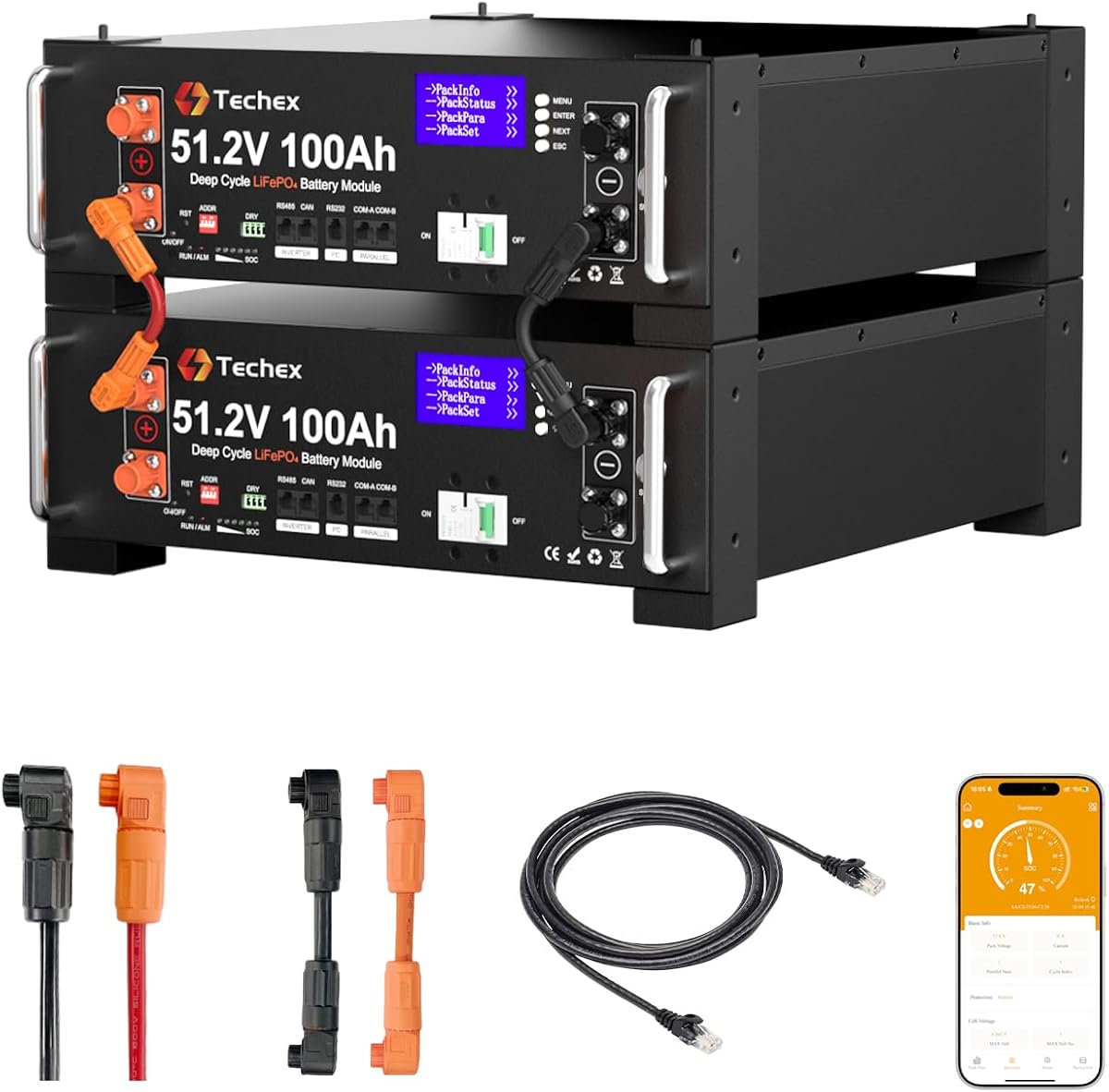
The Techex V2 is a 51.2V, 100Ah rack battery with a 4.7 rating and a feature set centered on clearer wiring, stronger connectivity, and installer convenience. It provides a 3U metal enclosure, a 100A BMS, WiFi and Bluetooth monitoring, a smart display, inverter communication, and automatic fire suppression. The stated maximum output is 5.12kW, making it relevant to solar, off-grid, telecom, workshop, and whole-home backup projects.
We may earn a commission when you buy through this link, at no additional cost to you.
The revised terminal arrangement places positive on the left and negative on the right. This simple change can reduce installation errors, especially where multiple batteries are paralleled in a rack. Dual terminals are designed to balance current and reduce heat, and a built-in 125A breaker controls output and disconnects power during overcurrent events. Fast-plug connectors offer a tool-free method for making compatible connections.
For communication, CAN and RS485 ports support popular inverter brands including Victron, Pylontech, Luxpower, Sol-Ark, DEYE, and GoodWe. The display's PackSet menu lets an installer choose the appropriate BMS protocol, which is a practical feature for technicians working across different inverter ecosystems. Bluetooth allows phone-based inspection, while WiFi provides remote monitoring after configuration. A state-of-charge indicator adds a quick visual reference.
The battery uses 16 Grade-A EV LiFePO4 cells and claims more than 6,000 deep cycles. Its stated charging range is 0 to 55 degrees Celsius, while its stated discharge range extends from minus 20 to 60 degrees Celsius. These conditions are important to verify against the site and charger settings, particularly if charging below freezing is otherwise common in the location.
Parallel expansion is listed for as many as 15 units, with parallel communication and power cables supplied. The enclosure is listed at 17.40 by 18.89 by 5.23 inches and 100 pounds, so rack supports and handling procedures need to accommodate that mass. Overall, the Techex V2 is a strong choice for installers who value unmistakable terminal positions, physical connection features, selectable communication protocols, and a comprehensive monitoring package.
The left-positive and right-negative arrangement gives installers a consistent reference across parallel modules. Dual terminals, a breaker, and keyed quick-plug connections further reduce ambiguity and help create orderly, serviceable wiring in a densely packed rack.
Allowing RS485 or CAN to be selected from the battery menu simplifies integration with a wider range of inverters. The correct choice must still be confirmed for the specific inverter model and firmware, and communication should be tested before the system is placed into service.
We may earn a commission when you buy through this link, at no additional cost to you.
The ECO-WORTHY Cubix100 Pro is a modern 48V, 100Ah rack battery with a 4.5 rating and a strong emphasis on user interface, cell management, and safety. Its upgraded V2 features 3A active balancing, a 4.3-inch full-color touchscreen, Bluetooth and WiFi connectivity, and dual onboard fire arrestors. The listing also describes a battery-level rapid-shutdown function and support for more than 6,000 cycles.
We may earn a commission when you buy through this link, at no additional cost to you.
Active balancing is intended to distribute charge more evenly across the internal cells. By reducing imbalance and associated energy waste, the system may improve usable energy consistency and long-term performance. The cold-weather electrolyte is also listed as supporting charging down to minus 4 degrees Fahrenheit, which is useful for cold-climate installations where a normal lithium battery would otherwise require heated or temperature-controlled charging.
The full-color touchscreen is larger than the simple LCDs on many competing models, providing room for status information, settings, and diagnostics. Bluetooth offers convenient local phone access, while WiFi allows remote monitoring. The battery is stated to support around 90% of mainstream inverters, including EG4, Sol-Ark, DEYE, SRNE, Victron, Growatt, and Sungoldpower.
Safety is addressed through dual fire arrestors and rapid shutdown. As with other suppression systems, the product should be installed with appropriate spacing, ventilation, wiring protection, and an emergency plan. The listing backs the battery with a 10-year limited warranty and lifetime technical support, which adds reassurance for long-term residential or commercial ownership.
One consideration is the product's transition to the V2 version. The listing says the new model was scheduled to start shipping on September 10, so buyers should confirm which hardware revision will be delivered and whether the stated accessories and functions match that revision. Its 4.5 rating is lower than several competing products, but the advanced display, active balancing, and connectivity justify consideration for users who prioritize interface and battery-management features.
The 4.3-inch color display makes a large difference for system owners who want to inspect detailed battery information without a phone. It is particularly useful during commissioning, when voltage, temperature, and communication behavior need to be checked repeatedly.
Three-amp active balancing supports more consistent cell behavior, while the stated low-temperature charging capability broadens seasonal usability. The cold-weather rating should still be matched to the charger, inverter, and manufacturer instructions so the battery is not operated outside its intended charge profile.
We may earn a commission when you buy through this link, at no additional cost to you.
The Techex 48V 200Ah model offers a higher-capacity alternative within a 3U rack format. Its product title lists a maximum output of 10.24kW, and the 5.0 customer rating is among the strongest in the group. It retains the communication, monitoring, fast-plug, terminal-layout, and fire-suppression features associated with the company's rack batteries, making it relevant where one module must provide more storage than a conventional 100Ah unit.
We may earn a commission when you buy through this link, at no additional cost to you.
The 100A BMS is a central design element. A 200Ah cell configuration can store more energy without necessarily increasing the battery's continuous-current rating, so the 100A limit should be respected in system design. Loads, inverter sizing, busbars, cables, and overcurrent protection must be matched to that current class rather than simply to the battery's Ah capacity. This distinction is essential when comparing a 200Ah battery with two separate 100Ah units.
WiFi and Bluetooth monitoring give users local and remote visibility, while the smart display shows operating information directly on the battery. CAN and RS485 communication supports listed integration with Victron, Pylontech, Luxpower, Sol-Ark, DEYE, GoodWe, and other inverter brands. The selected protocol should be configured through the display and verified with the intended inverter before commissioning.
The revised positive-left and negative-negative-right arrangement, dual terminals, 125A breaker, and fast-plug connectors support organized parallel installation. Fire suppression and anti-explosion protection add another layer of safety, while the listing describes more than 6,000 deep cycles and Grade-A EV cells. The unit supports as many as 15 batteries in parallel and includes parallel communication and power cables.
This battery is a sensible candidate for larger homes, workshops, telecom applications, and off-grid systems that want fewer modules in the rack. Its key trade-off is physical and electrical scale: a 200Ah unit puts more demand on supports, handling, transport, and system design than a 100Ah unit. The listing also notes that the item can arrive in multiple packages. Buyers should confirm the delivered configuration and complete component set before installation.
A 200Ah module can reduce the number of batteries required for a given storage target, which may simplify expansion and leave rack capacity available. This advantage should be weighed against handling requirements and the need to keep continuous current and protection within the battery's specified limits.
The consistent terminal positions, quick-plug connections, dual terminal design, and selectable communication protocols make the larger model familiar to installers working with the 100Ah version. The same caution still applies: rack loading, conductor sizing, and inverter limits must be recalculated for the higher-capacity unit.
We may earn a commission when you buy through this link, at no additional cost to you.
The Wattcycle 51.2V 100Ah battery offers a 5.12kWh rack-mounted energy reserve, a 100A smart BMS, and monitoring through a local LCD and Bluetooth 5.0. It also supports CAN, RS485, and RS232 communication. Its 3.3 customer rating is the lowest in this guide, so the model's technical feature set should be evaluated carefully rather than relying on customer feedback alone.
We may earn a commission when you buy through this link, at no additional cost to you.
The principal claim is exceptionally long cycle life. The listing states that the battery uses 102Ah EV-grade A+ LiFePO4 cells and supports more than 15,000 charge-discharge cycles at 60% depth of discharge. That is a meaningful specification for users who intend to cycle the battery regularly, although real results depend on temperature, charge method, current, and whether the stated depth-of-discharge condition is followed.
The listed operating range extends from minus 4 to 149 degrees Fahrenheit, giving the battery broad environmental coverage. A full-metal enclosure is intended to resist vibration, impact, and environmental exposure, qualities that may be useful in mobile, industrial, and remote applications. The smart BMS protects against overcharge, over-discharge, overcurrent, short circuits, and temperature extremes.
The integrated LCD touchscreen provides local status information, while Bluetooth 5.0 supports phone-based monitoring of voltage, current, and capacity. Communication with Victron and Schneider systems is highlighted, and the listed parallel limit is 16 batteries, corresponding to 81.9kWh. The enclosure measures 19.09 by 17.72 by 5.24 inches and weighs 91.9 pounds.
Despite the impressive stated cycle figure, the lower rating is the main reason to investigate this listing before committing. It could reflect a limited customer sample, early production issues, or differences between the photographed and delivered unit; the supplied data does not establish the cause. Prospective buyers should examine current customer feedback, ask for exact warranty and certification documents, and verify the delivered cell configuration before making a final decision.
The stated 15,000-plus cycles at 60% depth of discharge distinguishes the battery from products that advertise the same general chemistry without a defined condition. Daily cycling users should look closely at that condition, because deeper or shallower discharge patterns and temperature can materially affect realized life.
The metal enclosure and broad stated temperature range are appealing for RV, cabin, industrial, and remote installations. Structural support and environmental protection still need to be assessed in context, particularly where vibration, moisture, or restricted ventilation could affect the installation.
We may earn a commission when you buy through this link, at no additional cost to you.
The ECO-WORTHY Cubix100 600AH is a cabinet-oriented package built around six 51.2V 100Ah server-rack batteries. The supplied listing describes a 30.72kWh system and an integrated 600A busbar, while its certification information includes ETL UL9540 DC, UL1973, and CEC listing. Unlike the single-module products, it is designed as a high-current, professionally assembled energy-storage installation.
We may earn a commission when you buy through this link, at no additional cost to you.
The integrated busbar is a major practical feature. It distributes power more directly among the rack batteries and includes 10 preinstalled M8 PEM nuts for cable connections. This arrangement can reduce the amount of external interconnection work, though installers still need to verify conductor size, torque, insulation, protection, and the busbar's allowable loading before making connections.
Closed-loop communication is provided through CAN and RS485 interfaces and multiple protocols. Bluetooth and WiFi enable status monitoring through the ECO-WORTHY application, and the listing states compatibility with most mainstream inverters. When paired with a UL1741 inverter, the system is described as designed to meet AHJ inspection requirements. That language does not guarantee local approval, so permit and inspection requirements still need to be confirmed directly with the authority having jurisdiction.
The package includes parallel cables, communication cables, grounding wires, protective terminal covers, screws, and a user manual. The battery modules support vertical mounting and can be paralleled with additional units according to the listing, with expansion stated up to 32 batteries and 163.8kWh. A RACK6 V3 cabinet provides the enclosure framework for the primary package.
No customer rating is provided for this listing, so it cannot be compared on the same feedback basis as the rated products. It is best considered by buyers who have a clear need for a cabinet-scale 48V system and the resources to design the installation professionally. Its certifications, complete accessory set, and integrated high-current distribution make it a specialized option rather than a simple single-battery purchase.
A 600A busbar is a significant difference from a stand-alone battery with a single pair of terminals. It supports a more integrated multi-battery architecture, but its capability is not a substitute for engineering the entire power path, including fault current, breaker coordination, cable temperature rise, and emergency isolation.
The listed ETL UL9540 DC, UL1973, and CEC information can help installers assemble compliance documents. Because requirements vary by location, the exact system, inverter combination, installation method, and local authority should be reviewed before equipment is ordered or energized.
We may earn a commission when you buy through this link, at no additional cost to you.
Choosing a rack-mount lithium battery is a balance of electrical capability, physical fit, communication, safety, and serviceability. The most important starting point is the inverter and charging architecture, followed by usable capacity, site conditions, and the amount of monitoring or redundancy the installation requires.
Most products in this guide use a 51.2V nominal lithium iron phosphate configuration, marketed as a 48V battery for compatibility with common 48V solar inverters, UPS units, and charge controllers. The nominal voltage is not the same as the battery's maximum charging voltage or its output under load. Confirm the inverter's expected battery range, charge profile, cell chemistry, and communication requirements before choosing a module.
Choose a battery whose chemistry, voltage, and BMS behavior are supported by the rest of the system. A nominal-label match alone does not guarantee that the inverter will charge, discharge, or communicate with it correctly.
A 100Ah battery at 51.2V provides 5.12kWh of nominal energy, while a 200Ah unit provides roughly twice that amount. Nominal capacity is not the same as the energy available to the load: inverter efficiency, conversion losses, wiring losses, low-temperature operation, state-of-charge limits, and the depth of discharge permitted by the manufacturer all affect usable runtime. Add up the loads expected during an outage, estimate their duration, and apply an appropriate reserve margin.
For daily solar use, evaluate how much energy must be stored overnight and how much power the inverter can deliver continuously and briefly. For backup applications, identify essential loads separately from convenience loads so the battery is not depleted by equipment that is not needed during an emergency.
Battery capacity in amp-hours and output power in watts are different specifications. A 100Ah BMS may limit continuous current even when the cells have a large Ah rating, while some products advertise a much higher short-duration peak. Match the inverter's continuous output, surge capability, battery maximum current, and any startup-heavy loads such as pumps or compressors. Verify that cables, breakers, busbars, and contactors are also rated for the calculated current.
Do not size a battery by adding every possible household load to the inverter's surge rating. Instead, separate continuous demand from brief startup demand and confirm both against the battery and inverter manufacturers' limits.
Most single modules are described as 3U rack batteries, but rack mounting is not just about the three-inch nominal height. Check width, depth, weight, rail attachment, handle position, connector clearance, and front or rear service space. A battery that fits physically may still block airflow, prevent adjacent equipment from being removed, or place heavy components above lighter equipment that should be serviced more often.
Plan for safe lifting and rack loading. Confirm that the floor, wall, or cabinet can support the installed mass, and use suitable mechanical restraints where required. Stacking should only be done according to the manufacturer's instructions and with the correct kit or support hardware.
CAN, RS485, and RS232 communication can allow a compatible inverter to receive battery voltage, current, temperature, and state-of-charge data and to manage charging appropriately. Bluetooth and WiFi applications add visibility for the owner, while local LCDs help with installation and troubleshooting. The protocol must match the inverter, and some systems require a particular baud rate, termination setting, or communication address.
Obtain the manufacturer's compatibility list before buying. Ask whether the battery supports the exact inverter model, whether the appropriate cable is included, whether firmware updates are required, and how multiple batteries are addressed. Remote applications are useful, but stable closed-loop communication with the inverter is often the more important integration feature.
Look for relevant UL1973 battery certification, UL9540 or UL9540A energy-storage testing or listing, and applicable CEC or ETL information. The meaning and scope of each designation can differ, so buyers should request documentation for the exact model and complete assembled system rather than relying only on a listing badge. A built-in BMS should provide foundational protection against overcharge, over-discharge, overcurrent, short circuit, and temperature extremes.
Additional fire suppression, rapid shutdown, active balancing, and anti-explosion design can improve protection in the context of a complete installation, but they do not replace safe spacing, ventilation, proper fusing, compliant wiring, or an emergency response plan. Local fire and electrical codes should be reviewed before the system is installed.
LiFePO4 chemistry has a favorable thermal profile, but charging at very low temperatures can still be restricted. Some products include low-temperature charging functions, while others require heated batteries, temperature-controlled charging, or a heated enclosure. Compare the stated charge and discharge ranges with the site's winter conditions and the location of the rack. High ambient temperature also affects thermal management and the placement of sensitive electronics.
Choose an enclosure with suitable ventilation and service clearance, and avoid placing batteries where condensation, water, combustible material, or direct heat could create a hazard. Mobile RV and remote installations require particular attention to vibration, impact, moisture, and secure retention.
Check the maximum number of batteries that can be paralleled, the total energy available at that scale, and whether the inverter can charge and discharge the full bank. Expansion also affects conduit space, cable lengths, busbar ratings, breakers, protection coordination, monitoring, and the load of the rack itself. A platform that supports many modules on paper is only useful if the rest of the electrical system can support the same growth.
Confirm what is included: rack hardware, parallel communication cables, power cables, grounding wires, terminal covers, fasteners, and a manual. Missing specialized cables or communications parts can complicate installation, and extra batteries may require additional accessories that are not included with the base package.
Begin by confirming the battery's nominal voltage, charging requirements, communication protocol, physical dimensions, and current limits against the inverter, charger, and planned load. Mount the rack securely, maintain the required clearance, connect correctly polarized cables, and install the specified overcurrent protection. Configure the BMS and inverter communication before energizing the system, then perform a controlled initial charge rather than assuming the battery reached a useful state of charge during shipping or storage.
Operate the system within the manufacturer's temperature, voltage, current, and state-of-charge limits. Use the local display and application to monitor capacity, temperature, voltage, current, and active protection warnings. After a grid outage or heavy discharge, allow the battery to return to the recommended state of charge using the correctly configured charging source. Avoid repeated deep cycling when the installation does not require it, and do not use the battery as a direct power source for loads that exceed the continuous ratings.
Periodic maintenance should include visual inspection for damaged cables, loose terminals, corrosion, heat discoloration, dents, unusual odors, and signs of moisture. Confirm rack fasteners, grounding, ventilation, and cable routing, then review BMS event history and compare displayed data with inverter readings. Keep firmware and monitoring applications current, retain certification and warranty documents, and follow the manufacturer's long-term storage and end-of-life procedures. If a battery is damaged, swells, produces abnormal heat, or repeatedly enters protection mode, disconnect it according to safe procedures and seek qualified service rather than continuing to operate it.
No. Although most use a nominal 51.2V design, compatibility depends on the supported voltage range, charge profile, communication protocol, connector type, and inverter firmware. Check the exact inverter and battery pairing in the manufacturers' documentation before installing the battery. A physically matching terminal or nominal voltage label does not guarantee that closed-loop communication will work.
A 51.2V, 100Ah battery has 5.12kWh of nominal energy. The amount available to connected loads will be lower because of conversion losses, wiring, temperature, operating limits, and the usable state-of-charge range. A qualified installer can estimate practical runtime by dividing the appropriate usable-energy allowance by the measured load in watts.
Most models in this guide support parallel expansion, but the stated maximum varies from 15 to 32 batteries, and the ECO-WORTHY WT5100 listing claims support for as many as 63. The inverter, BMS communications, cable sizing, breakers, busbars, and local electrical code must all support the planned configuration. Use matching batteries and the manufacturer's specified parallel procedure.
Rack mounting can improve organization, but enclosure format alone does not determine safety. Relevant battery certifications, a sound BMS, correct protection devices, compliant wiring, ventilation, appropriate spacing, and a suitable installation location are still required. Fire suppression and rapid-shutdown features add protection but do not replace a complete site-safety plan.
Neither connection is essential for the battery to store and deliver energy, but both can improve monitoring and troubleshooting. Bluetooth is typically convenient for nearby setup and diagnostics, while Wi-Fi supports remote visibility. More important in many systems is compatible CAN or RS485 communication with the inverter, which allows the charge controller to coordinate charging using battery data.
One 51.2V, 100Ah unit provides about 5.12kWh nominally, while a 12V, 100Ah lead-acid battery provides about 1.2kWh nominally. The comparison also changes with inverter voltage, usable depth of discharge, and system voltage, so battery strings must be matched to the inverter. Lithium offers advantages in weight, space, efficiency, and cycle life, but the full conversion should include BMS, mounting, communications, and safety requirements.
It represents the number of expected charge-discharge cycles under the manufacturer's specified conditions, not a guaranteed number of years. Actual life depends on depth of discharge, charge method, current, temperature, calendar age, and maintenance. Review the exact warranty terms and test conditions because a cycle count produced under one operating condition may not apply to a different daily-use pattern.
Verify polarity, rack security, cable torque, grounding, breaker sizing, ventilation, and the absence of damaged cables. Select the correct CAN or RS485 protocol, confirm that the inverter recognizes the battery, and check voltage, temperature, capacity, and warning states on the display. Begin with a controlled charge and review application data before placing important loads on the system.
The WT5100 stands out as the most balanced overall option because it combines 5.12kWh of capacity, a 100A BMS, local and remote-style monitoring through the LCD and communications ports, extensive certification information, and a long warranty. The 48V 100Ah 3U model is a compelling value choice for users who are comfortable with application-based monitoring, while the ECO-WROETHY Cubix100 600Ah package leads the group for buyers who need a large, multi-module installation with extensive listed safety credentials.
Prioritize the entire energy system rather than choosing on Ah capacity alone. Confirm inverter communication, continuous and surge output, charge temperature limits, certification for the exact configuration, physical fit, included parallel accessories, and the amount of service clearance the rack allows. For larger or safety-critical installations, professional electrical design and local code review should take priority over adding another advertised feature.
Finally, check the current listing before ordering because battery revisions, included rack hardware, communication cables, certifications, warranty terms, and monitoring capabilities can change. Customer ratings and availability also evolve over time. Comparing the current specifications with the inverter, charger, installation environment, and expansion plan will lead to a more durable decision than focusing on a single headline number.