LRT 8858
4.4Editor score
Compact repair-bench controller
Digital heat control
Ten airflow levels
Automatic cooling sleep
Six precision nozzles
Heat Gun for Circuit Board buying guide compares 10 hot air rework stations for temperature control, accessories, safety features, and repair needs.
A heat gun for circuit board work must deliver controlled hot air without overwhelming small components, connectors, or heat-sensitive materials. The right rework station combines accurate temperature regulation, adjustable airflow, useful nozzles, and safeguards that make electronics repair safer and more repeatable.
This guide compares ten heat guns and hot air rework stations using the supplied specifications, including temperature ranges, control systems, accessories, power requirements, and intended repair applications. It covers both dedicated PCB tools and general-purpose heat guns that may be suitable for lighter electronics work.
Each pick highlights a different balance of features, from compact stations with preset controls to kits that combine hot air with a soldering iron. Ratings and specifications reflect the available product information, while prices and availability can change, so readers should confirm current details before purchasing.
4.4Editor score

4.5Editor score

4.5Editor score
The table below compares all ten tools by core heat range, control method, airflow adjustment, and included rework accessories, making it easier to compare dedicated stations with general-purpose heat guns.



The WEP 882D is a 2-in-1 soldering iron and hot air rework station that receives a 4.5 rating in the supplied data. It stands out as the most complete choice in the roundup because it supports both conventional soldering and component-level hot air work in one compact body, with separate displays, switches, and temperature controls for the two functions.
We may earn a commission when you buy through this link, at no additional cost to you.
Both sides of the station use PID-based temperature control. The soldering iron adjusts from 392°F to 896°F, while the hot air gun covers 212°F to 896°F and includes variable air volume. The package also includes two spools of solder wire, five soldering tips, three hot air nozzles, brass wool, tweezers, and a desoldering pump, making it a practical starting point for a new electronics-repair bench.
The main compromise is that a combined station presents more controls and functions than a dedicated hot air unit. The display arrangement also requires attention because the two systems are managed independently. Users should confirm the 110–127V rating and avoid connecting the station to a 220V socket, as specified by the manufacturer.
This is the strongest pick for readers who want one station to handle ordinary soldering, SMD rework, shrinking, and general electronics work. It offers the broadest practical feature set in the group without requiring a separate soldering station, making it especially suitable for students, hobbyists, and developing technicians.
PID control continuously adjusts power to help maintain the selected temperature, while the broad hot-air range allows settings to be matched to different tasks. Lower settings are useful for cautious rework, whereas the upper end supports heat-shrink, adhesive curing, and more demanding component removal.
The integrated soldering iron means a user can remove a component, clean the pads, and install a replacement without relying on a separate iron. Individual displays and power switches make the two tools easier to manage, while the included tips, nozzles, solder, tweezers, pump, and cleaner cover common setup needs.
We may earn a commission when you buy through this link, at no additional cost to you.
The Beaiguna 2-in-1 is a budget-oriented soldering station with a separate hot air function, and the supplied data gives it a 4.2 rating. Its appeal comes from combining two frequently used repair tools while maintaining independent switches, giving the user more operating flexibility than a basic single-purpose heat gun.
We may earn a commission when you buy through this link, at no additional cost to you.
The soldering side reaches 392°F to 896°F and is backed by an up-to-700W heating system, while the hot air side also extends to 896°F. A digital display provides live hot-air temperature readings, and features such as Celsius-to-Fahrenheit conversion, automatic sleep, and calibration help support repeatable work. The kit includes five soldering tips, three hot air nozzles, solder wire, a desoldering pump, a sponge, and tweezers.
The most important limitation is that the digital display shows only the hot air gun's temperature, not the soldering iron's temperature. The manufacturer also notes that tips that do not initially fit can often be secured by gently tapping around the chuck flange. These are usability details rather than deal breakers, but they deserve attention before a purchase.
The Beaiguna is a sensible option for a new workbench where one unit must cover both soldering and hot air rework. It is best suited to users who value the dual-tool format and accessories over having a separate display for every function.
Separate switches allow the soldering iron and hot air gun to be used independently, which is useful when a repair involves both joining and removal. This makes the station more versatile than a basic craft heat gun while keeping its footprint smaller than two separate stations.
Automatic calibration and a dedicated hot-air calibration procedure can correct temperature discrepancies over time. Because the process involves a specific control sequence, users should follow the supplied instructions carefully before attempting PCB rework.
We may earn a commission when you buy through this link, at no additional cost to you.
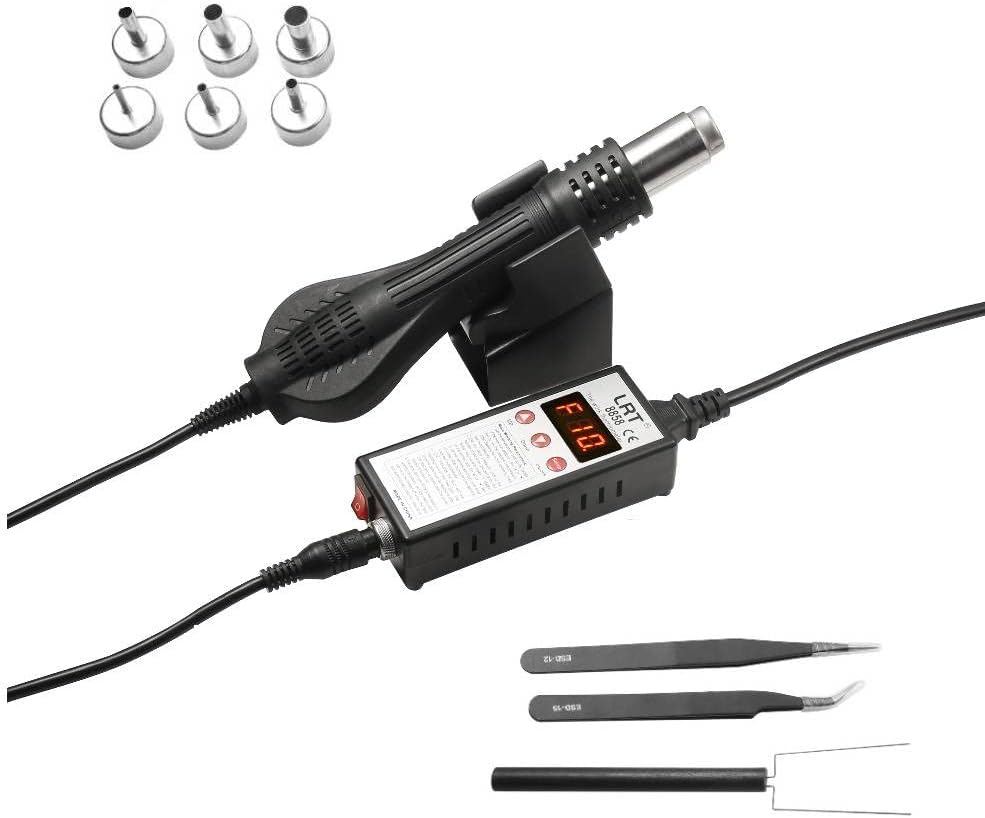
The LRT 8858 is a dedicated digital hot air rework station with a 4.4 rating. It focuses on the functions required for SMD work and PCB repair, including a broad 212°F to 932°F temperature range, microprocessor-based control, and ten selectable airflow levels.
We may earn a commission when you buy through this link, at no additional cost to you.
Its intelligent sleep behavior is particularly useful: when the handle is placed in its holder, the system enters cooling mode to protect internal components and support a longer service life. Airflow can be fine-tuned for chip removal, soldering rework, heat-shrink tubing, and preheating, while six nozzle sizes cover different heat patterns.
The station does not include a soldering iron, so users who also need conventional soldering will need another tool. It also lacks the multiple preset channels found on some higher-feature stations, meaning the operator may have to dial in settings more often. Its compact controller and included stand do make it attractive where bench space is limited.
The LRT 8858 is a strong selection for a focused electronics-repair setup. It combines digital control, detailed airflow adjustment, automatic cooling, and a generous nozzle range in a compact package, making it particularly useful for mobile technicians and experienced hobbyists who want a dedicated rework station.
Ten airflow levels allow operators to match the force of the hot air to the component and board. Lower airflow can reduce movement of small parts, while higher output helps with larger packages, rapid heating, shrinking, or preheating tasks.
Automatically entering cooling mode when the handle is returned to its holder is a sensible routine for a repair bench. It removes the need to manually switch the unit off during short breaks and helps protect the heating assembly between tasks.
We may earn a commission when you buy through this link, at no additional cost to you.
The WEP 2009D-II is a feature-rich hot air station with a 4.5 rating. Its defining advantage is the set of four preset channels, which let users switch among frequently used temperature configurations with one press and avoid repeating the same manual adjustment for different components.
We may earn a commission when you buy through this link, at no additional cost to you.
Temperature spans 212°F to 896°F, and PID programming is used for stable heat control. Airflow adjusts across ten levels, while a one-button cool-air mode helps clean PCBs or cool the heat gun. The digital display reports temperature, airflow, active preset, unit, and heating status, including when the set temperature has stabilized.
Its detachable heat gun is another meaningful benefit. The gun can be replaced when it or its heating element reaches the end of its useful life without discarding the entire station. The unit is limited to 110–127V and should not be connected to a 220V socket, and it does not include a separate soldering iron.
This station is best for a technician who repeats similar PCB jobs and values fast access to saved heat profiles. The combination of presets, detailed status feedback, stable control, and serviceable design makes it the most workflow-oriented dedicated hot air option in the roundup.
Four preset channels are useful for jobs that alternate among removal, installation, shrinking, and heating tasks. Once a suitable setting is established, the operator can recall it directly, improving consistency and reducing menu or dial adjustments.
The heat gun is detachable, reducing the need to replace the entire station when the handle or heating element reaches the end of its service life. This design can make the station more practical for sustained repair work.
We may earn a commission when you buy through this link, at no additional cost to you.
The WEP 8858-V is a compact hot air station with a 4.5 rating. Its most noticeable feature is the palm-sized controller, which incorporates both a hot air gun holder and nozzle holder to reduce clutter on a crowded workbench.
We may earn a commission when you buy through this link, at no additional cost to you.
A PID program monitors temperature and adjusts power to maintain a consistent operating point. The control panel offers direct temperature and air-volume adjustment, and the airflow can be changed using a panel knob without entering a secondary menu. Celsius-to-Fahrenheit conversion, digital temperature calibration, and a hot-air fail-safe add further control and safety functions.
The accessory package includes bent and straight tweezers and three nozzles in different sizes. Compared with the LRT 8858, it offers fewer included nozzles and no listed automatic holder cooling function, although its fail-safe and calibration features are valuable. The 110–127V requirement also limits where it can be used without an appropriate power solution.
The WEP 8858-V is a good match for small workspaces and users who prioritize simple panel operation, compact storage, and stable PID control. It is particularly appropriate for hobbyists and service technicians who perform a manageable variety of rework tasks rather than needing extensive preset profiles.
The integrated holders keep the gun and nozzles close to the controller while preserving workspace. That makes the station easier to store and less likely to be knocked over or displaced in an active repair area.
A dedicated panel knob changes air volume without requiring a deeper settings sequence. This reduces friction during repeated repairs and makes it easier to alternate between gentle heating and stronger airflow.
We may earn a commission when you buy through this link, at no additional cost to you.
The YIHUA 8858 IV is a general-purpose heat gun with a 4.3 rating that is still suitable for electronics soldering and basic circuit board rework. Its heat adjusts from 212°F to 932°F, providing enough range for heat-shrink tubing, epoxy curing, crafts, paint removal, and other household or workshop applications.
We may earn a commission when you buy through this link, at no additional cost to you.
Unlike a basic craft-only tool, it uses temperature-control technology intended for electronic rework and offers adjustable air volume. The airflow adjustment is valuable on small assemblies because it lets the user reduce force around lightweight components. Three interchangeable nozzles support different operating requirements and heat patterns.
The manual standby mode cools the gun toward 212°F and temporarily turns it off when the activation button is pressed. This is convenient but differs from the automatic standby behavior of several station-style competitors. The supplied data also does not mention a digital temperature display, which may be a drawback for users who want a numeric readout.
The YIHUA 8858 IV is the most versatile choice for someone who needs one heat tool across electronics, crafting, shrinking, and finishing tasks. For a dedicated PCB technician, a station with more precise digital feedback may be preferable, but for mixed household projects, this model covers more ground.
The same heat source can handle shrink tubing, epoxy resin, heat transfer, drying torch markers, shrink wrapping, and electronics work. That flexibility makes it useful for users who do not maintain a separate station for each discipline.
Reducing air volume helps prevent lightweight or loosely mounted components from shifting. The adjustment also allows a user to concentrate heat around a specific area rather than applying a broad, forceful stream across the board.
We may earn a commission when you buy through this link, at no additional cost to you.
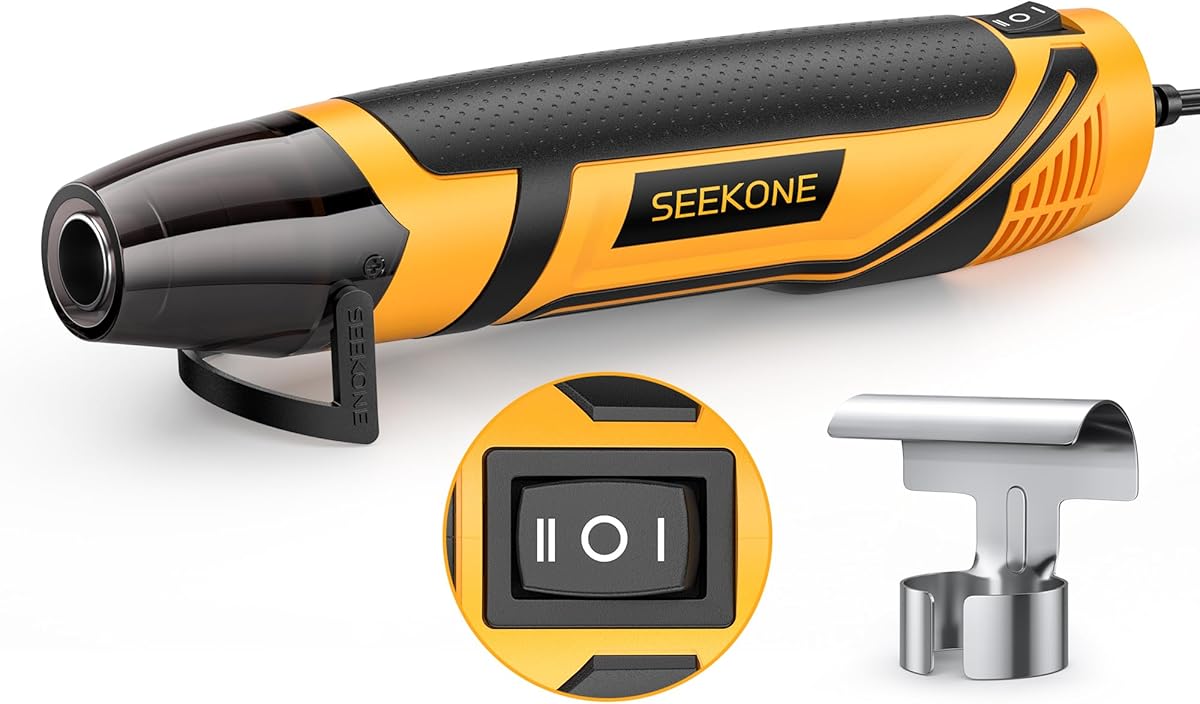
The SEEKONE 1800W is a high-output general-purpose heat gun with a 4.6 rating. It reaches up to 1202°F, giving it the broadest maximum temperature in this roundup, and offers two airflow modes with a combined range of 190 to 500 liters per minute.
We may earn a commission when you buy through this link, at no additional cost to you.
Temperature is adjusted through a black rheostat-style dial, while a high-and-low switch on the handle controls airflow. That means the operator can vary heat and air independently, although neither adjustment is presented as a precise digital process control. Overheat protection helps guard the tool from excessive temperature.
This is not a dedicated soldering station, so it lacks PID stabilization, digital readouts, preset channels, and an automatic cooling stand. Its high output and wide nozzles can be advantageous for crafts, paint removal, floor-tile loosening, PVC work, 3D printing, and other demanding heating tasks, but that power requires more care around delicate boards.
The SEEKONE 1800W is best for users who need serious heat output alongside occasional electronics work. It is less attractive as a primary precision PCB tool than the dedicated stations, yet its reach, airflow range, and 4.6 rating make it a capable multipurpose heat gun.
Separating airflow from temperature lets the user reduce force for small jobs while retaining high heat, or increase airflow for rapid material removal. This is useful across general workshop tasks, although precise PCB users may still prefer digital stabilization.
The upper temperature range supports tasks involving heavy heat, including paint removal, PVC softening, tile loosening, and 3D-print post-processing. The four nozzle designs help direct or disperse heat according to the task.
We may earn a commission when you buy through this link, at no additional cost to you.
The SEEKONE HG350 is a mini heat gun with two fixed temperature settings, 500°F and 842°F, and a 4.6 rating. Its simplicity and compact construction make it a convenient option for light heat-shrink, minor repair, crafting, and post-processing work in confined areas.
We may earn a commission when you buy through this link, at no additional cost to you.
Unlike many adjustable heat guns, it presents only two process choices. That is easy to learn and can be useful when a task repeatedly calls for the same modest or moderately hot setting. The included nozzle focuses heat in a narrow area, while a retractable stand provides stable hands-free positioning.
Built-in overheat protection and a nozzle safety shield are positive safety features, but the outlet must remain open and adequate distance from the workpiece must be maintained. Fixed temperatures offer no PID stability, digital display, or fine control, so the tool is not well suited to repeated PCB tasks involving different components and solder temperatures.
The HG350 is most appropriate for a mobile toolkit or occasional electronics work rather than a professional repair station. Readers who value fast access to two reliable settings and a small footprint will appreciate it, while frequent circuit board users should favor a model with broader adjustment and control.
The choice between 500°F and 842°F removes the need for a temperature dial. This is helpful for occasional users, although it provides less flexibility than continuously adjustable electronics-focused models.
The retractable stand keeps the gun upright and reduces the need to hold it during a task. Combined with the compact body, this makes the HG350 practical for field repairs and small work areas.
We may earn a commission when you buy through this link, at no additional cost to you.
The Mini 700W Heat Gun Kit is a portable hot air tool with a 4.2 rating. It offers ten temperature gears covering 212°F to 932°F and adjustable airflow from 180 to 300 liters per minute, providing more process options than a basic two-setting heat gun.
We may earn a commission when you buy through this link, at no additional cost to you.
Its heating is advertised as reaching the selected temperature within seconds, and the five-foot power cord gives the user room to work without moving a nearby outlet. The straight handle, compact size, and low weight make it suitable for precision operations in smaller spaces. A stand is included for stable, hands-free positioning.
Safety features include UL certification and an overheating power cutoff that interrupts current if the temperature becomes too high. The accessory bundle contains five 4, 5, 6, 8, and 10mm nozzles, a solder sucker, two ESD-safe tweezers, and an IC extractor. However, the listed controls are gear-based rather than a digital display with precise numerical feedback.
This kit is a practical middle ground for hobbyists and mobile repair users who want more control than a fixed-temperature craft gun. It is especially convenient when the necessary tools are desired in one package, though dedicated PID stations remain preferable for consistently demanding PCB work.
The stepped temperature selection lets users move from lower heat to stronger output without moving a continuously adjustable dial. It also provides a practical middle ground between fixed-temperature mini guns and digital rework stations.
Nozzles, tweezers, an IC extractor, and a solder sucker cover several common handling and desoldering needs. The compact handle and included stand keep the tool practical for mobile technicians and compact benches.
We may earn a commission when you buy through this link, at no additional cost to you.
The YIHUA 959D is a premium-style digital hot air rework station with a 4.5 rating. It combines a 212°F to 932°F operating range with a maximum stabilized output of 120 liters of hot air, giving it enough performance for a broad range of components and rework operations.
We may earn a commission when you buy through this link, at no additional cost to you.
Three memory channels store frequently used temperature settings, allowing one-touch recall when moving between different solder types or components. The unit supports Fahrenheit and Celsius display modes, and its brushed aluminum panel is intended to resist accidental burn marks while offering a more durable control surface.
Safety and convenience are emphasized through in-holder standby cooling and a hot air gun fail-safe function. The heating system is designed to react quickly when the gun is removed from its holder, while standby mode helps cool the tool when it is returned. As with the other USA-rated units in this roundup, it is designed for 110–127V operation.
The YIHUA 959D is an excellent choice for a technician who handles varied components and wants saved profiles without a large control panel. Its strong airflow, digital display, quick heating, and safety functions justify consideration as a premium dedicated PCB station, although it does not include a soldering iron.
Three memory channels are useful for technicians who alternate among heat-sensitive parts, larger packages, and different solder types. Recalling a setting directly reduces repeated adjustment and supports a more consistent sequence during mixed repair jobs.
The station can deliver up to 120 liters of hot air for demanding rework, but the fail-safe and in-holder standby functions help manage the risk of leaving a hot tool unattended or overheating between tasks.
We may earn a commission when you buy through this link, at no additional cost to you.
The best heat gun for circuit board repair balances heat output, airflow, control accuracy, nozzle support, and safety. The right choice depends on the types of boards and components you service as well as how often you use the tool.
A broad temperature range gives you room to adjust for different components, solder alloys, heat-shrink materials, and adhesives. More important than the maximum alone is whether the station can hold the selected temperature steadily. PID-controlled stations are generally better suited to repeated precision work because they adjust power as the element and workpiece temperatures change. A digital readout also helps operators reproduce a successful setting on a later repair.
Airflow determines how quickly heat reaches the work and how forcefully air moves across the board. Strong airflow can speed heating, but it may shift tiny components, disturb heat-shrink adhesive, or spread heat toward sensitive parts. Lower airflow provides more localized treatment. A good station offers several airflow levels, while multiple nozzle diameters let the user change both the coverage and the distance between the nozzle and component.
A dedicated hot air station is streamlined for removal, installation, shrinking, and board-level rework. A 2-in-1 station adds a soldering iron, making it convenient for users who perform both through-hole soldering and hot air tasks. The combination may be more economical in terms of bench space, but it also introduces two sets of controls and requires learning the digital display behavior. Choose based on the tools you actually use rather than the number of functions printed on the box.
Preset channels save temperature settings for recurring jobs. The WEP 2009D-II provides four channels, while the YIHUA 959D provides three. They are particularly valuable when a repair involves several component types because the user can move directly to a known setting instead of adjusting the dial repeatedly. Presets do not replace sound judgment, as heat requirements can vary with board construction and thermal mass, but they make proven configurations quicker to restore.
A hot tool should have a defined cooling routine. Some stations automatically enter sleep or standby mode when the gun is returned to its holder; others require a button press. Automatic behavior is more convenient and reduces the chance of leaving the unit running hot. Look for a stable holder, a cool-air mode, overheat protection, and a gun fail-safe. These features do not make careless handling safe, but they provide useful layers of protection.
Nozzles have a direct effect on the work, and a kit with several sizes gives more flexibility for component removal and heat-shrink tasks. ESD-safe tweezers are useful for positioning small parts, while an IC extractor helps lift chips without placing excessive force on the board. A desoldering pump, solder wire, tip cleaner, and soldering iron can round out a new station. Confirm the included quantity because accessories can vary significantly between models.
Several featured stations are explicitly rated for 110–127V and should not be connected to a 220V socket. Voltage compatibility matters if you travel internationally or operate in a region with a different supply. Also distinguish a small craft heat gun from a rework station: general-purpose tools may offer greater maximum heat or broader household uses, but they often lack the closed-loop control and feedback expected on a professional electronics bench.
Begin by working on a heat-resistant surface with the board properly supported and the surrounding area free of combustible materials. Select a temperature appropriate for the component, board, and solder being used, and begin with conservative airflow. Install a nozzle that matches the package size, then allow the heat gun to stabilize before bringing it near the board.
Keep the nozzle moving rather than holding it in one position. For chip removal, warm the area evenly, apply gentle mechanical assistance with an appropriate extractor, and stop as soon as the component releases. For heat-shrink or adhesive work, use airflow to move the material without directing excessive force at nearby components. After each task, return the gun to its holder and let it cool fully before changing nozzles or storing it.
Do not touch the nozzle or heating element, and do not block the air outlet or intake. Inspect the power cord, plug, holder, and nozzle before use, clean the gun only after it has cooled, and follow the product instructions for calibration, cleaning, and replacement. Never connect a USA-rated unit to an incompatible voltage, and do not attempt PCB work on energized equipment.
The correct setting depends on the component size, board construction, and the solder or adhesive being softened. Start below the station's maximum and use a narrow nozzle with moderate airflow, warming the area evenly rather than baking one point. Increase heat gradually only if the component will not release, because excess temperature can damage pads, lift traces, or discolor the board.
A PID system is helpful but not mandatory for every hobby task. It makes repeated work more consistent by keeping the selected temperature stable as the heating element and board change temperature. A simple adjustable hot air gun can still handle occasional shrinking, connector removal, and general rework if the operator monitors heat carefully and works in small areas.
A household heat gun can be useful for heat-shrink tubing and other noncritical tasks, but it usually offers less precise heat control than a rework station. Strong airflow and abrupt temperature changes may move small components or overheat nearby plastic connectors. For repeated board-level work, a tool with a digital readout, controlled airflow, and a focused nozzle is the safer choice.
A dedicated hot air station concentrates on component removal, installation, shrinking, and heating tasks. A 2-in-1 station adds a conventional soldering iron for joining through-hole parts, making it more versatile for a mixed repair bench. The trade-off is a larger control set and the need to manage two heating systems, so experienced users may prefer separate dedicated tools.
Many stations intentionally enter sleep, standby, or cooling mode when the handle is returned to the holder. This protects the heating element and reduces fire risk. Some models react automatically, while others require the user to press a standby button. Check the indicator and the product's instructions before assuming the unit has malfunctioned.
No. Start with a moderate setting, give the chip and surrounding area time to warm evenly, and increase the temperature or airflow only as needed. A large component can absorb considerable heat, and excessive airflow may dislodge it before the solder is fully released. Using a nozzle matched to the package also reduces the area exposed to unnecessary heat.
Neither tool is strictly required for every repair, but both can improve control. A desoldering pump removes molten solder from through-hole pads after heating, while an IC extractor provides a safer way to lift a multi-pin component without levering against the board. They are particularly useful when replacing connectors, ICs, and other heat-sensitive parts.
They can be, provided the nozzle is directed carefully and airflow is reduced. Keep heat concentrated on the target rather than washing the entire connector area with hot air, and inspect nearby plastic for softening or discoloration. For especially sensitive assemblies, a lower setting, a smaller nozzle, and short controlled heating intervals are safer than maximum output.
The WEP 882D is the most complete all-around option because it combines a soldering iron, hot air gun, PID controls, separate displays, and a broad accessory kit. The LRT 8858 stands out for compact dedicated rework, while the YIHUA 959D provides the premium combination of high airflow, saved profiles, rapid heating, and protective cooling behavior.
When choosing, prioritize stable temperature control, manageable airflow, correctly sized nozzles, and an automatic cooling routine if you work on boards regularly. A 2-in-1 station is more useful when soldering and hot air rework are equally important, while a dedicated station offers a simpler control layout for component-focused jobs.
Before purchasing, verify voltage compatibility, included accessories, stand placement, and the manufacturer's calibration instructions. Prices, ratings, product details, and availability can change, so check the current listing and compare the final package with the type of circuit board work you actually intend to perform.