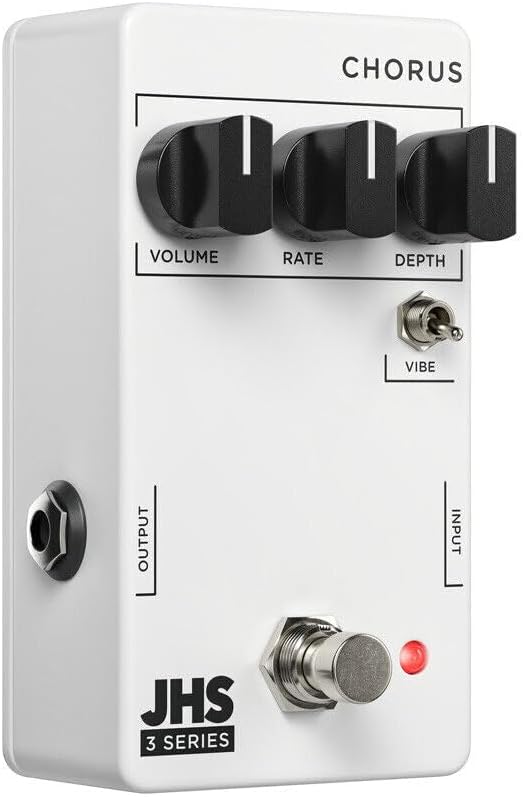
JHS 3 Series Chorus
4.6Editor score
Classic chorus and vibrato modes
Simple rate and depth controls
True pitch vibrato option
Compact 70mA power draw
Our expert guide compares 10 chorus vibrato pedals for guitars, covering modulation styles, controls, connectivity, build quality, and standout options for
Chorus and vibrato pedals shape a guitar’s sound by moving pitch, time, or both in ways that create width, movement, and texture. The best unit depends on whether you want a classic vintage tone, a precise modern shimmer, subtle clean-guitar movement, or dramatic modulation that changes dramatically over time.
This guide compares ten chorus vibrato pedals for guitars using their supplied specifications, ratings, control layouts, effect types, construction details, and connectivity. The list covers dedicated analog chorus designs, flexible chorus-and-vibrato models, bucket-brigade effects, and a compact multi-modulation option for players who value versatility.
Each review identifies the pedal’s most useful characteristics and honest trade-offs, helping narrow the field according to tone, control, power requirements, or pedalboard space. Product ratings and availability can change, and prices also fluctuate, so confirm the current listing and specifications before making a purchase.
4.6Editor score

4.5Editor score

4.7Editor score
The comparison below places the ten pedals side by side, highlighting their core technology, tonal focus, control approach, routing, and practical hardware considerations. These distinctions make it easier to identify the right model for a pedalboard, practice space, or live rig.




The Walrus Audio Julianna Deluxe combines chorus and vibrato with a notably deep modulation feature set, earning a 4.5 rating among the products in this guide. Its standout strengths are tempo control, flexible routing, speed ramping, drift behavior, and a random LFO option that goes beyond the basic rate-and-depth format.
We may earn a commission when you buy through this link, at no additional cost to you.
Tap tempo gives performers a practical way to establish the modulation speed without repeatedly reaching for a control. The Rate knob provides conventional manual adjustment, while the momentary secondary LFO control can ramp toward another speed. That makes the pedal useful for arrangements that move between steady pulsing and slower, evolving motion.
The stereo input and output arrangement is another important strength. Players can use mono in and mono out, mono in and stereo out, or stereo in and stereo out, according to their amplifier or recording setup. This flexibility distinguishes the Julianna Deluxe from pedals designed around a simpler mono signal path.
The main trade-off is complexity. A player who wants only a straightforward vintage shimmer may find more controls than necessary. The drift function, random wave shape, secondary speed behavior, and multiple routing choices require experimentation. Even so, the range makes this an attractive recommendation for players who actively shape modulation during a performance and want one pedal to cover several evolving chorus and vibrato roles.
Tap tempo, manual rate adjustment, and a momentary secondary speed control provide several ways to organize the pedal’s LFO behavior. The result is a modulation instrument that can remain static during clean passages or move dynamically when a performance needs more intensity.
The three supported input and output combinations make the Julianna Deluxe suitable for both basic pedalboard chains and stereo-capable systems. Players can preserve a familiar mono setup while retaining the option to explore a wider signal path.
We may earn a commission when you buy through this link, at no additional cost to you.
The JHS 3 Series Chorus delivers the essential chorus and vibrato sounds with a direct control layout and a 4.6 rating. It is made in Kansas City, USA, and its Rate and Depth knobs can move from subtle doubling to pronounced modulation without requiring a deep menu of secondary controls.
We may earn a commission when you buy through this link, at no additional cost to you.
The especially useful feature is the Vibe toggle, which removes the dry signal. That changes the character of the effect by eliminating the underlying unmodulated source and leaving a simpler true pitch vibrato. Players can therefore use the same pedal for lush chorus when the dry signal is present and more pronounced vibrato when it is removed.
The straightforward layout is both a strength and a limitation. It is easy to understand, dial in, and use live, but it does not provide the tap tempo, randomized waveform, stereo routing, or momentary speed ramp found in the Julianna Deluxe. It is better viewed as a focused core-sound pedal rather than a comprehensive modulation platform.
For guitarists who want dependable classic modulation without spending more for advanced sequencing or stereo features, the JHS 3 Series is a strong recommendation. It also uses 9V DC negative-center power and consumes 70mA, giving it a straightforward power profile. The 4.6 rating and versatile tone range make it an especially appealing budget choice.
Removing the dry signal through the Vibe toggle gives the pedal a more focused vibrato character. That single control can expand its usefulness across clean arpeggios, sustained leads, and atmospheric passages without requiring another modulation pedal.
Rate and Depth are the two principal sound-shaping parameters, making the JHS 3 Series easy to operate in rehearsal or onstage. Its limited power consumption is also convenient for players who compare several effects at once.
We may earn a commission when you buy through this link, at no additional cost to you.
The Universal Audio Brigade is built around an emulation of the iconic 1976 Boss CE-1 Chorus Ensemble, pairing that reference with a 4.7 rating. Its central appeal is the attempt to capture the recognizable bucket-brigade character of the vintage circuit while providing modern pedal features and flexible bypass operation.
We may earn a commission when you buy through this link, at no additional cost to you.
The pedal includes an emulation of a vintage analog preamp, adding a fat tonal component around the chorus and vibrato effects. The result is not limited to presenting a single isolated modulation texture; it is designed to reproduce the broader sonic identity associated with the referenced classic pedal.
True or buffered bypass gives players another practical consideration. Those who prefer an uninterrupted signal can use the true setting, while the buffered option may suit longer cable runs, effects chains, or players who want the pedal’s own circuitry to remain in the path. This choice makes the Brigade more adaptable than a fixed-bypass design.
The primary trade-off is its premium positioning, which makes it a less natural option for a minimal starter setup. In return, the buyer receives a feature-rich modeling approach, vintage preamp character, and flexible bypass selection. For musicians centered on classic chorus textures, the Brigade is the most ambitious choice in this roundup and a strong recommendation for a primary modulation pedal.
The included vintage preamp modeling expands the focus beyond chorus and vibrato alone. It is intended to reproduce the broader character of the referenced CE-1-style instrument, giving the pedal a strong identity within a signal chain.
True and buffered modes let the player decide how the pedal interacts with the rest of the rig. That flexibility is valuable in complex pedalboard systems where cable length, noise considerations, and preferred signal behavior can vary.
We may earn a commission when you buy through this link, at no additional cost to you.
The MXR Uni-Vibe is built around an iconic chorus and vibrato sound described as true to the classic late-sixties tone. Its 4.4 rating reflects a solid overall reception, while the three-knob interface makes it one of the most approachable options for players who value a recognizable vintage character over extensive modulation controls.
We may earn a commission when you buy through this link, at no additional cost to you.
The pedal’s simplicity is central to its appeal. Rather than presenting numerous waveform, routing, or speed options, it concentrates on the essential controls needed to shape the effect. This can be advantageous for live performers who want reliable access to the sound without navigating complex settings.
True bypass is another practical feature, allowing the pedal to behave as a conventional effect when disengaged. That makes it easier to incorporate the Uni-Vibe into a pedalboard alongside compressors, drives, and delay pedals, especially for players who care about preserving their base signal.
The trade-off is limited control depth. It does not offer tap tempo, stereo routing, random waveforms, or the kind of expressive modulation behavior found in the Julianna Deluxe. For a guitarist seeking a focused, classic chorus pedal with a traditional footprint and uncomplicated operation, however, the MXR Uni-Vibe remains a highly relevant recommendation.
A restrained control set keeps the focus on the pedal’s core late-sixties character. It is a practical choice for players who would rather set a sound and move on than spend time exploring secondary modulation behaviors.
True bypass lets the Uni-Vibe sit cleanly within a conventional chain without requiring special routing considerations. Its simple design makes it a practical foundation for a pedalboard built around familiar effects.
We may earn a commission when you buy through this link, at no additional cost to you.
The FLAMMA FC05 stands apart from the dedicated chorus pedals in this guide by offering 11 modulation effects in one compact package. Its 4.2 rating reflects the value of combining chorus, flanger, tremolo, phaser, vibrato, rotary, liquid, auto wah, stutter, ring, and low bit modes in a single pedal.
We may earn a commission when you buy through this link, at no additional cost to you.
The full metal shell and tiny proportions make it appealing for players with limited pedalboard space. The bright color also gives the unit a distinctive appearance, while the broad effect selection encourages experimentation across different modulation styles rather than committing the board to a single sound.
There is an important practical caveat: the pedal requires a 9V 150mA power supply, and the listed power supply is not included. Players should account for that requirement and any shared power needs before deciding that the FC05 is the right solution. A dedicated chorus pedal may ultimately be more convenient when chorus and vibrato are the only desired effects.
The FC05 is best recommended for experimental players, beginners exploring modulation, or anyone who wants a portable multi-effect option. It delivers the most comprehensive effect selection in the roundup, but its value depends on using more than just chorus and vibrato. For a focused classic tone, a dedicated model will generally offer a more specialized design.
The eleven listed modes span familiar classics and more unusual textures. That variety makes the FC05 useful for testing ideas quickly or carrying a broad modulation palette in a compact setup.
The full metal shell is designed for durability, while the small enclosure reduces pedalboard footprint. These practical traits are especially helpful for players who travel with compact rigs or maintain limited stage space.
We may earn a commission when you buy through this link, at no additional cost to you.
The Electro-Harmonix Eddy uses a bucket-brigade-based chorus and vibrato design with an all-analog signal path. Its 3.9 rating is the lowest among the ten products here, but the pedal offers notable creative controls, including envelope operation, expression pedal control, LFO shape warping, and a dedicated tone knob.
We may earn a commission when you buy through this link, at no additional cost to you.
The envelope and expression functions are the Eddy’s most distinctive features. Rather than limiting the user to a fixed repeating rate, they add ways to respond to or manually influence the modulation. This makes the pedal particularly interesting for players who want movement that can change with performance dynamics.
LFO shape warping extends the range beyond standard waveforms, potentially moving the effect toward asymmetric behavior. The tone control adds another layer of refinement, allowing the player to adjust how the effect affects the overall tonality of the instrument. It is a pedalboard-friendly footprint, but it does not minimize the number of creative decisions available.
The lower rating means the Eddy is not as universally favored as the higher-rated alternatives, and buyers should consider both the rating and their own comfort with advanced controls. Even so, it is a compelling recommendation for experimental guitarists seeking analog bucket-brigade texture and interactive modulation rather than a conventional one-knob vintage chorus.
Envelope control and expression pedal support can make modulation more responsive. The Eddy is therefore suited to players who want the effect to feel connected to touch and performance rather than operating only as a fixed rhythmic layer.
The all-analog bucket-brigade path is combined with LFO warping and a tone control. Those features give the pedal a broad creative range, although the dense control set calls for a more deliberate setup process.
We may earn a commission when you buy through this link, at no additional cost to you.
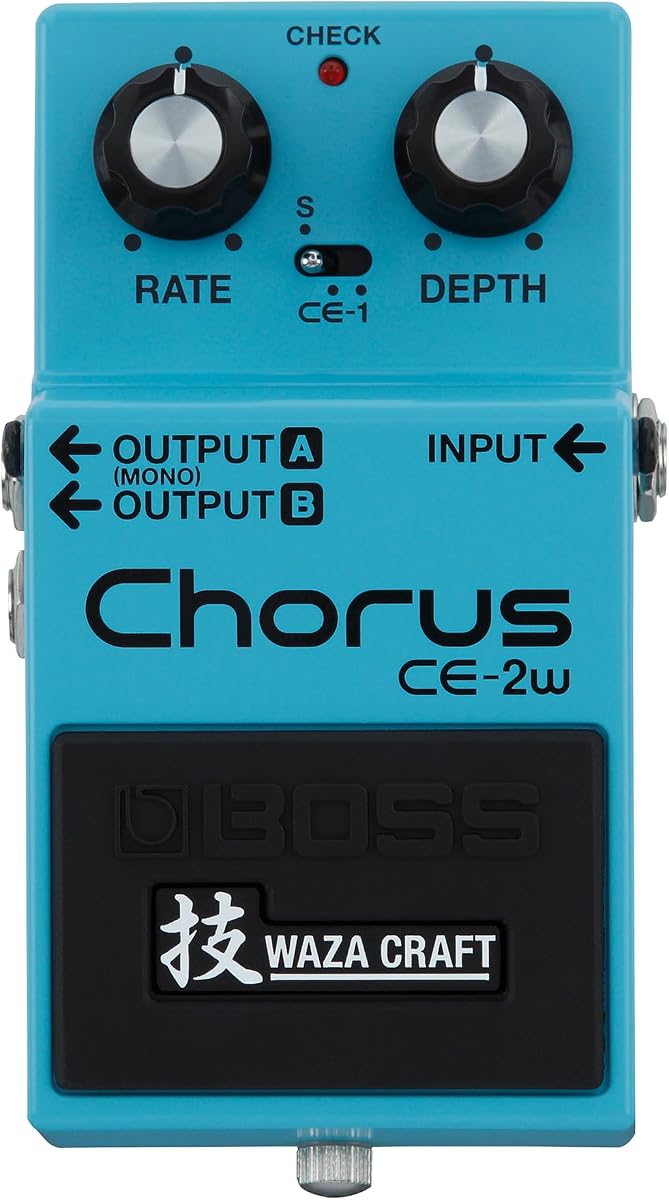
The BOSS CE-2W combines premium all-analog circuitry with a bucket-brigade delay line, earning a 4.6 rating. It offers the familiar identity of a classic chorus pedal while presenting the implementation as a Waza Craft product built for players who value a premium analog approach.
We may earn a commission when you buy through this link, at no additional cost to you.
Rate and Depth knobs provide fine adjustment in both of the pedal’s operating modes. That focused control scheme is a major reason to consider it: rather than adding unrelated effects or complicated routing, the CE-2W concentrates on refining the central chorus and vibrato behavior with precision.
The analog BBD circuit is the defining technical element. Bucket-brigade designs became closely associated with classic chorus textures, and the CE-2W preserves that approach while using premium circuitry. It is therefore a natural fit for guitarists who associate chorus with a recognizable analog character rather than a digital imitation.
The trade-off is the premium format. A player who needs a broad range of modulation effects or advanced expression features may find other options more flexible. For a dedicated, high-quality chorus pedal with straightforward adjustments, however, the CE-2W is an excellent recommendation, especially for those who prioritize the BOSS analog sound and the Waza Craft platform.
The premium all-analog implementation and BBD delay line focus the pedal on a traditional chorus identity. This concentration makes it appealing to players who want one well-defined modulation sound rather than a menu of unrelated effects.
Separate Rate and Depth controls provide the fundamental tools for balancing speed and intensity. Because the same core controls work across both modes, changing character does not require navigating a complicated control architecture.
We may earn a commission when you buy through this link, at no additional cost to you.
The Donner Tutti Love is a straightforward analog chorus pedal with a 4.4 rating and a focus on classic warm sound. Its Level, Depth, and Rate controls provide everything needed for familiar chorus shaping, while the specification listing also notes suitability for both electric guitar and bass.
We may earn a commission when you buy through this link, at no additional cost to you.
The natural wave curve and warm jazz-chorus character are central to its positioning. Donner describes the pedal as suitable for jazz, rock, and pop, giving it a broad stylistic foundation. The extra Level control, in addition to the traditional Depth and Rate parameters, makes it slightly more flexible than a minimal three-effect control set.
Construction and switching are practical strengths. The aluminum-alloy housing is described as stable and strong, while true bypass provides a transparent path when the pedal is not in use. An LED indicator provides a visible confirmation of the working state, which is helpful in live and rehearsal settings.
One drawback is that the required 9V DC power supply is not included. The absence of more advanced timing or performance controls also means the Tutti Love is less expressive than the Julianna Deluxe. For players who want a warm, familiar chorus with uncomplicated settings, it remains a strong and economical recommendation, particularly for jazz, rock, pop, and bass applications.
Depth and Rate cover the expected modulation parameters, while Level provides an extra output-balance tool. The arrangement remains easy to understand but offers a little more tonal control than the most basic chorus designs.
A durable aluminum-alloy shell and true bypass support dependable pedalboard use. The LED indicator makes it easier to confirm the pedal’s state at a glance during a performance.
We may earn a commission when you buy through this link, at no additional cost to you.
The Walrus Audio Julia V2 is an analog chorus vibrato pedal designed to cover a wide array of tonal landscapes. Its 4.3 rating reflects a favorable but slightly less emphatic reception than the highest-rated models, yet the described range from mild smooth chorus to extreme seasick vibrato makes it appealing for varied playing styles.
We may earn a commission when you buy through this link, at no additional cost to you.
The Lag knob is the most notable control in the supplied specifications. It sets the center delay time from which the LFO effect modulates, giving the player direct influence over a central part of the pedal’s behavior. This can help define the underlying texture before the chorus or vibrato range is explored.
The Julia’s strength is its broad expressive span. A player can begin with a restrained chorus that adds movement without overwhelming the source, then move toward an intense vibrato sound for sustained or atmospheric passages. That makes it potentially useful as a single modulation pedal across clean and lead contexts.
The trade-off is that the V2 is less elaborate than the Julianna Deluxe, which adds tap tempo, stereo routing, drift, and random waveform options. Those advanced features are not required for players who care primarily about analog chorus and vibrato texture. For that audience, the Julia V2 is a versatile recommendation with a dedicated Lag control and a notably wide sonic range.
The Lag knob lets the player establish the center delay time that the LFO modulates around. This gives the effect a defined underlying character and adds a useful dimension beyond simply choosing speed and depth.
The described tonal range covers everything from mild, smooth chorus to pronounced seasick vibrato. A single pedal can therefore provide subtle movement, traditional width, or much more dramatic modulation depending on the player’s setting and performance.
We may earn a commission when you buy through this link, at no additional cost to you.
The BOSS CH-1 SUPER Chorus pairs a classic clean, brilliant chorus sound with a 4.7 rating, tying for the highest rating among the products in this roundup. Its control set and longstanding design make it especially relevant to guitarists who need modulation that remains clear and present within a mix.
We may earn a commission when you buy through this link, at no additional cost to you.
Effect Level, EQ, Rate, and Depth provide a complete set of primary adjustments. The EQ control adds tonal refinement beyond modulation speed and depth, while the high rating indicates broad appeal among users. The pedal is also described as capable of taking the signal into vibrato and flanger-adjacent territory.
Mono input and stereo outputs offer useful routing flexibility, including the ability to connect to dual amplifiers. That capability supports a wider presentation without requiring the player to abandon a familiar mono input arrangement. A five-year BOSS manufacturer warranty is also listed, adding ownership support beyond the hardware itself.
The AC adapter is not included, and a BOSS PSA unit is recommended for operation, so power should be considered during budgeting. The pedal also lacks the modern tap tempo, drift, and randomized modulation features found elsewhere. For players seeking clean chorus, lead clarity, stereo outputs, and a proven compact design, the CH-1 remains an excellent recommendation.
The CH-1 is designed around clarity and edge, making it well suited to lead passages where a buried modulation sound would be less useful. Effect Level and EQ help the player balance the effect while preserving definition.
Mono input paired with stereo outputs supports connection to dual amplifier setups. This provides a practical path to a wider sound while keeping the initial instrument connection straightforward.
We may earn a commission when you buy through this link, at no additional cost to you.
The right chorus vibrato pedal depends on the sound you want, the controls you will actually use, and the realities of your signal chain. The following factors cover tone, circuitry, control style, power, routing, and construction.
Chorus and vibrato occupy related but distinct corners of modulation. The MXR Uni-Vibe emphasizes a classic late-sixties character, while the JHS 3 Series, Walrus Audio Julia V2, and Walrus Audio Julianna Deluxe explicitly balance chorus and vibrato. Players seeking a recognized vintage bucket-brigade reference may prefer the BOSS CE-2W or Universal Audio Brigade, while the Electro-Harmonix Eddy offers analog BBD character with more interactive control.
Start with the sound you want, not the number of features on the panel. A dedicated pedal may fit a classic tone better than a multi-effect, while a broad control set may be worthwhile if you intend to perform tempo, speed, and waveform changes.
Several products in this guide use analog circuitry or analog bucket-brigade technology: the MXR Uni-Vibe, Electro-Harmonix Eddy, BOSS CE-2W, JHS 3 Series, Donner Tutti Love, and Walrus Audio Julia V2. The Universal Audio Brigade takes a modeling approach, emulating the bucket-brigade circuit and vintage preamp of the 1976 Boss CE-1.
Analog and modeled designs should be chosen according to tone preference and practical needs. The key is to compare the stated circuit character, available controls, and intended use rather than treating either category as automatically superior.
Simple Rate and Depth controls appear on the JHS 3 Series and Donner Tutti Love, while the MXR Uni-Vibe uses a three-knob layout. The Walrus Audio Julianna Deluxe adds tap tempo, a momentary secondary speed control, drift, and a random waveform. The Electro-Harmonix Eddy supports envelope and expression pedal control. These differences determine whether a pedal suits quick live changes or more deliberate sound design.
Use the controls you will enjoy operating. Extra options can inspire creativity, but a focused layout can be more reliable under stage pressure. Match the pedal’s workflow to your playing habits rather than assuming the largest feature count is the best choice.
Modulation speed and depth determine the character of the movement, but the overall effect level and tonal balance also matter. The Electro-Harmonix Eddy has a tone knob, the Donner Tutti Love includes an extra Level control, and the BOSS CH-1 provides Effect Level and EQ. The BOSS CE-2W offers Rate and Depth adjustment across both pedal modes.
Look for controls that help the effect sit well with your amplifier, pickup, and other pedals. A brighter or more intense modulation can need a different balance than a warm, subtle chorus, so level and tone access may matter as much as the modulation parameters.
Stereo support varies considerably. The Walrus Audio Julianna Deluxe can operate in mono-to-mono, mono-to-stereo, or stereo-to-stereo configurations. The BOSS CH-1 has mono input and stereo outputs for dual-amplifier use. The Universal Audio Brigade offers true or buffered bypass, and the FLAMMA FC05 prioritizes a compact single-footprint multi-effect format.
Map the pedal to the rest of the rig before buying. If you use two amplifiers, run stereo equipment, or record in stereo, dedicated routing can be essential. If the rig is mono, prioritize sound and control style over unused connectivity.
Several pedals need a power source that may not be included. The FLAMMA FC05 requires 9V 150mA and does not include the listed supply. The Donner Tutti Love runs on 9V DC with the power supply not included. The BOSS CH-1 does not include an AC adapter, with a BOSS PSA adaptor recommended for operation. The JHS 3 Series uses 9V DC negative-center power and consumes 70mA.
Confirm the connector polarity, voltage, and current requirements before building a pedalboard. A shared power supply can simplify cable management, but it must meet the requirements of every connected pedal and provide adequate isolated power.
The FLAMMA FC05 is specifically described as tiny and compact, the Electro-Harmonix Eddy has a pedalboard-friendly footprint, and the BOSS CH-1 is a classic compact pedal. Larger enclosures can accommodate more controls, but physical dimensions and the number of adjacent pedals can affect a crowded board.
Measure available space before purchasing and consider whether the features you need justify the footprint. A multi-effect can save room, while a dedicated pedal may be easier to operate and may better match a carefully planned signal chain.
The included ratings offer a useful snapshot of user reception. The BOSS CH-1 and Universal Audio Brigade each have a 4.7 rating, while the BOSS CE-2W and JHS 3 Series have 4.6 ratings. The Electro-Harmonix Eddy has the lowest listed rating at 3.9, despite offering distinctive envelope, expression, and LFO-shaping controls.
Use ratings as a guide rather than a complete verdict. A lower-rated pedal may still be ideal for a player seeking a specific creative feature, while a highly rated model may not match a particular signal chain or control preference.
Begin with the guitar, amplifier, and other pedals in a familiar state, then place the chorus vibrato pedal where it can be reached comfortably. Power it with a compatible supply, confirm the input and output cables are secure, and start with the depth, rate, level, or effect controls at conservative settings before building the sound.
Set the modulation rate to match the tempo and character of the material, then adjust depth to control how noticeable the movement becomes. On models with alternate modes, compare chorus and vibrato with the dry signal present or removed as applicable. The JHS 3 Series Vibe toggle, for example, removes the dry signal for a true pitch vibrato sound, while expressive pedals such as the Julianna Deluxe and Eddy can be explored through tempo, envelope, or expression functions.
For maintenance, keep the enclosure dry, avoid leaving it in direct heat or moisture, and clean the exterior with a soft, dry cloth. Inspect cable jacks and power connections periodically, avoid pulling cables by their plugs, and confirm power requirements before using a shared supply. When changing settings, lower the guitar or amplifier level if necessary and move gradually to prevent sudden changes in output.
Chorus typically blends a delayed and pitch-modulated copy of the signal with the dry sound to create width and movement. Vibrato generally modulates pitch more intensely and may remove or minimize the dry signal for a more pronounced pitch effect. Some pedals combine both modes, while others let the player switch the dry signal out to move between the two.
There is no universally better category. Analog and bucket-brigade pedals can provide a traditional character that many players associate with classic chorus, while modeling pedals can offer accurate references and flexible bypass or voicing features. The right choice depends on the desired sound, control requirements, signal chain, and personal preference.
Yes, especially with pedals that offer separate level, tone, depth, and rate controls. A subtle chorus setting can add movement beneath clean chords, while a stronger or faster vibrato can become a lead sound. The BOSS CH-1’s Effect Level and EQ controls are particularly relevant for balancing the effect across different playing contexts.
Not necessarily. If your amplifier, recording interface, or pedalboard is mono, a standard mono pedal can work perfectly well. Stereo capability becomes more important with dual amplifiers, stereo effects, or a desire to preserve a wide signal path, as offered by the BOSS CH-1 and Walrus Audio Julianna Deluxe.
Requirements vary by model, so the product listing and pedal label should always be checked. The FLAMMA FC05 requires 9V 150mA, the Donner Tutti Love uses 9V DC, the JHS 3 Series uses 9V DC negative center and consumes 70mA, and the BOSS CH-1 requires a power adapter with a BOSS PSA unit recommended. Some listed power supplies are not included.
The easiest pedals are generally those with a focused layout and conventional controls. The MXR Uni-Vibe uses three knobs, the Donner Tutti Love offers Level, Depth, and Rate, and the JHS 3 Series uses Rate and Depth plus a Vibe toggle. These options are easier to learn than a pedal with tap tempo, drift, random waveforms, envelope control, and expression control.
There is no single mandatory order, and the result depends on the desired interaction with the guitar and amplifier. Placing chorus before distortion allows the modulated signal to be processed by the drive, which can create more complex moving textures. Placing it afterward can produce a clearer, more obvious effect. Auditioning both arrangements is the best way to decide.
The FLAMMA FC05 is explicitly designed for a tiny, portable format and includes chorus and vibrato among 11 modulation effects. The Electro-Harmonix Eddy also has a pedalboard-friendly footprint, and the BOSS CH-1 is described as compact. The best choice depends on whether you prioritize a focused effect, advanced controls, or multi-effect variety.
The Walrus Audio Julianna Deluxe is the most feature-rich option for active performers, with tap tempo, flexible stereo routing, secondary speed ramping, drift, and random waveforms. The JHS 3 Series stands out as the best value-oriented dedicated pedal, while the Universal Audio Brigade offers the strongest premium case through its 1976 CE-1 emulation, vintage preamp modeling, and flexible bypass.
For players seeking a traditional three-knob experience, the MXR Uni-Vibe is a concise and convincing option. The BOSS CE-2W emphasizes premium bucket-brigade chorus, the Electro-Harmonix Eddy favors creative interaction, the Donner Tutti Love provides a warm and approachable format, and the Walrus Audio Julia V2 spans a broad analog texture range. The FLAMMA FC05 and BOSS CH-1 suit players who respectively value compact multi-effect variety and clean chorus with strong lead presence.
Before buying, compare the tonal character, control workflow, power requirements, signal routing, and available pedalboard space rather than choosing on rating alone. Product prices and availability change over time, so check the current listing, included accessories, specifications, and seller information before making a final purchase.
