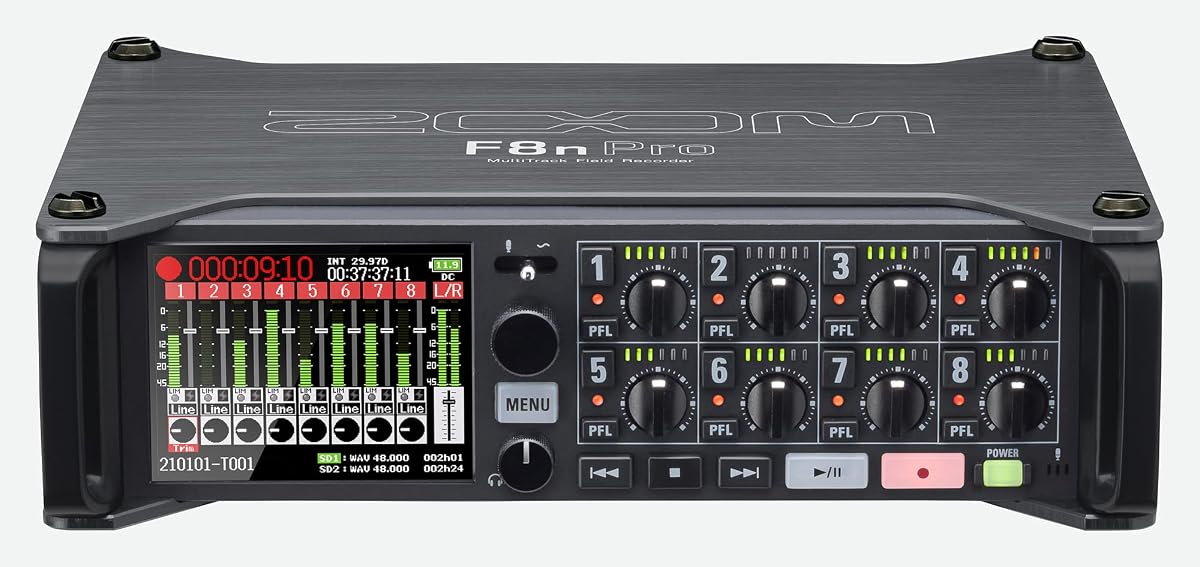
Zoom F8n Pro
4.6Editor score
Eight-channel ten-track recording
Dual redundant SD slots
0.2ppm timecode accuracy
Eight-in four-out USB mode
Compare the best audio field recorders for film, including key features, recording formats, microphone inputs, timecode, portability, monitoring, and ideal
Audio field recorders for film give filmmakers a dependable way to capture dialogue, ambience, effects, and production audio away from the camera. The right unit balances input flexibility, recording reliability, sound quality, timecode support, battery life, and the portability required for location work.
We compared these ten recorders by examining their channel counts, microphone and line inputs, recording formats, timecode capabilities, monitoring options, storage support, power options, and relevance to different filmmaking workflows. The list includes compact lav recorders, portable stereo units, and professional multi-input production recorders.
Each selection highlights a distinct practical use, from discreet interviews to full crew sound capture. Ratings and specifications reflect the supplied product information, while product availability and pricing can change, so readers should verify current listing details before making a purchase.
4.6Editor score

4.7Editor score

4.6Editor score
This side-by-side comparison covers the ten recommended recorders across input count, audio format, timecode, storage, and practical filmmaking applications.



The Zoom F6 is the strongest all-around choice in this guide, combining a 4.7 rating with the professional features expected from a dedicated film sound recorder. Its six XLR inputs, dual analog-to-digital converters, and support for up to 14 tracks give crews room to capture several isolated sources at once, while 32-bit float recording helps preserve detail across an unusually wide range of sound levels.
We may earn a commission when you buy through this link, at no additional cost to you.
Its most important filmmaking advantage is the combination of input capacity and synchronization. Locking XLR connections suit productions using boom, lavalier, plant, and line sources, while timecode input and output support frame-accurate synchronization with cameras and other recorders. The unit can also function as a USB audio interface with headphone monitoring and line input, giving location sound mixers a flexible path between isolated capture and a connected editing workflow.
This is still a professional tool rather than a simple point-and-shoot recorder. Its six inputs and production-oriented menu system can feel substantial to someone who only needs one microphone, and the package does not include a microphone or the accessories needed for every possible rig. Those limitations are reasonable because the F6 is intended to solve multi-source production recording rather than compete with a pocket stereo unit.
Choose the F6 when a documentary, narrative short, commercial, or crew-based shoot requires multiple microphones, timecode, and dependable isolated tracks. It is also suitable for a smaller crew that wants professional room for growth. For most filmmakers seeking one recorder to cover dialogue, effects, and production sound, the F6 offers the most convincing balance of capability, portability, and recording flexibility.
Dual analog-to-digital converters and 32-bit float recording help the F6 accommodate quiet dialogue and sudden loud peaks without forcing the operator to chase gain changes. That makes it well suited to unpredictable locations and mixed production audio.
Six XLR inputs and up to 14 tracks support a much more advanced field workflow than the recorders designed around one or two channels. Timecode I/O adds the synchronization control needed when a camera recorder is only part of the sound chain.
We may earn a commission when you buy through this link, at no additional cost to you.
The Zoom F3 is an appealing option for filmmakers who want professional reliability without carrying a larger multichannel production recorder. Its 4.6 rating reflects a well-regarded feature set centered on two locking XLR inputs, 32-bit float recording, and ultra-low-noise preamps. The result is a focused tool for recording two important sources with minimal level management.
We may earn a commission when you buy through this link, at no additional cost to you.
The automatic float workflow is particularly valuable on a set or location where an unexpectedly quiet line or sudden loud sound could ruin a conventional take. Because the recorder can capture a broad dynamic range without requiring constant gain adjustments, its operator can concentrate on performance and placement. Locking XLR sockets also reduce the need to check connections on a rig that may be mounted out of reach.
The principal compromise is scale. Two inputs cannot isolate a full production team, and the supplied information does not list timecode support. Teams recording camera audio, boom, and several wireless tracks simultaneously will need a more specialized unit such as the F6 or F8n Pro. The F3 is better suited to two essential channels captured with quality and portability in mind.
This is a strong recommendation for independent filmmakers, documentary producers, and location recordists who primarily need a pair of microphones. It can also work as a compact USB workflow when connected to a computer. Pick the F3 when you value excellent capture, secure connections, and simple operation over maximum channel count.
Thirty-two-bit float recording helps preserve quiet and loud material without clipping during unexpected level swings. This reduces interruptions and makes the F3 especially useful for dialogue and location work where conditions can change quickly.
The F3's locking connectors, low-noise preamps, flexible power options, and support for standalone or USB operation make it a practical centerpiece for a small field kit. It captures the essentials without the menu depth of a full production recorder.
We may earn a commission when you buy through this link, at no additional cost to you.
The Zoom F8n Pro represents the premium end of this selection, using an eight-channel, ten-track architecture for productions that need more simultaneous sources than a standard field recorder. Its 4.6 rating and feature list emphasize professional film workflows, particularly 32-bit float capture, high-quality preamps, accurate timecode, redundant recording, and flexible camera-feed outputs.
We may earn a commission when you buy through this link, at no additional cost to you.
The recorder's gain range and low equivalent input noise are designed to serve both quiet dialogue and action sequences. Timecode accuracy down to 0.2ppm provides a strong synchronization foundation, while dual SD card slots support redundant recording for valuable takes. Three outputs add routing flexibility for camera feeds, headphones, and external devices, and the unit can operate as an eight-input, four-output USB interface while continuing to record to card.
Premium complexity brings premium responsibility. The F8n Pro offers more controls and routing than a compact recorder, and it will be larger in a bag. It may also be more than a solo creator needs if all sound can be captured on one or two channels. Nevertheless, those limitations reflect a device designed to coordinate complex, multi-source productions rather than merely record a conversation.
Choose the F8n Pro for larger crews, demanding documentaries, narrative work with extensive production sound, and productions where redundant media and precise sync are high priorities. It is also attractive to filmmakers who want one advanced recorder to serve as a standalone unit and a multichannel audio interface. For those needs, it is the most capable premium choice in the group.
Dual SD slots allow redundant recording, reducing the risk associated with a full or failed card. Multiple outputs further help connect the recorder to cameras, monitoring systems, and other parts of a location sound chain.
A temperature-compensated oscillator with 0.2ppm timecode accuracy provides dependable synchronization for camera audio and multi-recorder workflows. That level of timing control is a major reason to move beyond a basic portable unit.
We may earn a commission when you buy through this link, at no additional cost to you.
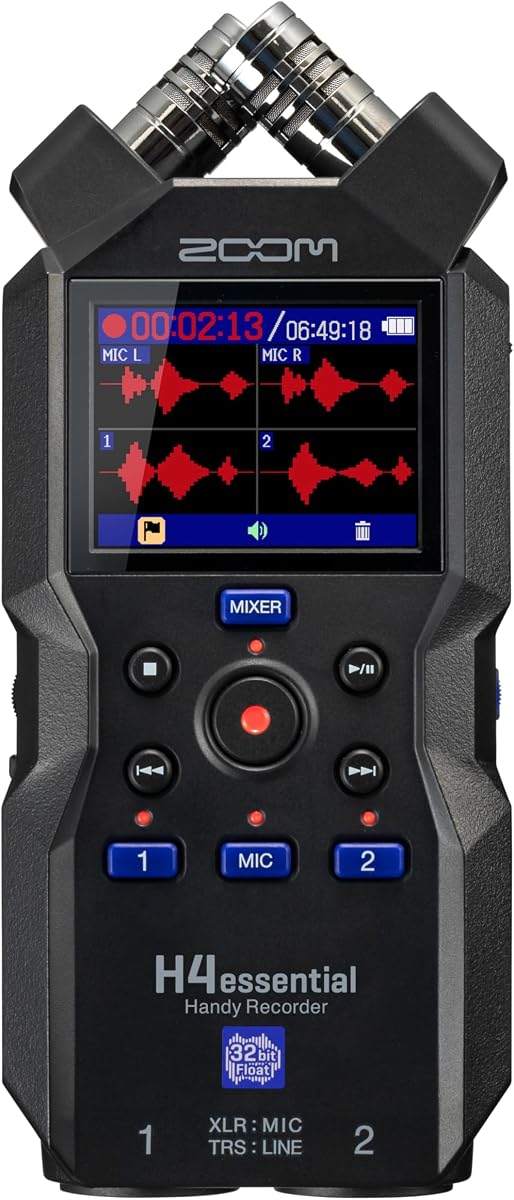
The Zoom H4 Essential is a versatile four-track recorder aimed at creators who may move between film audio, interviews, music, podcasts, and live performance. It carries a 4.4 rating and offers two XLR/TRS inputs alongside built-in stereo microphones, making it a flexible choice for productions that do not require the channel count of a professional sound cart.
We may earn a commission when you buy through this link, at no additional cost to you.
Its four-track capability allows a filmmaker to capture a stereo microphone pair and two additional XLR sources at the same time. That is useful for a two-person interview, a small narrative setup, or adding room ambience while recording isolated dialogue. USB-C connectivity permits recording or streaming to a phone, tablet, or computer, while direct SD card backup helps preserve a local copy during connected work.
Compared with the F6 or F8n Pro, the H4 Essential offers less advanced synchronization and fewer physical inputs. It also relies on a more compact recorder architecture, so complex crew rigs may demand additional boxes or cabling. These are meaningful constraints for a professional location mixer, but they are acceptable for creators seeking a single recorder for several types of content.
The H4 Essential is most appropriate for independent filmmakers, documentary interviews, educational video, web content, and small location shoots. It also makes sense for musicians who want occasional film-sound utility from the same device. Buyers who need more than two external inputs should compare it carefully with the F6, while those wanting an even simpler unit may prefer the H1 XLR or DR-05XP.
The H4 Essential can pair its stereo microphones with two XLR/TRS sources, allowing a small crew to record dialogue, practical sound, and ambience simultaneously. That balance makes it more versatile than a single-channel recorder without reaching full professional input complexity.
USB-C recording and streaming provide access to computer and mobile workflows, while SD card backup preserves a separate local recording. Spoken menu guidance adds accessibility for users who benefit from guided navigation.
We may earn a commission when you buy through this link, at no additional cost to you.
The Zoom H1 XLR is a compact two-channel recorder designed for filmmakers who want a clear visual reference for levels and a straightforward way to connect professional microphones. Its 4.5 rating reflects a practical feature set that includes two XLR/TRS combo inputs, 32-bit float recording at 96kHz, an OLED waveform display, and support for SDXC cards up to 1TB.
We may earn a commission when you buy through this link, at no additional cost to you.
The waveform display is especially useful because it lets a recordist see signal activity and potential overload at a glance rather than relying entirely on audible monitoring. The two combo inputs support microphones, instruments, and other suitable sources, while a 3.5mm input and headphone output broaden the range of monitoring and connection options available in a compact setup.
Its two-channel limit makes it less appropriate as the central recorder for a multi-microphone crew. It also lacks built-in stereo microphones, so users must supply the intended capture source. For a documentary maker recording one boom, one lav, a stereo ambience pair, or a matched interview pair, however, those limitations are predictable and easy to plan around.
The H1 XLR is a good match for location recordists, student filmmakers, and small production teams who prioritize compactness, visible level information, and professional input connectors. It can also serve as a dedicated ambience, interview, or effects recorder alongside a larger production setup. Its strongest case is a focused two-channel assignment where a large menu and multiple routing paths would add little value.
The OLED waveform display gives operators immediate visual feedback, helping them identify low signals and sudden peaks. That visibility can support faster decisions while monitoring a live source in a changing environment.
Two XLR/TRS combo inputs support common production microphones and instruments without demanding a large field rig. The 3.5mm input and headphone output add extra connection options for monitoring and external gear.
We may earn a commission when you buy through this link, at no additional cost to you.
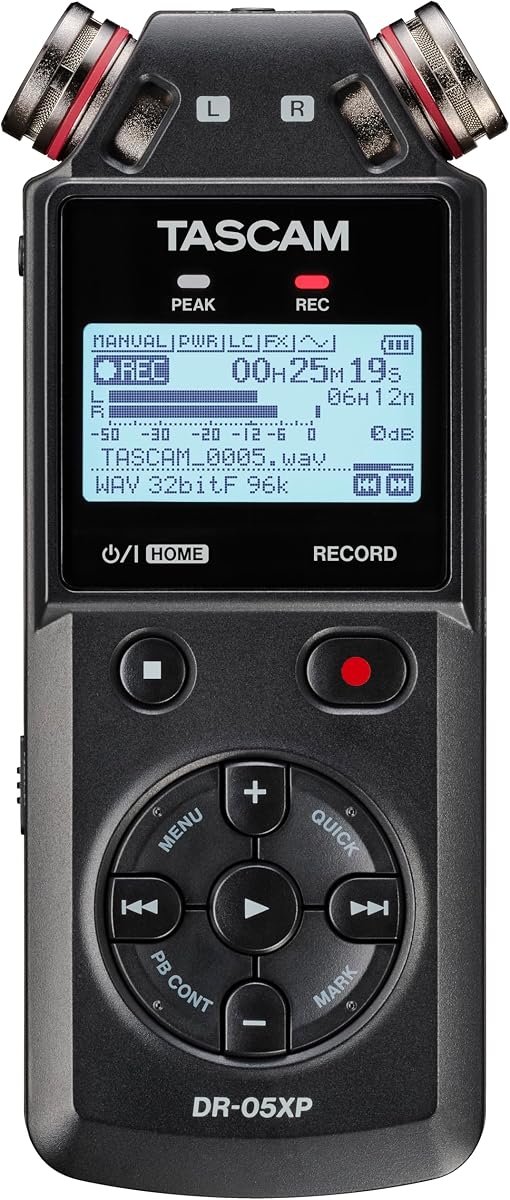
The TASCAM DR-05XP is a portable stereo recorder built around its own omnidirectional condenser microphones. Its 4.2 rating reflects a straightforward, accessible option for ambience, interviews, music, meetings, and audio for video when a filmmaker does not need isolated external microphone channels.
We may earn a commission when you buy through this link, at no additional cost to you.
It supports 32-bit float, 24-bit, and 16-bit recording, along with 96kHz, 48kHz, 44.1kHz, and MP3 modes. Those choices give users flexibility between maximum resolution, workflow compatibility, and file efficiency. The built-in microphones are rated to handle sources up to 125dB SPL, while a claimed operating time of up to 17.5 hours on two AA alkaline batteries makes the recorder practical for extended standalone sessions.
The lack of external microphone inputs is the main limitation for film production. A recordist cannot connect a boom, shotgun, or separate lavalier directly to it, so the DR-05XP is best treated as a dedicated stereo ambience, room-tone, reference, or self-contained recording tool. SD cards and batteries are not included, adding two items to the purchase checklist.
Choose the DR-05XP for location scouting, atmosphere recording, backup reference tracks, podcasting, and compact productions. It can also serve as a two-in, two-out USB-C audio interface for computer recording. It is most valuable in a kit alongside a more flexible recorder rather than as a replacement for one with production inputs.
The integrated omnidirectional condenser microphones make the DR-05XP ready for standalone ambience, room-tone, and reference recording. It captures a broad range of sound without requiring separate microphones for those tasks.
Multiple bit depths, sample rates, and MP3 support let the recordist adapt to storage limits and post-production needs. The included 32-bit float mode offers additional recovery flexibility when levels change unexpectedly.
We may earn a commission when you buy through this link, at no additional cost to you.
The Zoom H5 combines a 4.7 rating with a distinctive modular design that allows its input capsule to be changed much like a camera lens. It includes a shock-mounted detachable X/Y capsule, records four tracks simultaneously, and provides two mic or line inputs with XLR/TRS combo connectors, making it a flexible recorder for film, music, and field production.
We may earn a commission when you buy through this link, at no additional cost to you.
Its interchangeable capsule system is a major advantage for changing assignments. A filmmaker can use the included stereo pair for ambience or interviews and connect professional microphones through the combo inputs for more directed sound capture. Each input offers selectable phantom power and a -20dB pad, helping it handle different production sources more effectively.
The H5 records to SD or SDHC cards up to 32GB, which is a clear limitation for long, high-resolution sessions compared with newer recorders supporting larger capacities. Its feature set also predates some current models, particularly in the area of 32-bit float recording. Nevertheless, compatibility with all Zoom input capsules and multichannel or stereo USB operation with loopback functionality preserve considerable usefulness.
The H5 is well suited to filmmakers who value microphone flexibility, four-track capture, and a simple handheld interface. It can serve as a small interview rig, a production sound recorder for a limited number of sources, or a music recorder. Buyers should factor in the storage cap and decide whether an older architecture suits their present and future projects better than a newer alternative.
Interchangeable input capsules let the H5 adapt to different recording styles without replacing the entire recorder. The included detachable X/Y capsule provides a protected stereo configuration for location and environmental sound.
Simultaneous four-track recording and two combo inputs create a useful middle ground between compact stereo devices and larger production recorders. Phantom power, a -20dB pad, and USB loopback support add practical control for connected sessions.
We may earn a commission when you buy through this link, at no additional cost to you.
The TASCAM DR-10L Pro is purpose-built for discreet personal audio, pairing a compact field recorder with an included TM-10L lavalier microphone. Its 4.4 rating and feature set make it particularly relevant to filmmakers who need reliable, timecode-aligned voice recording from one or more talent or crew members.
We may earn a commission when you buy through this link, at no additional cost to you.
Its 32-bit float recording helps accommodate a broad range of vocal levels, while support for high-capacity microSDXC media reduces storage interruptions on extended shoots. Firmware Version 2.0 adds LTC Jam Sync for timecode synchronization, enabling audio from multiple devices to be brought together more efficiently in post-production.
The recorder has a specialized role rather than serving as a general-purpose mixer. It is intended around a lavalier microphone, not a broad array of XLR inputs. The supplied information also notes compatibility with the Atomos Wireless Timecode AK-BT1 adapter, sold separately, and specifically states that it is not compatible with the AK-BT2 adapter. Buyers should verify their timecode equipment before purchase.
The DR-10L Pro is a strong fit for interview films, behind-the-scenes production, confidential dialogue, and multi-camera projects in which several people need synchronized local recordings. The CONNECT App can control up to five simultaneous recordings, reducing the need to approach every participant individually. For those use cases, its specialized design is an advantage rather than a limitation.
LTC Jam Sync support helps align the recorder with other timecode-equipped devices, making it useful in multi-camera and multi-recorder productions. The included matched lavalier simplifies the capture chain for interviews and production sound.
The CONNECT App provides master control for up to five simultaneous recordings. This is particularly helpful when talent is wearing a recorder and cannot conveniently operate its controls during a take.
We may earn a commission when you buy through this link, at no additional cost to you.
The Zoom H1 Essential is an approachable compact recorder for creators who want better dedicated sound for video, voiceovers, interviews, tutorials, rehearsals, and real-world sound. Its 4.0 rating reflects a useful entry point, and the built-in stereo microphones make it possible to begin recording without assembling a microphone and XLR cable setup.
We may earn a commission when you buy through this link, at no additional cost to you.
USB-C connectivity allows the H1 Essential to function as a microphone for livestreams, remote meetings, video calls, podcasts, and desktop or mobile recording. Its stereo capture can also document ambience, nature, room tone, sound effects, travel audio, and ordinary environments that add texture to a finished film.
Unlike the F3, H1 XLR, or other XLR-equipped options, it has no external microphone inputs. That means it cannot isolate a boom, wired lavalier, or instrument in the same way, and it is not the primary choice for a traditional production sound cart. It also cannot offer the multi-source routing and synchronization features of professional recorders.
The H1 Essential suits a creator who prioritizes simplicity, compactness, and an integrated stereo microphone. It works well as a video creator's dedicated voice and effects recorder, a podcast companion, or a travel ambience unit. A filmmaker building a professional sound kit should consider it alongside, rather than instead of, a recorder with external inputs.
USB-C connection turns the H1 Essential into a straightforward microphone for calls, livestreams, podcasts, and voiceover recording. It can improve the source compared with relying on a computer or phone microphone when positioned properly.
Built-in microphones make the recorder convenient for ambience, music, meetings, and behind-the-scenes content. A filmmaker can capture environmental sound immediately without first selecting and connecting separate microphones.
We may earn a commission when you buy through this link, at no additional cost to you.
The Zoom F2 is one of the smallest recorders in the guide, designed for discreet lavalier capture during interviews, vlogs, weddings, and other on-camera work. It has a 4.0 rating and includes the LMF-2 omnidirectional lavalier microphone, windscreen, and lapel clip, giving users a ready recording chain in a highly portable form.
We may earn a commission when you buy through this link, at no additional cost to you.
Thirty-two-bit float recording at 44.1kHz or 48kHz helps the F2 capture sound without manual gain adjustment. The REC Hold switch guards against accidental stops, while the internal clock has a stated accuracy of plus or minus 0.5ppm for audio and video synchronization. These details show that the recorder is designed to function as a practical production tool rather than a toy.
The F2 records a single channel, so it cannot isolate several sources at once. The included omnidirectional microphone will also pick up more ambient sound than a more directional lavalier, which may require careful placement and gain planning. For those willing to work with one person at a time, however, this focused design is a major advantage in size and simplicity.
The Zoom F2 is ideal for solo content creators, wedding videographers, journalists, and filmmakers who need a dependable backup track for a subject. Its claimed 15-hour operating time on two AAA batteries and support for microSD, microSDHC, and microSDXC media up to 512GB suit extended shoots. It is particularly useful when a camera track needs an independent, discreet companion.
The included lavalier, windscreen, lapel clip, and screw-lock connection make the F2 straightforward to place and less likely to be disconnected. Its small footprint suits talent who need reliable audio without carrying a larger field recorder.
Up to 15 hours of stated operation and support for 512GB cards accommodate extended recording sessions. The REC Hold switch adds an important safeguard during critical takes, while the precision internal clock assists synchronization.
We may earn a commission when you buy through this link, at no additional cost to you.
The right film field recorder depends on the number of isolated sources, synchronization method, recording environment, and degree of portability your production requires.
Begin by counting the audio sources that must be recorded independently at the same time. A recorder with one lavalier may suit a solo creator, while two XLR/TRS inputs can handle a dialogue and ambience pairing. The Zoom F6 offers six XLR inputs and up to 14 tracks, and the F8n Pro supports eight channels and ten tracks for larger crews. Check connector type as carefully as channel count: combo XLR/TRS sockets provide useful flexibility, but an integrated stereo microphone cannot provide the same isolation as a wired boom or shotgun.
Modern field recorders may capture conventional fixed-bit files or 32-bit float files that preserve extra headroom and recover clipped peaks during editing. Float recording is especially useful in unpredictable film locations, where a sudden shout, impact, or noisy aircraft can exceed a carefully chosen level. Compare supported sample rates, bit depths, and file formats with the demands of your editing system. Consider workflow too: a recorder offering high-resolution and compressed formats gives you flexibility for final production audio, scratch tracks, voice backup, and reference recordings.
Accurate synchronization prevents lip-sync errors and makes isolated dialogue, effects, and ambience easier to align during editing. Dedicated timecode input and output on the F6 supports multi-device workflows, while the F8n Pro offers especially precise 0.2ppm timing and redundant media. The DR-10L Pro supports LTC Jam Sync for compatible setups, and the F2 includes a stated plus or minus 0.5ppm internal clock. If your camera audio cannot be synchronized reliably, a compact recorder with a timecode input may offer more value than a stereo-only model.
Match the card format and maximum capacity to expected session length and file size. A 32GB ceiling can be restrictive for long, high-resolution recordings, while 512GB support on the F2 and 1TB support on the H1 XLR offer much more room. Redundancy matters for an irreplaceable performance: the F8n Pro can record to two SD card slots simultaneously, while the F6's high track count also makes dependable media important. Format cards in the recorder, confirm write speeds, carry a spare card, and do not treat advertised capacity as a guarantee that every file format will fit the entire card.
Accurate headphone monitoring helps a recordist evaluate noise, handling, placement, and source balance in real time. A visible waveform makes level management easier, which is one reason the H1 XLR stands out with its OLED display. Other useful controls include input attenuation, pads, selectable phantom power, and direct monitoring. The H5 includes a -20dB pad on its combo inputs, while professional units typically provide more extensive routing. If you are new to location sound, prioritize understandable meters and monitoring rather than advanced options that may remain unused.
A field recorder must survive transport, mobile use, and long production days. The F2, DR-10L Pro, H1 XLR, and other compact units are easiest to place with talent or carry as backups. The F6 and F8n Pro offer more inputs but are better suited to a sound cart or organized field bag. Compare battery requirements and stated operating times, and confirm whether batteries or cards are included. The DR-05XP uses two AA batteries and can operate for up to 17.5 hours, while the F2 can run for up to 15 hours on two AAA batteries.
USB operation can streamline direct-to-computer recording, streaming, and post-production transfer. The H4 Essential can save a backup to an SD card while connected by USB-C, and the F8n Pro can operate as an eight-input, four-output interface while recording to card. The DR-05XP provides two-in, two-out USB-C operation, while the H5 offers multichannel and stereo USB modes with loopback. Confirm the computer operating system, software expectations, channel configuration, and simultaneous-recording behavior before relying on a wired workflow for a critical shoot.
A recorder should protect the performance after the crew has done the work of setting microphones and completing the scene. Dual-card recording on the F8n Pro provides a direct response to that concern. By contrast, compact recorders are easier to place with individual talent, making independent backup recordings a practical form of redundancy. Whichever model you choose, use the record hold or lock function where available, begin recording before the action, check the first take for noise and clipping, and avoid relying on a single card for irreplaceable material. Reliability also depends on correct card formatting, available storage, and disciplined file management.
Begin by choosing the correct sample rate and file format for the project, then format a compatible storage card in the recorder. Connect microphones with power off, confirm the input assignment, enable phantom power only when the microphone requires it, and set monitoring levels that do not introduce excessive headroom into the headphone mix. Before filming, record several seconds of controlled noise, dialogue, and movement to confirm clean connections, sensible levels, and stable files.
On location, place the recorder where movement, clothing, wind, and electromagnetic interference will not compromise the source. Monitor continuously rather than only during dialogue, and use a visual meter or waveform when levels may be difficult to judge by ear. Start recording before the scene begins, avoid touching a microphone during a take, and use recording holds or locks where available. Keep spare batteries and storage cards organized so they can be swapped without interrupting a setup.
After the shoot, save files to more than one reliable location before reformatting any card. Label recordings with scene, take, subject, and timecode information, then preserve the original files in addition to working copies. Keep the recorder dry, protect its connectors and screen, remove batteries during long storage, and follow the manufacturer's guidance for firmware, media compatibility, and calibration. A complete field kit should also include spare cables, windscreens, a headphone cable, and a clear method for assigning each recording to a scene.
A separate recorder is still valuable on most professional film shoots. Camera audio can provide a convenient reference, but an external recorder usually offers better preamps, isolated tracks, higher-quality inputs, and more reliable monitoring. It also protects dialogue from camera noise, handling vibration, and unexpected level changes. For a solo creator, the extra track may be optional, but it becomes increasingly important as the number of performers, microphones, or locations grows.
A stereo recorder combines sound into two channels, which is useful for ambience, a matched microphone pair, or a self-contained recording. A multichannel production recorder keeps multiple sources separate, allowing a boom, lavalier, plant microphone, and other signals to be recorded independently. The latter offers greater editing flexibility and mix control. Compact stereo models suit simpler assignments, while multichannel units are more appropriate for multi-person interviews and crew production sound.
Thirty-two-bit float recording preserves a wide range of levels and can retain information even when a transient signal exceeds the nominal recording ceiling. That extra headroom makes it easier to capture a quiet line followed by a sudden loud sound without clipping the recording. It does not eliminate poor microphone placement, handling noise, or excessive room sound, but it can prevent a technically ruined take when levels change unexpectedly.
Timecode becomes important whenever dialogue or production sound is recorded on more than one device and must be synchronized later. It is especially valuable for multi-camera interviews, parallel boom and lavalier recording, and productions using separate recorders for effects or ambience. A single camera and one synchronized recorder may need less elaborate timing, but checking the camera's available sync options before the shoot can prevent avoidable editing problems.
Recording both is a common and practical approach. The camera track provides a reference and can serve as a backup, while the field recorder captures cleaner, isolated sources with professional preamps and monitoring. A small system may use the camera for scratch or guide audio and record final dialogue separately. The exact workflow depends on the crew size, camera audio quality, number of tracks available, and your post-production synchronization process.
The best microphone depends on the source and environment. A wired lavalier is discreet for dialogue, a shotgun can provide directional focus, and a stereo pair is valuable for ambience. Match the connector to the recorder and verify whether external phantom power is required. Placement and environmental control usually affect the result more heavily than the model of microphone, so test the complete signal chain before the production day.
Required storage depends on sample rate, bit depth, channel count, and shoot length. More channels and high-resolution files can consume space rapidly, so a high-capacity card is useful for extended locations and multi-day work. Use cards that meet the recorder's compatibility requirements, format them in the device, and keep at least one unused card available. For critical multi-camera work, dual-card recording on a compatible model adds protection against a single card failure.
Several options in this guide support USB operation. The F6, F8n Pro, DR-05XP, H4 Essential, H5, and H1 Essential can connect to a computer for recording or streaming, although their channel counts and routing differ. Confirm the exact USB behavior, operating system support, and whether the device can record to card while connected. A short pre-shoot test is essential if the computer workflow will carry production audio.
The Zoom F6 is the strongest overall recommendation because it combines six XLR inputs, up to 14 tracks, 32-bit float recording, and timecode in a portable professional design. The F8n Pro takes the premium path with more channels, redundant card recording, precise timing, and extensive routing, while the F3 offers a focused and economical two-channel solution for smaller crews.
For the remaining needs, match the recorder to the assignment. The H4 Essential and H5 are useful for flexible four-track work, the H1 XLR suits focused two-channel capture, and the DR-05XP or H1 Essential are convenient stereo tools. The DR-10L Pro and F2 are purpose-built around discreet personal recordings, making them useful for interviews, backup tracks, and talent who need a compact solution.
Before buying, verify current product details, storage compatibility, power requirements, and the synchronization method your camera workflow requires. Ratings and specifications can change over time, and availability may also shift. Most importantly, test the recorder, microphone, monitoring setup, and card workflow before the shoot so the final audio chain is dependable under real location conditions.