
AstroAI 2000-Count Digital Multimeter
4.5Editor score
Backlit 1999-count display
Continuity buzzer and data hold
Double-fuse protection
This Multimeter for Beginners guide compares ten digital multimeters across accuracy, ranges, safety features, displays, accessories, and ease of use.
A multimeter is one of the most useful tools for anyone learning basic electrical troubleshooting, but the differences between models can be confusing. Voltage, resistance, continuity, current, and numerous other functions may sound interchangeable until you actually need to select the right range or interpret a reading.
This guide compares ten digital multimeters using the specifications and features provided by their manufacturers. It considers measurement ranges, automatic or manual ranging, safety indicators, display readability, true RMS support, non-contact voltage detection, included accessories, and how approachable each model appears for a first-time buyer.
Each selection shows what stands out about that particular model and where its capabilities may matter most. Ratings reflect the supplied customer feedback, while current prices and availability can change, so readers should confirm those details and their own safety requirements before purchasing.
4.5Editor score

4.7Editor score

4.6Editor score
The comparison below places all ten multimeters side by side, focusing on the measurement capabilities, ranging method, display, safety aids, and practical features most relevant to beginners.


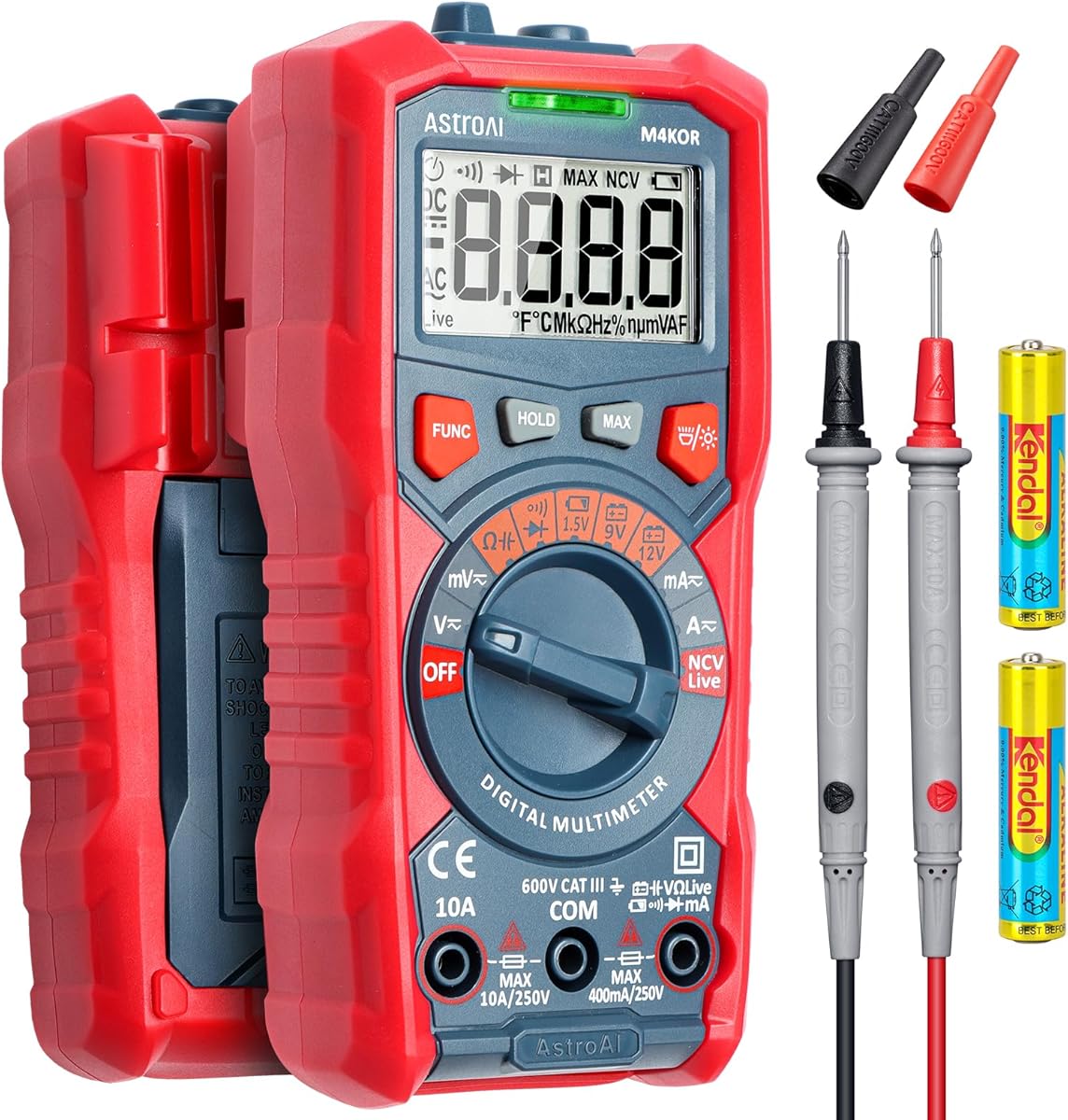


The AstroAI Digital Multimeter Tester 2000 Counts is a straightforward entry into electrical testing, with a 4.5 customer rating and a feature set aimed at household troubleshooting. Its backlit 3½-digit LCD, continuity buzzer, data hold, and clearly separated test-lead sockets make it approachable for someone learning how a multimeter works.
We may earn a commission when you buy through this link, at no additional cost to you.
The meter covers the fundamental functions most beginners need: AC and DC voltage, DC current, resistance, continuity, and diode testing. Its 1999-count display provides the core voltage, current, and resistance measurements, while the double-fuse arrangement offers overload protection. A low-battery indicator helps prevent confusing readings caused by depleted batteries.
Its limitations deserve attention. The rotary selector requires users to choose the correct function and range, which adds responsibility for a new user but can also teach the fundamentals. It cannot test all AC-current measurements or AC voltage below 100mV. Proper lead insertion and switch positioning are essential, as the manufacturer specifically warns that incorrect setup may prevent results.
This is a compelling choice for a beginner who wants a conventional multimeter without paying for advanced auto-ranging capabilities. It is particularly suitable for batteries, household outlets, fuses, basic automotive circuits, and general electronics checks. For those who can live with manual ranging and do not need true RMS or low-impedance measurements, it offers a useful set of fundamentals in a simpler design.
The backlit display, data hold, and audible continuity mode make common checks easier to perform, particularly in dim spaces. These features help beginners focus on the reading rather than juggling the meter, while the included test leads and manual provide the basic materials needed to begin.
Manual ranging gives the user greater control over the measurement process, but it also creates opportunities for incorrect selection. Because the meter has specific AC-current and low-AC-voltage limitations, beginners should consult the manual before making assumptions about its coverage.
We may earn a commission when you buy through this link, at no additional cost to you.
The Klein Tools MM325 combines a 4.7 rating with a focused set of measurements that makes it our overall recommendation for beginners. It measures AC and DC voltage up to 600V, DC current up to 10A, and resistance to 2MΩ while adding continuity, diode, and battery testing.
We may earn a commission when you buy through this link, at no additional cost to you.
Several details improve usability without making the meter overly complicated. LEDs illuminate to indicate correct test-lead placement, helping newcomers avoid one of the most common setup errors. The LCD backlight improves readability in low-light areas, and a battery-test mode offers a practical way to check common cells without relying on a separate tester.
The manual-ranging design is the main tradeoff. A beginner must learn which range suits a measurement rather than relying on the meter to select automatically. Its 2MΩ resistance maximum is also lower than many advanced alternatives. Even so, these limits remain sensible for basic household, education, and light troubleshooting tasks.
The MM325 is best for someone who wants a recognizable, practical multimeter and values clear safety prompts. It avoids the feature density of professional models while still covering the measurements encountered in introductory electronics and household repair courses. The kickstand and rear test-lead holders also make it practical to use without constantly balancing the meter and probes.
The dedicated lead-alert indicators confirm when the probes are inserted into the appropriate sockets. This visual guidance helps build safer habits, particularly when moving between voltage, resistance, and current measurements.
Voltage, current, resistance, continuity, diode, and battery testing cover most foundational diagnostic tasks. The backlit screen and fold-out stand improve convenience during longer troubleshooting sessions.
We may earn a commission when you buy through this link, at no additional cost to you.
The AstroAI True RMS 6000 Counts Digital Multimeter offers a large measurement selection while retaining a 4.6 rating. It is a natural choice for beginners who expect to move beyond basic outlet checks into automotive troubleshooting, electronics, temperature checks, and more nuanced AC measurements.
We may earn a commission when you buy through this link, at no additional cost to you.
Automatic ranging reduces the chance that a new user will select an inappropriate range. The meter measures AC and DC voltage and current, resistance, continuity, capacitance, frequency, duty cycle, capacitance, and temperature. True RMS is included for AC current and voltage, which can be useful on modern electronics and variable loads.
The display is large and backlit, while data hold, auto shutoff, and a kickstand support comfortable extended use. Its safety provisions include F400mA/600V and F10A/600V explosion-proof ceramic fuse tubes. However, beginners must remove the probe cap before using the leads and should read the manual rather than assuming every function behaves like a basic voltage test.
This model suits users who want room to grow. It provides more measurement types and easier range selection than a basic manual-ranging meter, while remaining approachable through auto-ranging and familiar controls. It is a strong fit for learning, household electrical work, and automotive diagnostics, provided the owner takes time to understand each mode and its limits.
The meter selects a suitable measurement range automatically, allowing beginners to concentrate on connecting the probes correctly. This convenience makes the broader function set less intimidating.
Temperature, capacitance, frequency, and duty-cycle measurements extend the meter beyond the most basic electrical checks. These functions make it useful for mixed electronics and automotive projects.
We may earn a commission when you buy through this link, at no additional cost to you.
The Crenova MS8233D earns a 4.6 rating by combining true RMS measurement, a 6000-count display, and unusually broad troubleshooting functions. Its support for both manual and automatic ranging gives beginners an accessible starting point while preserving more control for users who learn quickly.
We may earn a commission when you buy through this link, at no additional cost to you.
Measurements cover DC and AC voltage, DC and AC current, resistance, capacitance, frequency, duty cycle, continuity, and diode performance. The non-contact voltage detector adds audible and visual alarms, and the buzzer becomes faster as the detected AC signal strengthens. Data hold, maximum and minimum readings, auto poweroff, and a low-battery indicator support daily use.
Safety features include an IEC61010-1 CAT III 600V standard, two overload-protection fuses, and an insulated rubber holster. The sample rate is three times per second. These specifications make the meter suitable for household, automotive, school, lab, and factory troubleshooting, although the number of modes may be intimidating for a first purchase.
For a beginner who wants both manual and automatic ranging, the MS8233D offers flexibility without forcing an either-or choice. The included probes, alligator clips, batteries, case, and manual make it a well-organized starting package. It is especially compelling for users interested in live-wire detection and varied AC measurements.
Users can switch between automatic and manual range modes. Automatic operation helps newcomers, while manual selection offers greater control when learning measurement theory or repeating a known test.
The NCV mode provides both sound and flashing-light warnings without requiring probe contact. Its changing beep rate offers an additional indication of signal strength, although contact measurements remain necessary for diagnosis.
We may earn a commission when you buy through this link, at no additional cost to you.
The Klein Tools MM420 pairs a 4.7 rating with auto-ranging true RMS measurement and a rugged 2-meter drop specification. It is a practical choice for beginners who will use one meter across residential, business, HVAC, and light-industrial tasks rather than keeping it limited to occasional household checks.
We may earn a commission when you buy through this link, at no additional cost to you.
It measures AC and DC voltage up to 600V, AC and DC current up to 10A, and resistance to 50MΩ. Continuity, temperature, capacitance, frequency, duty cycle, and diode testing round out the functions. A backlit LCD, lead-alert LEDs, rear probe holders, kickstand, and optional magnetic hanger support convenient operation.
The main consideration is its greater complexity than a simple entry-level meter. Users must still understand the appropriate input jack, measurement mode, and category limitations. True RMS does not make unsafe practices safe, and the 600V measurement ceiling requires careful planning around more demanding circuits.
The MM420 is recommended for a beginner seeking one adaptable meter with a broad measurement set and rugged construction. It suits students progressing into professional maintenance, technicians adding a portable meter, and DIY users who want temperature and capacitance support without relying on separate instruments.
The stated 6.6-foot drop capability and durable construction make this model appropriate for active work environments. Rear probe storage and the kickstand reduce the need to place the meter in an awkward position.
Temperature and capacitance broaden its diagnostic value, while true RMS and auto-ranging simplify variable AC work. The included thermocouple, safety-capped leads, instructions, and batteries create a ready-to-use package.
We may earn a commission when you buy through this link, at no additional cost to you.
The AstroAI TRMS 4000 Counts Digital Multimeter combines a 4.7 rating with auto-ranging, true RMS capability, and one of the more useful beginner features: dedicated testing for 1.5V, 9V, and 12V batteries.
We may earn a commission when you buy through this link, at no additional cost to you.
The meter measures AC and DC voltage to 600V, current to 10A, and resistance to 40MΩ. Continuity, diode, battery, and live-wire testing extend its usefulness. Battery results are communicated through color: the light turns red for low voltage and green when enough voltage is detected.
Data hold, maximum-value tracking, auto shutoff, a low-battery indicator, a continuity buzzer, a backlit screen, and a flashlight make it suitable for dark cabinets, vehicles, and unfinished spaces. The non-contact detector uses audible and visual alarms when it senses a strong AC signal. Double ceramic fuses and a CAT III 600V safety standard support responsible use.
This model is ideal for a learner who wants automatic ranging without a large or complex instrument. It is less expansive than premium meters, but its core electrical tests, battery assessment, NCV alerts, and illumination features are highly relevant to household and automotive troubleshooting.
Three dedicated battery modes remove the need to select a general voltage range for common cells. The red-versus-green indication gives an immediate visual cue, making this function approachable for beginners.
A backlit display and separate flashlight illuminate both readings and the immediate work area. These details are especially useful in vehicle interiors, recessed outlets, and poorly lit equipment rooms.
We may earn a commission when you buy through this link, at no additional cost to you.
The Klein Tools 80196 Digital Multimeter Kit has the highest supplied customer rating in this group at 4.8. Its manual-ranging meter measures AC and DC voltage up to 600V, DC current up to 10A, and resistance to 2 megaohm, with battery, diode, and continuity functions.
We may earn a commission when you buy through this link, at no additional cost to you.
The kit's defining advantage is organization. A heavy-duty carrying case protects the testing equipment and gives a beginner a dedicated place for the meter and accessories. The 600D nylon construction is described as resistant to abrasion, punctures, and tears, while the heavy-duty zipper helps keep the case securely closed.
Lead-alert LEDs help users confirm correct probe placement, and the backlit LCD supports work in poor lighting. The manual-ranging format and 2MΩ resistance limit are similar to those of the MM325, so buyers seeking deeper resistance capability or automatic selection should look elsewhere. The case, however, makes this package especially tidy for storage and transport.
Choose the 80196 if a protective case is a priority or you want a complete, mobile starting setup for household and educational work. It is also a sensible option for keeping test equipment together in a toolbox, workshop, or classroom drawer.
The carrying case keeps the meter and related testing equipment together and protects them from everyday handling. That makes the kit practical for users who move between work areas rather than leaving one meter exposed on a bench.
Voltage, current, resistance, battery, diode, and continuity tests cover the usual introductory curriculum. Lead-position warnings and a backlit display support safer, clearer operation.
We may earn a commission when you buy through this link, at no additional cost to you.
The Klein Tools MM720 is the premium selection in this guide, combining a 4.6 rating with a 1000V measurement capacity, true RMS technology, and a particularly useful low-impedance mode. Those features allow it to serve beginners who want to build toward advanced troubleshooting from the outset.
We may earn a commission when you buy through this link, at no additional cost to you.
Auto-ranging removes much of the range-selection burden. AC and DC voltage are measured up to 1000V, AC and DC current up to 10A, and resistance up to 60MΩ. The meter also handles continuity, temperature, capacitance, frequency, duty cycle, diode testing, and low-impedance measurements.
The standout feature is LoZ mode, which can help identify or eliminate ghost and stray voltages that may create misleading readings. A large reverse-contrast LCD remains readable across changing lighting conditions. Rear probe holders, a kickstand, and compatibility with an optional magnetic hanger improve handling during extended work.
The tradeoff is complexity and cost relative to basic models. A first-time owner may not immediately understand every function, and the 1000V capability should never be treated as permission to work on unsuitable circuits. For a serious learner, technician, or experienced homeowner, however, the MM720 offers a capable foundation with room for advanced tasks.
LoZ mode helps distinguish a useful voltage from stray or ghost voltage that may appear in a conventional high-impedance test. That makes it particularly valuable when learning why a disconnected circuit can still register a reading.
The reverse-contrast display is easy to read in both bright and dark surroundings. Auto-ranging, true RMS, broad resistance capability, and hands-free accessories make the meter adaptable to evolving troubleshooting needs.
We may earn a commission when you buy through this link, at no additional cost to you.
The Klein Tools 69355 Premium Electrical Test Kit has a 4.8 rating and stands apart because it combines three tools: an MM320 manual-ranging digital multimeter, an NCVT3P dual-range non-contact voltage tester, and an RT250 GFCI receptacle tester.
We may earn a commission when you buy through this link, at no additional cost to you.
The MM320 measures up to 600V AC and DC, 10A DC current, and 2MΩ resistance while testing batteries, diodes, and continuity. Its CAT III 600V safety rating and included test leads suit the broader kit. The NCVT3P detects from 12 to 1000VAC or 70 to 1000VAC and includes an independent flashlight for illuminating the work area.
The RT250 adds another layer of usefulness with a large backlit LCD and clear wiring-condition indications, including open-neutral and open-ground faults. It also shows the time required for a GFCI device to trip on a three-wire North American 120V outlet. This focused receptacle testing makes the set especially relevant to household electrical inspection.
The bundle is best for a beginner who wants a dedicated electrical-testing setup rather than only a standalone meter. It is more specialized than a general-purpose electronics tool and carries a higher overall price than a single entry-level model. Buyers should confirm that the receptacle tester matches the outlets and wiring conditions in their location.
Combining a meter, non-contact voltage detector, and receptacle tester removes the need to purchase separate basics for common household diagnostics. The range of tools supports a structured learning path from general measurement to wiring and GFCI checks.
The GFCI tester's backlit display identifies wiring conditions and shows trip timing. Its specified use with three-wire North American 120V outlets makes that capability particularly useful for relevant residential environments.
We may earn a commission when you buy through this link, at no additional cost to you.
The Klein Tools MM450 Slim Digital Multimeter combines a 4.7 rating with a pocket-friendly design and true RMS capability. It measures AC and DC voltage up to 600V, AC and DC current up to 10A, and resistance to 50MΩ, adding continuity, temperature, capacitance, frequency, duty cycle, and diode testing.
We may earn a commission when you buy through this link, at no additional cost to you.
Its reverse-contrast LCD is designed for high visibility under changing lighting conditions, while auto-ranging reduces the need to manage multiple range settings. Lead-alert LEDs help confirm correct probe placement, and the stated 2-meter drop resistance suits use across residential, automotive, HVAC, business, and light-industrial settings.
The slim profile is the defining benefit, allowing the meter to fit into most pockets and remain convenient to carry. The tradeoff is that the long feature list can be more than a complete beginner needs immediately. It also does not list a non-contact voltage detector, so users seeking quick live-wire screening would need another instrument.
The MM450 is a strong match for students, mobile technicians, and homeowners who want capable protection in a compact instrument. The included carrying case, safety-capped leads, thermocouple, instructions, and batteries add convenience. It is a particularly appealing choice when portability matters as much as measurement breadth.
True RMS, auto-ranging, a 50MΩ resistance range, and extensive diagnostic functions are packed into a slim housing. This gives beginners room to use the meter beyond simple voltage checks without carrying a larger model.
The pocket-friendly design improves access in crowded tool bags and on the move. A carrying case, rear test-lead storage, and an optional magnetic hanger help keep the instrument protected and accessible.
We may earn a commission when you buy through this link, at no additional cost to you.
The right beginner multimeter balances essential measurements, understandable controls, safe construction, and enough capability to grow into common tasks. Reviewing these factors before buying helps narrow a large catalog to a tool that feels useful rather than intimidating.
A manual-ranging meter asks the user to select both the measurement type and a suitable range. This gives learners direct control over the process and can reinforce how electrical measurements work, but choosing the wrong range may produce confusing results. An auto-ranging model detects an appropriate range automatically, reducing setup time and making a crowded selector easier to manage.
For a first meter, auto-ranging is usually the simpler choice. Manual ranging may suit someone already taking an electronics course or comfortable learning measurement fundamentals. Either can work well, so beginners should consider how much guidance they want rather than assuming one method is automatically more accurate.
At minimum, look for AC and DC voltage, DC current, resistance, continuity, and diode testing. Those functions cover battery checks, outlet testing, basic circuit diagnosis, fuse evaluation, and many introductory electronics projects. Continuity mode is particularly useful because its audible signal lets the user concentrate on the circuit instead of the display.
Beginners should avoid paying extra for advanced modes they will not understand. However, a model with temperature, capacitance, frequency, duty cycle, or true RMS can become valuable as skills develop. The best choice balances a manageable present feature set with a few clearly explained functions that support future learning.
Look for a stated safety category, overcurrent protection, insulated enclosures, and warnings that help confirm correct lead placement. Fuses are important because a mistake on a high-current input can damage an instrument or create a hazard. A low-battery indicator is also useful because an exhausted battery may produce misleading results.
A CAT rating describes the meter for use within defined installation categories, while its voltage rating indicates the measurement ceiling. These labels do not authorize unsafe work. Beginners should use correctly rated probes, avoid connecting probes incorrectly, and never exceed the meter or lead limits.
A large LCD is easier to read during troubleshooting, particularly when the user must view the meter while holding a probe or component. Backlighting helps in dim locations, while a reverse-contrast display can remain readable across both bright and dark environments. Display resolution also affects how precisely a value can be observed.
A larger screen does not automatically make every meter easier to use. Beginners should also consider the number of digits, readability of labels, and whether data hold can freeze a value. A backlit, clearly labeled display is generally a more useful priority than maximum resolution alone.
True RMS measurement is designed to represent AC waveforms more effectively than a basic average-responding approach. It can be valuable for modern electronics, variable loads, and certain motor or HVAC applications where waveform shape affects the reading. It is not necessary for every household battery or outlet check.
Beginners should view true RMS as a useful capability rather than a guarantee of suitability for every circuit. Pair it with the correct measurement category, rated leads, and sound electrical practice. If the intended work mainly involves simple DC electronics and batteries, a non-true-RMS model may meet the need.
A non-contact voltage detector can indicate the presence of AC voltage without placing a probe directly on a conductor. Audible and visual alarms make it useful for initial screening and for work in areas where the light is poor. Because the exact operation and sensitivity vary by model, it should not replace direct measurement for final verification.
A multimeter with NCV is helpful for owners who want an extra layer of awareness around outlets, wiring, or vehicle electrical systems. Read the manual to understand what the detector can and cannot recognize. Beginners should still use insulated tools and the appropriate contact-testing procedure.
Consider where the meter will be used and how it will be transported. A slim profile fits into a pocket or small tool pouch, while a kickstand, magnetic hanger, and rear lead holders improve access on a bench or in a service environment. A sturdy carrying case is particularly valuable when the instrument must be organized with other tools.
Useful accessories include correctly rated test leads, alligator clips, batteries, a thermocouple when temperature is supported, and a readable manual. A case is not essential for every user, but complete packages reduce friction for a beginner who has not yet assembled a toolkit.
Display counts and maximum measurement ranges determine the resolution and scope of a meter. A model with more counts can show additional detail in a reading, while a higher resistance maximum is useful for certain electronics tasks. These figures matter only when matched to the work the user expects to perform.
Avoid comparing counts without considering accuracy specifications and real test conditions. For basic household checks, a conventional display is usually adequate. For precise electronics or advanced troubleshooting, look beyond display size to range selection, true RMS, resistance limits, and documented measurement accuracy.
Before using a multimeter, read its manual and identify the input sockets, rotary switch positions, display symbols, and required battery type. Install the batteries before switching the meter on, then confirm that the display behaves normally. Connect the probes to the correct sockets and check the lead-alert indicators if the model provides them.
Choose the measurement function and range before touching a circuit. For a basic voltage check, place the meter in parallel with the component under test; for resistance or continuity, disconnect power and discharge stored energy where appropriate. Current measurement requires placing the meter in series, so the setup differs substantially and mistakes can damage the meter or the circuit.
After each test, return the meter to an appropriate off or neutral position and disconnect probes carefully. Store it in a dry environment with the leads loosely secured, remove batteries for long-term storage if the manual recommends it, and inspect the cable insulation and probe tips for damage. Replace a blown fuse only with the type specified by the manufacturer, and seek qualified help for circuits beyond the meter's rating.
A true RMS multimeter is not required for every beginner task. It can be valuable for AC measurements involving modern electronics, variable loads, motors, or certain HVAC systems. For basic DC circuits, household batteries, and introductory continuity checks, a conventional meter may be sufficient. Choose true RMS when your planned work includes AC waveforms that could make an average-responding reading misleading.
An auto-ranging model with a backlit display is generally among the easiest choices because the meter selects the range automatically. The Klein Tools MM325 is a strong alternative for beginners who prefer manual control and straightforward lead-alert guidance. Whichever style you choose, use the labels, manual, and correct input socket for every measurement.
No. Resistance and continuity measurements should be performed on a de-energized circuit whenever possible. Turn off the power, disconnect equipment, and verify that stored voltage has been discharged before using a resistance or continuity function. Testing a live circuit can produce incorrect readings, damage the meter, and create a safety risk.
Continuity mode indicates whether a low-resistance path exists between the probes, usually through an audible tone and a display indication. Diode mode applies a small test voltage and displays the forward voltage or junction behavior of a diode. Both are useful for finding broken wires, poor connections, and damaged components after power has been removed.
A properly rated multimeter can help check voltage and continuity in household troubleshooting, but beginners should work cautiously and respect the meter's category and voltage limits. Do not remove outlet covers if you are not qualified to do so. The Klein Tools 69355 kit includes a dedicated GFCI receptacle tester for specified North American 120V applications.
A reading with no intended power can result from induced, electrostatic, or stray voltage, especially on high-impedance circuits. Low-impedance mode on suitable models can help identify this issue by loading the circuit more heavily. Confirm that the meter, leads, and connection points are sound before drawing conclusions from an isolated reading.
Start with the correct input socket, measurement mode, and range, and never exceed the current or voltage limits. Avoid using the current input for a measurement that may exceed the rating, and disconnect power before resistance testing. If a fuse blows, consult the manual and replace it only with the specified type and rating.
Alligator clips can hold a probe in place while leaving both hands free, which is useful for continuity checks and longer observations. They are convenient but not essential for every task. The Crenova MS8233D includes a pair, while some other kits provide probes and other accessories instead.
The AstroAI 2000-Count model is the economical starting point for someone learning manual ranging and basic household checks, while the Klein Tools MM325 is the most well-rounded choice for general beginners. The Klein Tools MM720 stands apart as the premium recommendation with 1000V capacity, true RMS, and low-impedance mode for users ready to take on more advanced work.
Prioritize the functions you will actually use, the clarity of the controls, and the safety protections appropriate to your environment. Auto-ranging and a backlit display can make the early learning process easier, while carry cases, battery testing, NCV alerts, temperature, and capacitance become more valuable as projects become more involved.
Finally, confirm the current price, availability, included accessories, measurement limits, and safety documentation before ordering. Ratings and product configurations can change over time, and the most suitable multimeter is the one that matches your skill level, intended tasks, and working environment.