
Workman A28 Lightning Arrestor
4.5Editor score
PL-259 male and female ends
Side-mounted ground connection
Suitable for inline coax protection
Ham Radio Lightning Protection for Antennas is compared across connector type, frequency range, grounding needs, RF loss, and installation demands.
Ham radio antenna systems can place valuable radios, amplifiers, and accessories close to the path of lightning energy. A properly selected coaxial lightning arrester helps divert surge energy away from that equipment, while the correct connector, frequency range, and grounding arrangement determine how effectively the device can perform its intended job.
This guide compares ten lightning-protection options for amateur-radio antennas, emphasizing published connector types, supported frequencies, insertion loss, construction, and installation requirements. It covers PL-259, SO-239, and N-type configurations for ham, CB, two-way radio, and related RF applications without suggesting that any product eliminates the need for sound grounding.
Each product review explains the characteristics that distinguish that model and identifies the stations most likely to benefit from it. Ratings and product details reflect the supplied listings, while availability and market conditions can change. Buyers should verify the connector, frequency range, grounding arrangement, and system requirements before ordering.
4.5Editor score

4.6Editor score

4.8Editor score
The comparison below highlights the most important published distinctions among these ten arrestors, including connector interfaces, frequency coverage, RF performance, and grounding or installation considerations.



The Diamond SP1000 is a wideband coaxial surge protector designed for mobile and base-station antennas. Its supplied rating is 4.6 out of 5, and its strongest published qualities include insertion loss below 0.3 dB, a 6000-amp impulse wave discharge capacity, and a replaceable surge element. Those characteristics make it a strong all-around option for stations that need low RF loss without neglecting surge-handling capability.
We may earn a commission when you buy through this link, at no additional cost to you.
The SP1000 is particularly attractive because it balances several practical concerns in one device. Its wideband performance is intended to preserve signal integrity across widely used radio frequencies, while the replaceable element can make maintenance more practical than with a sealed disposable design. The listing also identifies the unit as suitable for coaxial transmission lines, vehicle antennas, towers, and portable setups, giving it broader relevance than a ham-only accessory.
Its main limitation is that even a robust arrestor cannot provide complete protection without a suitable ground path. The device must be installed in the correct position and bonded appropriately so that diverted energy has a low-resistance route away from sensitive equipment. Buyers should also verify the exact connector interface and the operating limits of the particular antenna and feedline combination before purchasing.
This is a compelling recommendation for ham operators comparing multiple protection categories rather than simply choosing the smallest inline accessory. It suits base stations, mobile installations, and mixed radio setups seeking a balance of low loss, strong surge capacity, and serviceability. The replaceable element is particularly valuable for operators who want a device that can be maintained over a long service life.
An insertion loss below 0.3 dB helps preserve the signal presented to the receiver or transmitter. That makes the SP1000 suitable for stations where preserving link margin matters alongside equipment protection.
The replaceable surge element is a useful feature for long-lived antenna systems. Routine inspection and replacement can help maintain protection after the device has experienced a severe surge event.
We may earn a commission when you buy through this link, at no additional cost to you.
The Diamond SP3000 carries a supplied rating of 4.8 out of 5 and stands out for its published DC-to-3000 MHz range. Designed as an N-type male-to-female coaxial lightning arrester, it supports radio systems extending from traditional amateur frequencies into much higher RF bands. Its stated 200-watt rating also makes it relevant to more powerful ham-radio installations.
We may earn a commission when you buy through this link, at no additional cost to you.
The principal advantage is unusual bandwidth for a dedicated lightning arrester. A device that operates from DC through 3000 MHz can serve a broad range of ham-radio bands rather than being limited to one section of the spectrum. The N-type interface can also be advantageous for operators using higher-quality coaxial runs or modern base-station installations already terminated with N connectors.
Connector compatibility is the clearest trade-off. An N-type arrangement will not directly mate with the common PL-259 connectors found on many consumer antennas, so operators may need suitable cable transitions or a different cable. As with every protective device, correct grounding remains indispensable, and the 1000-volt impulse rating should not be interpreted as permission to omit a sound bonding system.
The SP3000 is best suited to operators with N-type infrastructure, a need for wide frequency coverage, or a requirement to support equipment rated up to 200 watts. It is a particularly logical premium recommendation for modern, multi-band installations. Buyers should inspect their feedline and antenna connectors first so the installation remains mechanically sound and electrically consistent.
Coverage through 3000 MHz allows the arrestor to accompany a wide range of RF services. This is useful for a shared antenna site where different radios and bands may be connected over time.
The published 200-watt limit gives operators a clear basis for matching the device to their transmitter. Confirming actual system power and connector configuration before installation avoids avoidable mismatches.
We may earn a commission when you buy through this link, at no additional cost to you.
The Workman A28 is a compact inline lightning arrester for CB, ham-radio, and other two-way antenna feeds. It has a supplied rating of 4.5 out of 5 and uses PL-259 connectors, with one male end and one female end. A side ground screw makes the device easy to understand and practical for many conventional coax installations.
We may earn a commission when you buy through this link, at no additional cost to you.
Its main strength is installation simplicity. The A28 sits in series with the antenna feedline, allowing the coax to be divided between the antenna side and equipment side. This basic arrangement is easy to inspect, and the side-oriented grounding connection is intuitive for operators accustomed to working with conventional PL-259 hardware.
The listing provides less technical detail than some competing products, including no published insertion-loss figure. That makes the A28 less compelling when a station has unusually strict RF-loss or surge-capacity requirements and needs extensive published specifications. Operators should also plan on supplying an appropriate ground connection and confirming that their cable and connectors are in good condition.
The A28 is a sensible budget-oriented choice for a basic fixed base antenna where PL-259 is already installed. It is particularly approachable for new ham-radio operators who want a recognizable in-line device without adding unnecessary complexity. It may be less suitable for high-power or highly specialized installations, but for conventional service it offers a practical, focused function.
PL-259 interfaces are common on ham and CB base antennas. The mixed male-and-female arrangement makes it straightforward to place the A28 between two compatible coax sections.
The side ground screw gives installers an obvious bonding point. A short, secure ground connection remains important because a loose or inadequate wire can compromise the protection path.
We may earn a commission when you buy through this link, at no additional cost to you.
The Proxicast ProGrade 230V is a bidirectional UHF coaxial lightning arrester with two SO-239 female interfaces. It holds a supplied rating of 4.6 out of 5 and uses a 230-volt gas discharge tube to shunt damaging surges and transients. Its DC pass-through and 50-ohm impedance make it relevant to VHF, UHF, ham, CB, and two-way radio feeds.
We may earn a commission when you buy through this link, at no additional cost to you.
Bidirectional protection is the defining feature. The device is designed to provide a surge path regardless of which direction the transient travels, while the gas discharge tube offers multi-strike capability. Very low RF insertion loss is another important strength, helping preserve signal quality through a device that must remain in the active coax path.
The SO-239 connection arrangement is the deciding compatibility issue. Many PL-259 antennas require adapters, and those transitions should be made mechanically secure and installed where they will not create an avoidable impedance discontinuity. The ground connection also has to be attached to the antenna feedline and bonded to a proper grounding system.
This model is well suited to operators with SO-239 hardware who want explicit bidirectional protection and multi-strike capability. It is a solid choice for base-station coax where the system already uses quality UHF connectors. Confirm the connector type and provide a short, dependable ground path before installation.
A bidirectional configuration is valuable in a coax system where surges may approach from either the antenna or equipment side. It helps simplify the protection arrangement compared with a one-directional component.
The device's stated low insertion loss is important because an arrestor remains in series with the working signal. Operators can protect the feedline without intentionally accepting a substantial RF performance penalty.
We may earn a commission when you buy through this link, at no additional cost to you.
The UHF PL-259 Surge Protector has the highest supplied rating in this group at 5.0 out of 5. It uses a female-to-female PL-259 interface, includes an earth lead, and is marketed for VHF, UHF, ham, CB, HF, and other two-way radio applications. Its simple package contains one arrestor.
We may earn a commission when you buy through this link, at no additional cost to you.
Including the earth lead makes the basic protection system easier to assemble. Operators can install the device in the coax run, connect the lead to an appropriate grounding point, and avoid having to source that specific cable separately. The aluminum housing is also described as providing heat dissipation and corrosion resistance, useful qualities for an outdoor inline accessory.
The listing does not provide a numeric insertion-loss or surge-discharge figure, so operators cannot compare those technical specifications directly with devices from more extensively documented manufacturers. The broad compatibility language should also be understood as a general application description rather than a substitute for checking frequency, power, and connector requirements.
This protector is a practical choice for stations using female-ended PL-259 components and wanting a straightforward, grounded installation. It may appeal especially to users who appreciate the included earth lead and simple housing. Confirm connector orientation, provide a sound ground, and keep the device positioned close to the equipment entry point where practical.
The included earth lead reduces the number of separate items needed for a basic installation. Its quality and length should still be checked against the grounding method required by the station.
An aluminum housing with corrosion resistance is well suited to exposure around an antenna installation. Weather resistance does not remove the need to prevent moisture from entering the coax connectors.
We may earn a commission when you buy through this link, at no additional cost to you.
The Diamond SP3000 N-Type is a high-rated coaxial arrester for ham-radio antennas. Its 4.8 supplied rating reflects a device with a broad published frequency range, support for up to 200 watts, and an N-type male-to-female connection. It is intended for operators whose antenna systems extend well beyond the common VHF and UHF ranges.
We may earn a commission when you buy through this link, at no additional cost to you.
The combination of broad bandwidth and power handling differentiates this model. A single arrestor can accommodate signals across numerous bands, while the stated 200-watt capability suits more demanding radio installations. N-type connectors also provide a suitable option for higher-quality feedlines and professional-looking base-station configurations.
The trade-off lies in the required connector ecosystem. If the existing antenna and radio use PL-259, the operator will need suitable adapters or a plan to transition to N-type cabling. Adapters should not be used to bypass the need for solid mechanical connections, and the feedline should remain correctly impedance-matched after the change.
This model is an excellent candidate for multi-band stations, contesters, and technically confident operators who value broad specifications. It is less convenient for a basic PL-259 installation but more appropriate when a broad, durable interface is desired. Grounding remains the decisive installation requirement.
The DC-to-3000 MHz specification supports flexible use across traditional and modern amateur-radio bands. It is a useful choice for operators who do not want to replace the protector every time the operating plan changes.
A stated 200-watt capability provides a useful starting point when matching an arrestor to a station. Actual transmitter output, duty cycle, and manufacturer limits should still guide the final decision.
We may earn a commission when you buy through this link, at no additional cost to you.
The XRDS-RF Bulkhead Arrester combines a PL-259 male connector with a SO-239 female socket and includes hardware intended for mounting through an enclosure wall. It has a supplied rating of 4.4 out of 5, DC-to-500 MHz frequency performance, and a 230-volt gas discharge tube. Its physical design is especially relevant to protected radio-room entry points.
We may earn a commission when you buy through this link, at no additional cost to you.
The integrated bulkhead nut is the key differentiator. Instead of hanging an inline component loosely near a wall, the operator can secure the arrestor through a copper strip, outdoor enclosure, or box. That creates a more deliberate feedline transition and makes it easier to position the protection device near where the coax enters the building.
The listing specifies a maximum power of 50 watts, which is a meaningful limit for ham stations. Operators running more powerful equipment should choose a model explicitly rated for their system. The unit also has a lower supplied rating than several alternatives, and the listing does not state that a ground cable is included.
The device is best for lower-power stations already using mixed PL-259 and SO-239 connections, particularly those building a weather-resistant enclosure. It is less suitable for high-power transmitters and offers fewer broad technical specifications than some competitors. Its strongest use is as a clean bulkhead feedthrough with integrated surge protection.
Mounting through a bulkhead creates a more organized entry point for the coax. It can also help keep the protection component in a predictable position where inspection is easier.
The PL-259 male and SO-239 female ends accommodate two common coax styles. That makes the product useful in systems where one side of the entry uses threaded PL-259 and the other uses SO-239.
We may earn a commission when you buy through this link, at no additional cost to you.
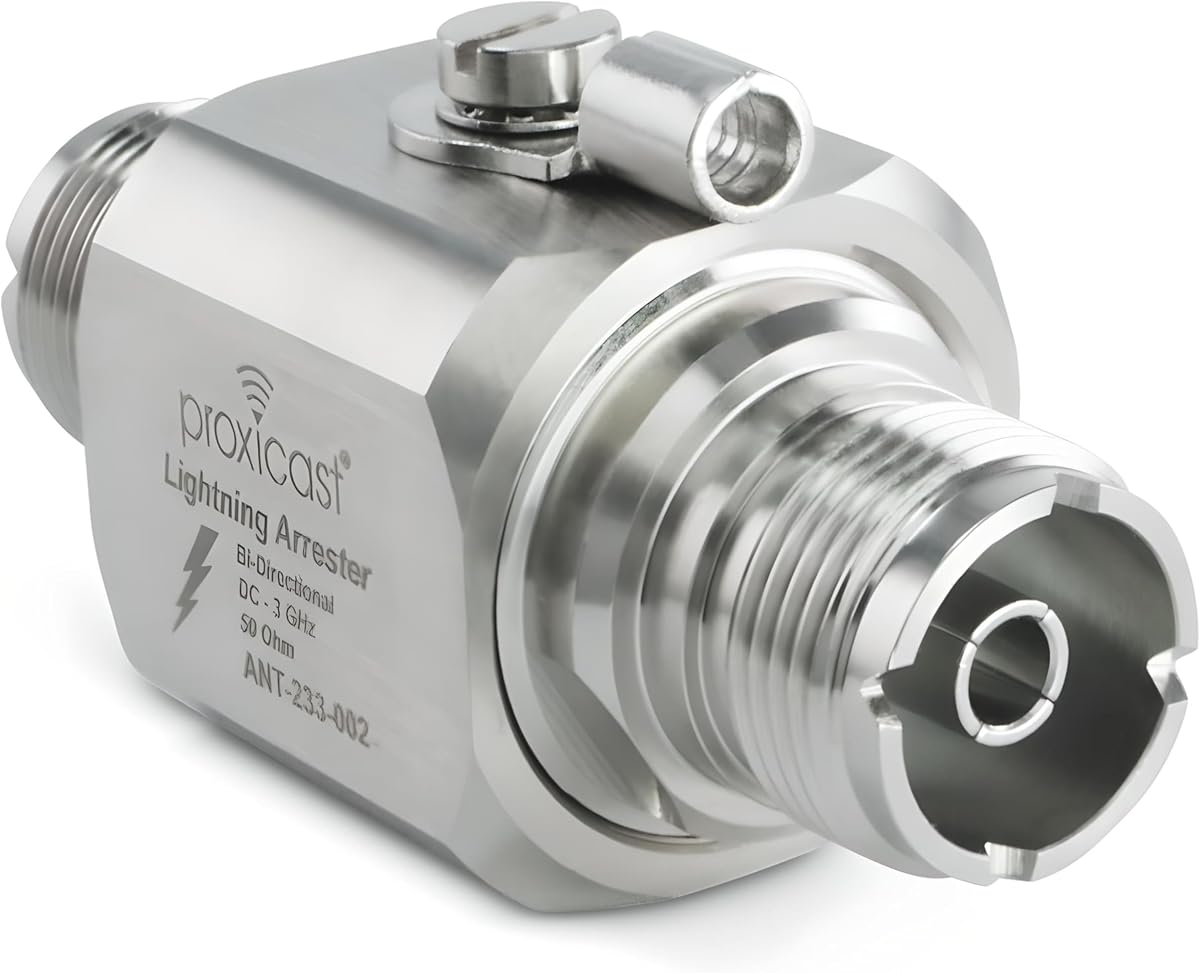
The Coaxial Lightning Arrester two-pack includes two female-to-female SO-239 devices. Its supplied rating is 4.6 out of 5, and the construction listing emphasizes a brass nickel-plated outer conductor, a brass-plated inner pin, and PTFE insulation. The package is aimed at installations that need more than one protected feedline entry.
We may earn a commission when you buy through this link, at no additional cost to you.
Providing two units adds flexibility. Operators may protect separate antenna inputs, keep a spare on hand, or use the devices in different outdoor enclosures. The nickel-plated components are described as improving hardness, abrasion resistance, and corrosion resistance, while PTFE supports stable insulation around the center conductor.
The listing does not provide a numeric power rating, and the ground wire is not explicitly identified as included. It recommends installing the device as close as possible to the protected equipment, often at the cable entry point, but that placement still requires a proper external ground. The two-pack format may also be unnecessary for a single-radio station.
This product is best for operators with multiple SO-239 feedlines or a need for a spare enclosure-mounted protector. It is particularly useful when a clean, durable interface is desired at more than one building entry. Confirm grounding materials, connector condition, and the device's suitability for the station's RF power before installation.
Two arrestors support separate feedlines or provide a serviceable spare. This is useful for multi-radio rooms, shared antenna sites, and installations that value preparedness.
Nickel-plated brass and PTFE construction are useful for an exposed inline component. Routine inspection can identify corrosion, loose fittings, or moisture intrusion before they affect the installation.
We may earn a commission when you buy through this link, at no additional cost to you.
The RAIGEN N-Type Outdoor Arrester supports ham-radio use but is designed around a much broader set of RF services. It has a supplied rating of 4.8 out of 5, 50-ohm impedance, an operating range of 0 through 6 GHz, and published insertion loss below 0.1 dB. Its N-type male-to-female connectors suit modern wideband installations.
We may earn a commission when you buy through this link, at no additional cost to you.
The headline advantage is the combination of frequency reach and very low insertion loss. The device is listed for LoRaWAN, LoRa, outdoor Wi-Fi, cellular boosters, LTE, GPS, CB, ham radio, and other antenna-connected systems. A replaceable 90-volt gas discharge tube with multi-strike capability adds serviceability for professional or mission-critical deployments.
The ground cable is expressly not included, and the listing is emphatic that surge protection is incomplete without attaching an appropriate grounding cable. The N-type connectors may also require different cabling from a typical PL-259 amateur-radio installation. Weatherproof construction supports outdoor use, but it does not excuse poor sealing or unmanaged moisture around fittings.
This is a strong option for operators who need one protector across many RF services or maintain a mixed ham, cellular, IoT, or Wi-Fi antenna site. It is particularly relevant where low loss and replaceable protection are priorities. Verify cable compatibility and provide the proper ground system before installation.
The published loss below 0.1 dB is among the strongest stated figures in this comparison. That makes the arrestor appealing where preserving weak or high-frequency signals is a priority.
Support extending through 6 GHz makes the device useful beyond conventional ham-radio feeds. It can serve mixed installations involving cellular, LoRa, Wi-Fi, GPS, and other 50-ohm RF services.
We may earn a commission when you buy through this link, at no additional cost to you.
The Opek LP-350a is a 50-ohm surge protector for amateur-radio, two-way, and CB antennas. Its supplied rating is 4.6 out of 5, and the listing specifies a 0-to-600 MHz frequency range, support for radios up to 350 watts, a ground terminal, and compatibility with optional PL-259 cables.
We may earn a commission when you buy through this link, at no additional cost to you.
The LP-350a is especially relevant to conventional HF and VHF installations, and even UHF systems below its stated upper limit. Its 350-watt radio support gives it a useful power ceiling for many established base-station stations. The ground terminal and PL-259 cable compatibility simplify integration into a familiar antenna arrangement.
Its published specifications do not include insertion loss, surge-discharge capacity, or detailed construction information, making technical comparison less complete. The 600 MHz upper limit also makes it less appropriate for newer wideband services extending well beyond UHF. Cable and connector quality should be checked because optional accessory compatibility does not guarantee every possible installed configuration.
The model is a sensible choice for traditional ham and CB base antennas that operate within its frequency and power ratings. It fits operators who prefer a simple 50-ohm inline protector with a conventional ground terminal. It is less compelling for high-frequency mixed RF sites that need broader bandwidth or more extensive published performance data.
A 350-watt ceiling is suitable for many traditional base-station radios. Operators should confirm the actual transmitter output and antenna-system requirements before finalizing the installation.
Compatibility with optional PL-259 cables supports integration into common amateur-radio feeds. The ground terminal provides a clear connection point for a properly engineered bonding system.
We may earn a commission when you buy through this link, at no additional cost to you.
Choosing an effective antenna lightning arrester requires matching the protector to the feedline, operating frequency, transmitter power, installation environment, and grounding system rather than selecting solely by connector appearance.
Begin by identifying the connector on both ends of the coax run. PL-259, SO-239, and N-type fittings look superficially similar but differ in thread diameter, coupling method, and system use. A protector that cannot mate directly may require an adapter, and improvised transitions can add loss, create poor joints, or make the enclosure entry less secure. Checking the radio, feedline, antenna, amplifier, and any existing bulkhead hardware avoids purchasing the wrong interface. Mixed systems may justify a purpose-built PL-259-to-SO-239 bulkhead model, while operators with N-type infrastructure should favor a native N-type protector.
The arrestor's frequency range must encompass the bands used by the station. Conventional products may cover only part of the HF and VHF range, while models specified through 3000 MHz or 6 GHz can support wider-band operations and mixed RF services. A broader range is not automatically necessary, but it can prevent future replacement when the station adds another band or antenna service. Pay particular attention to products described for lower-frequency antennas, since a UHF-only assumption can lead to an unsuitable purchase. Cross-check the stated range against the antenna and radio rather than relying on a broad marketing description.
A lightning arrester needs a low-impedance path to ground. Most listings in this guide explicitly require an additional ground lead, earth wire, or attachment to the coax and an earth ground. Operators should use a short, robust connection and bond it to the station's grounding system in accordance with local electrical guidance. Corroded terminals, loose screws, undersized wire, and long indirect paths can undermine protection. A ground rod is not automatically the best target; the connection should integrate with the antenna system, building grounding plan, and any tower bonding. Professional consultation is prudent for large towers, sensitive equipment, or complex sites.
Because the arrestor remains in series with the signal path, insertion loss matters. Published figures range from below 0.1 dB to below 0.4 dB among the more explicitly documented products, while some listings provide no figure. Lower loss can help preserve link margin on weak or high-frequency signals, although a competent installation and sound connectors also influence overall results. Confirm that the device is designed for the system's 50-ohm coax. A mismatched or poorly terminated component can create reflections and standing waves that have more effect on performance than the arrestor's small additional loss.
The arrestor must tolerate the transmitter output present at that point in the system. A 50-watt bulkhead model may be suitable for a modest station, while published limits of 200 or 350 watts cover a broader range of conventional base-station equipment. Use the lower rating when a linear amplifier is involved or when the manufacturer imposes a stricter limit. Do not infer unlimited capacity from a general surge-protection description. Confirm actual output, duty cycle, connector arrangement, and all manufacturer restrictions before placing the device inline. Protection hardware that is overworked may no longer provide the consistent surge diversion expected by the station.
Antenna components are exposed to rain, moisture, temperature changes, UV, and corrosion. Listings mention nickel-plated brass, brass construction, PTFE insulation, weather-resistant materials, and aluminum housings across this group. These features can improve durability, but no label replaces good installation practices. Use weather-appropriate connectors, avoid exposed unsealed ends, inspect grommets and cable entry points, and mount the device where it will not collect water. A bulkhead arrangement can protect the transition through an enclosure, while an inline unit still needs careful strain relief and sealed coax connections. Periodic inspection helps identify corrosion or moisture before performance is affected.
A replaceable gas-discharge tube or surge element can simplify maintenance after the unit absorbs a serious event. It may also allow a failed element to be serviced without replacing the entire connector assembly. This is especially useful for fixed stations, critical two-way equipment, and installations exposed to repeated surges. Operators should still establish an inspection routine because a protective element can deteriorate before obvious RF symptoms appear. If the model uses a sealed element instead, understanding that design is important for long-term maintenance. Either approach is valid, but it should be matched to the station's serviceability needs.
The location of the arrestor influences how effectively it protects the equipment. A common approach is to place it close to the point where the coax enters the building, particularly when the objective is to shield indoor radios and accessories from surges arriving on the feedline. Other arrangements may place protection near the antenna, depending on the grounding system and equipment at risk. The listing for the two-pack recommends proximity to protected equipment, while the bulkhead model supports a formal enclosure transition. Decide based on the entire antenna path, grounding layout, and which equipment requires the strongest protection, rather than selecting the position solely for convenience.
Before installation, power down and disconnect the radio, amplifier, and other equipment connected to the coax. Identify the intended protection point, confirm that the arrestor's connectors match the feedline, and inspect the existing connectors for corrosion, damaged threads, water intrusion, or poor cable support. Decide how the device will be grounded before loosening any hardware, since a secure and electrically suitable ground connection is fundamental to its operation.
Mount the arrestor in the coax path with the protected equipment positioned on the appropriate side of the surge protection arrangement. Connect the ground lead to the station's bonding system using the shortest practical, mechanically sound route. If using a bulkhead model, secure it through the designated panel or enclosure and verify that the opening is sealed against moisture. Avoid sharp cable bends, unsupported connectors, and crossover or parallel routing with other metal structures where practical.
After installation, inspect every joint and confirm that coax connectors seat properly without excessive force. Test the feedline for continuity and expected impedance behavior using suitable RF test equipment, and check that the ground connection is secure. During routine maintenance, especially after major storms, look for discoloration, melting, corrosion, damaged insulation, or displaced components. Replace or service a surge element that shows evidence of damage, and never bypass the arrestor simply because the station is temporarily off the air.
No. An arrester is one layer of a broader protection strategy and can divert part of a surge away from sensitive equipment. It cannot control where lightning strikes, eliminate all induced surges, or substitute for proper grounding, bonding, and surge protection on power or control lines. Large or exposed installations may require additional protective devices and professional assessment.
The ideal position depends on the system, but protection is often placed close to the point where the feedline enters the building to help protect indoor equipment from surges arriving on the antenna line. A bulkhead unit can make that transition neat and secure. The final location should reflect the equipment at risk, available grounding paths, and the complete antenna arrangement.
An adapter can make connectors physically compatible, but it does not guarantee ideal RF performance, environmental sealing, or secure operation. Where possible, choose an arrester with the native interfaces needed by the feedline. If an adapter is necessary, secure it properly, inspect it for corrosion, and ensure the combined connection will not create a poorly supported or moisture-prone joint.
The conductor should be appropriately sized for the grounding system and local electrical requirements, with a short and dependable route to the relevant bond point. Avoid relying on a loose ground, corroded metal, or an improvised connection through unrelated equipment. For towers, building entrances, or complex multi-antenna sites, consult a qualified grounding or lightning-protection professional.
A properly selected unit should have minimal impact because its published insertion loss is generally small. The more significant concerns can come from poor connector contact, incorrect impedance, unnecessary adapters, or a damaged feedline. Comparing published loss figures is useful, but inspecting and maintaining the entire coax installation is equally important.
A replaceable element is convenient for fixed or critical stations because it may simplify maintenance after a major surge. Sealed designs can also be effective and may offer a simpler, more compact installation. The better choice depends on the station, environmental conditions, and willingness to inspect and service components, provided the device otherwise matches the required interfaces and specifications.
Only if they share a compatible feedline, impedance, frequency requirement, power limit, and grounding arrangement. Separate antennas commonly need separate protection paths, and multiple coaxial lines entering one building may benefit from individual arrestors or coordinated bulkhead protection. A shared protection design should be planned so that one fault or surge does not compromise unrelated systems.
Start with the complete system, not just the arrestor. Look for melted or discolored components, damaged connectors, corrosion, water intrusion, shifted mounting hardware, and changes to the ground connection. Test the feedline and grounding path with appropriate equipment, and replace or service any arrestor that has taken a severe surge. If the tower, antenna, or nearby electrical infrastructure shows damage, keep the station offline and seek qualified assistance.
The Diamond SP1000 is the most balanced overall recommendation because it combines published low insertion loss, high discharge capacity, and a replaceable surge element. The Diamond SP3000 is the stronger premium choice for N-type infrastructure, higher stated power handling, and extremely broad frequency coverage. For a straightforward conventional PL-259 installation, the Workman A28 provides a simple and accessible inline solution.
Prioritize native connector compatibility, adequate frequency and power ratings, and a grounding method that fits the complete antenna system. A sophisticated arrestor cannot compensate for a weak ground, damaged coax, or improper placement. Operators with towers, multiple services, or valuable equipment should consider a broader protection plan and qualified installation assistance rather than treating one inline component as the entire solution.
Ratings, availability, and market conditions can change, so confirm the current product listing and all technical details before ordering. Recheck the connector type, stated limits, included grounding hardware, and installation instructions at the time of purchase. Those details are more important to long-term protection than a headline rating or a temporary promotional offer.