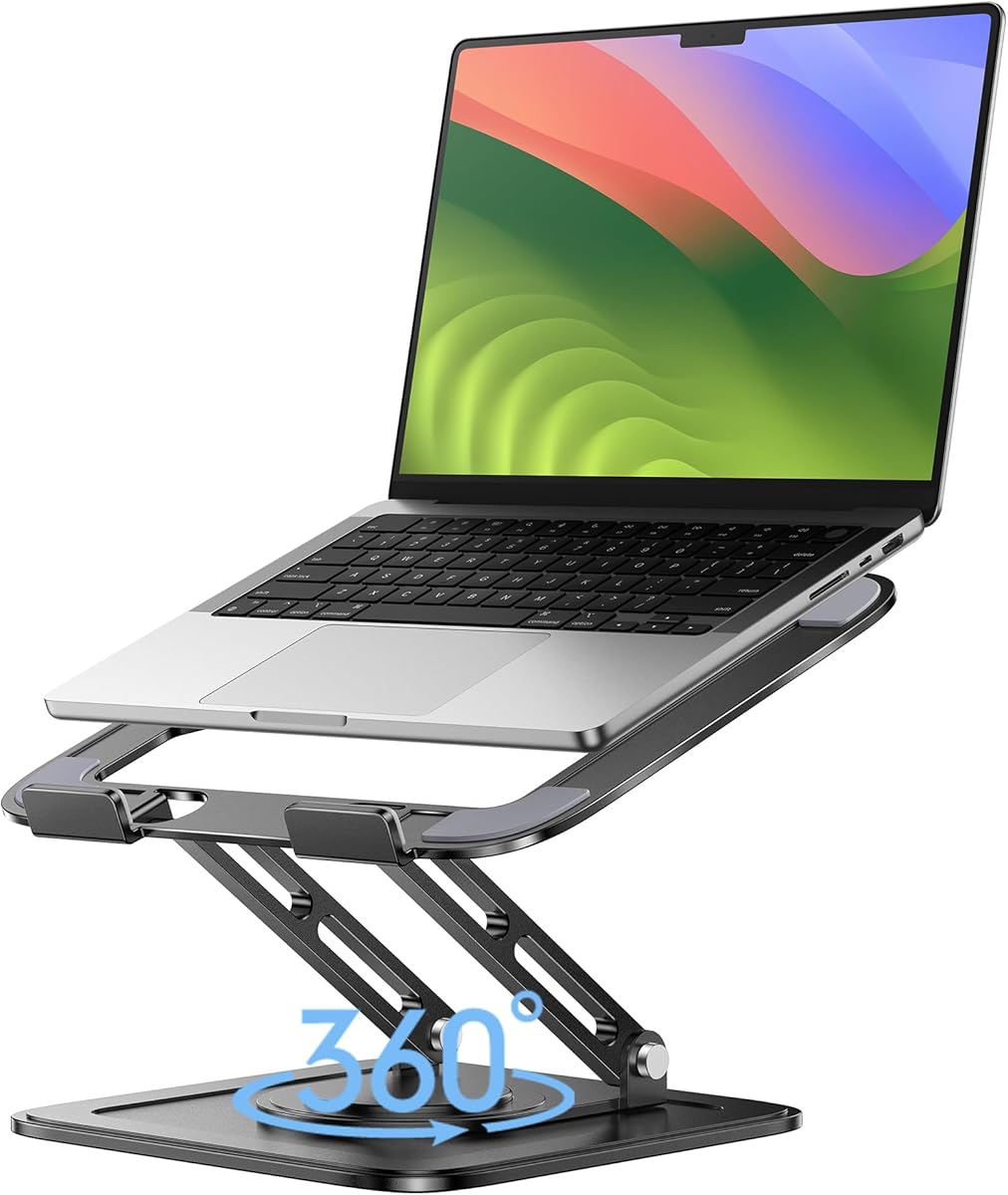
LOXP Adjustable Laptop Stand
4.6Editor score
360-degree rotating base
Adjustable height and angle
Supports 10 to 16-inch laptops
A rotating laptop stand can make a crowded desk more flexible while bringing the screen closer to eye level. The best models combine smooth swiveling, stable construction, useful height and angle adjustments, laptop protection, and enough airflow to discourage heat buildup during demanding work.
This guide compares the available rotating stands by examining their supported laptop sizes, materials, swivel mechanisms, portability, ergonomic range, base stability, cooling design, and practical features. The list includes detailed listings and options for which the supplied product information is limited, so readers can distinguish documented benefits from features that still require verification.
Each numbered review explains who the stand is best suited to, the strengths confirmed by its product information, and any limitations buyers should consider. Ratings and availability can change over time, as can product pricing, so readers should confirm the current listing and details before making a purchase.
4.6Editor score

4.7Editor score

4.7Editor score
As an Amazon Associate we earn from qualifying purchases.
The table below compares the ten rotating laptop stand listings by their documented size support, rotation, materials, and portability. Five listings include complete specifications, while the remaining entries have limited information and should be evaluated directly through their Amazon pages.


The LOXP Adjustable Laptop Stand earns a 4.6 rating and stands out as a well-rounded option for people who want a rotating riser without moving to a specialized workstation. Its core appeal is the 360-degree rotating base, which allows a laptop to be turned toward a colleague, client, or second screen rather than requiring the entire computer to be repositioned.
We may earn a commission when you buy through this link, at no additional cost to you.
Its foldable construction makes the stand practical for home offices, shared workplaces, and outdoor work. The platform supports laptops from 10 to 16 inches, covering many popular MacBook, Dell XPS, HP, ASUS, Lenovo ThinkPad, Acer, Chromebook, and Microsoft Surface models. Height and angle adjustments help bring the display closer to eye level, while non-slip silicone is intended to limit sliding and protect the laptop's contact surface.
The product information describes the frame as one-piece fiber metal rather than ordinary aluminum alloy, with an upgraded rotating base for stability. That distinction may appeal to buyers who prioritize durability and a solid feel, although the listing does not provide a numerical load rating. It also does not quantify cooling performance, so buyers should judge the open platform primarily by airflow rather than expecting a specific temperature reduction.
This is a strong choice for students, hybrid workers, and anyone who regularly shares a laptop screen. It combines swivel control, portability, and broad size compatibility in a straightforward package. The 16-inch ceiling is worth checking against your device, but for a typical 10-to-16-inch laptop, it provides the most balanced feature set in this guide.
The full rotating base is most valuable when a laptop serves more than one person. Turning the display toward someone at the same table is much more convenient than turning the entire computer, particularly when the laptop is connected to peripherals that should remain undisturbed.
A foldable frame and adjustable viewing position make this stand useful beyond a permanent desk. The same raised platform can improve screen height in a café or shared office, then fold for storage in a bag when the work location changes.
We may earn a commission when you buy through this link, at no additional cost to you.
The OMOTON Adjustable Laptop Stand has a 4.7 rating and offers one of the most balanced combinations of portability, rotation, and laptop protection. Its 360-degree axis is positioned at the connection with the base, giving the upper platform enough freedom to swivel toward different people around a desk.
We may earn a commission when you buy through this link, at no additional cost to you.
The aluminum alloy construction is described as having a smooth finish and refined edges, while soft rubber pads on the top help protect against scratches and sliding. A dedicated heat vent improves airflow around and beneath the laptop, and the aluminum body is also intended to dissipate heat. These details make the stand practical for routine use with demanding applications that generate more warmth.
The listing confirms a foldable design for carrying the stand to coffee shops, offices, and other locations. That portability does not appear to compromise the broad adjustment range or aluminum construction. The only notable omission is a specific load capacity, which may matter for buyers comparing it with heavier iron-based models or using unusually large systems.
OMOTON is a strong all-around recommendation for commuters, remote workers, students, and office users who want a lightweight aluminum stand with dependable rotation. It supports laptops up to 17 inches, offers a higher rating than many alternatives, and includes both screen-sharing and cooling considerations without an especially complicated feature set.
Aluminum alloy gives the stand a refined appearance and provides a practical surface for heat dissipation. The smooth edges also reduce the chance of the frame catching on sleeves or scratching nearby equipment during frequent repositioning.
The vent and elevated platform work together to promote circulation beneath the computer. This is especially useful when the laptop's bottom intake is not fully exposed, although a stand should complement—not replace—sensible thermal practices.
We may earn a commission when you buy through this link, at no additional cost to you.
The Lamicall Aluminum Laptop Stand combines a 4.7 rating with the broadest documented size range in the list, supporting laptops from 10 to 17.3 inches. Its elevated aluminum platform can also function as a projector mount, extending its usefulness beyond a conventional laptop riser.
We may earn a commission when you buy through this link, at no additional cost to you.
A larger, heavier base is designed to improve stability when the user types, reducing the likelihood of shaking, sliding, or falling. The upper section supports 360-degree rotation, multiple height settings, and angle adjustments. That range is especially helpful in presentations, client demonstrations, group collaboration, and dual-screen arrangements where two displays benefit from similar heights.
The aluminum construction and multiple ventilation holes are designed to move heat away from the laptop, while the wider base adds a reassuring sense of solidity. It can also be folded for travel or stored in a laptop bag. Since the base is intentionally large and heavy, people who carry a stand every day may find it less convenient than a more compact aluminum model.
Lamicall is the strongest premium-style pick here for offices, home studios, conference rooms, and buyers with larger laptops. It combines broad compatibility, sturdy construction, cooling, folding portability, and flexible screen positioning. The extra bulk is the main tradeoff, but the stability benefits make it particularly compelling for a fixed workstation.
The upgraded large base is one of this stand's most important distinctions. Its extra weight and footprint help resist movement during typing, which is valuable for larger laptops and for users who frequently reach across the desk.
Rotation, multiple angles, and broad size support allow the stand to serve individual work, shared presentations, and dual-screen arrangements. The stated projector-mount capability further expands its role in a compact desktop setup.
We may earn a commission when you buy through this link, at no additional cost to you.
The JOYEKY Laptop Stand has a 4.7 rating and is distinguished by a clearly stated load capacity of up to 11 pounds. Its dual-axis base provides smooth 360-degree rotation, while the larger aluminum base is designed to prevent shaking, sliding, or tipping during active typing.
We may earn a commission when you buy through this link, at no additional cost to you.
Height and angle can be adjusted to a maximum height of 11.81 inches, offering enough range to bring a laptop display closer to eye level. The ergonomic goal is to reduce shoulder and neck discomfort associated with looking down for long periods. The stand supports 10-to-16-inch laptops, including common MacBook, Dell XPS, HP, Lenovo, Acer, and Chromebook models.
When folded, it measures 9.45 by 9.45 by 1.25 inches, making it easier to place in a backpack than many larger desk stands. Its open, suspended construction promotes airflow beneath the computer, while anti-skid silicone and smooth edges are intended to prevent sliding and scratches. A maximum height of 11.81 inches is generous, although desk clearance and personal posture still need to be considered.
JOYEKY is a good fit for people with heavier laptops, limited desk space, or a frequent need to work across different locations. Its combination of stated capacity, compact folding, aluminum construction, and dual-axis rotation gives it a balanced profile. Buyers should simply confirm that their device falls within the documented 10-to-16-inch range.
The stated 11-pound limit gives shoppers a concrete benchmark when assessing stability. That figure is more informative than a generic claim of durability, especially for users with larger performance laptops who want confidence during vigorous typing.
The documented 9.45-inch square folded footprint simplifies packing compared with a permanently rigid riser. It is a sensible option for hybrid workers who alternate between a home desk, office, and travel locations.
We may earn a commission when you buy through this link, at no additional cost to you.
This Amazon listing is included to represent all ten products in the source set, but the supplied information does not provide a product title, rating, image, or descriptive specifications. As a result, there is no factual basis for describing its rotation mechanism, size range, construction, or adjustment system.
We may earn a commission when you buy through this link, at no additional cost to you.
A buyer should not treat the presence of a 360-degree category as proof that this particular listing has a rotating base. It should also not be assumed to support a particular laptop size, fold for travel, include ventilation openings, or use aluminum construction. Each of those claims would require confirmation from the current product page.
The most responsible recommendation is to treat this as a listing to investigate rather than a proven alternative. Check the product photographs, dimensions, material description, supported devices, swivel mechanism, package contents, customer feedback, and warranty information before ordering. The absence of details in this guide does not imply that the product is poor; it simply means the evidence available here is insufficient for a fair assessment.
If the live listing provides a clear rotating base, stable support, appropriate height adjustment, and a laptop size range that matches your equipment, it may be worth considering. Until those points are verified, it would be premature to rank it above the five fully documented products in this guide.
Look for photographs or written confirmation showing that the upper platform rotates around a defined axis and remains stable in a turned position. A simple tilted hinge is not equivalent to a rotating base.
Measure the laptop's width and compare it with the platform dimensions and stated size limit. Also examine the contact points and lip depth to ensure the computer will not slide when the display is turned.
We may earn a commission when you buy through this link, at no additional cost to you.
No usable title, rating, image, or description accompanies this listing in the supplied product data. The entry is therefore retained in the roundup for completeness, but its qualities cannot be compared fairly with the documented stands on rotation, stability, portability, heat management, or ergonomics.
We may earn a commission when you buy through this link, at no additional cost to you.
A useful evaluation would begin with the product's current Amazon page. Look for clear evidence of a 360-degree axis, adjustable viewing height, protective pads, a stable base, and a compatible laptop size range. Reviewers of the listing should also be checked for recurring comments about wobble, loose swivel tension, heat, scratches, or difficult folding.
It is also important to distinguish a rotating laptop riser from a simple fixed stand with an adjustable viewing angle. Rotation must occur around the platform so the screen can face a neighboring person without relocating the whole device. A product that only tilts backward may improve posture but will not offer the same collaborative flexibility.
This entry may be suitable if its live listing confirms those requirements, but the available evidence does not support a strong recommendation. Reviewers should verify the specifications, customer feedback, dimensions, and compatibility directly before purchase, and compare those details with the fully documented options in this guide.
A stand can be adjustable without being rotatable. Confirm that the upper platform turns horizontally and that the mechanism is designed to retain its position without shifting toward the desk edge.
Feedback can reveal practical weaknesses that specifications omit. Look for repeated comments about stability, swivel smoothness, protective padding, dimensions, and whether the folding process damages the product's shape.
We may earn a commission when you buy through this link, at no additional cost to you.
The source data for this entry contains only an Amazon identifier and link, with the title and descriptive fields recorded as N/A. Because the product's defining features cannot be confirmed, assigning a rating, capability, or comparative advantage would risk giving shoppers inaccurate information.
We may earn a commission when you buy through this link, at no additional cost to you.
Potential shoppers should inspect the live listing for a measurable rotating range, dimensional information, and supported screen sizes. A solid buying case would also require confirmation that the raised platform can hold the computer securely while turned and that the base remains stable at the desk's front edge.
The listing's portability is particularly important to check. A stand can be foldable without being compact, and a larger 17-inch platform may be more appropriate for a permanent office than a travel setup. Buyers should compare the folded dimensions with their available bag space rather than relying on a generic portable label.
Until the missing information is available, this listing belongs in a research list rather than in a confident recommendation. Direct verification of materials, swivel control, laptop fit, stability, cooling, and warranty coverage will reveal whether it deserves consideration alongside the better-documented rotating stands.
Check both the raised platform and the base footprint, then compare them with your desk and bag. A model can support a large laptop yet still be impractical if its base occupies too much working space.
Review the lowest and highest usable positions. A stand is only ergonomic if it can raise the display enough for your seating or standing-desk setup without forcing an awkward viewing angle.
We may earn a commission when you buy through this link, at no additional cost to you.
This listing lacks the product information needed for a meaningful, evidence-based review. Its name, rating, image, and descriptive features are unavailable in the supplied data, so the roundup cannot responsibly characterize it as stable, portable, adjustable, or compatible with any particular laptop.
We may earn a commission when you buy through this link, at no additional cost to you.
A potential buyer should first determine whether the product actually rotates 360 degrees. The listing should show or explicitly describe a horizontal swivel mechanism rather than only an adjustable hinge. Next, verify that the base is wide enough to resist tipping when the computer is turned and that silicone or another protective material contacts the laptop.
Construction quality also deserves close attention. Material alone does not determine durability, but it can influence weight, portability, corrosion resistance, and heat transfer. Shoppers should also look for ventilated construction, smooth contact edges, and a defined laptop-size range rather than assuming every stand fits a particular model.
The prudent recommendation is to postpone judgment until the live page has been reviewed. If the verified features align with the priorities outlined in this guide, the listing could become a viable contender. Until then, the documented products provide a sounder basis for an informed buying decision.
A rotating stand should stay where it is positioned without drifting or wobbling. Buyers should look for a credible adjustment or tension mechanism and consider whether the supplied hex key or other tool is appropriate for their setup.
Pads at each corner help prevent scratches and keep the computer from shifting. Confirm that the surfaces are placed where the laptop actually rests and that they are made from a material unlikely to mark the chassis.
We may earn a commission when you buy through this link, at no additional cost to you.
The 360-Degree Rotating Laptop Stand has a 4.5 rating and offers the strongest stated load capacity in the guide. Its reinforced iron construction, thickened U-shaped support bars, and industrial-grade rivets are designed to support up to 10 kilograms, or roughly 22 pounds, making it a credible option for large or heavy gaming laptops.
We may earn a commission when you buy through this link, at no additional cost to you.
Precision dual-axis bearings provide 360-degree swiveling, and the included hex wrench allows the user to adjust the stand's height, angle, and swivel tightness. That adjustability is valuable for shared screens, client meetings, and collaborative work. A user can turn the display toward someone nearby without moving the entire computer or disturbing connected accessories.
The platform raises the laptop from zero to 7.5 inches and tilts to align the display more closely with eye level. Its open, suspended design promotes airflow, while non-slip silicone pads protect against scratches and sliding. The listing also states a 15-to-20-percent temperature reduction during intensive tasks, but no underlying test conditions are provided, so that number should be treated cautiously.
This stand is best for users who prioritize strength, load capacity, and adjustable rotation over minimal packed size. The folded dimensions are 9.8 by 8.5 by 1.8 inches, but the stated weight of 1.3 kilograms makes it heavier than the aluminum options. That tradeoff is reasonable for a robust permanent setup or a demanding mobile workstation.
A 10-kilogram stated capacity provides ample margin for most portable computers and offers reassurance to owners of thick performance laptops. The reinforced frame also suggests that the stand is intended to remain stable when the display is turned during active work.
Dual-axis bearings and an adjustment tool give the user more control over the mechanism than a basic friction hinge. Adjustable tightness can help prevent unwanted drift while still allowing the screen to be shared smoothly.
We may earn a commission when you buy through this link, at no additional cost to you.
The final entry is retained to complete the ten-product roundup, but its supplied data consists of an Amazon link rather than a usable title, rating, image, or feature description. The listing therefore cannot be compared confidently with the documented models or assigned a justified rating.
We may earn a commission when you buy through this link, at no additional cost to you.
Before buying, check that the product has a true rotating platform, a mechanism capable of supporting the laptop in multiple orientations, and a base that will not tip during screen sharing. Confirm the maximum laptop dimensions and compare them with your device, including any ports or protrusions that might affect the fit.
Ergonomic claims should also be examined in context. A useful stand needs enough height and tilt range to bring the display closer to eye level for your chair, desk, or standing setup. Reviewers should determine whether the adjustment method is convenient for daily use or requires tools every time the position changes.
No strong recommendation can be made from the information at hand. The live product page is the appropriate place to establish whether this option offers meaningful advantages over the better-documented picks. Buyers should prioritize verified compatibility, stable rotation, protective contact points, and an adjustment range that suits their workspace.
A tool-free or clearly adjustable mechanism is usually more convenient for a frequently used stand. If a hex key is required, consider whether changing position is frequent enough to make that step inconvenient.
A rotating base needs enough clearance to turn without striking a monitor arm, wall, or neighboring equipment. Measure the available space and check the stand's footprint before assuming a compact appearance in photographs.
We may earn a commission when you buy through this link, at no additional cost to you.
The right rotating laptop stand should improve screen positioning without introducing wobble, awkward bulk, poor laptop protection, or unnecessary complexity. Comparing rotation, stability, adjustability, portability, compatibility, cooling, and construction will help narrow the field.
A true rotating stand lets the entire upper platform turn horizontally so the display can face another person. This differs from a simple tilt hinge, which changes the screen's angle but does not let it rotate toward a colleague. The best mechanism feels smooth while still holding its position and should not cause the laptop to drift slowly toward the desk edge. Some models include adjustable swivel tension or a tool for changing how firmly the axis holds position.
Choose smooth 360-degree rotation for presentations, collaboration, and dual-screen work, and verify that tension is sufficient for frequent typing. If your priority is a fixed viewing position, rotation may be less important than a wide tilt range.
Rotation adds leverage to the base, so stability matters more than it would with a conventional fixed riser. Look for a broad or weighted base, supportive feet, and a stated load rating appropriate for your computer. A capacity of around 10 kilograms is more than many portable laptops need, but it can provide reassurance for thick gaming systems or workstations. The platform should not shake noticeably when you type with the screen turned.
Prioritize a stable base and documented capacity over vague durability language. Also make sure the footprint leaves enough desk space for a mouse, keyboard, notebook, or external monitor.
A rotating stand is also an ergonomic tool, so it should raise the display enough to reduce the need to look downward. Some products offer a limited platform that starts close to desk level, while others reach substantially higher. Angle adjustment is useful for reducing glare, changing the view between seated and standing work, and positioning the screen next to a second display.
Compare the minimum and maximum height with your desk and seating. The best setup places the top of the screen near eye level without forcing your shoulders upward or pushing the keyboard too far away.
Size compatibility is a practical starting point. Documented ranges in this guide extend from 10 inches to as wide as 17.3 inches, but nominal screen size is not the only measurement. A narrow platform may still be too shallow for a particular computer, and a thick chassis may rest differently than an ultraportable. Check the listed width, depth, lip position, and supported inch range.
Choose a platform that supports the full base of your laptop and prevents it from sliding when turned. If you own multiple devices, look for a stand that can accommodate both a compact notebook and a larger workstation without changing mounts.
Aluminum alloy is common because it combines a relatively low weight with useful heat transfer and a smooth finish. Iron construction can provide greater strength and load capacity, although it may weigh more and be less convenient to carry. Smooth edges, joined support points, and non-slip pads are equally important. A robust frame should not flex, creak, or develop a loose axis during regular rotation.
Choose the material that best fits your priorities: aluminum for portability and finish, or reinforced iron for heavy-duty stability. Inspect the assembly, contact points, and adjustable joints regardless of the material used.
Portable stands are useful for hybrid workers, students, and anyone who regularly changes locations. Foldability reduces the space required in a backpack or laptop bag, but a compact shape alone does not guarantee a light product. The 360-Degree Rotating Laptop Stand, for example, folds to a relatively compact size but is documented at 1.3 kilograms.
Compare both folded dimensions and weight with the space and carrying capacity you actually have. A slightly larger aluminum stand may be easier to live with daily if it feels much lighter and packs more neatly.
Laptops need room to expel heat, and a raised stand can keep the bottom intake from sitting flush against a desk. Open platforms, ventilation holes, and heat-dissipating materials can support that airflow. These features are useful, but temperature results depend on the laptop, workload, room conditions, and cooling design, so dramatic numerical claims should be considered alongside the product's overall design.
Prioritize an open underside and unobstructed vents. A cooling-oriented stand is most helpful during heavy workloads, but it should still be used with sensible ventilation and normal care around the computer.
Rubber or silicone contact points help prevent scratches and sliding, while smooth edges protect nearby hands and equipment. Some stands include a hex key for tightening the swivel mechanism, and others offer additional uses such as a projector mount or a stable platform for dual screens. These extras can be useful, but they should not compensate for weak core features such as poor stability or limited compatibility.
Check whether the package includes required adjustment tools and whether the protective pads are positioned where your laptop rests. Favor a simple design that protects the device and fits your routine over a stand loaded with features you will not use.
Begin by placing the stand on a level, stable surface and positioning the base beyond the front edge of the keyboard area. Set the laptop on the support surface, confirm that all contact points rest on protective pads, and make sure the machine is centered. Connect cables before turning the display so that the screen can be shared without pulling or disconnecting peripherals.
Raise the stand gradually until the screen is close to eye level, then adjust the angle to reduce glare. For swivel use, move the platform in the direction indicated by the manufacturer and do not force it past a mechanical stop. If the axis feels loose, use the documented adjustment method or supplied tool; excessive tightening can damage the mechanism.
For care, wipe the metal frame with a soft, dry or lightly damp cloth and avoid harsh chemicals. Do not pour liquid into the rotating joint, and keep the vents and underside clear of dust. Before moving the stand, disconnect the laptop and support the base with one hand while turning or lifting it. Check the swivel axis and silicone pads periodically for looseness, cracks, or accumulated debris.
The defining benefit is horizontal screen rotation, which makes it easier to share a display with someone seated nearby. It also allows the laptop to face a second monitor or viewer without relocating the entire computer and its connected peripherals. A separate height and tilt adjustment then provides the ergonomic benefit of bringing the display closer to eye level.
It is better when collaboration, presentations, or dual-screen positioning are common. A fixed riser may be simpler, lighter, and less mechanically complex, so it can be sufficient for one user. The best choice depends on whether the swivel capability solves a recurring problem in your workflow.
An elevated, open platform can improve airflow beneath the laptop and may help it dissipate heat more effectively. Results vary by computer, workload, and stand design, so buyers should focus on visible ventilation openings and an unobstructed underside rather than relying only on a numerical temperature claim.
Check the stated screen-size range, platform dimensions, and supported depth before ordering. Also consider the laptop's thickness and whether any ports or raised feet could interfere with the support surface. Centering the computer on all available contact points is important for stable rotation.
Only if it folds or otherwise packs compactly. Compare the folded dimensions and weight with your available bag space, and place the stand where it cannot bend or damage the swivel joint. Heavier reinforced models may remain portable but are often better suited to permanent desks and occasional transport.
A swivel axis may be designed to swivel smoothly and can loosen with repeated movement. Check the manufacturer's instructions for tension adjustment, and avoid forcing the mechanism. If tightening is required frequently, or the platform no longer holds its position, contact the seller rather than applying excessive force.
Many are designed for several common brands, including MacBook, Dell, HP, Lenovo, ASUS, Acer, Chromebook, and Microsoft Surface models. Brand compatibility alone is not enough, however; confirm the platform dimensions, weight rating, and physical fit for the exact computer being used.
Not always. Stability depends on the entire design, including the base footprint, center of gravity, swivel tension, construction, and the weight and placement of the laptop. A wide, well-designed aluminum base can feel stable, while a poorly proportioned heavy frame may still wobble. Look for documented capacity and a broad, low-profile foundation.
The LOXP Adjustable Laptop Stand is the strongest budget-oriented all-rounder, combining a 360-degree base, height and angle adjustment, folding portability, and support for laptops from 10 to 16 inches. The OMOTON model is an excellent balanced option with a 4.7 rating, aluminum construction, heat ventilation, protective pads, and a 17-inch upper limit, while the Lamicall stand leads the feature-rich group with broad compatibility and a large, stable base.
For heavy systems, the reinforced 360-Degree Rotating Laptop Stand offers the highest stated load capacity and a 10-kilogram limit, making it worth considering when strength matters more than minimum packed weight. The JOYEKY stand also stands out for an 11-pound capacity, compact folded dimensions, and a generous 11.81-inch height range. Buyers should prioritize verified laptop fit, stable rotation, protective contact points, and the adjustment range that suits their desk.
Product details, customer ratings, availability, and prices can change, so the live Amazon listing should be checked before ordering. Pay particular attention to the supported dimensions and any required swivel tension adjustment. For shoppers ready to buy, the LOXP, OMOTON, and Lamicall stands are the clearest starting points because each combines documented rotation with useful ergonomic and portability features.