
Garage Door Opener Surge Protector
4.7Editor score
900-joule surge protection
UL Listed safety rating
Universal opener compatibility
LED protection indicator
Standard grounded outlet plug
Surge Protector for Garage Door Opener guide comparing 10 options for electrical ratings, surge capacity, safety features, and installation needs.
A garage door opener contains a motor, sensors, controls, and other electronics that can be vulnerable to voltage spikes. A properly selected surge protector for garage door opener use can add a layer of defense while remaining compatible with the outlet, wiring, and equipment involved.
This guide compares dedicated garage door openers, general appliance protectors, multi-outlet models, and panel-mounted surge protective devices. The evaluation focuses on surge energy, voltage and current ratings, safety listings, status indicators, outlet format, and the type of installation each product requires.
The list shows which products may suit straightforward plug-in protection, shared appliance circuits, or professional whole-home installations. Ratings reflect the supplied customer feedback, while product details and availability can change. Readers should confirm electrical compatibility, current listings, and current prices before purchasing.
4.7Editor score

4.8Editor score

4.6Editor score
This side-by-side comparison covers dedicated and general-purpose plug-in protectors as well as professional panel-mounted devices, helping readers distinguish basic point-of-use protection from broader household surge suppression.




The Garage Door Opener Surge Protector is a purpose-built plug-in device with a 4.7 rating and a straightforward focus on the electrical needs of a standard garage door opener. Its 900-joule surge rating, 15A capacity, 125VAC compatibility, and UL Listed construction distinguish it from general-purpose strips designed mainly for entertainment equipment.
We may earn a commission when you buy through this link, at no additional cost to you.
The most useful feature is its direct fit with a grounded outlet. It is designed to protect one garage door opener regardless of brand, so homeowners do not have to determine whether a refrigerator-style appliance protector has the right features. An LED indicator makes it possible to check whether the protection remains active without interpreting a complicated display.
There are limits. The product is intended for a single opener and does not provide several outlets for workshop tools or other garage equipment. The supplied information also does not mention a controlled restart delay or high- and low-voltage monitoring. Those omissions matter more for compressors than for many openers, but buyers who want broader monitoring should consider a more advanced device.
This is the most direct recommendation for a homeowner who wants uncomplicated protection without paying for a panel installation. It is also a sensible choice when the opener is connected to a dedicated, properly grounded receptacle. Confirm the receptacle condition, avoid extension cords, and select this device when single-opener coverage and straightforward installation are the priorities.
Unlike a multi-outlet power strip, this protector is designed around one garage door opener. That specialization makes setup easier because the user does not need to balance the opener against several other appliances or identify which plug receives surge protection.
The LED indicator provides a convenient visual check of operating status. Periodically looking for the indicator can help owners notice when a protector has reached the end of its protective life and should be replaced.
We may earn a commission when you buy through this link, at no additional cost to you.
The Fosmon Refrigerator Surge Protector is a 4.8-rated single-outlet appliance protector explicitly listed for garage door openers. It combines a 140-joule surge rating, 1200V clamping voltage, and a 15A capacity with four separate LEDs for normal operation, high voltage, low voltage, and delay mode.
We may earn a commission when you buy through this link, at no additional cost to you.
Its defining strength is monitoring rather than raw surge energy alone. The device is described as helping protect against high and low voltage, brownouts, spikes, instant surges, power failures, voltage fluctuations, and load shedding. A three-minute restart delay prevents immediate power restoration after an out-of-range event, reducing the chance of rapid cycling in connected equipment.
The 140-joule rating is lower than that offered by several heavy-duty options in this guide, and the product is not limited to garage door use. Its long title and broad compatibility list may initially make it feel less focused than the dedicated opener protector. However, the diagnostic LEDs and controlled delay make it attractive for owners who want more situational information from a compact outlet.
Choose this Fosmon unit when the garage door opener is the primary concern but the same outlet may serve other household appliances over time. It is also a good match for users who value voltage monitoring and a delayed restart. As with any plug-in protector, use a sound grounded outlet and avoid daisy-chaining or extension cords.
Distinct indicators make normal, high-voltage, low-voltage, and delay conditions easy to distinguish. This is more informative than a single light and helps owners understand whether the outlet is simply protecting the load or responding to an abnormal event.
The three-minute delay provides time for power conditions to settle before connected equipment restarts. That feature is especially relevant to compressors, although it is not the only consideration when choosing protection for an opener.
We may earn a commission when you buy through this link, at no additional cost to you.
The SURAIELEC Single Outlet Surge Protector earns a 4.8 rating and offers 1470 joules of surge protection in a compact wall-plug format. Its 900V clamping voltage, 15A and 1875W rating, and ETL Listed status make it a technically substantial alternative for a garage door opener.
We may earn a commission when you buy through this link, at no additional cost to you.
The product is advertised for homes, offices, workshops, and garages, as well as washing machines, refrigerators, and consumer electronics. That broad compatibility is useful because a garage outlet may be shared with different equipment over the life of the home. Its small size is also practical where there is little space between the receptacle and a wall or appliance.
Compared with the dedicated opener protector, this model provides a higher stated joule rating. Compared with the four-LED Fosmon, however, it offers less diagnostic detail. The supplied information does not identify a restart delay, undervoltage detection, or a detailed protection-life indicator, so buyers prioritizing event visibility may prefer the Fosmon design.
This SURAIELEC protector is well suited to a compact installation where higher surge capacity is desired without a large power strip. Verify that the single outlet accepts the opener plug without force and that the receptacle is properly grounded. It is a strong alternative for users who want simple, high-energy protection rather than advanced voltage monitoring.
The lightweight single-outlet body is designed to fit where a full-sized strip would be inconvenient. It can preserve access to the outlet and reduce the chance that a heavy adapter prevents a wall plate from fitting.
The 1470-joule rating provides a notable capacity advantage over lower-rated appliance plugs. While surge energy should not be treated as the only safety measure, it is one useful way to compare devices designed for motors and heavier household loads.
We may earn a commission when you buy through this link, at no additional cost to you.
The Fosmon Three Outlet Heavy Duty Appliance Surge Protector has a 4.7 rating, 1200 joules of protection, and three grounded outlet positions. It is explicitly marketed for garage doors along with refrigerators, microwaves, and washing machines, making it a flexible choice for a shared garage circuit.
We may earn a commission when you buy through this link, at no additional cost to you.
Unlike a conventional power strip, this product presents as a compact wall adapter with three outlets. That design can keep cords organized while adding capacity where only one receptacle is available. It conforms to UL 498A and UL 1449 standards, carries a total capacity of 1875W at 125V and 15A, and includes protected LED indicators.
The total electrical rating applies to the adapter as a whole, so users should not treat it as three independent 15A circuits. A garage door opener motor may also draw a meaningful startup load, making the combined load of several appliances an important consideration. The product set includes two units, which may be useful in different locations but adds unnecessary bulk for a single-opener setup.
This is a good selection for a garage where the opener and one or two other grounded appliances need access to a protected outlet. It is less focused than the dedicated opener unit and offers fewer diagnostics than the four-LED Fosmon. Check the combined load, keep the adapter unobstructed, and use it only with a properly grounded receptacle.
Three grounded outlets make this useful in workshops and garages where tools, an opener, and another appliance share limited wall space. The compact adapter format reduces visual clutter compared with a long strip.
Conformance to UL 498A and UL 1449 adds useful context for safety-conscious buyers. Protected LEDs offer a basic indication that the unit remains active, although they do not match the detailed voltage diagnostics of some alternatives.
We may earn a commission when you buy through this link, at no additional cost to you.
The Eaton Tripp Lite IBAR2-6D combines a 1410-joule rating with an all-metal housing, making it the most premium-oriented heavy-duty choice in the roundup. Its 4.6 rating reflects a strong overall profile built around two outlets, line-noise filtering, and a six-foot power cord.
We may earn a commission when you buy through this link, at no additional cost to you.
The isolated filter bank is designed to limit interaction between connected devices, while EMI and RFI filtering can reduce line noise up to 80 dB. A 12A circuit breaker provides automatic shutoff if the protection circuit becomes incapacitated. Keyhole slots and a right-angle plug also give owners multiple ways to position the unit around garage equipment.
As a premium pick, it is not as convenient for someone seeking a tiny outlet adapter. The attached cord can complicate installations where a plug-in protector must sit directly against the receptacle or in a tight wall box. Only two outlets are provided, and the cord can become a snag point in a busy garage unless routed carefully.
The IBAR2-6D is best for a workshop-like garage where durability, filtering, surge capacity, and flexible mounting matter more than a minimal footprint. It is also a good option for owners who want a protected outlet away from the wall plate. Confirm that the opener and any co-connected devices fit within the breaker rating, and mount the unit where it will not be struck.
The all-metal case is a meaningful difference from typical plastic plug-in protectors. It suits garages and workshops where impact, heat, and frequent handling make a basic outlet adapter feel less substantial.
The isolated filter bank and EMI/RFI protection address electrical noise as well as larger transients. This can be useful in garages with motors, power tools, and sensitive controls sharing the same general electrical environment.
We may earn a commission when you buy through this link, at no additional cost to you.
The Generac Whole House Surge Protective Device 7409 has the highest rating in this group at 4.9 and takes a fundamentally different approach. Instead of protecting one garage receptacle, it is a panel-mounted Type 1 and Type 2 surge protective device intended to protect major residential systems.
We may earn a commission when you buy through this link, at no additional cost to you.
Its stated capacity is 50KA per phase with a 200KA SCCR rating. Thermally protected metal-oxide varistors absorb high-energy transients, and the NEMA 4X enclosure supports indoor or outdoor installation. A solid green LED indicates that the MOV elements remain active, while an extinguished light after a major event signals that replacement is needed.
This is not a DIY plug-in solution. The unit includes 24-inch, 12-gauge pre-wired leads and mounting hardware for a panel knockout, but a 20A two-pole breaker is not included and must be supplied by the installing electrician. License, code, panel compatibility, and safe working practices are important considerations.
For a homeowner seeking a single protected outlet, the Generac device is excessive. It makes sense for broad protection of the garage opener and other connected household equipment, particularly when coordinated with a qualified electrician. It can also serve generator-related applications when installed and configured as required by local rules.
A whole-home protective device can reduce the need to place separate point-of-use adapters on every important outlet. It broadens protection across the electrical system while remaining separate from the opener's local receptacle.
The NEMA 4X housing is rated for indoor and outdoor use within its specified temperature range. That flexibility can be valuable when the electrical service equipment is located in a damp or exposed area.
We may earn a commission when you buy through this link, at no additional cost to you.
The ABB THQLSURGE2 is a 4.8-rated Type 1 surge protective device designed for whole-home or office use. It provides up to 25kA protection per phase, and its LED indicators make the operating status easy for a qualified installer to inspect.
We may earn a commission when you buy through this link, at no additional cost to you.
The major advantage is scope. A panel-mounted device can protect multiple circuits and connected loads rather than only a single garage receptacle. The product is described as compatible with PowerMark load-center models and suitable for service entrances, subpanels, and load centers, subject to the exact installation instructions.
Its plug-on installation is more convenient than wiring a free-standing surge protector into a panel, but it still requires careful assessment. Load-center compatibility, available breaker spaces, conductor routing, grounding, local electrical requirements, and appropriate protective measures must all be considered. A panel surge device is not automatically a substitute for point-of-use protection.
This ABB unit is a strong option for homeowners who want broader protection and have a compatible panel. It is most appropriate when a licensed electrician can assess the service equipment and install it safely. For a quick, inexpensive outlet-level upgrade, one of the dedicated plug-in products is a more direct fit.
The 25kA per-phase rating and Type 1 design make this a broad infrastructure-level option. It can support a layered protection strategy that also includes point-of-use devices for especially sensitive equipment.
LED indicators allow the device's condition to be checked during routine service. Owners should know where the indicator is located and follow the manufacturer's replacement guidance if it no longer shows an active state.
We may earn a commission when you buy through this link, at no additional cost to you.
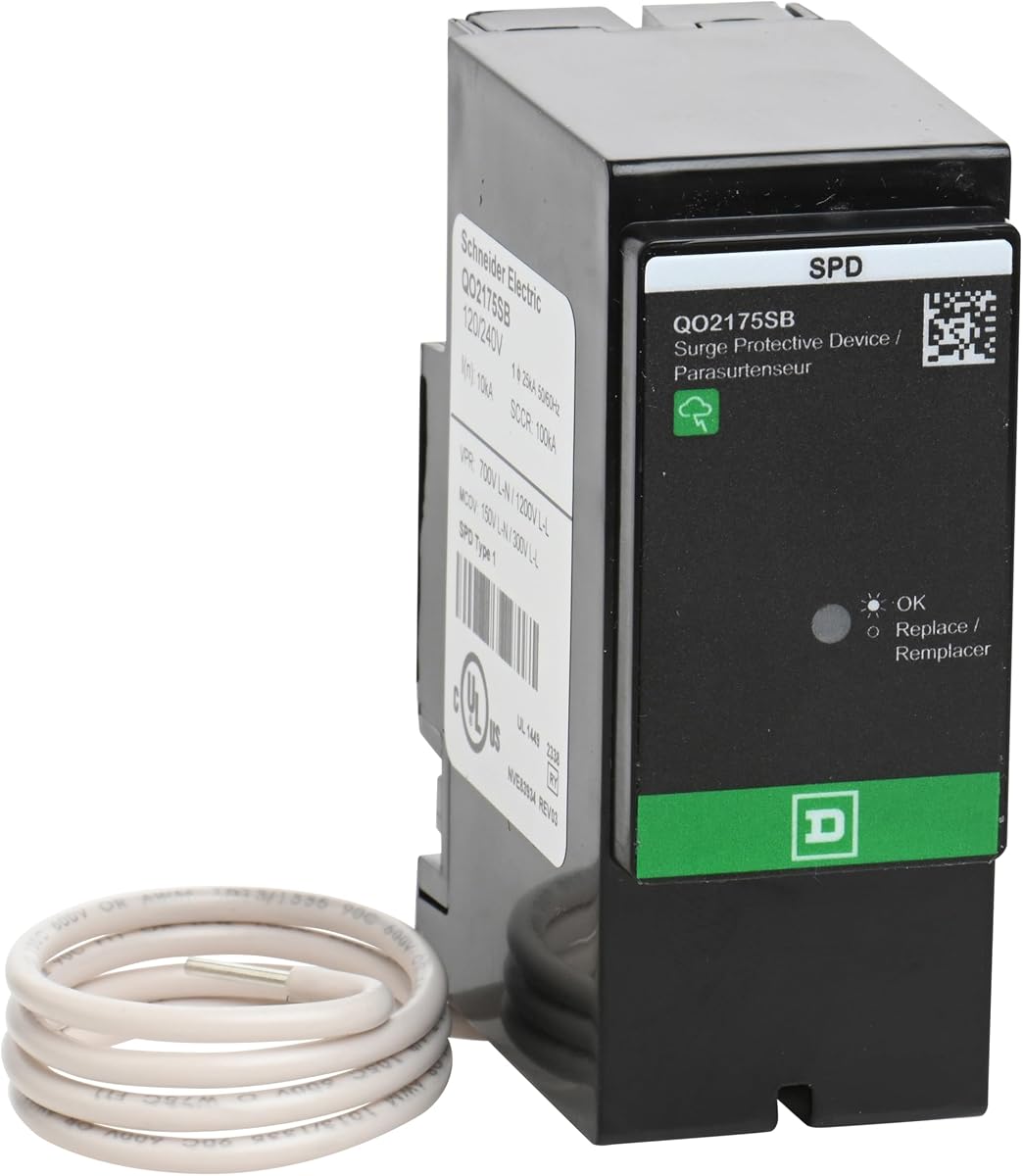
The Square D QO2175SB carries a 5.0 rating, the highest customer rating in the supplied data. It is a secondary surge arrestor for QO load centers, with a 5kA surge rating, 22.5kW SCCR rating, and high-energy circuitry using individually fused metal-oxide varistors.
We may earn a commission when you buy through this link, at no additional cost to you.
Installation is designed to be quick: the unit plugs into a QO load center and occupies two adjacent mounting spaces. An LED shows whether the device remains operational. The product is listed for residential and small-business uses, including whole-home or building protection, solar, temperature control, uninterruptible power supplies, and electric vehicle charging.
Compatibility is the central limitation. A QO-specific device cannot simply be installed in an arbitrary panel, and the two-space requirement may determine whether it is practical in the available enclosure. It also has a NEMA 1 indoor rating, so it is not suitable for a wet outdoor location without an appropriate enclosure and installation arrangement.
For a homeowner with a compatible QO load center, this is a technically focused way to add secondary surge protection. It offers the strongest customer rating in the roundup and a clear status indicator, but an electrician should confirm compatibility and installation requirements. It is less convenient than a plug-in garage protector and should not be selected solely by rating.
Each metal-oxide varistor is individually fused, providing a defined response to severe transient activity. The design is intended for installations where QO load-center compatibility has already been established.
The integrated LED gives installers and owners a simple way to determine whether the surge arrester is operational. Routine visual inspection should be included as part of whole-home electrical maintenance.
We may earn a commission when you buy through this link, at no additional cost to you.
The Square D HOM2175SB Homeline SurgeBreaker is a 25kA surge protection device designed for 120/240V, single-phase, three-wire residential systems. Its 4.7 rating and UL 1449 Third Edition listing make it a credible panel-level option for owners with compatible Homeline equipment.
We may earn a commission when you buy through this link, at no additional cost to you.
The device is intended to provide equal protection to circuits and receptacles throughout the home. It can be used in service entrance locations, CSEDs, and Homeline load centers. Installation is a plug-on process requiring two spaces, and an LED indicator provides a straightforward operating-status reference.
The phrase about equal protection to circuits and receptacles describes the category and intended reach of a home surge device; it should not be interpreted as guaranteeing that no local point-of-use protector is ever appropriate. Sensitive or motor-driven equipment can still benefit from being paired with dedicated protection closer to its power connection.
This is a sensible broad-protection option for a house with a compatible Homeline panel, especially when the goal is to support every ordinary branch circuit rather than protect only the garage. Confirm the panel model, available space, wiring configuration, and local requirements with a qualified electrician. It is not a substitute for a simple plug-in adapter in the garage itself.
A 25kA panel device can protect the electrical infrastructure serving multiple rooms and appliances. That scope makes it useful for households seeking one central layer of surge suppression.
UL 1449 Third Edition listing provides a clear safety standard, while the LED helps owners recognize whether the device is still operating. Replacement should follow the manufacturer's instructions and applicable electrical practices.
We may earn a commission when you buy through this link, at no additional cost to you.
The Siemens QSPD2A035B BoltShield is an indoor surge protective device with 35kA of surge current protection per phase. Its 4.4 rating is the lowest among the products in the roundup, but that does not make it a poor option within its intended category; panel devices differ substantially from simple plug-in adapters.
We may earn a commission when you buy through this link, at no additional cost to you.
The unit fits into existing Siemens load centers and plugs directly into the load-center bus for quick installation. Green and red mechanical visual indicators show protection status without relying on an LED. Mechanical indicators can remain readable under varied lighting and do not require an illuminated display to be checked.
Its chief limitation is compatibility. It is designed around Siemens equipment, so owners with another panel brand should not assume it will fit. The product is also an indoor device, and the lack of detailed electrical diagnostics means it will not provide the kind of high-voltage, low-voltage, or delay readouts offered by some appliance protectors.
Choose the Siemens QSPD2A035B when the home has a compatible Siemens load center and a qualified electrician can install it. It is a sensible central option, especially for owners who prefer mechanical status indicators. For a single garage opener outlet, a dedicated plug-in unit remains simpler and more targeted.
The green and red indicators provide a simple visual status system. Because they are mechanical rather than illuminated, owners can inspect them without relying on a powered display.
A 35kA per-phase rating places the device among the higher-capacity panel options shown. It is intended to serve as infrastructure protection across a compatible Siemens load center rather than as an adapter for one appliance.
We may earn a commission when you buy through this link, at no additional cost to you.
The right choice depends on whether the goal is simple outlet protection, broader voltage monitoring, shared-appliance coverage, or professional panel-level suppression. Compatibility, safe installation, and the electrical demands of the opener should take priority over marketing language.
A garage door opener commonly uses a standard grounded 120V receptacle, but the actual circuit and opener requirements should be verified before adding a protector. Look for a device rated for 125V and at least 15A, or the rating specified by the opener manufacturer and the receptacle. A plug-in protector must also fit the three-prong outlet without bending the plug, forcing the wall plate, or blocking the grounded pin. For panel-mounted options, compatibility is more demanding because the device must match the panel family, breaker format, conductor arrangement, available mounting spaces, and local electrical requirements.
The joule rating describes the amount of surge energy a device is designed to absorb. Higher figures can indicate greater capacity, but they are not a guarantee against every possible event and should not be compared without considering voltage, current, clamping specifications, and the quality of the protection design. The dedicated opener protector provides 900 joules, while several heavy-duty and panel options range from 1400 to 1470 joules at the plug-in level. Panel devices use different capacity language, such as KA per phase, because they are designed to handle larger service-level events. Choose a clearly rated, safety-listed device whose specifications suit the equipment rather than selecting solely by the largest printed number.
Clamping voltage indicates the maximum voltage the protector allows to pass during a surge, while high- and low-voltage protection addresses abnormal line conditions that may not be ordinary surge events. The Fosmon single-outlet model combines a 140-joule rating with 1200V clamping voltage and separate LEDs for high voltage, low voltage, normal operation, and delay. The SURAIELEC model provides 1470 joules and 900V clamping voltage. Garage door openers contain electronic controls, so stable voltage and useful fault indicators can be valuable. However, a clamp specification should be evaluated with the equipment manufacturer's guidance and not treated as a guarantee that every voltage fluctuation will be corrected.
A point-of-use protector is installed directly at the opener's receptacle and offers focused protection. A multi-outlet adapter can serve an opener and other grounded appliances, but all connected loads share its total rating. A whole-home device is installed at the service panel and can form a broad first layer of protection. Many homeowners benefit from a layered approach: panel-level suppression for the property and a dedicated point-of-use protector for the opener. If the garage has a simple, dedicated outlet and the goal is minimal disruption, a plug-in unit is the least complicated choice. If a new service device, generator arrangement, or comprehensive electrical upgrade is planned, consult a licensed electrician about panel protection.
Look for recognized safety standards appropriate to the device and location. The dedicated opener protector is UL Listed, the SURAIELEC and three-outlet Fosmon products are ETL Listed, the Eaton model conforms to UL 1449 Third Edition, and the Square D HOM2175SB is UL 1449 Third Edition Listed. The panel products also carry their own listed or certified designations. These markings provide a stronger basis for comparison than vague claims about heavy-duty construction. For a garage, pay attention to the casing, grounding, temperature considerations, and whether a device could be struck by a moving vehicle, stored equipment, moisture, or debris.
A status indicator is useful because surge protectors can be damaged by a major event even when the connected equipment appears normal. A single LED gives a basic operating indication, the four-LED Fosmon adds voltage and delay conditions, and the Eaton unit includes protection-related indicators. Panel devices use LED or mechanical windows to show whether their internal components remain active. Owners should know how to identify the indicator, where it is located, and what action the manufacturer recommends when protection has been sacrificed. A protective device that is past its useful service life cannot continue providing the protection it was designed to provide.
Some protective outlets delay power restoration after an abnormal voltage event, while others simply stop or indicate a fault. The Fosmon single-outlet model has a documented three-minute restart delay intended to avoid rapid cycling. This behavior is particularly relevant to refrigerators and other compressor-driven appliances, but it can also be helpful for sensitive electronics. A delayed restart does not guarantee that every connected device is safe, and a garage door opener should never be relied upon as an emergency egress system. Owners who use an automatic opener should maintain a manual release and clear access under power-loss conditions.
The combined load on a multi-outlet adapter matters because a single adapter's total ampere and wattage rating applies to all connected devices. A garage door opener can draw a substantial current when its motor starts, while chargers, compressors, and power tools add further demand. Stay within the stated rating, avoid connecting high-load appliances beyond the device's capacity, and do not use extension cords to extend a surge protector. Physical layout is equally important. A metal unit with a six-foot cord may need secure routing, while a compact wall adapter may be preferable near a tight wall plate. A panel-mounted product requires available breaker space and professional electrical work.
Begin by confirming that the garage door opener's wall receptacle is intact, properly grounded, and appropriate for the protector's plug. Read the instructions supplied with both the opener and the protective device. If the receptacle is loose, discolored, warm, or otherwise damaged, have an electrician evaluate it rather than using a protector to compensate for unsafe wiring.
For a plug-in model, connect the surge protector to the receptacle and plug the opener into the protector. Keep the unit dry, uncovered, and away from standing water, excessive heat, corrosive materials, and locations where a vehicle or stored object could strike it. Do not use extension cords, power strips, or daisy-chained adapters, and do not exceed the protector's total current and wattage rating.
Check the status indicator periodically and after a severe storm, power interruption, breaker event, or unusual opener behavior. If an indicator shows a failed state, if the unit is damaged, or if the manufacturer specifies replacement after a major surge, replace it. For panel-mounted devices, have routine inspection and replacement performed by a qualified electrician. Always keep a manual way to operate the garage door safely during a power outage.
A surge protector is not a substitute for correct wiring, grounding, or a properly maintained receptacle, but it can provide an added layer of protection for sensitive opener electronics. The value is greatest in areas where power fluctuations, storms, or utility switching are more common. Point-of-use protection is also useful when the opener is connected to a dedicated outlet that can be upgraded easily.
Only if the device's specifications clearly support the opener's voltage, current, wattage, and plug configuration. Several appliance protectors in this guide are explicitly listed for garage doors. Also check whether features such as a restart delay, low-voltage cutoff, or maximum motor load are appropriate for the connected equipment.
No. A higher joule rating is one sign of greater advertised surge capacity, but safe protection also depends on electrical ratings, clamping performance, construction, and safety certification. Compare complete specifications rather than choosing solely by the largest number, and make sure the device is appropriately rated for the load and installation environment.
A panel-mounted device can be useful when the goal is broad protection for many circuits or when a larger electrical system is being upgraded. It must match the panel and comply with applicable electrical requirements, so installation generally belongs with a qualified electrician. A dedicated opener protector remains a simpler choice for one receptacle.
No. Extension cords are not a recommended way to install a surge protector because they can add connection points, create additional unprotected segments, and prevent the protector from sitting close to the equipment it is intended to protect. Plug the protector directly into a suitable grounded receptacle.
Check the status indicator described in the product instructions. A missing or changed light can indicate that the internal protection has been sacrificed, although physical damage or unusual breaker behavior can also require attention. After a major event, follow the manufacturer's inspection and replacement guidance rather than assuming the connected opener is unaffected.
A surge protector does not create backup power, so an opener normally will not operate if the circuit loses electricity. Keep the manual release accessible and know the safe manual procedure for your opener. Do not attempt to power a garage door through a generator or inverter unless the equipment and installation have been specifically designed for that use.
Only within the device's stated combined voltage, current, and wattage limits. Garage door openers can create significant startup loads, and multiple tools or appliances may exceed a compact adapter's capacity. A multi-outlet model with adequate ratings may work, while a dedicated single-outlet protector is better when the opener is the only load.
The Garage Door Opener Surge Protector is the most focused choice for a standard opener connected to a sound grounded outlet, while the Fosmon single-outlet model stands out for four status indicators, voltage monitoring, and a controlled restart. The Eaton Tripp Lite IBAR2-6D is the premium heavy-duty pick for owners who value metal construction, filtering, and flexible mounting.
Prioritize compatibility, recognized safety standards, and the correct amount of protection for the installation. A dedicated outlet is simplest to protect, a multi-outlet model can serve several appliances within its total rating, and panel-mounted devices provide broad coverage when professionally selected and installed. Do not let a higher surge specification compensate for damaged wiring or an unsuitable receptacle.
Product ratings, technical details, design, and availability can change, and current prices should be checked before ordering. Review the opener manufacturer's guidance, compare the protector's complete specifications, and select the option that safely fits the outlet, load, and long-term protection strategy.