
SUPERNIGHT 30A PWM Dimmer
4.2Editor score
Smooth 0–100% dimming
Supports up to 30A
Durable aluminum housing
Screw-terminal installation
Our LED Light Strip Dimmer guide compares ten options by control style, voltage support, brightness control, remote range, memory functions, and installation
An LED light strip dimmer gives single-color strip lighting more useful control over brightness, scheduling, and everyday operation. A capable model should match the strip’s voltage, handle the required current, provide smooth low-level output, and offer a control method that suits the installation.
The products in this guide were compared using their stated voltage ranges, current ratings, control options, dimming methods, pairing behavior, memory functions, housing materials, and installation requirements. The list covers rotary controllers, RF remotes, smart voice-control options, and one complete dimmable strip with an integrated control box.
Each pick highlights a different practical advantage, from flexible low-voltage support to wireless multi-directional control or smooth stepless dimming. Product details and availability can change, so confirm the strip voltage, power-supply type, current draw, and connector arrangement before buying.
4.2Editor score

4.5Editor score

4.4Editor score
This side-by-side comparison highlights the major differences in control method, supported voltage, dimming behavior, and installation approach, helping readers identify the most suitable option for their particular single-color LED strip setup.


The PAUTIX RF WiFi Smart Remote Dimmer combines a 14-key radio-frequency remote, an in-line receiver, and smart-home compatibility in one single-color lighting controller. Its 4.5 rating reflects a feature-rich design aimed at 12V and 24V LED strips, with 11 brightness levels and a stated operating range of up to 32.8 feet in open areas.
We may earn a commission when you buy through this link, at no additional cost to you.
Its standout benefit is the range of control methods. The RF remote is multi-directional and does not need to point directly at the receiver, while the controller can connect through Tuya or Smart Life for use with Alexa or Google Assistant. That makes the system useful for cabinets, shelves, counters, and bedrooms where reaching a concealed controller would otherwise be inconvenient.
A memory function restores the previous setting after power is restored, and timer choices of 15, 30, and 60 minutes add practical scheduling. One-to-one or one-to-many pairing also allows the remote to manage a single receiver or synchronize several installations. The trade-offs are a 5A maximum current and the exclusion of 5V strips, so it is best for installations comfortably within a 12–24V system.
This is the strongest choice for readers who want traditional remote convenience alongside voice and app control. Verify that the strip is single-color, operates on 12V or 24V, and draws no more than the controller’s maximum current. Those constraints met, the combination of wireless control, memory, timers, and smart-home compatibility makes it especially versatile.
Control can extend beyond the handheld remote through compatible smart-home platforms. This is useful for permanently installed strips that are difficult to access or benefit from voice-activated lighting.
The last setting is retained after the lights return, while three timer options simplify delayed shutdown. Pairing can be configured for one receiver or multiple synchronized kits, accommodating both focused and whole-room installations.
We may earn a commission when you buy through this link, at no additional cost to you.
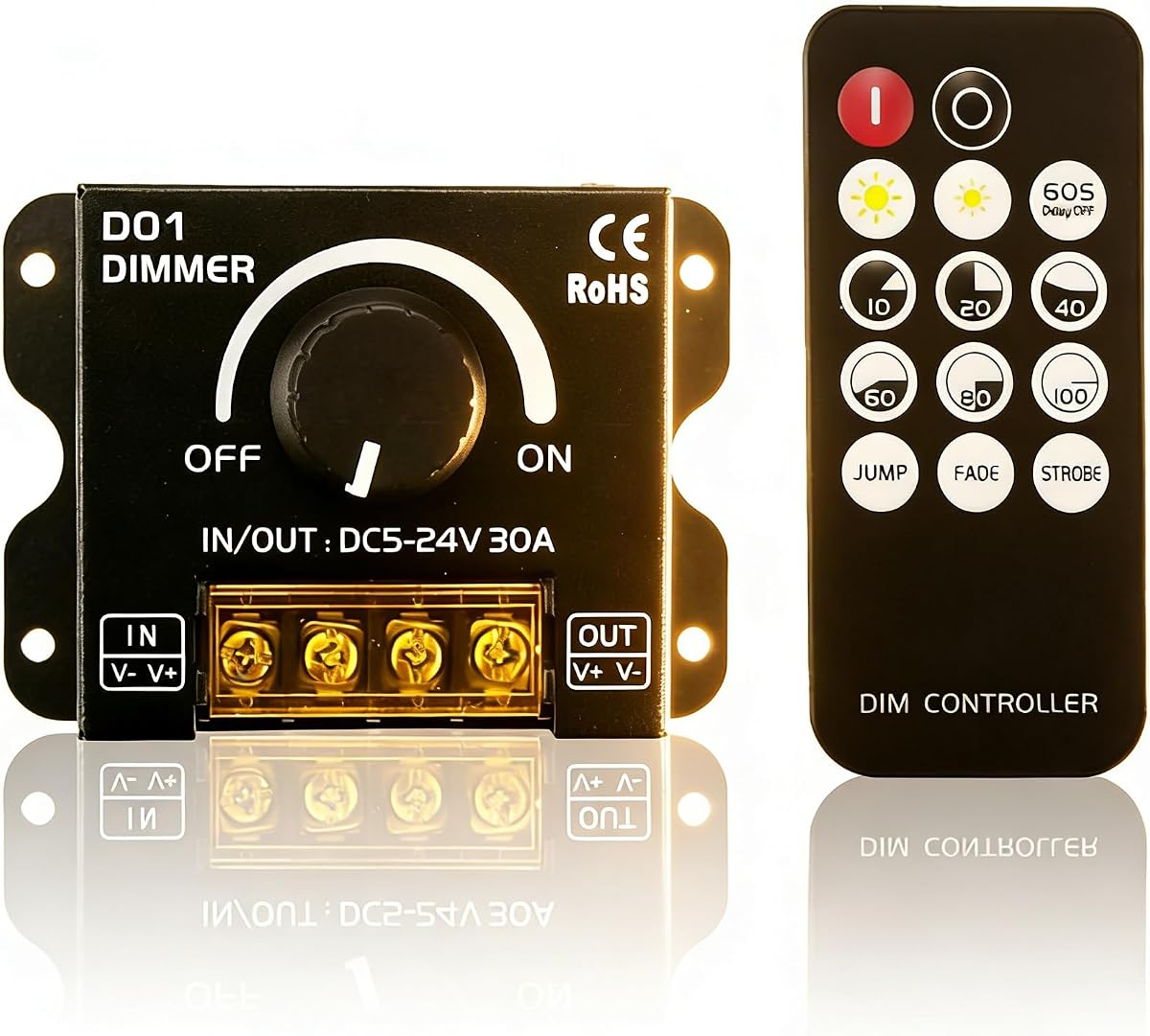
This 5V, 12V, and 24V LED dimmer switch is a versatile single-color controller for users who want both manual and remote operation. It earns a 4.5 rating and offers smooth 0–100% adjustment through a rotary knob, with a 14-key RF remote providing an alternative when the control is out of reach.
We may earn a commission when you buy through this link, at no additional cost to you.
One of its most useful features is the redundancy. The knob remains functional if the remote is lost, while the remote adds convenience after installation. PWM digital dimming is described as producing steady low-brightness output, and the aluminum housing is designed to dissipate heat while resisting corrosion in demanding installations.
The controller supports up to 30A and includes jump, fade, and strobe modes along with a timing-off function. A built-in memory feature restores the last brightness and mode after power restarts. It is important to note that this is a single-color controller: it is explicitly unsuitable for RGB lighting, fans, energy-saving lamps, and conventional bulbs.
The pick suits anyone who wants flexibility across 5V, 12V, and 24V strip projects and values having a local control as well as wireless access. Check the strip voltage, total current, and power-supply output before installation. If the strip falls within the stated limits, the combination of smooth dimming, memory, effects, and two control methods is especially useful.
The rotary control provides direct access to brightness even without the RF remote. This makes the unit practical for permanent installations where a small handheld controller could easily be misplaced.
Supporting 5V through 24V makes the controller adaptable to several common strip classes. The input must still match the strip exactly, and the connected load must remain within the 30A output limit.
We may earn a commission when you buy through this link, at no additional cost to you.
The frequency-adjustable LED strip dimmer switch is designed for single-color 5–24V strips and offers a 5.0 rating. Its defining feature is a four-position PWM frequency selection, allowing the installer to balance current capacity against output frequency rather than relying on a single fixed setting.
We may earn a commission when you buy through this link, at no additional cost to you.
The available modes are 8 kHz at 10A, 4 kHz at 15A, 2 kHz at 20A, and 800 Hz at 30A. Higher frequency can help reduce visible flicker in compatible systems, which is especially relevant when filming. The product description notes that actual camera results vary according to the strip, power supply, and frame rate.
A smooth rotary control provides 0–100% brightness adjustment, while the metal housing helps manage heat in a protected installation. The limitations are meaningful: it has no remote, is not waterproof, and cannot control RGB, RGBW, tunable-white, addressable, 120-volt AC, 0–10-volt, fan, or motor systems.
This is the pick for technically minded users who want selectable PWM behavior and precise control over a compatible DC strip. Select the frequency according to the load’s current requirement, verify that the voltage matches exactly, and install the controller where it remains dry. It is less convenient for casual users who want wireless control.
Choosing among four PWM levels lets the installer account for both load capacity and the appearance of the output. The tradeoff is that maximum current falls as the selected frequency changes.
The higher-frequency option may minimize banding artifacts in compatible recordings. Actual results still depend on the strip, supply, camera, and frame rate, so visual testing remains important.
We may earn a commission when you buy through this link, at no additional cost to you.
The 30A PWM stepless dimmer is a high-capacity rotary controller for DC 5V, 12V, and 24V single-color lighting. Its 4.0 rating reflects a straightforward design centered on smooth 0–100% dimming, automatic memory, screw terminals, and a durable metal enclosure.
We may earn a commission when you buy through this link, at no additional cost to you.
Its broad voltage support makes it relevant to under-cabinet strips, marine and RV lighting, trucks, off-grid systems, and other low-voltage installations. A 30A maximum current gives it substantially more headroom than most compact RF controllers, while PWM technology is intended to provide smooth adjustment and reduce abrupt current surges.
The compact housing measures 3.37 by 2.4 by 0.79 inches and includes pre-drilled mounting holes for installation in tight spaces. Its memory function restores the previous setting. Two cautions are important: the positive and negative terminals must be connected correctly, and the minimum operating load is stated as greater than 1 watt.
Buyers should choose this controller when the calculated current draw is substantial and local knob control is preferable to a remote. The product is for dimmable single-color LED loads, not motor-speed regulation. Confirm the supply type, polarity, load size, and environmental placement before installation.
The 30A rating makes this controller more appropriate for larger low-voltage strip projects than a small inline unit. The connected strip and power supply must both be suitable for the planned load.
A single knob, screw terminals, and automatic memory keep the controls simple. Pre-drilled mounting holes also simplify fitting the controller into a cabinet, vehicle, or compact equipment enclosure.
We may earn a commission when you buy through this link, at no additional cost to you.
The JOYLIT RF LED Dimmer is a single-color controller with a stated 5–36V range, an 8A maximum current, and a remote whose stated open-area range reaches 98 feet. Its 4.4 rating and feature set make it a strong choice for larger rooms or installations where the receiver is remote from the user.
We may earn a commission when you buy through this link, at no additional cost to you.
The 2.4 GHz RF remote is multi-directional and can transmit through a wall or closed door, avoiding the line-of-sight limitations of infrared remotes. A sensitive touch slider controls brightness, and the remote can wake after inactivity when the strip is already on. The last brightness setting is retained through a power cycle.
A notable distinction is the configurable three-second fade-in and fade-out function. The product documentation explains that this is enabled through a specific remote sequence, with the indicator blinking three times to confirm the change. The remote also includes a magnetic wall-mount bracket, making it easier to keep within reach and reduce the chance of losing it.
The primary limitation is its 8A maximum current, which is lower than several 30A alternatives. It is still well suited to many residential strips and offers unusually generous voltage compatibility. Choose it when remote convenience, long range, and a gentle fade matter more than maximum power capacity.
The RF design can cross walls and doors while remaining multi-directional. This makes the controller useful in bedrooms, living areas, and installations where the receiver is concealed.
A configurable three-second fade creates a softer on-and-off transition. The magnetic bracket provides a simple place to store the remote and keep it accessible.
We may earn a commission when you buy through this link, at no additional cost to you.
The weideer inline rotary dimmer is a compact solution for 12V and 24V single-color strips using standard 5.5 by 2.1 millimeter barrel connectors. It carries a 4.2 rating and includes two black dimmer controllers, making it convenient for projects with more than one short run of lighting.
We may earn a commission when you buy through this link, at no additional cost to you.
Installation is centered on a simple inline arrangement: the male and female barrel connectors join the dimmer to the strip and supply. A rotary knob then provides smooth 0–100% PWM adjustment, with the product description specifying reduced flicker at low brightness. No remote pairing, app setup, or menu configuration is involved.
The maximum load is 2A per controller, making it more suitable for smaller installations than high-current alternatives. It is intended for 12–24V LED strips, rope lights, aquarium lighting, ambient lighting, and common 5050, 3528, 2835, and 5630 strips. It must never be connected to AC mains.
This pick is attractive to users who prefer a straightforward controller that can be inserted inline without screw terminals. Check whether the strip uses compatible barrel connectors and calculate the current before buying. If the load is within 2A and the installation is relatively small, the simple operation and two-pack configuration provide good value.
The inline barrel connectors simplify connections for strips already designed around that format. It is a cleaner alternative when there is no practical location for exposed screw connections.
Two controllers are included, allowing separate short runs to be dimmed independently. This is especially useful for accents, displays, or multiple cabinet sections.
We may earn a commission when you buy through this link, at no additional cost to you.
The SUPERNIGHT 30A PWM controller is a rotary dimmer for 12V and 24V single-color LED strips. Its 4.2 rating is supported by a straightforward feature set: 0–100% PWM adjustment, a 30A maximum current, screw terminals, and an aluminum housing built for heat dissipation and corrosion resistance.
We may earn a commission when you buy through this link, at no additional cost to you.
The high current rating makes it suitable for long runs and larger strip installations, while PWM control is intended to provide smooth brightness changes and avoid abrupt current surges. The enclosure and pre-drilled mounting holes support practical permanent installation where heat management and mechanical durability matter.
Connection is straightforward, but polarity must be correct. The manufacturer notes that an unresponsive adjustment may indicate a loose knob, which may need to be pressed down so the internal adjustment screw engages. This small mechanical detail is worth checking if the lights illuminate but the dimmer initially seems unresponsive.
Choose this model for users who want a dependable local knob with generous current capacity and do not need remote, voice, or app control. It is not intended for RGB strips, and its 12–24V range is narrower than controllers that accept 5V. The trade-off is simple, durable operation without wireless conveniences.
A 30A maximum supports more demanding single-color strip circuits. Long installations still require a correctly rated DC power supply and sound voltage distribution.
The knob provides direct, continuous control without navigating a remote. The troubleshooting note about ensuring the knob and adjustment screw engage is useful during setup.
We may earn a commission when you buy through this link, at no additional cost to you.
The PAUTIX 18-Key RF Dimmer adds wireless control and dynamic effects to 12V and 24V single-color strips. It has a 4.4 rating, a 15-meter stated open-area range, ten brightness levels, eight dynamic modes, and eight levels of effect-speed adjustment.
We may earn a commission when you buy through this link, at no additional cost to you.
The multi-directional RF remote does not need a direct line to the receiver, making it more flexible than an infrared controller. One-to-one or one-to-many pairing can be selected, allowing a remote to operate a single receiver or synchronize multiple kits. The strip itself is not part of the package, so a compatible 12–24V installation is required.
A memory function returns the lights to their previous setting, while timer options of 0.5, 1, and 3 hours provide delayed shutdown. The 18-key layout gives direct access to brightness, mode selection, speed, pairing, and timing without complicated setup. A CR2025 battery is included for the remote.
The most important limitation is the 3A maximum current. That is suitable for many residential accent strips but not large installations. This controller is most appropriate for readers who prioritize remote effects and quick preset adjustment over stepless control or high-current capacity.
Eight dynamic modes and adjustable speed add visual variety beyond ordinary brightness control. They are useful for decorative displays, counters, and accent lighting.
Three timer settings support delayed shutdown, while memory restores the prior configuration. Together, these features reduce the need to reset lighting each time the circuit is energized.
We may earn a commission when you buy through this link, at no additional cost to you.
The BTF-LIGHTING Mini RF Dimmer is a compact 14-key controller for 5V, 12V, and 24V single-color strips. It carries a 4.4 rating and supports a stated maximum current of 6A, with a wireless range of up to 20 meters in open areas.
We may earn a commission when you buy through this link, at no additional cost to you.
Brightness can be adjusted in two ways: quick preset selection or general continuous adjustment. The product description states a brightness range from 10% to 100%. Three dynamic modes—jump, fade, and strobe—add effects for cabinets, counters, TV tables, nightstands, bathrooms, and other decorative applications.
The multi-directional RF design removes the need to point the remote directly at the controller. One of the most practical installation notes is that the power supply must have enough capacity for the connected strip. An undersized supply can cause flickering, so matching the supply to the load is essential.
This pick is well suited to compact residential projects where a small remote controller and multi-voltage support are desirable. The 6A ceiling restricts it compared with 30A models, and the controller is intended for single-color strips rather than multicolor systems. Check the strip’s voltage and power requirements carefully.
The mini format suits furniture accents, counters, and display areas where a larger rotary controller would be inconvenient. The remote provides access without requiring direct panel access.
The controller does not replace a properly sized power supply. An inadequate supply can produce visible flicker, so its rated output should match the strip and controller load.
We may earn a commission when you buy through this link, at no additional cost to you.
The Govee Warm White LED Strip Lights are different from the standalone controllers in this guide because the dimmable strip and control box are sold together. The complete 16.4-foot system has a 4.6 rating, uses 300 warm-white LEDs, and produces a 3000K color temperature.
We may earn a commission when you buy through this link, at no additional cost to you.
Its integrated control box provides six brightness levels for different uses, from stronger task or general lighting to a softer decorative glow. The strip runs on 12V and includes an ETL-listed power adapter. Built-in short-circuit prevention is also listed, making the system a convenient option for users who do not want to source a separate dimmer and strip.
Installation is designed for accessibility. Strong adhesive allows the flexible strip to follow cabinets, shelves, counters, closets, classrooms, and living-room features, while clips provide additional holding support. The strip can be trimmed to a desired length for a more tailored installation.
This is the right pick for a ready-made dimmable strip rather than a universal controller for existing lighting. It does not offer color adjustment, multiple effects, or a remote, and its six brightness levels are less granular than continuous 0–100% PWM control. Choose it for convenient warm-white accent lighting with minimal component matching.
The strip, control box, and listed adapter are supplied as one system. This removes the need to compare a separate strip, dimmer, and power supply for a basic installation.
The flexible strip can follow corners and cabinet edges, and its six brightness levels cover common ambient and accent needs. Adhesive and clips help secure it to a clean, dry surface.
We may earn a commission when you buy through this link, at no additional cost to you.
Choosing a reliable LED strip dimmer requires matching the controller to the lighting system and deciding how it should be controlled. Voltage, current, connection style, dimming behavior, and placement are more important than the number of features listed on the package.
Voltage compatibility is the first and least negotiable check. Most low-voltage LED strips run at 5V, 12V, or 24V, and the dimmer must accept the exact voltage supplied to the strip. A controller that lists a range does not convert voltage, so a 12V strip cannot safely be powered from 5V or 24V.
Match the stated input voltage to the existing power supply and strip. If the setup includes an AC adapter, verify that its output is DC and that its voltage and current rating are appropriate for the installation.
Current capacity protects the dimmer, power supply, wiring, and strip. Add the current requirements of every connected load rather than checking only the length of a single segment. Stay below the controller’s stated maximum current and allow sensible margin for installations operating for extended periods.
A 30A controller suits larger circuits, while compact inline and RF units often support smaller loads. The dimmer’s voltage and current ratings must both be satisfied; a broad voltage range does not compensate for insufficient current capacity.
Rotary knobs are simple, durable, and easy to operate, but they must be physically accessible. RF remotes offer wireless control, can work through some obstacles, and are convenient for high or concealed installations. Smart controllers add app and voice control but require compatible ecosystems and setup.
Think about who will use the lighting and from where. A touch slider or remote may be better for a bedroom, while a local knob can be preferable in a cabinet, workshop, vehicle, or marine installation.
PWM dimming is common for low-voltage LED strips because it controls brightness electronically and can produce a more stable result than simple resistance control. Preset levels are convenient, while stepless adjustment offers finer control. Adjustable PWM frequency may be valuable for cameras or unusually sensitive loads.
Flicker can still depend on the strip, power supply, controller, and surrounding electronics. If the lighting will be filmed or viewed under particular conditions, test the complete setup before committing to a permanent installation.
Screw terminals accommodate stripped wire and are useful for permanent hardwired installations. Inline barrel connectors are quick to fit but require the correct plug size and polarity. In-line receivers sit between the supply and strip, which can be convenient for concealed or accessible controller placement.
Inspect the existing strip and power-supply leads before choosing. A controller cannot be assumed to fit every connector, and mismatched barrel dimensions may prevent a secure connection even when the voltage appears correct.
RF range depends on the environment, interference, walls, and placement. A stated open-area maximum is useful for comparison, but it is not a guarantee for every building. Multi-directional radio control is generally more convenient than infrared, which must point toward the receiver.
One-to-one pairing is helpful when nearby systems use similar remotes. One-to-many pairing can synchronize several zones, but it also increases the importance of correct pairing procedures. Review the product instructions before linking multiple controllers.
Memory restores the last brightness and mode when power returns, which is helpful for daily use. Timers provide automatic shutdown, while fade functions can make switching less abrupt. Dynamic jump, fade, and strobe modes add visual interest but are unnecessary for task-focused installations.
Prioritize the features that remove real friction. If users frequently forget to turn lights off, a timer is more valuable than a long list of decorative effects. For dedicated ambient lighting, presets and effects may be worthwhile.
Metal housings generally assist with heat dissipation, which matters around high-current controllers. The product may still require ventilation and should be installed where it will not be exposed to moisture unless it is specifically designed for wet locations. Compact dimensions help in tight cabinets, while larger housings can be easier to wire and cool.
The stated environmental limits take priority over appearance. A non-waterproof controller belongs in a dry, protected enclosure or interior location, even if the connected strip is used near a kitchen, vehicle, or outdoor feature.
Before installation, switch off and disconnect the DC power supply. Identify the strip voltage, calculate the current draw, and confirm that the dimmer supports both values. Arrange the controller where it will remain accessible, ventilated, and protected from moisture. Connect the strip and supply according to the indicated positive and negative terminals, then secure any screw terminals or barrel connectors.
Restore power and test the lighting at its highest setting. If using a remote, perform the specified pairing process and confirm that it controls the intended receiver. Learn any brightness, mode, speed, memory, and timer controls before making the installation permanent. For multiple zones, pair them one at a time to avoid unintended simultaneous changes.
For ongoing care, keep the controller dry and free of dust, and avoid placing insulating material over a metal housing that needs to dissipate heat. Inspect connections for looseness, discoloration, or signs of heating, especially in high-current systems. Unplug the supply before changing wiring, and replace the controller if it becomes unusually hot, fails to dim smoothly, or shows damaged terminals.
Most controllers in this guide are designed for single-color strips and do not control RGB, RGBW, CCT, or addressable systems. RGB and addressable strips require compatible multi-channel controllers or their proprietary control systems. Check the product listing and controller labels before connecting another lighting type.
Choose a dimmer that accepts the exact voltage of the strip and power supply. Common options include 5V, 12V, and 24V DC, although some controllers support a range. The controller does not automatically convert between voltages, and the power supply must provide DC rather than AC.
PWM dimming is widely used with low-voltage LED strips because it can provide smooth brightness control and reduce visible flicker. Actual performance still depends on the strip, power supply, controller settings, and camera or display equipment. An adjustable-frequency controller offers more control when compatibility is uncertain.
A controller with a higher maximum current can generally handle a lower load as long as the voltage also matches. The power supply must still be appropriate for the strip, and the load should not exceed the controller’s rating. Higher ratings do not add output voltage or compensate for an undersized power supply.
Infrared remotes generally require a direct line of sight to the receiver, while RF remotes can work through walls and doors and are multi-directional. RF range still varies with walls, interference, and placement. Stated range figures generally refer to an open area rather than every real environment.
Flickering can result from an undersized power supply, incorrect voltage, reversed polarity, incompatible wiring, or a PWM setting that does not suit the load. Check the controller’s compatibility requirements and confirm that the supply has enough current capacity. If the problem continues with the correct setup, test the strip and controller separately.
Several RF controllers support one-to-many pairing, allowing a single remote to control multiple zones. The PAUTIX models and JOYLIT dimmer include this type of flexible pairing. Follow the manufacturer’s sequence carefully, especially when nearby systems use the same remote style.
Most are not intended for exposed outdoor or wet installations. The frequency-adjustable controller is explicitly described as suitable only for dry, protected locations, and other models should likewise be checked for their environmental limitations. Use a suitable weatherproof enclosure when the controller cannot remain in a protected location.
The PAUTIX RF WiFi Smart Remote Dimmer stands out for combining wireless operation with smart-home compatibility, memory, and timers. The 5V, 12V, and 24V dual-control model offers broad practical versatility, while the frequency-adjustable controller provides the most technical PWM selection for compatible loads.
Prioritize voltage, current, and connection type before considering remote range, voice control, effects, or decorative features. Rotary models are dependable for local access, RF controllers suit concealed installations, and ready-made strip systems are convenient when a complete warm-white kit is preferred. Always follow the controller’s stated exclusions, particularly for RGB, motors, AC power, and wet locations.
Prices, ratings, availability, and product configurations can change, so confirm current information before purchasing. Read the seller’s latest specifications and compare them with the strip’s power-supply label, total current draw, and installation environment to avoid an incompatible choice.