
Nektar SE49
4.5Editor score
Broad DAW integration
Mac PC iOS compatibility
Included Bigwig Studio bundle
Discover the best 49 key MIDI keyboards for music production, comparing keybeds, controls, software bundles, DAW integration, connectivity, and portability.
A 49-key MIDI keyboard offers enough range for melodies, chords, and bass parts without occupying the space required by a larger instrument. A strong model should combine a responsive keybed, dependable computer connectivity, useful performance controls, and software that complements your existing production setup.
This guide compares ten 49-key options across essential categories such as key response, assignable knobs and faders, drum pads, DAW integration, included software, portability, and expression controls. The list includes basic controllers for practice and arranging, dedicated FL Studio and DAW-focused keyboards, and more advanced models for stage and studio work.
Each review highlights the strongest use case, important limitations, and the type of musician who may benefit most from that model. Ratings reflect the information available for the listed products, while prices and promotional offers can change, so readers should verify current details before purchasing.
4.5Editor score

4.7Editor score

4.4Editor score
The table below summarizes the principal differences among all ten keyboards, including their control layouts, pad and wheel options, software support, and likely strengths. It is designed to make it easier to identify the right level of control for practice, composing, recording, and live performance.




The M-Audio Keystation 49 MK3 combines a familiar 49-key format with a level of control that suits beginning producers, performers, and practice rooms. Its 4.5 rating reflects a generally well-rounded package, and the most appealing feature is the combination of 49 full-size velocity-sensitive keys with dedicated performance controls. That makes the controller useful well beyond basic note entry.
We may earn a commission when you buy through this link, at no additional cost to you.
Its practical layout includes a volume fader, transport controls, directional buttons, octave controls, pitch and modulation wheels, and sustain pedal input. The wheels and pedal support are particularly valuable for anyone using expressive virtual instruments, while the transport controls reduce mouse movement during recording and playback. A plug-and-play USB connection to Mac or PC means there are no drivers or separate power supply requirements, and compatibility with iOS is possible through an Apple to USB Camera Adapter sold separately.
The main limitation is that this is a conventional controller rather than a comprehensive production command center. It lacks the larger pad arrays, extensive knob and fader banks, and specialized editing modes found on models higher in this list. That simplicity can be an advantage, because essential commands are easier to locate, but advanced users may eventually want finer software control from the hardware itself.
This is a strong recommendation for a musician who wants full-size keys, a manageable learning curve, and dependable basic transport operation. It is especially suitable for students, songwriters, and home-studio users who want to begin playing virtual instruments without navigating a complex interface. For those needs, the Keystation 49 MK3 offers one of the most balanced ways to enter the 49-key category.
Velocity-sensitive full-size keys help the controller respond to changes in playing intensity, while the dedicated pitch and modulation wheels provide access to parameters that are often difficult to adjust accurately with a mouse. The sustain pedal input also supports more natural phrasing when working with piano, string, and other sustained instruments.
The included package covers several parts of the learning process. MPC Beats, Ableton Live Lite, virtual instruments such as Velvet, XPand2, and Mini Grand, plus lessons from Skoove and Melodics, provide ways to explore sounds and develop technique without relying exclusively on external material.
We may earn a commission when you buy through this link, at no additional cost to you.
The Novation Launchkey 49 MK4 is the most complete all-purpose controller in this group, earning the Editor's Choice designation for its unusually broad combination of playing, composing, and production features. Its 4.7 rating is the highest listed among the ten products, which supports its reputation as a flexible centerpiece for a computer-based studio.
We may earn a commission when you buy through this link, at no additional cost to you.
A premium 49-key keybed supports the instrument side of the controller, while 16 responsive FSR pads expand it into a drum, clip-launching, chord, and step-sequencing instrument. The pads also support polyphonic aftertouch and can act as step sequencers, clip launchers, or chord triggers. Scale Mode, single-key chords, and arpeggio creation tools make the keyboard more useful for sketching ideas, while the listed DAW integration covers Ableton Live, Logic, Cubase, Reason, Reaper, FL Studio, and Ardour.
The controller is more sophisticated than a learner may initially need, and its many modes can take time to understand. Native Instruments compatibility and NKS readiness are notable additions, but they do not make every third-party plugin automatically behave like a native control surface. Buyers who only need basic note input may never use many of these capabilities.
The Launchkey 49 MK4 is best suited to a producer who moves between songwriting, beat creation, software instrument performance, and DAW arrangement. It is a particularly compelling choice for musicians who value a premium keybed and versatile pads more than a minimal control surface. For that broad creative role, its integration and feature density make it the standout option here.
The 16 FSR pads are not limited to triggering percussion. They can launch clips, act as sequencer steps, generate chords, and respond with polyphonic aftertouch. That versatility makes them useful during composition rather than only during live performance, particularly for producers who alternate quickly between arranging and instrument ideas.
Purpose-built workflows for major DAWs reduce the need to memorize a completely different mapping in every application. Scale Mode, chord generation, and arpeggiation further streamline the process of moving from a melodic idea to a more developed production passage.
We may earn a commission when you buy through this link, at no additional cost to you.
The Nektar SE49 delivers a focused 49-key MIDI controller at an approachable tier, making it the Best Budget pick for musicians who need reliable computer control without a large collection of specialized features. Its 4.5 rating indicates a well-received general-purpose option, and the included Bigwig Studio 8-track DAW and sound package add practical value.
We may earn a commission when you buy through this link, at no additional cost to you.
Nektar DAW integration provides a more convenient starting point for common production environments, while compatibility with MIDI music applications allows the keyboard to function as a general input controller. It supports Mac, PC, and iOS, so it can fit into different creative environments rather than being tied to one type of computer. The 49 keys provide a useful middle ground between a small practice controller and a full piano-sized instrument.
The trade-off is a comparatively modest feature set. There is no listed pad bank, and the model does not emphasize the same advanced scale, chord, arpeggiation, or specialized editing tools offered by newer premium controllers. Musicians who mainly need musical typing, melodic input, and basic DAW navigation will find that restraint useful because it keeps the workflow understandable.
The SE49 is a compelling recommendation for a student, beginner, or budget-conscious home producer who wants a complete starting setup. It also suits musicians who prefer a traditional controller without learning a dense collection of modes. When the priority is useful DAW integration, broad compatibility, and a foundational software package, the Nektar SE49 is a smart value-focused choice.
DAW integration and a bundled recording environment remove some of the friction associated with assembling a first production setup. The included sound package gives users material to explore immediately, while standard MIDI compatibility ensures that the keyboard can also serve other music applications.
Mac, PC, and iOS support makes this a practical option for musicians who move between a desktop studio and a mobile device. The controller is centered on conventional musical functions, which keeps it relevant for practice, composition, recording, and general MIDI sequencing.
We may earn a commission when you buy through this link, at no additional cost to you.
The M-Audio Oxygen 49 MKV is a feature-rich production controller with a 4.6 rating and one of the strongest combinations of playing keys, pads, and assignable physical controls in the list. It is designed for musicians who want to manipulate virtual instruments, effects, and DAW parameters directly rather than repeatedly reaching for a mouse.
We may earn a commission when you buy through this link, at no additional cost to you.
The 49 full-size velocity-sensitive keys are joined by two banks of eight backlit, velocity-sensitive drum pads. Eight assignable knobs and nine assignable faders provide access to a substantial range of parameters, while Note Repeat supports faster rhythmic programming and clip launching. Auto-mapping, Smart Chord, Smart Scale, an arpeggiator, pitch and modulation wheels, and sustain pedal input broaden the controller's creative functions beyond the keybed.
Native Kontrol Standard integration is a notable advantage for musicians working within compatible Native Instruments software, and a complimentary Komplete 15 Select bundle is available. At the same time, the dense control layout may feel busy to someone who only needs a straightforward input device. The software downloads and registration process also add setup steps before every included tool becomes available.
The Oxygen 49 MKV is best recommended to a home producer who wants hardware access to a large software ecosystem and enjoys building beats while playing. It works particularly well for beat makers, electronic musicians, and composers who alternate between keyboard parts and drum programming. Its combination of pads, faders, and editable controls makes it a commanding but highly practical studio centerpiece.
Eight knobs and nine faders transform the controller into a practical mixer and plugin-control surface. Because the controls are assignable, the same hardware can be adapted to different instruments and effects, reducing the need to rebuild a mouse-based workflow for every project.
Sixteen backlit, velocity-sensitive pads support beat production, clip launching, and sound triggering. Note Repeat is especially useful for maintaining consistent subdivisions while adding live variation, making the pad section a genuine production tool rather than merely an accessory.
We may earn a commission when you buy through this link, at no additional cost to you.
The Arturia KeyLab Essential mk3 is an approachable creative controller designed to make sound exploration and composition easier for new users. Its 4.5 rating reflects a generally favorable feature set, while the inclusion of Analog Lab V immediately gives buyers a substantial collection of modern, orchestral, hybrid, and vintage-style sounds to explore.
We may earn a commission when you buy through this link, at no additional cost to you.
Scale Mode, Chord Mode, and an arpeggiator simplify common musical tasks, and the bright 2.5-inch LCD provides real-time feedback from the controller. The RGB-backlit pads respond to velocity and pressure, adding tactile triggering for rhythm and performance tasks. Custom scripts for Ableton Live, Logic Pro X, FL Studio, and other DAWs improve the native-control experience.
Compared with the flagship KeyLab mk3, the Essential version lacks some of the premium model's advanced expression hardware and extensive physical control suite. The supplied information does not detail the exact number of performance pads in this model, so buyers seeking a very specific pad count should verify the full specifications. It is also important to download the included software and follow the activation process before evaluating the entire package.
This is a strong recommendation for a beginner, student, or composer who wants a musical controller paired with a rich software library. It is particularly helpful for users who want guided tools such as scale and chord assistance rather than a blank hardware-control canvas. The Essential mk3 gives learners an inviting path from basic playing to broader music production.
Analog Lab V supplies thousands of presets across categories that include vintage sounds, modern synthesis, orchestral instruments, and hybrids. Two piano instruments, plus access to Loopcloud and Melodics, add both sonic range and structured learning opportunities for new users.
The 2.5-inch LCD makes it easier to understand the currently selected function or parameter without memorizing every button behavior. Scale, chord, and arpeggiator modes also reduce the technical barrier to building basic harmonies and repeating patterns.
We may earn a commission when you buy through this link, at no additional cost to you.
The 49-Key MIDI Keyboard Controller is a basic, compact model intended for music practice, composition preparation, recording, arranging, and other desktop creative tasks. It is one of the simplest options in the guide, and the available information does not provide a user rating, making it more difficult to assess long-term owner satisfaction.
We may earn a commission when you buy through this link, at no additional cost to you.
Its main advantage is a practical 49-key format combined with dimensions of approximately 66 by 11.4 by 3.5 centimeters. That compact profile should be easier to accommodate on a small desk, in a music room, or within a home practice area than a broad, feature-heavy controller. The black ABS construction gives it a coordinated appearance suited to a variety of workspaces.
The product information is also limited regarding key sensitivity, expression wheels, assignable controls, DAW mapping, bundled software, and connection details. As a result, it is difficult to recommend it for nuanced virtual-instrument performance or intensive production control. A musician may need to verify whether it includes the connections and performance functions required by a particular setup before committing.
This model is best considered for basic melodic input, practice, lessons, and arrangement preparation in a space where compact dimensions matter more than extensive controls. It may serve as a secondary keyboard or an approachable first controller. Buyers seeking a feature-rich production instrument should look elsewhere, while those wanting a simple and space-conscious option may find the format well suited to their needs.
The approximately 66-centimeter width and slim listed depth create a relatively manageable desktop footprint. This can be especially helpful for students working at a shared desk or musicians who want a dedicated practice keyboard without turning a compact room into a permanent studio.
The stated use cases center on melody practice, composition preparation, recording, and arranging. That makes the model most relevant when a musician needs reliable note entry and a familiar number of keys rather than extensive real-time control of a complex software instrument.
We may earn a commission when you buy through this link, at no additional cost to you.
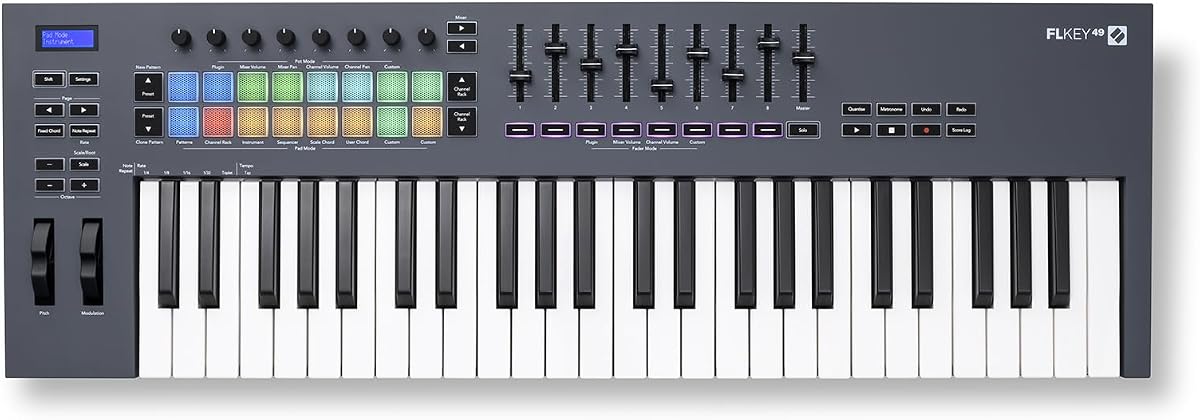
The Novation FLkey 49 is purpose-built for producers who work primarily in FL Studio, and its 4.6 rating reflects a strong specialized control experience. It brings essential software operations into the hardware with a design that reduces mouse movement and makes the relationship between playing and beat programming more immediate.
We may earn a commission when you buy through this link, at no additional cost to you.
Eight pots and nine faders provide direct access to FL Studio's Mixer and Channel Rack, while dedicated buttons cover transport, score log, undo, redo, quantize, and metronome functions. Sequencer Mode maps the pads to the step sequencer, allowing patterns to be created or changed directly, and Two Pad mode introduces variation that helps rhythms move away from a rigid grid.
The primary trade-off is specialization. A producer committed to FL Studio will appreciate the purpose-built layout, but musicians who regularly alternate among several DAWs may prefer a controller with more generic mappings. Scale mode and three chord modes improve musical usability, although they should be understood as composition aids rather than substitutes for developing harmonic knowledge.
The FLkey 49 is a strong recommendation for a beat producer who wants tactile control over FL Studio and particularly values the connection between keyboard playing and step sequencing. It is also well suited to composers who want the mixer and arrangement tools close at hand. Within that software environment, it delivers a focused workflow that few general-purpose controllers reproduce as directly.
The nine faders and eight pots are mapped to core FL Studio controls, allowing volume and pan changes to be performed directly. That physical access can make mixing adjustments quicker and more musical than navigating on-screen controls with a pointer.
Sequencer Mode turns the pad section into a direct interface for FL Studio's step sequencer. Two Pad mode offers a way to introduce variation into repetitive patterns, helping a programmed rhythm feel less mechanically uniform while keeping the workflow inside FL Studio.
We may earn a commission when you buy through this link, at no additional cost to you.
The M-Audio Oxygen Pro 49 is aimed at serious virtual-instrument players and producers who want a more expressive keybed than a lightweight practice controller can offer. Its 4.5 rating reflects a capable professional-style package, and 49 semi-weighted keys with aftertouch and assignable zones make it particularly interesting for nuanced, performance-oriented software instruments.
We may earn a commission when you buy through this link, at no additional cost to you.
The keyboard's 16 RGB backlit, assignable, velocity-sensitive drum pads support beat production, clip launching, and sound triggering. Eight assignable knobs and buttons, nine assignable faders, pitch and modulation wheels, sustain pedal input, and an arpeggiator create a broad tactile control surface. Five-pin MIDI output expands compatibility with hardware synths and other external MIDI equipment.
This greater flexibility introduces complexity. A musician interested only in typing notes may not need zones, aftertouch, or a large control surface. In addition, the included MPC Beats, Ableton Live Lite, AIR Music Tech virtual instruments, and Akai Professional MPC Expansion packs require downloads and setup through the manufacturer's website before the software is ready to use.
The Oxygen Pro 49 is a good recommendation for an experienced producer who performs virtual instruments, builds detailed arrangements, and wants physical control over a busy production environment. It is also compelling for musicians who still value traditional MIDI output alongside USB computer control. For expressive playing and comprehensive studio functionality, it offers a balanced and substantial toolset.
Semi-weighted keys respond to more than simple note-on commands, and aftertouch can add another layer of dynamic control when the connected software instrument supports it. Assignable zones let a musician split or layer different playing areas for different sounds, expanding the controller's usefulness in layered productions.
The five-pin MIDI output allows the controller to send conventional MIDI to compatible synthesizers, samplers, and other external devices. This matters for musicians building hybrid computer-and-hardware setups rather than limiting the keyboard to software-only production.
We may earn a commission when you buy through this link, at no additional cost to you.
The midiplus AK490 is a straightforward 49-note master keyboard for musicians who primarily need physical note control for a computer or external MIDI device. Its 4.3 rating is the lowest listed among the reviewed models, yet the basic feature set remains useful for users who value simplicity over software-specific control.
We may earn a commission when you buy through this link, at no additional cost to you.
Velocity-sensitive piano-style keys are supplemented by pitch and modulation wheels, octave buttons, and a sustain switch jack. DIN MIDI output adds compatibility with conventional hardware, and the supplied USB cable supports connection to a computer. The owner’s manual and cable are the listed package contents, keeping the setup uncomplicated.
A sustain pedal is not included, and the controller does not present the pad arrays, large knob banks, LCD feedback, or extensive DAW features found elsewhere in the list. Its lower listed rating may also indicate a less refined playing experience than models built around premium or semi-weighted keybeds. Users who rely on extensive expression may want to test the key response and wheel action carefully.
The AK490 is a sensible recommendation for a musician who wants an uncomplicated master controller for a software instrument, basic sequencing, or a hardware MIDI setup. It is particularly suitable for learners, classroom environments, and straightforward home arrangements where fast note entry matters more than extensive control. Its uncomplicated design makes it easier to begin with than a densely featured production controller.
Velocity-sensitive keys, pitch and modulation wheels, and octave controls cover the main physical actions required for controlling many software and hardware instruments. The layout avoids unnecessary complexity, which can help new users focus on playing and recording.
The DIN MIDI output and sustain jack broaden the controller's usefulness in a traditional MIDI signal chain. A separately purchased sustain pedal can complete the setup for musicians who want hands-free pedal control during a performance.
We may earn a commission when you buy through this link, at no additional cost to you.
The Arturia KeyLab mk3 is the premium selection in this guide because it combines a 49-key aftertouch keyboard with 12 pressure-sensitive performance pads, nine encoders, and multiple pedal inputs. Its 4.4 rating is respectable for a top-tier control surface, although it does not lead the group in overall user-rating value.
We may earn a commission when you buy through this link, at no additional cost to you.
Aftertouch is the defining musical feature, allowing supported virtual instruments to respond to changes in pressure after a key is pressed. The twelve pads add an expressive second dimension through pressure sensitivity, while the nine encoders provide dedicated access to continuous parameters. Sustain and auxiliary pedal inputs offer expanded hands-free control, and USB-C power provides a modern connection approach.
Premium hardware does not automatically deliver a superior experience in every workflow. Musicians whose virtual instruments do not respond to aftertouch may use only part of the keyboard's expressive potential, while the nine encoders and multiple pedals add a steeper learning curve than a simple controller. The model also sits in a higher cost tier, making value a valid concern for buyers.
The KeyLab mk3 is recommended for a serious performer or producer who wants the highest level of tactile expression in this category. It is especially relevant for ambient, cinematic, classical, electronic, and hybrid music where pressure and continuous control add meaningful nuance. For those users, its premium hardware turns advanced expression into an immediate part of the playing process.
Keyboard aftertouch can control volume, brightness, filter movement, or other parameters after the initial note begins. When paired with software that supports it, this allows a single held note to evolve continuously, much as an acoustic performance instrument can respond to changing pressure.
Twelve pressure-sensitive pads and nine encoders create a large tactile workspace for live control. Multiple pedal inputs further support hands-free operation, although musicians should map them carefully to avoid interrupting a complex performance with accidental changes.
We may earn a commission when you buy through this link, at no additional cost to you.
The right 49-key keyboard depends less on the number of features than on how you make music. Keybed feel, expression, DAW integration, control layout, portability, and included software should be matched to your priorities and technical setup.
Keybed feel is one of the most consequential features in a MIDI controller because it determines how naturally you can play virtual instruments. Velocity sensitivity is essential for dynamics, while semi-weighted or premium action can offer a more realistic response when moving between a controller and a stage-oriented or weighted piano. The Keystation 49 MK3 and Oxygen 49 MKV use full-size velocity-sensitive keys, the Oxygen Pro 49 uses semi-weighted keys, and the premium KeyLab mk3 adds aftertouch. The supplied information does not describe the key weighting for every model, so buyers should consider trying the feel rather than assuming that all 49-key controllers feel alike.
A controller can send the same MIDI data as any other keyboard, but dedicated DAW integration determines how naturally the knobs, faders, buttons, and pads control the application. The FLkey 49 is designed around FL Studio, while the Launchkey 49 MK4 supports major DAWs including Ableton Live, Logic, Cubase, Reason, Reaper, FL Studio, and Ardour. The Oxygen models include auto-mapping, and the Essential KeyLab mk3 provides custom scripts for several applications. The Nektar SE49 also offers DAW integration. If you already know which DAW you use, choose the controller whose mapping is strongest for that environment rather than paying for generic controls that will need extensive configuration.
The number of hands-on controls determines how much of your software can be operated from the instrument. Dedicated drum and clip pads are valuable for beat makers, while knobs and faders are valuable for instrument parameters, mixing, and effects. The Oxygen 49 MKV and Oxygen Pro 49 each provide 16 velocity-sensitive pads, eight knobs, and nine faders. The FLkey 49 has eight pots and nine faders optimized for FL Studio, and the KeyLab mk3 includes nine encoders and 12 pressure-sensitive pads. More controls increase capability, but they also make the surface denser, so consider whether you will actually use them.
Expression controls include pitch, modulation, aftertouch, and pedal inputs, and they can have a major effect on realism. Pitch and modulation wheels appear on the Keystation 49 MK3, Oxygen 49 MKV, Oxygen Pro 49, and midiplus AK490. The premium KeyLab mk3 adds aftertouch along with sustain and auxiliary pedal inputs. The midiplus AK490 has a sustain jack but does not include a pedal. Consider the instruments and effects you use, because not every virtual instrument supports every type of expression. A controller is most useful when the connected software can respond to the controls it provides.
Bundled software can determine how quickly a new controller becomes useful, but quantity should not be confused with value. The Keystation includes MPC Beats, Ableton Live Lite, several virtual instruments, and lessons. The Essential KeyLab mk3 includes Analog Lab V, two pianos, Loopcloud, and Melodics subscriptions. The Oxygen 49 MKV includes MPC Beats, Ableton Live Lite, AIR Music Tech instruments, and MPC expansion packs. The Launchkey 49 MK4 offers Ableton Live Lite, Cubase LE, Novation Play, GForce, Klevgrand, Orchestral Tools, and Native Instruments sounds. Check activation requirements, operating-system compatibility, and whether you already own equivalent software before choosing primarily for the bundle.
Most modern 49-key controllers rely on USB for computer control, but compatibility details still matter. The Keystation 49 MK3 works with Mac or PC without drivers or a separate power supply and can work with iOS through an Apple to USB Camera Adapter sold separately. The Nektar SE49 supports Mac, PC, and iOS. The KeyLab mk3 lists USB-C power, while the midiplus AK490 includes a USB cable and a DIN MIDI output. The Oxygen Pro 49 adds five-pin MIDI output for hardware use. Confirm the connector, cable requirements, power arrangement, and device compatibility before ordering, particularly if your workflow depends on mobile sequencing or a traditional MIDI signal chain.
A 49-key controller is already smaller than a full piano, but models with pads, displays, and multiple control banks can still occupy substantial desk space. The basic 49-Key MIDI Keyboard Controller has listed dimensions of approximately 66 by 11.4 by 3.5 centimeters and is positioned as a compact desktop option. The Keystation 49 MK3 also emphasizes a compact design for desks, studios, or stages. Producers who travel should consider both the body size and the need to carry cables, pedals, and other accessories. A workstation with a broad control surface may suit a permanent studio better than a small practice room or shared teaching space.
The most advanced controller is not automatically the easiest to use. The FLkey 49 is immediately focused for FL Studio users, while the Launchkey 49 MK4, Oxygen models, and Essential KeyLab mk3 provide various mapping, scale, chord, and arpeggiation tools. A simple master keyboard such as the midiplus AK490 offers fewer decisions but fewer ways to accelerate production. Beginners may benefit from a moderate interface with guided software, while experienced producers may value programmable pads and faders enough to accept a steeper initial setup. Think about the tasks you perform most often and choose a workflow that supports them without burying useful features behind unnecessary complexity.
Begin by connecting the controller to the computer with the specified USB cable, then open the DAW or MIDI application and select the keyboard as its input. Confirm that MIDI activity reaches the application by playing a few notes and monitoring their velocity. For devices with pads, wheels, knobs, or faders, assign only a small set of functions at first and learn their locations before expanding the mapping.
Use Scale, Chord, or arpeggiation modes as temporary composition aids rather than permanent replacements for musical understanding. In a DAW-focused model, begin with the supplied integration templates, then adjust the transport, mixer, and pad mappings to match your project. If the controller supports traditional MIDI output, configure the external device to receive on the appropriate channel and test the connection before rehearsing with layered hardware.
For care, place the keyboard on a stable surface and avoid stacking heavy objects on the keybed. Keep the controller away from moisture, direct heat, and excessive dust, and use a soft dry cloth rather than harsh liquid cleaners. Store it in its case or in a protected area when it is not in use, route cables without creating strain at the connectors, and clean the keys and controls periodically. Download the required firmware and software updates from the manufacturer's official website, and never interrupt an update while it is in progress.
A 49-key MIDI keyboard is primarily a controller that sends performance data to a computer or other MIDI device. It generally focuses on note input, expression, and software control rather than producing sound through built-in speakers.
A 49-key digital piano is designed to make sound directly and usually includes a more piano-oriented action, built-in instruments, and speakers. Some modern models can also send MIDI, but they serve a different primary purpose.
Yes, for many songwriters, producers, and performers, 49 keys provide a useful middle ground between a small practice controller and a full-size keyboard. The range is adequate for many melodies, chords, and bass parts, particularly in combination with octave controls.
Certain pianists may prefer 61 or 88 keys for larger repertoire, while electronic musicians may find 49 keys ample. Your software, playing style, and physical space requirements are the best guides when choosing a size.
Velocity sensitivity is valuable because it lets the controller communicate how loudly or softly a note is played. Virtual instruments can use that information to vary volume, brightness, attack, and other characteristics.
It is especially useful for piano, strings, drums, and other sounds that respond dynamically. A non-velocity model can still be practical for sequencing, but it offers less expressive control.
Velocity describes the initial force of a key press and is generally captured once when the note begins. Aftertouch measures pressure or movement after that initial event, allowing a held note to continue evolving.
Aftertouch can control filter movement, volume, vibrato, or other parameters, but the connected software instrument must support it. Controllers with aftertouch also tend to place greater emphasis on expressive performance rather than only basic note entry.
Almost all modern DAWs can receive standard MIDI notes from a compatible keyboard. The more important question is whether the controller includes mappings for that DAW's mixer, transport, plugins, or pads.
The FLkey 49 is specifically designed for FL Studio, while the Launchkey 49 MK4 supports a range of major DAWs. Other models may provide generic MIDI, auto-mapping, or custom scripts, so check the compatibility details before buying.
A sustain pedal is useful for holding notes and chords while playing other notes, and many virtual instruments respond to the standard MIDI sustain message. It is particularly important for piano, organ, strings, and ensemble sounds.
Several models provide a sustain pedal input, but the midiplus AK490 does not include a pedal. A compatible pedal would need to be purchased separately. The essential KeyLab mk3 also supports an auxiliary pedal for additional control.
The included bundles generally provide a useful starting point, with virtual instruments, DAW editions, lessons, or sound libraries that can be explored immediately. Their value depends on your existing software and the type of music you intend to make.
Some bundles require account creation, downloads, or activation before use. Artists who already own major DAWs and a suitable sound library may prioritize hardware feel and control instead, while beginners may get more immediate benefit from a generous starter package.
Drum pads are valuable if you program rhythms, launch clips, trigger samples, or want a more tactile way to build beats. Models such as the Oxygen 49 MKV, Oxygen Pro 49, FLkey 49, and KeyLab mk3 provide pad-based workflows.
A musician focused mainly on melodic composing may be happy with a simpler keyboard. Pads add useful creative options, but their value depends on whether the associated software modes and mappings fit your production process.
The Novation Launchkey 49 MK4 stands out as the most versatile all-purpose option, with a premium keybed, 16 FSR pads, and integration for major DAWs. The Nektar SE49 is the most practical value choice for essential control, while the Arturia KeyLab mk3 takes the premium route with aftertouch, pressure-sensitive pads, nine encoders, and multiple pedal connections.
Prioritize the parts of the workflow you use every day. FL Studio producers should examine the FLkey 49, beat makers may prefer the Oxygen models, and players focused on expressive virtual instruments should investigate the KeyLab mk3 or Oxygen Pro 49. A simpler model can be more appropriate when fundamentals, compact dimensions, and an uncluttered interface matter most.
Before purchasing, verify current specifications, software compatibility, included accessories, and the latest retailer information because configurations and offers can change. Checking those details against your computer, DAW, virtual instruments, workspace, and performance needs will lead to the most dependable long-term match.