
Garpsen Clip-On Grow Light for Indoor Plants, 52 LEDs, Full Spectrum
4.7Editor score
52 full-spectrum LED bulbs
Five brightness levels
Three color modes
Six, twelve, sixteen-hour timer
Clip or soil-insertion setup
Clip on LED Grow Lights guide compares light output, spectra, timers, dimming, adjustability, coverage, and power options for healthy indoor plant growth.
Clip on LED grow lights bring supplemental illumination to indoor plants without requiring a permanent ceiling fixture or a large freestanding setup. A secure clip, adjustable neck, full-spectrum output, and automatic timer can make them especially useful for desk collections, seed starts, herbs, succulents, and flowering plants that need more light than a room provides.
We compared the ten products in this guide by examining their lamp configuration, spectral features, brightness controls, timer options, gooseneck flexibility, mounting methods, heat-management claims, and intended plant applications. The list covers compact pot lights, dual-head fixtures, multi-pack options, and brighter units with replaceable bulbs or more specific light-output measurements.
Each review identifies the strongest reasons to choose a particular model and the compromises worth considering before buying. The top selections represent different priorities: convenient value, versatile control, and stronger specialist performance. Product listings, features, and prices can change, so readers should confirm current specifications and availability before ordering.
4.7Editor score

4.6Editor score

4.4Editor score
The comparison chart highlights the principal differences among these clip-on grow lights, including lamp output, mounting flexibility, lighting controls, and specialty features. It is designed to help readers match a fixture to their available space, plant types, and preferred level of automation.




This two-pack stands out for sheer configuration. Each light combines white and red LEDs, a four-head gooseneck, three spectral modes, ten dimming levels, and automatic timing. That breadth makes it a practical one-light solution for anyone managing several pots or a mixed collection with different lighting needs.
We may earn a commission when you buy through this link, at no additional cost to you.
The ten brightness levels provide finer control than most competing fixtures. Users can select red for flower, fruit, and leaf development, white for vegetative growth, or a combined mode intended to imitate sunlight. The four adjustable heads spread illumination over a broader area than a single circular lamp could cover, while the sturdy clip supports the multi-arm structure.
Its main trade-off is physical bulk. A four-head design with two bars requires room above the plant and can look less discreet in a small office or living area. The timer offers the familiar three, nine, and twelve-hour settings, which are useful but less distinctive than the six, twelve, and sixteen-hour alternatives offered by some competitors.
Choose this model when you want extensive manual and automatic control in one package. It is especially suitable for a plant shelf, compact indoor garden, or collection where different plants benefit from varied brightness levels. For one small decorative pot, however, a less expansive single-head light may be easier to position.
Ten dimming levels make it possible to reduce output for seedlings and delicate plants while retaining higher settings for mature specimens. This is more adaptable than the five-level controls common in this category.
The flexible gooseneck and four heads can direct light toward separate parts of a plant or across neighboring pots. This makes the two-pack suitable for shelves and small indoor growing areas.
We may earn a commission when you buy through this link, at no additional cost to you.
This 96-LED model combines a distinctive dual-halo design with the broad controls expected from a capable indoor grow light. It includes 90 white LEDs and six red LEDs, three modes, five brightness levels, and a cycle-memory timer with six, twelve, or sixteen-hour options.
We may earn a commission when you buy through this link, at no additional cost to you.
The circular aluminum lampshade supports heat dissipation, while the anti-slip clip is intended to hold the fixture securely on a pot or other support. A 360-degree gooseneck allows the halo to be angled toward the plant. The extended cord also provides more freedom in arranging the lamp around a desk or plant stand.
Five dimming levels offer less granularity than the ten-level model in first place, and the dual circular head may take up more visual space than a conventional bar. Nevertheless, the unusual six, twelve, and sixteen-hour timer choices can be useful for households that do not want to operate a light on a nine-hour schedule.
This is an attractive choice for a reader who values a modern appearance, flexible scheduling, and a light that can function as supplemental plant illumination. It works particularly well for flowers, herbs, seedlings, vegetables, fruits, and succulents in homes, offices, balconies, or greenhouse-like spaces.
The six, twelve, and sixteen-hour settings differ from the most common three, nine, and twelve-hour options. That gives users more scheduling choices for workdays, overnight routines, and vacation periods.
An anti-slip clamp and adjustable aluminum-bodied lamp help the fixture remain in position. The long cord reduces the need to place the light directly beside a wall outlet.
We may earn a commission when you buy through this link, at no additional cost to you.
This SANSI model is the most technical option in the group, combining a 20-watt output with a stated PPFD of 402 micromoles per second per square meter at one foot. Its secondary optical design is intended to improve light distribution, while the 360-degree gooseneck can surround a plant with light.
We may earn a commission when you buy through this link, at no additional cost to you.
Replaceable bulbs distinguish it from fixtures that require the entire lamp to be replaced after a failure. SANSI's ceramic heat-transfer technology is designed to move heat away from the LED chip efficiently, and the stated 25,000-hour lifespan applies to the grow bulbs. The 4000K output and color-rendering index near 100 are also more specific than many competing listings.
The fixture uses more power than low-wattage pot lights, and the product information notes a ten-watt maximum safety rating for each head. Buyers should also distinguish the stated twenty-watt system output from the per-head limit. Despite those considerations, replaceable bulbs and quantified light output are meaningful advantages for long-term users.
This is the pick for a serious indoor gardener who wants stronger, more precisely positioned light and values serviceability. It suits plants requiring concentrated supplemental illumination, including seedlings, flowers, vegetables, fruits, and succulents. Buyers seeking the simplest possible control panel may prefer one of the multi-mode models.
A stated PPFD of 402 at one foot gives shoppers a more concrete basis for comparison than LED counts alone. This figure is particularly relevant when choosing a light for demanding indoor plants.
Replacing a failed bulb avoids discarding the complete gooseneck assembly. The design therefore supports continued use and reduces the need to repurchase an entire fixture.
We may earn a commission when you buy through this link, at no additional cost to you.
The bseah light is a straightforward full-spectrum fixture centered on automatic operation and precise brightness adjustment. It provides three switch modes, ten dimming levels, and a three, nine, or twelve-hour cycle-memory timer for consistent daily lighting.
We may earn a commission when you buy through this link, at no additional cost to you.
A flexible 360-degree gooseneck makes it possible to reposition the lamp as a plant changes or as neighboring foliage blocks the original angle. The clip format suits a desk, plant stand, or pot without requiring permanent hardware. The three modes are designed to accommodate different growth stages, while the ten levels allow gradual reduction or increase in intensity.
Its timer choices are common across the category, and the listing does not provide a specific PPFD measurement or detailed lumen output. Those omissions make direct technical comparisons with SANSI or Barrina more difficult. For shoppers who prioritize everyday usability rather than laboratory-style specifications, that is not necessarily a significant drawback.
This model is best for an indoor gardener who wants automatic daily lighting, numerous dimming choices, and simple positioning. It is a sensible option for a single plant or small grouping where the main requirements are spectrum, adjustability, and a dependable clip-on format.
The stepped dimming range gives users more control than basic on-and-off fixtures. Lower output can suit young plants, while higher settings are available for mature growth.
Once configured and kept connected to power, the cycle-memory timer repeats the same daily schedule. This reduces the need to switch the lamp on and off manually.
We may earn a commission when you buy through this link, at no additional cost to you.
This SANSI two-pack offers a convenient way to illuminate two small plants without installing permanent equipment. Each five-watt pot light includes a flexible gooseneck, clamp, four brightness settings, and a three, six, or twelve-hour timer.
We may earn a commission when you buy through this link, at no additional cost to you.
The stated output of 35.78 micromoles per second per square meter at six inches is positioned as efficient growth power in a compact format. The lights use five-volt low-voltage power and can be connected to a power bank, laptop, or computer. Their 4000K color is intended to resemble natural daylight without appearing excessively intense.
The obvious limitation is scale. A five-watt light is intended for potted plants such as succulents, aloe vera, devil's ivy, calibrachoa, and African violets rather than replacing a large room-lighting system. Four dimming levels are less granular than the controls on some competitors, and two separate units require two appropriate power connections or hubs.
This set is a strong fit for a desk containing multiple compact plants. It gives buyers two independently positionable lights, a tidy pot-clamp installation, and automatic scheduling without a large fixture. It is less suitable for a single expansive plant that needs a wide area of intense illumination.
Two lights can serve separate pots on a desk or plant stand. Their individual goosenecks make it easier to aim each light at a different canopy than using one broad fixture.
Five-volt operation allows connection to common USB-powered devices or power banks. This can simplify setups where a nearby wall outlet is inconvenient.
We may earn a commission when you buy through this link, at no additional cost to you.
This 5W two-pack shares the core configuration of the other SANSI pot light: ceramic-based LED technology, 4000K daylight color, four dimming levels, a 360-degree gooseneck, and 3/6/12-hour cycling. It adds the appeal of matching lights for a coordinated indoor display.
We may earn a commission when you buy through this link, at no additional cost to you.
The stated growing power is 35.78 micromoles per second per square meter at six inches, and the product information positions the five-watt output as efficient compared with similar ten-watt alternatives. The pair can be clipped to pots, desks, plant stands, or hanging arrangements without adding separate parts that might damage plants.
Like the preceding SANSI pot set, it offers fewer dimming steps than products with five or ten levels, and its output is aimed at small indoor plants rather than a dense seedling rack. The USB-style low-voltage power arrangement can also require careful cable management if both lights are positioned far from a power source.
This model is well suited to home offices, desks, and small plant groupings where two attractive, coordinated fixtures are useful. Choose it over a single-light option when you want consistent coverage across multiple pots and appreciate the included service and listed safety verification.
Matching lights create a consistent appearance across several pots. Each unit can be angled independently, providing practical coverage without a large bar extending over the entire group.
The five-watt output and close-range specification align best with compact houseplants. Larger specimens may benefit from a more powerful directional fixture.
We may earn a commission when you buy through this link, at no additional cost to you.
The wolezek 2-in-1 light is defined by installation flexibility. It can be clamped to a pot or inserted into the soil, giving users a way to raise the lamp above crowded foliage or position it closer to a developing plant. A 360-degree gooseneck further improves directional control.
We may earn a commission when you buy through this link, at no additional cost to you.
Three spectral options cover readings from 660 nanometers to 6500K, five brightness levels adjust the intensity, and the timer offers six, twelve, or sixteen hours. The aluminum alloy housing is designed to dissipate heat efficiently, while the 80.7-inch cord gives users more freedom to find a reachable outlet.
Soil insertion requires caution around tender roots, and the listing does not state a PPFD or lumen figure, making it harder to compare raw output with more technical competitors. The three color options also differ in function from a simple full-spectrum-only approach, so buyers should understand what mode best matches their plant and preferred viewing conditions.
This is a good option for a gardener who wants one lamp to serve several mounting situations. It works well for seedlings, potted plants, and compact indoor gardens where raising or lowering the source can solve a difficult lighting angle. Buyers focused on published light measurements may prefer SANSI or Barrina.
Clamping is useful when a pot rim provides stable support. Soil insertion can raise the light above a dense canopy, although insertion should be performed carefully to avoid damaging roots.
Three color modes, five brightness levels, and 6/12/16-hour timing allow users to adapt the light across plant stages. The longer cycle choices are useful for consistent overnight or extended operation.
We may earn a commission when you buy through this link, at no additional cost to you.
Barrina's OG11A2 is among the most specification-rich products in the guide. It combines a 22-watt rating, 1550 lumens, 36 high-efficiency chips, 5000K full-spectrum output, a CRI of 98, and a stated PPFD of 1980.5 micromoles per square meter per second at 3.94 inches.
We may earn a commission when you buy through this link, at no additional cost to you.
Unlike fixtures controlled by a small set of preset steps, the integrated stepless dimming allows continuous brightness adjustment. Each bulb has its own timer panel, with four, eight, or twelve-hour options, which provides useful control in multi-lamp arrangements. A flexible gooseneck directs the light, and the E26 base permits bulb replacement.
The light requires a minimum seven-inch distance above the plant canopy to reduce overheating risk, so it needs more clearance than a compact pot lamp. Its power draw is also higher than that of the five-watt SANSI products. Those demands should be weighed against the more concentrated output and unusually detailed measurements.
This model is a strong candidate for experienced indoor growers who want stepless control, replaceable bulbs, and clear technical guidance. It is suitable for grow tents, shelves, and tabletop gardens where the plant canopy can accommodate the specified clearance and the grower's setup benefits from precise direction.
Lumens, PPFD, CRI, wattage, chip count, and mounting distance are all stated. These details make the model easier to evaluate against other technically specified grow lights.
Stepless dimming offers more precise control than fixed brightness presets. Independent controls on each bulb are also useful when lamps illuminate plants at different stages.
We may earn a commission when you buy through this link, at no additional cost to you.
This ten-watt SANSI pair delivers more output than the five-watt versions while retaining the same basic pot-clip format. The product information states 169.7 micromoles per second per square meter at six inches, positioning the lights for stronger supplemental coverage of indoor potted plants.
We may earn a commission when you buy through this link, at no additional cost to you.
Each lamp has a flexible 360-degree gooseneck, four brightness levels, and a built-in timer with three, six, or twelve-hour cycles. The product emphasizes even light distribution as a way to avoid uneven illumination and leggy growth. A two-year protection plan and online support add reassurance for long-term owners.
Compared with the five-watt SANSI set, this pair draws more power and provides fewer dimming steps than models offering five or ten. The stated PPFD is measured at a close six-inch distance, so buyers should still allow reasonable space between the lamp and foliage rather than assuming the same performance at greater distances.
This is a strong choice for users with medium-sized potted plants who want two directional lights but do not need a large freestanding fixture. It is particularly useful for succulents, aloe vera, devil's ivy, calibrachoa, African violets, and other indoor plants that benefit from close, even supplemental illumination.
The ten-watt output provides a middle ground between low-power pot lights and larger directional fixtures. The two-pack lets users cover separate plants while maintaining an uncluttered setup.
SANSI's ceramic technology and secondary optics are designed to distribute light more evenly. Even coverage is valuable for plants that may otherwise stretch toward a narrow light source.
We may earn a commission when you buy through this link, at no additional cost to you.
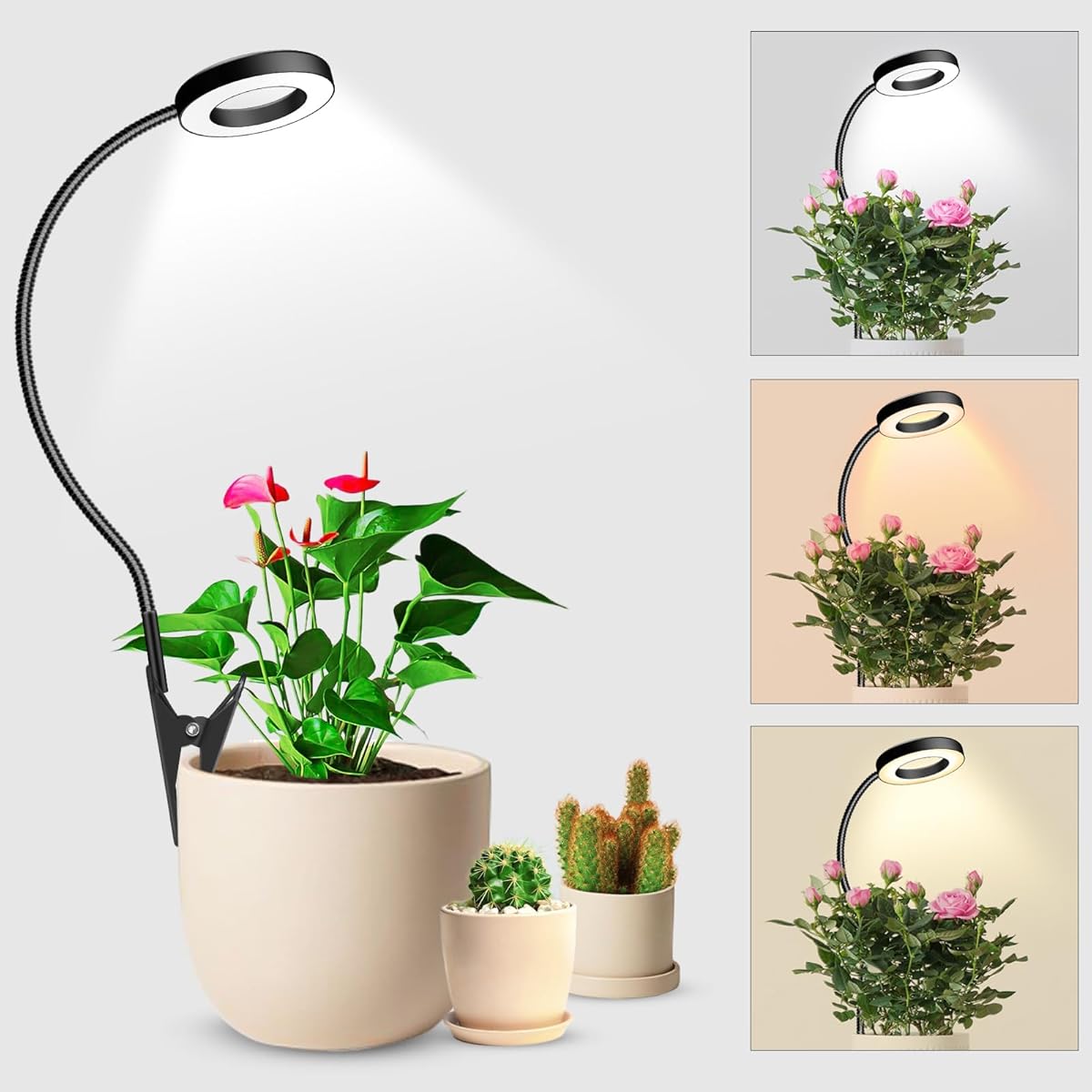
The Garpsen light is a well-rated, accessible option for small indoor plants. Its 52 LEDs produce 6000K full-spectrum light, and the fixture can be clipped to a flower pot or table or inserted into potting soil using the included additional mounting option.
We may earn a commission when you buy through this link, at no additional cost to you.
A smart controller provides five brightness levels, three color modes, and automatic timing at six, twelve, or sixteen hours. The 21-inch gooseneck extends from a rectangular head and rotates 360 degrees, making it possible to position the light over a plant or beside a pot. The ten-foot cable also provides generous reach.
Unlike the SANSI and Barrina options, Garpsen does not publish a PPFD, lumen, or CRI figure in the supplied information. Its LED count is also lower than the models advertising 96 or 168 bulbs. However, LED count alone does not describe total quality or intensity, and the fixture's long neck and multiple controls remain useful for compact setups.
Choose this model for a home gardener who wants straightforward full-spectrum supplementation for flowers, herbs, mint, succulents, seedlings, and bonsai. It is a particularly good match for small plants that need a light positioned over the canopy, while its work-light and reading-light function adds value outside plant care.
The clip provides a stable pot or table mount, while the soil-insertion option can bring the source closer to a plant. Both approaches support different shelf and desk arrangements.
The 21-inch neck and 360-degree rotation offer substantial reach over a pot. A ten-foot cord helps the fixture connect to a power source without forcing an awkward placement.
We may earn a commission when you buy through this link, at no additional cost to you.
The right clip-on grow light depends on plant size, available clearance, mounting conditions, and the degree of automation desired. Comparing these factors before buying helps prevent a light that is too weak, too bulky, or difficult to position.
Begin by considering the area the plant actually occupies. A compact five-watt pot light may suit a small succulent or desk herb, while a dense seedling collection or broad plant canopy needs a stronger directional source. LED count, wattage, lumens, and PPFD provide different ways to compare output, and no single figure tells the entire story. PPFD is especially useful for estimating light intensity at a stated distance, while lumens describe overall brightness and wattage indicates electrical consumption.
Choose output that matches the plant and space. A high-powered light can overwhelm a small setup or create unnecessary heat, while a low-output fixture may be too weak for vigorous growth. Confirm the recommended distance and compare coverage against the plant's canopy.
Full-spectrum output is intended to provide a broad range of wavelengths for multiple plant processes. Some products also separate red and white modes, allowing users to emphasize flowering, fruiting, vegetative development, or a combined spectrum. Three color temperatures or spectral modes offer useful flexibility, but mode names do not always tell buyers exactly how the diodes are distributed.
Look for clear explanations of each mode and select a light that gives you useful choices for different plant stages. A combined full-spectrum setting is convenient for general care, while dedicated modes can help tailor light to changing needs.
Dimming controls determine how easily output can be adapted as a plant develops. Preset levels are simple and predictable, while stepless adjustment allows more precise changes. Automatic timers are valuable for busy households, vacations, and consistent routines. Three, nine, and twelve hours are common, but six, sixteen, and other longer cycles may better suit a particular schedule or location.
Prioritize a timer with an automatic cycle memory and enough duration options for your routine. If several plants need different schedules, independently adjustable lamps are more useful than one shared controller.
A secure clip should hold the lamp without damaging the pot, and a flexible gooseneck should let you aim the source without constantly moving the base. Some lights can also be inserted into soil, which is useful when foliage sits below the rim. Long goosenecks and extended power cords offer more freedom but can make the setup less tidy.
Check the included mounting hardware and the stability of the selected surface. Measure available clearance before buying, and ensure the lamp can be positioned above or beside the plant without obstructing daily care.
LEDs generate heat even though they are more efficient than many traditional sources. Aluminum housings, circular shades, ceramic substrates, and combined plastic-and-aluminum cooling systems are used to move heat away from the LEDs. A well-designed fixture should also provide a minimum distance from the plant canopy when its output is high enough to create a meaningful heat load.
Give the lamp room to dissipate heat and avoid pressing a warm housing directly against leaves. Follow the stated clearance guidance, especially for high-output models, and do not treat a grow light as a substitute for the ventilation required by a dense indoor garden.
Power requirements affect where a light can be installed. Low-voltage models can often use a power bank, laptop, or other compatible USB power source, which is helpful on desks. Higher-output fixtures generally require standard mains power and offer stronger light in exchange for greater electricity consumption. Cord length also matters when the nearest outlet is inconvenient.
Check voltage, connector type, and cord length before purchase. Choose low-voltage power for portable setups, but select a higher-output mains fixture when a plant needs stronger illumination and the location supports it.
Replaceable bulbs can extend the useful life of a fixture because a failed light does not require replacing the entire clamp, neck, and controller assembly. E26 bases also offer some compatibility with other grow bulbs. Warranty length, certification listings, and available support are additional indicators of manufacturer confidence, although they should not replace an assessment of the light's fit for a particular plant.
Look for documented service periods and replaceable components when longevity matters. Also consider whether replacement parts are likely to remain available after the initial purchase.
Different plants have different needs, and a single houseplant light may not work equally well for every collection. Succulents and compact foliage plants can often use modest close-range light, while seedlings, herbs, vegetables, and flowering specimens may benefit from stronger output, broader coverage, and longer daily cycles.
Match the lamp to the most demanding plants you intend to grow. If multiple types share the setup, favor several modes, multiple brightness levels, and an adjustable neck so one fixture can be reconfigured as conditions change.
Start by selecting a stable location and inspecting the clamp, gooseneck, cord, and controls. Attach the light to the pot, shelf, or another suitable support, then angle the head toward the area where leaves are growing. For soil-insertion models, insert the stake carefully and avoid placing it against major roots. Leave the recommended clearance between the lamp and the canopy, particularly with higher-output fixtures.
Choose a spectrum and brightness appropriate to the plant and its current stage. Use lower intensity for seedlings, delicate shoots, or plants showing stress, and increase output gradually as the plant becomes established. Set the timer according to the plant's needs and your available natural light. Because a cycle-memory timer repeats its schedule, changing the duration generally requires reconfiguring the control.
Check the plant's response rather than assuming more light is always better. Look for new leaves, compact growth, and normal color, and adjust the angle or distance if leaves lean, appear discolored, or show signs of heat stress. Wipe the lamp with a dry or lightly damp cloth after it has cooled, avoid spraying liquid into the fixture, and inspect the clamp periodically so the lamp does not slowly shift position.
Yes, clip-on LED grow lights are well suited to houseplants that receive inadequate natural light or need supplemental illumination. They work particularly well for compact specimens, desk plants, seedlings, and herbs. Plants with dense canopies or heavy flowering or fruiting requirements may need a stronger, broader light source.
The correct distance depends on the lamp's output and design. Compact low-wattage pot lights often work close to small plants, while high-output models may require several inches of clearance to dissipate heat. Follow the product's distance guidance and adjust if leaves show signs of heat stress.
A longer schedule is not automatically better. Indoor plants benefit from a consistent light period, and many clip-on models offer timed cycles for this reason. Consider the plant's needs and the amount of natural light it already receives, then use the shortest suitable schedule that meets those needs.
A single fixture can illuminate nearby plants if its beam and output reach them, but larger or more demanding specimens may compete for light. A multi-head, two-pack, or multi-bulb setup usually provides more even coverage. Individual lights can also be aimed at separate plants for better control.
PPFD measures the density of photosynthetically active light reaching a surface, making it useful for estimating plant illumination at a stated distance. Lumens describe visible brightness for human perception, while LED count simply reports the number of diodes. None should be considered alone, because diode efficiency, optics, heat management, and fixture design also affect performance.
They can become warm, particularly at high brightness and close mounting distances. Models with aluminum or ceramic heat-transfer components are designed to dissipate heat more effectively. Maintain clearance, avoid blocking ventilation, and stop or reduce output if leaves show scorching or excessive heat.
Several models are described for balconies, greenhouses, grow tents, darkrooms, and indoor shelves. Their suitability depends on available power, ventilation, humidity exposure, and the fixture's stated conditions. Indoor-rated models should be protected from water and excessive moisture even when used in a protected growing area.
Replaceable bulbs can save money and waste over time because only the light source needs replacement if it fails. They are especially attractive for clamp-on fixtures, where the clamp, gooseneck, controls, and cord are otherwise functional. Confirm that the replacement uses the correct base, wattage, voltage, and intended spectrum.
The Garpsen 52-LED model is a strong budget-oriented choice because it combines a dual mounting method, a long gooseneck, several color modes, and flexible timing. The 96-LED halo model is the editor's choice for its more distinctive illumination design and unusual timer options, while the SANSI 20W fixture leads the premium group through quantified output, replaceable bulbs, and ceramic heat-transfer technology.
Prioritize the factors that affect your actual setup: enough output for the plant, stable mounting, proper clearance, usable controls, and a power source you can reach. A compact five-watt pair may be ideal for two small pots, whereas a technically specified directional light is more appropriate for demanding plants and a carefully planned grow area.
Before ordering, verify the current product details, included accessories, electrical requirements, and plant-specific guidance. Product specifications and prices can change, so current listings are the best source for final confirmation. The right fixture is the one that fits the plant, the available space, and a routine you can maintain.
