
10-Inch Heavy Duty Cable Cutter
4.6Editor score
Cuts up to 1-inch coax
Handles battery and communications cable
Includes finishing accessories
A coaxial cable cutter must do more than sever a cable. The right tool controls blade pressure, preserves the conductor, minimizes jacket deformation, and can handle the recurring preparation demands of residential installations, telecom work, and field service. A good cutter should feel controlled, leave clean edges, and suit the cable types encountered in your work.
This guide compares ten cable-cutting and stripping tools across essential considerations such as maximum cable capacity, cutting mechanism, included functions, blade adjustability, handle design, and intended applications. It includes dedicated coax cutters, heavy-duty communications cable cutters, and multi-purpose stripper-cutter combinations for RG6, RG59, Ethernet, and larger hard-line installations.
Each review identifies the tool's strongest use case, practical advantages, and important limitations based on the supplied product information. The selections include budget-friendly general-purpose options, professional hardline cutters, and complete installation kits. Product availability and prices can change, so confirm current specifications and retailer listings before purchasing.
4.6Editor score

4.8Editor score

4.7Editor score
As an Amazon Associate we earn from qualifying purchases.
The comparison covers capacity, cutting approach, cable compatibility, and workflow usefulness. Dedicated hardline shears prioritize clean ends, while rotary and adjustable stripper-cutter designs offer broader preparation functions and kits consolidate several essential coax tools.


This 10-inch heavy-duty cable cutter combines high-leverage handling with a broad cutting range, earning a 4.6 rating. Its shear-type jaws are designed to grip coax, aluminum, copper, battery, and communications cable, making it a versatile choice when one tool must serve several kinds of field wiring.
We may earn a commission when you buy through this link, at no additional cost to you.
The reduced-effort design is especially useful for repeated cuts, while the jaw geometry is intended to produce smooth cable ends with limited fraying or deformation. Its stated capacity reaches 7/8-inch coaxial cable, 4/0 aluminum, 2/0 soft copper, and 100-pair 24 AWG communication cable. That makes it more versatile than a tool limited to residential RG6 or RG59.
Heat-treated carbon steel provides the core cutting strength, and a black protective coating is intended to resist rust and wear. The included ring terminals and heat-shrink tubes add value for jobs that continue from cutting into termination and finishing. The important limitation is explicit: this cutter is not intended for steel wire.
Choose this tool if you want one dependable cutter for a mixture of coax, electrical, automotive battery, and telecom cable. It is a particularly sensible option for installers who need more capacity than a compact residential stripper but do not require the tube-cutter-style precision of a dedicated hardline tool.
The broad capacity makes this cutter useful beyond standard RG6 work. Installers can move between coax, communications, copper, aluminum, and battery cable without changing tools, provided the selected cable falls within the stated limits.
Secure, shear-type jaw contact is intended to reduce fraying and keep cable geometry predictable. That matters when the cut must be centered, stripped, and terminated without unnecessary reshaping.
We may earn a commission when you buy through this link, at no additional cost to you.
The Jonard Tools JIC-755 is a dedicated hardline coax and fiber cutter with a 4.7 rating. Its defining feature is tube-cutter-like operation, which minimizes distortion and frayed ends while cutting coax up to one inch in diameter and similarly sized fiber cable.
We may earn a commission when you buy through this link, at no additional cost to you.
Construction combines chrome vanadium steel with induction-hardened cutting edges, emphasizing strength and durability in demanding cable-preparation work. Curved, plastic-dipped handles improve comfort and control, making the tool easier to use over a series of repetitive cuts.
The trade-off is specialization. This is a cutter for clean severing rather than an all-in-one stripper and cutter, and its tube-cutter approach is better suited to hardline than thin, flexible drop cable. The manufacturer also warns against using it on ACSR or other steel cable, so users must verify conductor construction before cutting.
For technicians who regularly terminate larger hardline systems or work with fiber cable, the JIC-755 is a strong professional choice. Its clean-cut design, substantial capacity, hardened edges, and limited lifetime warranty make it particularly compelling when cable appearance and end quality are priorities.
Instead of simply squeezing the cable flat, the operating style is intended to preserve the shape of the cable end. This reduces the compression and fraying that can complicate hardline preparation.
Chrome vanadium steel and induction-hardened edges address the two demands of heavy-duty cutting: a strong body and a cutting surface that withstands repeated contact. The warranty adds reassurance for professional users.
We may earn a commission when you buy through this link, at no additional cost to you.
The BOOSDEN 8-Inch Wire Cutters with Stripper offer a compact two-in-one approach to cable preparation. With a 4.4 rating, it offers practical functionality for copper and aluminum cable, combining cutting blades with integrated wire-stripping functions.
We may earn a commission when you buy through this link, at no additional cost to you.
The tool is manufactured from 65 manganese steel and uses precision dual-ground cutting blades. Spring-loaded construction supports balanced handling, while the smart plastic grips are designed to resist slipping when the tool is used to cut through cable sheaths.
Its most important limitation is electrical safety. The handles are not insulating, so power should be disconnected before use. It is also a general cable tool rather than a dedicated hardline shear, making it better suited to routine preparation than applications requiring a maximally square, undistorted end.
This BOOSDEN model fits installers who want to reduce the number of tools carried for common cutting and stripping tasks. It is a useful companion for standard service work, provided the operator follows the electrical precautions and keeps the tool within its intended material range.
Integrating a stripper with the cutter can shorten a basic preparation sequence. It also reduces tool clutter for technicians who repeatedly handle copper or aluminum conductors and cable jackets.
Spring-loaded action and slip-resistant plastic grips are intended to keep the tool stable and manageable. The compact format is helpful for basic residential and service applications.
We may earn a commission when you buy through this link, at no additional cost to you.
Klein Tools 63030 is a precision coaxial cutter built for aluminum and copper cable up to one inch in diameter. Its 4.6 rating reflects a strong balance of clean shearing, durable construction, and convenient one-hand operation.
We may earn a commission when you buy through this link, at no additional cost to you.
Precision-ground steel blades within a forged, heat-treated body are designed to withstand frequent cutting. The hot-riveted design requires no adjustment, while plastic-coated handles support comfort and grip. Instead of compressing or fraying the cable, the jaws use a controlled scoring method.
Operation takes two steps: first score the jacket with a back-and-forth motion until reaching the inner conductor, then squeeze the handles firmly to sever it. For drop wire with an internal steel conductor, Klein recommends diagonal-cutting pliers instead. That distinction should be checked before work begins.
The 63030 is a strong option for technicians who install larger aluminum or copper coax and prefer a dedicated one-hand shear. It combines a clean end with a straightforward, adjustment-free mechanism, making it especially useful for recurring hardline preparation.
The hot-riveted construction and precision-ground blades are designed to maintain smooth, consistent operation. Eliminating the need for periodic adjustment simplifies workflows where several cables may be prepared in succession.
Scoring the jacket before cutting the inner conductor helps manage compression. The process is deliberate, but it offers control over the finished cable end.
We may earn a commission when you buy through this link, at no additional cost to you.
The Cables Direct rotary coax tool is built for stripping and cutting common RG6 and RG59 coaxial cable, as well as RG58 and dual-wire applications. Its 4.2 rating makes it a practical choice for installers who primarily work with standard communications cable.
We may earn a commission when you buy through this link, at no additional cost to you.
A rotary mechanism provides consistent action around the cable jacket, reducing the need to manually coordinate a blade at different angles. The adjustable depth control lets users set the amount of jacket removed, which is useful when cable construction and connector preparation requirements vary.
Ergonomic handles are designed to improve control and reduce hand fatigue during prolonged use. The trade-off is scope: this is a focused coax preparation tool rather than a universal communications cable cutter, and it is not presented as a solution for large hardline or heavy copper and aluminum cable.
For residential coax work involving RG6 or RG59, this tool offers a straightforward combination of rotary stripping, cutting, and adjustable precision. It is best suited to technicians who want repeatable jacket removal without carrying a separate stripper for every cable type.
Turning the tool around the cable keeps blade engagement more uniform than a one-direction pull. Consistent engagement is valuable when every strip must follow the same preparation standard.
Depth adjustment allows the operator to accommodate different insulation requirements. It reduces the need to estimate how deeply the blade should score each cable.
We may earn a commission when you buy through this link, at no additional cost to you.
The trueCABLE tool is built for technicians who handle both communications coax and structured network cable. With a 4.6 rating, it supports Cat3 through Cat6A Ethernet, UTP, FTP, STP, and coax ranging from RG59 and RG6 through RG7 and RG11.
We may earn a commission when you buy through this link, at no additional cost to you.
Its infinitely adjustable stripping depth allows the installer to score jackets to suit different insulation thicknesses. Replaceable coax blade cassettes are designed to extend service life, and high-strength ABS construction with long-life springs supports repeated field use.
Two thoughtful additions set it apart from basic strippers. A Velcro cable comb helps separate braided shields more safely around the fingers, while a molded-in wire straightener addresses kinks in Ethernet conductors. These features are especially useful for network-cable preparation rather than simple coax cutting alone.
This is a strong choice for low-voltage and network installers who want one tool spanning multiple cable families. It is less appropriate as a dedicated heavy hardline cutter, but it offers excellent flexibility for common coax and Ethernet preparation workflows.
Compatibility across Ethernet and coax simplifies tool selection for installers moving between structured cabling and television or communications work. The supported range spans common residential and commercial standards.
The cable comb separates braided shields while reducing finger exposure, and the built-in straightener helps remove conductor kinks. These details support neater, more controlled preparation.
We may earn a commission when you buy through this link, at no additional cost to you.
The Klein Tools VDV026-211 Coax Installation Kit is the most complete option in this guide, combining a cable cutter, radial stripper, compression crimper, connectors, and a storage pouch. Its 4.8 rating is the highest among the selected products.
We may earn a commission when you buy through this link, at no additional cost to you.
The multi-cable cutter uses precision shear-type blades and curved, double-dipped comfort grips. The radial stripper provides two-level, one-step coax preparation with durable high-carbon steel blades, while the compression crimper is designed for F-connectors and includes a fixed plunger for quicker cable insertion and removal.
The included connectors cover common RG6, RG6Q, and RG59 termination needs, and the zipper pouch keeps the components organized. The tradeoff is that buyers seeking only one cutting tool are paying for a broader toolkit. The package is also centered on F-connector workflows rather than every possible connector or cable-preparation need.
This kit is the editor's choice because it covers the complete basic coax installation sequence with purpose-built tools. It is especially attractive to new technicians, service providers, and installers who want a ready-to-use set organized in one compact pouch.
The included cutter, stripper, crimper, and connectors allow a technician to move from raw cable to a prepared compression connection. This reduces the need to assemble essential tools from separate purchases.
Each primary tool is designed for a distinct stage of coax preparation. Separate radial stripping and compression crimping functions are easier to standardize than a single all-purpose mechanism.
We may earn a commission when you buy through this link, at no additional cost to you.
The BOOSDEN Heavy Duty Coaxial Cable Cutter is a ten-inch, long-handle option for copper and aluminum cable. Its 4.4 rating reflects straightforward construction aimed at users who want a dedicated cutting tool with added leverage and a storage latch.
We may earn a commission when you buy through this link, at no additional cost to you.
The body is forged from chrome vanadium steel and heat treated for durability. Long plastic handles offer a slip-resistant grip, while the extended length should make the tool easier to control when more force is needed than a short plier-style cutter can provide.
As with many general cable cutters, the handles are not insulating, and the power supply should be disconnected before use. It also focuses on cutting rather than stripping, so technicians still need a separate tool for connector-ready coax preparation. The latch is useful for keeping the tool closed in a pouch.
The BOOSDEN model is best for general copper and aluminum cable cutting where a long-handle format is preferred. It is a practical alternative to larger dedicated communications cutters, particularly for users who value the added latch and straightforward heavy-duty design.
A ten-inch design separates the handles farther from the cable than a compact tool. That geometry can improve control and reduce the effort required during a firm cut.
Forged chrome vanadium steel is intended to provide a durable cutting body. Heat treatment supports the tool's ability to withstand repeated cable work.
We may earn a commission when you buy through this link, at no additional cost to you.
Klein Tools 63050 is a heavy-duty cable cutter aimed at aluminum, copper, and communications cable. Its 4.6 rating and broad stated capacity make it especially relevant to telecom and electrical installers who regularly cut larger cable bundles.
We may earn a commission when you buy through this link, at no additional cost to you.
The tool cuts up to 4/0 aluminum, 2/0 soft copper, and 100-pair 24 AWG communications cable. Cable-gripping shear-type jaws support controlled cuts, and the one-hand action is paired with beveled jaw tips that are designed to preserve leading edges through repeated use.
Unlike many long-handle cutters, its compact construction is intended to fit in most tool pouches and work in confined spaces. Through-hardened cutting surfaces, rather than only case-hardened ones, are specified for longer-lasting performance. It remains a cutter, so coax stripping and connector preparation require other tools.
This is a strong selection for professionals who need communications-cable capacity without the bulk of a full-size compound cutter. It is particularly useful where portability, one-hand control, and repeated heavy-duty cutting are more important than integrated stripping.
The ability to cut 100-pair communications cable and substantial aluminum or copper conductors separates this model from compact residential coax tools. It targets demanding field cable preparation.
Despite its cutting capacity, the tool is designed to fit most pouches and operate in confined spaces. Beveled jaw tips and through-hardened steel support dependable repeated use.
We may earn a commission when you buy through this link, at no additional cost to you.
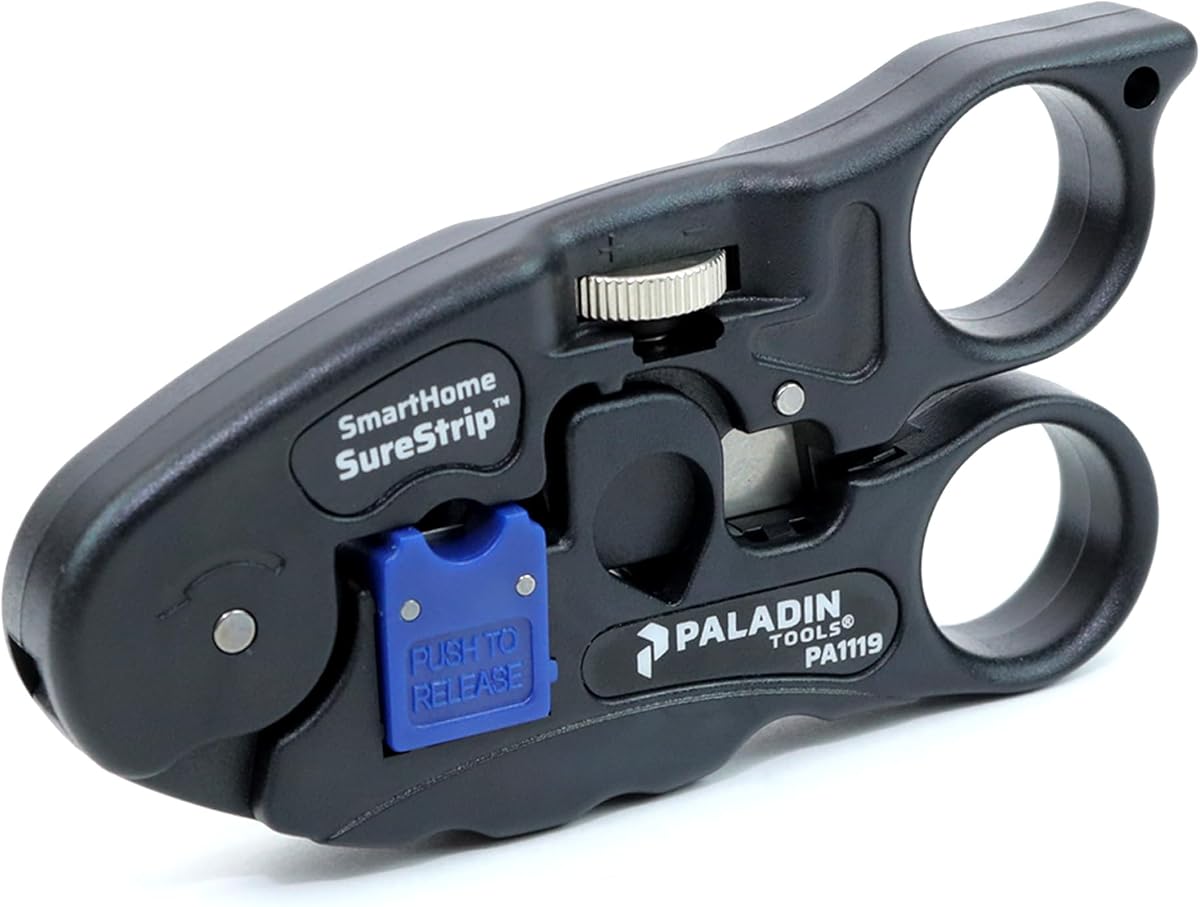
The Paladin Tools PA1119 is an all-in-one stripper and cutter designed for coax and twisted-pair cable. Its 4.4 rating suits technicians who work across RG6, RG6 Quad, RG59, Cat6, Cat5e, Cat5, UTP, and STP installations.
We may earn a commission when you buy through this link, at no additional cost to you.
A self-regulating cassette blade is intended to prevent nicks while the adjustable stripping control accommodates different insulation thicknesses. These features support precise, damage-free preparation across different cable constructions, which is important when a single blade must handle multiple standards.
Contoured finger grips provide cutting power and comfort during prolonged use, and a lanyard hole simplifies attachment to a belt or tool bag. The limitation is that the stated scope does not extend to large aluminum, copper, or fiber hardline applications, so it is not a substitute for a heavy cable shear.
The PA1119 is well suited to low-voltage installers and network technicians who alternate between coax and Ethernet. Its self-regulation, broad compatibility, and integrated preparation functions make it a practical all-purpose option for supported cable types.
The self-regulating cassette blade is designed to minimize conductor nicks. That protection is useful when small differences in insulation and cable construction make aggressive manual stripping risky.
Support for common coax and twisted-pair standards lets one tool cover television, communications, and Ethernet preparation. Adjustable depth provides additional control across different insulation thicknesses.
We may earn a commission when you buy through this link, at no additional cost to you.
The best coaxial cable cutter depends on cable diameter, material, connector workflow, and the amount of installation work you perform. Use the following factors to identify the tool that matches your most common tasks.
Start with the largest cable you expect to cut. Common residential coax tools focus on RG6 and RG59, while dedicated hardline cutters may accept cables up to one inch in diameter. Heavy communications cutters may go further, cutting 4/0 aluminum, 2/0 soft copper, or 100-pair cable. Checking diameter alone is not enough; conductor material and construction also affect whether a tool is appropriate.
Shear-action cutters use opposing jaws to compress and sever cable, while tube-cutter-style tools roll or cut around the circumference to preserve the end shape. Rotary stripper-cutters use a rotating blade to score the jacket evenly. The best mechanism depends on the result you need: a fast general cut, a square hardline end, or consistent connector-ready preparation.
Do not assume that a tool labeled for coax can cut every cable encountered on the job. Some models support only RG6 and RG59, while others also cover RG58, RG7, RG11, fiber, Ethernet, battery cable, aluminum, or copper. A broader multi-cable cutter is convenient for mixed work, but specialized tools may provide better control on a narrow category.
A cutter separates the cable, but many installations also require jacket removal, shield combing, conductor straightening, and connector crimping. Integrated stripper-cutter tools can streamline those steps. Complete kits also supply radial strippers, crimpers, connectors, and storage. Integrated functions are convenient, but a dedicated cutter may provide cleaner or more controlled results for high-volume hardline work.
Blade quality, hardening, and adjustment affect consistency. Precision-ground or induction-hardened edges are intended to retain cutting performance. Adjustable stripping depth is useful across cables with different insulation thicknesses, while self-regulating mechanisms can reduce nicks. Replaceable blade cassettes may extend tool life and are valuable for technicians who prepare cable daily.
A cutter should remain controllable without excessive hand strain. Long handles can improve leverage for heavy cable, while compact one-hand shears are easier to carry and use in confined spaces. Coated, dipped, or contoured grips can improve stability and comfort. Weight and balance matter too, particularly when the tool is used overhead, inside cabinets, or for extended periods.
Look for steel bodies, hardened cutting surfaces, and protective finishes designed to resist wear. Forged and heat-treated construction is common among heavy-duty tools. Through-hardened cutting surfaces are specified for longer-lasting edges in demanding work. A protective coating helps limit rust, while replaceable components can be more economical than replacing an entire tool when wear occurs.
None of the listed non-insulated cable cutters should be treated as electrically insulated. Disconnect power before use and verify that no live conductor is present. A locking latch can improve safe transport in a tool pouch, while ring terminals or heat-shrink tubes support finishing after a cut. Always check whether a manufacturer explicitly excludes steel cable, ACSR, or other specific constructions.
Begin by identifying the cable type, diameter, and conductor material, then confirm that the cutter is rated for that combination. Inspect the jaws, blade, pivot, and handle for damage or unusual residue. For powered or live electrical work, disconnect the supply and verify the circuit is de-energized before placing any non-insulated tool near a conductor.
Secure the cable in the jaws without twisting it. For a standard shear cutter, close the handles in a controlled motion while keeping the cable perpendicular to the jaws. For a scoring cutter, use the manufacturer's recommended back-and-forth scoring motion before completing the cut. For rotary tools, set the stripping depth, rotate the tool smoothly, and stop when the intended jacket layer is removed.
After cutting, inspect the end for a square profile, fraying, crushed insulation, or exposed conductor strands. Wipe the tool after use and remove adhesive or jacket debris with a dry, non-damaging cloth. Keep the blades dry, periodically inspect the pivot for looseness, and store the tool closed or secured in a pouch. Follow the manufacturer's instructions for blade replacement, sharpening, and warranty service.
A coax cable cutter severs the cable into a manageable length, while a coax stripper removes the outer jacket, dielectric, braid, and foil to prepare the conductor for a connector. Some tools combine both functions, but dedicated cutters are often better for producing clean, undistorted cable ends.
Only if the tool is explicitly rated for the cable's diameter and construction. A general heavy-duty cutter may handle some coax, but it can crush the jacket, deform the cable, or damage the conductor. Check the stated cable range before use and avoid steel, ACSR, or other exclusions.
A dedicated hardline cutter designed to reduce compression and fraying is the most appropriate choice. The Jonard Tools JIC-755 and Klein Tools 63030 both state a one-inch capacity, but they use different scoring and cutting approaches, so operators should follow the instructions for the selected model.
For installation rather than temporary cable shortening, you usually need a stripper and suitable crimper as well. A complete kit can reduce tool clutter, while an integrated stripper-cutter can be convenient for lighter work. Match the connector type and cable series to the tool specifications.
Use a cutter that supports the cable diameter and conductor material, and keep the cable straight without twisting. A controlled score, rotary cut, or tube-style shear generally preserves the end better than forcing a hard bite with pliers. Inspect the result before moving on to stripping.
The listed products with non-insulating handles should not be assumed safe for live conductors. Disconnect power and verify the circuit is de-energized before cutting. The product descriptions for the BOOSDEN models explicitly instruct users to cut off the power first.
A rotary stripper is convenient for consistent jacket scoring on common RG6 and RG59 cable, while a shear-style cutter is generally more useful for larger cable and general communications work. The best choice depends on whether your priority is routine connector preparation or clean, high-capacity severing.
Wipe away jacket and adhesive residue after each use, keep the tool dry, and inspect the jaws and pivot regularly. Follow the manufacturer's guidance for lubrication, sharpening, and blade replacement. Store the tool in a secure pouch and use the latch, if provided, to prevent accidental opening.
The best overall choice for a complete basic coax workflow is the Klein Tools VDV026-211 kit because it combines cutting, radial stripping, compression crimping, connectors, and organized storage. For the most demanding clean-cut hardline applications, the Jonard Tools JIC-755 stands out, while the 10-inch heavy-duty cutter offers the broadest general-purpose value across coax, battery, copper, aluminum, and communications cable.
Prioritize cable capacity and conductor compatibility before considering secondary features. A beautifully equipped tool is less useful if it cannot safely cut the cable in front of you. For repetitive connector preparation, prioritize adjustable or self-regulating stripping depth; for heavy cable, prioritize leverage, durable edges, and clean shearing; and for field organization, a kit with a suitable pouch can be especially useful.
Ratings, availability, and prices can change, so confirm the current retailer listing and manufacturer specifications before purchasing. Check the included components, exclusions, warranty, and cable ratings carefully. The right coaxial cable cutter should handle your most common work comfortably and leave cable ends that are clean enough for the next preparation step.