
Lowrance Active Imaging 3-In-1 Transducer
4.6Editor score
CHIRP, SideScan, DownScan
FishReveal target identification
Multiple supported frequencies
Three transducer modes
Compare 10 down and side imaging transducers for sonar coverage, display compatibility, frequencies, mounting options, and key features in this expert buying
A down and side imaging transducer gives an angler two complementary views of the water: a downward look beneath the boat and a horizontal view extending to either side. The right unit can reveal fish-holding structure, distinguish targets from cover, and provide more detail than a conventional 2D sonar transducer, but compatibility and supported frequencies matter more than any headline feature.
This guide compares 10 transceivers from Humminbird and Lowrance, including compact MEGA imaging, Active Imaging 3-in-1 systems, SideScan and DownScan combinations, and more focused Down Imaging models. We evaluated the stated imaging capabilities, operating frequencies, display compatibility, mounting approach, cable length, temperature sensing, and installation features without claiming hands-on testing.
Each review explains the practical strengths and limitations of its featured product, while the comparison table makes the major differences easier to scan. The top selections cover premium all-in-one imaging, a versatile side-and-down unit, and a more affordable Humminbird option. Product availability and pricing can change, so confirm the latest listing and fit before ordering.
4.6Editor score

5.0Editor score

4.6Editor score
The comparison covers imaging combinations, operating frequencies, unit compatibility, mounting provisions, and distinguishing hardware features. It includes true side-and-down units, compact MEGA models, 3-in-1 sonar packages, and Down Imaging-focused alternatives for different Humminbird and Lowrance displays.



The Humminbird XM 14 HW CMSI T stands out as the most advanced all-in-one imaging transducer in this guide, carrying a 5.0 rating and a broad set of modern Humminbird features. Its compact body houses MEGA Side Imaging+, MEGA Down Imaging, and Dual Spectrum 2D CHIRP sonar, giving compatible displays unusually rich information in a single installation.
We may earn a commission when you buy through this link, at no additional cost to you.
Imaging at 455 kHz and 1.1 MHz is the defining feature. The higher-frequency MEGA channels emphasize fine detail, structure definition, and clear separation between fish and cover, while the stated side and down coverage can extend as far as 400 feet under suitable conditions. Dual Spectrum CHIRP adds narrow, wide, and full-spectrum 2D modes, making this more versatile than a strictly imaging-only design.
The compatibility list includes XPLORE, APEX, and SOLIX G3 fish finder models, and the 20-foot cable with a secure screw-on connector simplifies installation on many transom setups. The trade-offs are important: 1.1 MHz imaging generally represents a more specialized hardware and display combination than conventional 455 kHz equipment, and maximum coverage depends on water conditions as well as the stated specification.
Choose this transducer when you have a compatible modern Humminbird unit and want the strongest combination of side detail, down detail, and CHIRP flexibility. It is especially compelling for anglers targeting structure from a relatively compact mounting footprint. Verify the exact unit model before purchase, because the impressive capabilities are tied to compatible displays and their supported imaging modes.
The 455 kHz and 1.1 MHz MEGA channels prioritize definition, helping separate fish targets from rock piles, vegetation, drop-offs, and other structure. That emphasis makes this a strong choice when locating specific underwater features rather than simply finding open water and deeper contours.
Combining MEGA Side Imaging+, MEGA Down Imaging, and Dual Spectrum 2D CHIRP reduces equipment clutter while keeping multiple search methods available. The 150–220 kHz full spectrum, 180–240 kHz narrow, and 140–200 kHz wide ranges also provide useful flexibility for different depths and target sizes.
We may earn a commission when you buy through this link, at no additional cost to you.
The Lowrance 000-14489-001 Active Imaging 3-In-1 Transducer earns a 4.6 rating by combining three established sonar approaches in one housing: CHIRP, SideScan, and DownScan with FishReveal. It is a compelling premium choice for anglers who want a detailed side view, a downward structure view, and conventional 2D sonar without maintaining separate transducers.
We may earn a commission when you buy through this link, at no additional cost to you.
Its main appeal is the combination of refinement and practical interpretation. SideScan helps locate structure and cover at a distance, while DownScan creates a fish-eye view beneath the boat. FishReveal works with high-detail DownScan imagery to make individual fish easier to recognize against structure, and the transducer supports medium and high CHIRP at 83/200 kHz alongside 455/800 kHz imaging frequencies.
Compatibility is broader than it may initially appear because the product works with Lowrance HDS LIVE, Elite FS, and Simrad NSS evo3s and GO series displays. However, the operating system, connector, and required accessories still need to be checked before ordering. Its capability depends on the connected display offering the corresponding sonar mode and processing features.
This is a strong recommendation for a compatible Lowrance or Simrad setup where versatility and target recognition are priorities. It offers more sonar functions than a Down Imaging-only transducer and presents them in a unified package. If your fish finder supports only conventional 2D sonar, a simpler unit would be more appropriate.
FishReveal combines high-detail DownScan data with CHIRP information to help separate fish from nearby cover. This makes the 3-in-1 system more than a collection of images, giving anglers a clearer way to interpret what appears beneath the boat.
CHIRP is well suited to traditional sonar searches, SideScan expands the view toward structure beside the boat, and DownScan examines the area directly below it. Supporting medium and high CHIRP plus 455/800 kHz frequencies lets the display adapt to different scanning priorities.
We may earn a commission when you buy through this link, at no additional cost to you.
The Humminbird XM 14 20 MSI T provides a balanced combination of MEGA Side Imaging, MEGA Down Imaging, and DualBeam PLUS sonar. Its 4.3 rating reflects a capable, established package, while support for XPLORE, APEX, SOLIX, and selected ONIX models gives it an appealing mix of compatibility.
We may earn a commission when you buy through this link, at no additional cost to you.
The side-imaging system extends 125 feet to either side of the boat, creating a broad view for locating rock piles, weed edges, drop-offs, and other fish-holding structure. Down Imaging and DualBeam PLUS add a view beneath the boat and a conventional sonar return with useful detail and coverage.
One compatibility nuance is worth noting: ONIX SI models support only 455/800 kHz frequencies for Side Imaging and Down Imaging. Other compatible systems may unlock different capabilities, so checking the full frequency and mode support of the exact display is essential. The product is otherwise installation-ready with a built-in temperature sensor and 20-foot cable.
This transducer suits Humminbird owners who want more than a downward-only unit but do not necessarily need the specialized 1.1 MHz MEGA Side Imaging+ configuration of the first-ranked model. It is a natural all-around choice for compatible systems, provided the display supports the desired MEGA modes.
The stated 125-foot reach on each side creates a large search area without requiring the angler to fish directly over every target. It is particularly useful for finding breaks, channels, vegetation edges, and submerged timber that may remain difficult to recognize from conventional forward-looking sonar.
A built-in temperature sensor adds a practical environmental reading without requiring a separate sensor installation. Combined with the 20-foot cable and broad Humminbird unit support, it helps keep the setup straightforward for compatible boat configurations.
We may earn a commission when you buy through this link, at no additional cost to you.
The Humminbird 710200-1 XNT 9 SI 180 T is the most economical route into a combined Side Imaging and Down Imaging system among the products highlighted here. Its 4.6 rating and compatibility with numerous HELIX, 899CI, 798ci, 698ci, 598ci, and 398C SI units make it a practical choice for anglers with an established Humminbird setup.
We may earn a commission when you buy through this link, at no additional cost to you.
Rather than relying on the newest MEGA frequency package, this transducer focuses on delivering both side and downward views to compatible machines. That matters for owners of earlier-generation HELIX systems who want to move beyond basic 2D sonar without replacing their entire fish finder.
The product data does not list MEGA imaging support, a specific cable length, or a built-in temperature sensor, so buyers should not assume features found in newer alternatives. The transom-mount format is familiar and generally easier to position, but actual range and image quality depend on the connected display, water conditions, and the unit's supported modes.
For an owner seeking the least disruptive upgrade path, this is one of the strongest choices in the guide. Confirm the precise model number, confirm Side Imaging support, and inspect the included hardware before installation. It is particularly well suited to older compatible Humminbird displays that can benefit from dedicated imaging without requiring a new transducer platform.
The long compatibility list includes multiple HELIX generations and several older ci-series units. That makes this transducer useful when replacing a basic setup or upgrading an existing boat without changing displays, provided the model is confirmed as Side Imaging capable.
The SI designation and 180-degree model name point to broad lateral coverage. Side imaging can reveal structure extending away from the boat, while Down Imaging adds a direct view underneath, giving anglers two useful ways to search without relying solely on forward-looking sonar.
We may earn a commission when you buy through this link, at no additional cost to you.
The Humminbird Helix 7 G4 GPS Fish Finder with Transducer is a complete sonar package rather than a replacement transducer alone. Its 4.5 rating reflects a capable combination of a 7-inch display, MEGA Side and Down Imaging, Dual Spectrum CHIRP, GPS navigation, and an included imaging transducer.
We may earn a commission when you buy through this link, at no additional cost to you.
The imaging system reaches 125 feet to either side and 125 feet directly below the boat, according to the product data. Wide and narrow Dual Spectrum CHIRP modes provide coverage and detail options, while the Low-Q transducer is credited with precise 2D target separation. This combination allows the same setup to search for fish arches, structure, and bottom contours.
The bundle extends beyond sonar. It includes Humminbird Basemap coverage for more than 10,000 lakes and the continental U.S. coastline, compatibility with premium mapping products, and AutoChart Live for recording depth contours, bottom hardness, and vegetation. Those navigation features are the main reason to consider the complete package rather than a standalone transducer.
Choose this option when you need a new display, not merely a new transducer. Its key limitation is obvious but important: it is a dedicated Humminbird HELIX 7 G4 package and cannot be treated as a universal add-on for another brand or unrelated model. For a buyer starting from scratch, the integrated display, mapping, and transducer can offer a more coherent setup.
The included Basemap, GPS functions, and AutoChart Live capabilities make this more than an imaging display. Anglers can record local contours, hardness, and vegetation data while navigating, while optional premium chart support expands mapping choices.
Dual Spectrum CHIRP provides separate wide and narrow approaches, letting anglers move between broad coverage and detailed target separation. MEGA Side and Down Imaging add lateral and beneath-boat perspectives, making the package useful for locating structure around the boat as well as directly below it.
We may earn a commission when you buy through this link, at no additional cost to you.
The Humminbird XNT 9 HW SI T is a focused upgrade for owners of compatible HELIX 7 CHIRP SI GPS G4 displays. It combines CHIRP Side Imaging, CHIRP Down Imaging, and Dual Spectrum CHIRP 2D sonar, earning a 4.5 rating for a product designed to fill several sensing roles with one transom-mounted unit.
We may earn a commission when you buy through this link, at no additional cost to you.
Side Imaging operates at 455 kHz and provides the lateral view needed to search for submerged structure, while Down Imaging shows the water beneath the boat. The Dual Spectrum CHIRP system covers 150–220 kHz and supplements both imaging modes with standard sonar information. A built-in temperature sensor and included mounting hardware improve setup convenience.
The important limitation is explicit: MEGA Side Imaging models are not supported. This transducer is therefore not the right upgrade for a HELIX display that depends on 1.1 MHz MEGA Side Imaging, even if it shares the HELIX 7 name. The exact display model and its supported sonar channels should be checked before ordering.
For a G4 owner seeking a direct imaging upgrade, the package is clear and practical. The 20-foot cable supports flexible transom positioning, and the included hardware reduces the need to source extra components. It is less versatile than the newer XM 14 models, but its focus makes it a sensible match for the specified HELIX 7 generation.
This transducer is designed around the capabilities of HELIX 7 CHIRP SI GPS G4 units, including CHIRP side and down channels. Matching the transducer to a specific display generation avoids the confusion that can arise when newer ME GA-related models use similar product names.
The built-in temperature sensor, 20-foot cable, and mounting hardware provide most of what is needed for a transom installation. This makes it a convenient option for replacing an older unit while keeping the display and basic boat layout unchanged.
We may earn a commission when you buy through this link, at no additional cost to you.
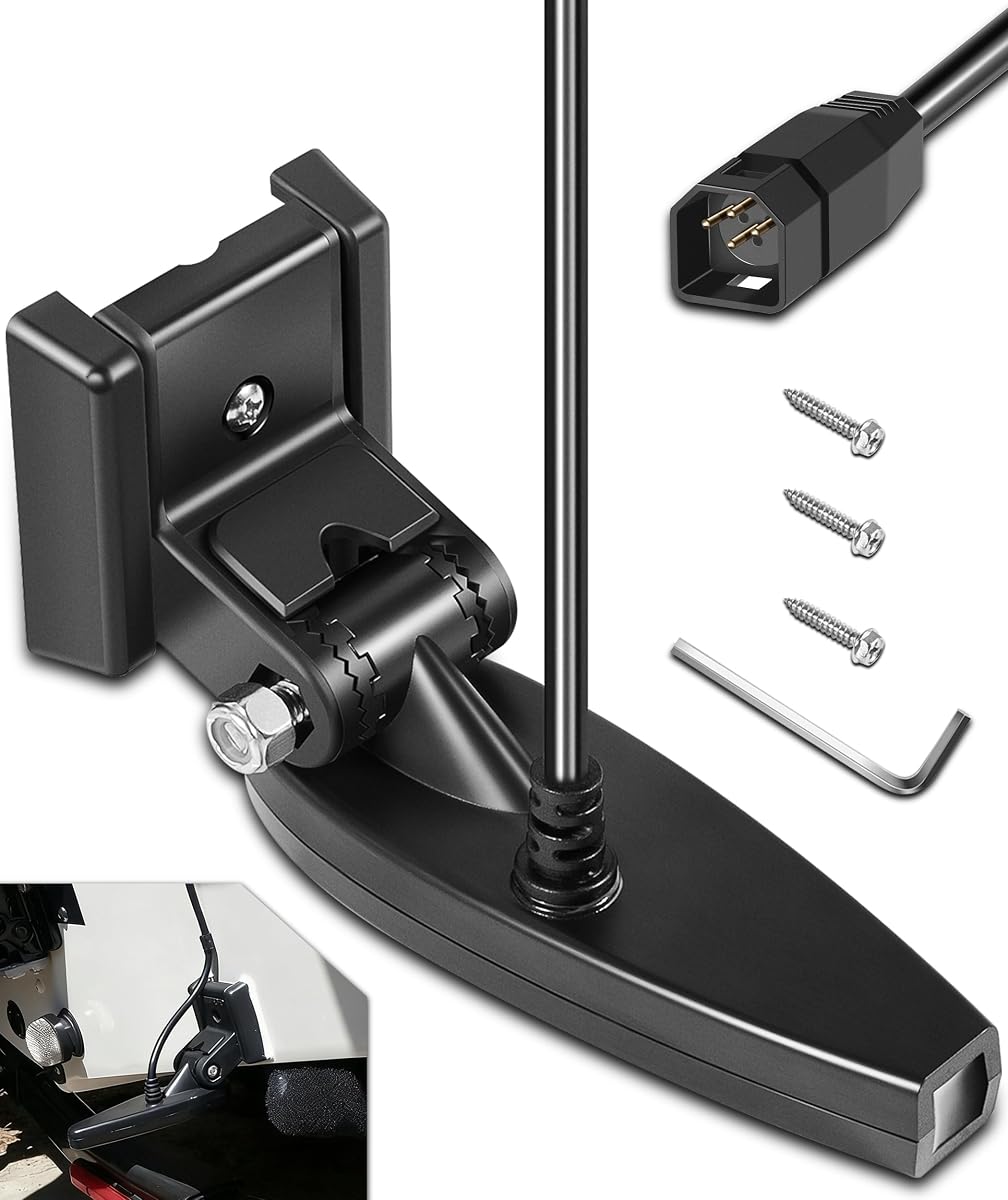
The Lowrance Active Imaging 3-in-1 Transducer with 6' Cable offers CHIRP, SideScan, and DownScan in a transom-mounted package. Its 4.2 rating is supported by a versatile feature set, although the short cable and required adapter make it less universally convenient than a longer, more self-contained installation.
We may earn a commission when you buy through this link, at no additional cost to you.
This model is compatible with HDS LIVE, HDS Carbon, and Elite Ti2 units according to the supplied information. Its supported sonar modes include medium and high CHIRP alongside SideScan and DownScan, giving compatible displays several ways to examine fish, cover, and bottom structure.
The principal concern is connection logistics. A 9-pin connector is specified, and an adapter cable is required. That may be perfectly reasonable for an installation where the fish finder sits close to the transducer, but it can complicate routing through a console, especially if the display and mounting point are separated by a considerable distance.
Consider this transducer for a compatible Lowrance or listed related display when a short cable suits your boat and you already understand the connection arrangement. It is a capable imaging choice with a manageable footprint, but verify both the adapter requirement and cable reach before installation rather than relying only on the transducer's headline sonar functions.
At six feet, the cable can be advantageous on compact boats or installations with the display close to the transom. It may also simplify routing, although the required adapter should be factored into the total installation path.
The listed compatibility includes HDS LIVE, HDS Carbon, and Elite Ti2 systems. Because connector standards and supported channels can vary by display generation, the exact unit model remains the deciding factor.
We may earn a commission when you buy through this link, at no additional cost to you.
Despite its abbreviated listing title, the supplied product data describes a Lowrance Active Imaging 2-in-1 installation with SideScan and DownScan at 455/800 kHz. Its 4.1 rating makes it a less universally impressive pick than the full 3-in-1 model, but it remains a focused option for compatible displays that value clear structural imaging.
We may earn a commission when you buy through this link, at no additional cost to you.
The main benefit is the combination of lateral and downward views. SideScan can reveal rock piles, standing timber, weed beds, ditches, and drop-offs, while DownScan provides detail directly below the boat. The emphasis is on clear target separation and refined structure rendering rather than the addition of conventional CHIRP sonar.
Compatibility includes Lowrance HDS LIVE, Elite Ti, and Simrad NSS evo3 and GO series displays. As with other products in this category, however, the precise unit, connector, and supported mode should be confirmed. The unusual product name also makes it especially important for buyers to review the full listing information carefully before assuming it is a general mounting accessory.
This is a sensible option when the priority is a dedicated SideScan and DownScan pair without paying for the additional 2D CHIRP functionality found in a 3-in-1 transducer. It is less attractive for anglers who want a unified all-purpose sonar package, but it may suit a compatible display that already handles conventional 2D sonar well.
The 455/800 kHz SideScan and DownScan configuration concentrates on structure and cover. It is especially useful for locating defined edges, submerged timber, weed lines, and abrupt depth changes that can attract fish.
The product name supplied for this item is unusually brief, while the feature details describe a complete imaging transducer. Buyers should review the images, compatibility notes, and included components to confirm that they are ordering the intended 2-in-1 unit rather than a bracket or fitting alone.
We may earn a commission when you buy through this link, at no additional cost to you.
The 710226-1 XNT 9 DI T is a Down Imaging and DualBeam PLUS transducer offered for a broad range of Humminbird fish finders. It carries a 4.5 rating and focuses on producing clear downward images, wide sonar coverage, and target detail rather than adding a side-imaging channel.
We may earn a commission when you buy through this link, at no additional cost to you.
Its imaging behavior is described through several beam options. Down Imaging uses 75-degree and 45-degree beam angles at 455/800 kHz for sharp, high-resolution views, while DualBeam PLUS uses 25-degree and 16-degree angles at 200/455 kHz for broader coverage. This combination gives the angler detailed downward images alongside conventional sonar returns.
Compatibility is extensive across HELIX, PiranhaMAX, legacy Down Imaging, and several named ci-series models. The product includes an impact-release bracket, required hardware, a temperature sensor, and a 20-foot cable. One critical operating point is clear: the transducer must remain fully submerged because sonar signals cannot pass through air, and air pinging may damage it.
This is a good choice for an owner whose Humminbird unit supports Down Imaging but not Side Imaging. It is not the most complete imaging solution because its stated functions do not include a lateral view, but it can add valuable fish-eye detail and target separation. Confirm the exact display model and use the proper bracket to reduce installation errors.
The 75-degree and 45-degree Down Imaging angles emphasize detail directly beneath the boat, while the 25-degree and 16-degree DualBeam PLUS profiles cover more surrounding terrain. Using the available modes makes it possible to balance precise target views against wider situational awareness.
The transducer must be fully underwater for proper operation because sonar does not travel through air. A secure transom position that keeps the sensing face submerged, combined with the included impact-release bracket, helps protect both performance and hardware.
We may earn a commission when you buy through this link, at no additional cost to you.
The Humminbird XNT 9 DI T is a transom-mounted Down Imaging transducer with a 4.6 rating and a well-defined role: improve the beneath-boat view while retaining DualBeam PLUS sonar. It is a sensible alternative for anglers whose compatible fish finders support Down Imaging but do not need a side-scan system.
We may earn a commission when you buy through this link, at no additional cost to you.
Down Imaging operates at 455/800 kHz and provides a fish-eye-style view of fish, cover, and bottom contours below the boat. DualBeam PLUS combines two beams to add detail and a generous area of standard sonar coverage. Together, they support both close inspection beneath the hull and broader searches around the vessel.
The product is listed as compatible with select HELIX Down Imaging models, PiranhaMAX Down Imaging models, legacy Down Imaging models, and specifically the 788ci HD DI Combo, 597ci HD DI Combo, 596c HD DI, Combo, and 570 DI. It includes a built-in temperature sensor and 20-foot cable, making it an installation-ready option for matching systems.
Its main limitation is the absence of a stated side-imaging function, and buyers should not treat it as a substitute for a true side-and-down transducer. For a compatible Humminbird display that needs a dedicated Down Imaging upgrade, it remains a practical, focused choice with a strong rating and a conventional, recognizable transducer platform.
The 455/800 kHz Down Imaging channel is designed to show the area directly beneath the boat with more structural detail than conventional sonar alone. It can help separate fish from vegetation, timber, rock, and changing bottom contours.
A transom mount, built-in temperature sensor, and 20-foot cable form a familiar setup for supported Humminbird systems. The cable provides useful installation flexibility while the temperature sensor reduces the need for a separate water-temperature accessory.
We may earn a commission when you buy through this link, at no additional cost to you.
Choosing a sonar transducer requires matching the imaging package to your display, balancing detail against coverage, and confirming the physical installation. The following factors cover the features that most directly affect real-world usability and long-term satisfaction.
Begin with the exact model number of your fish finder rather than its brand alone. A transducer may fit physically yet lack the connector, frequency, or processing capability needed for Side Imaging, Down Imaging, MEGA imaging, CHIRP, or FishReveal. Humminbird options in this guide span XPLORE, APEX, SOLIX, ONIX, HELIX, and older ci-series models, while Lowrance options include HDS LIVE, HDS Carbon, Elite FS, Elite Ti, Elite Ti2, and listed Simrad systems. Compatibility also varies within a product family, as illustrated by the XNT 9 HW SI T's support for specified HELIX 7 G4 models but not MEGA Side Imaging models. Check the manual or manufacturer chart for the display before purchasing, and confirm whether an adapter cable is required.
Decide which perspectives you need: down only, side only, or both. A side-and-down transducer searches a larger area around the boat, while a down-only unit is often sufficient for anglers fishing structure directly beneath them. The 3-in-1 Lowrance option adds conventional CHIRP to SideScan and DownScan, whereas the Lowrance 2-in-1 listing focuses on imaging alone. Humminbird's XM 14 units combine MEGA Side Imaging, Down Imaging, and 2D sonar. Think about how you fish: moving along drop-offs and weed edges benefits from side coverage, while vertical structure beneath a boat may be explored efficiently with Down Imaging.
Frequency affects the balance between detail and range. The 455 kHz and 1.1 MHz MEGA setup in the XM 14 HW CMSI T emphasizes fine structural definition, while 455/800 kHz is common in Down Imaging systems. The Lowrance Active Imaging products support 455/800 kHz for imaging and 83/200 kHz medium and high CHIRP for conventional sonar. Dual Spectrum CHIRP adds selectable frequency ranges rather than relying on one narrow band. Higher frequencies commonly produce more detailed images but may cover less distance in challenging conditions. The best choice is one whose frequency plan is fully supported by your display and suits the depth and clarity you want from the side and beneath-boat views.
Coverage figures provide a useful scale, but image quality is equally important. The XM 14 HW CMSI T states side and down scanning up to 400 feet, while the XM 14 20 MSI T and Helix 7 G4 package describe 125-foot side-to-side and downward views. Wide beams can quickly reveal nearby structure, whereas narrow beams add target separation. A practical setup benefits from both: broad views for discovery and detailed modes for inspection. Actual performance changes with water depth, clarity, bottom composition, boat speed, and display processing, so treat stated ranges as capability under suitable conditions rather than guaranteed performance in every location.
Most options use a transom mount, which keeps installation relatively accessible and lets the angler adjust the transducer's depth and angle. Cable length affects routing choices: a 20-foot cable provides flexibility for larger or differently arranged boats, while the six-foot Lowrance cable may suit compact layouts but can constrain placement. The first-ranked Humminbird unit includes a screw-on connector, and several other products include mounting hardware. Inspect the bracket, screws, cable path, and sensing face clearance before drilling or altering the boat. The transducer must stay fully submerged during operation, and its adjustable position should avoid bubbles, turbulence, and interference with the propeller.
A built-in temperature sensor can make a subtle but useful difference when tracking changing water conditions or locating deeper water. It is particularly useful during seasonal transitions, when surface readings and deeper temperatures may differ. The XM 14 HW CMSI T, XM 14 20 MSI T, XNT 9 HW SI T, 710226-1 XNT 9 DI T, and the original XNT 9 DI T are described as including a temperature sensor. The other products do not state this feature in their supplied data. If temperature is already shown through a separate sensor or another integrated component, this may matter less, but it remains a worthwhile convenience for a new installation.
Raw sonar detail is more useful when the display can help interpret it. Lowrance FishReveal combines high-detail DownScan imagery with CHIRP information to help identify fish against structure. Humminbird's MEGA systems emphasize detail and target separation, while DualBeam PLUS provides two-beam coverage for broader situational awareness. These processing features depend on compatible hardware, so verify that the transducer and display support the same mode. A feature-rich package is not automatically better for every boat; a user who understands structure, weeds, rock, and bottom contours can gain plenty from a simpler two-view setup.
Brand ecosystem can simplify ownership. Humminbird offers several transducers tailored to different HELIX, SOLIX, APEX, XPLORE, and ONIX capabilities, ranging from the 710200-1 XNT 9 SI 180 T to the advanced XM 14 HW CMSI T. Lowrance options center on Active Imaging technology and listed HDS, Elite, and Simrad displays. Staying within the display's native ecosystem often simplifies channel matching and mode support, while a complete fish finder bundle can be a better choice than a stand-alone transducer for a new installation. This factor should be considered alongside rather than instead of exact model compatibility.
Begin by confirming the transducer, connector, cable, and display are compatible before installation. Read the display manual, identify the supported side and down frequencies, and compare them with the transducer specifications. Mount the unit securely on the transom with the sensing face fully submerged and positioned so it does not contact the hull, propeller, weeds, or other obstructions.
Route the cable away from sharp edges, hinges, and moving hardware. Secure excess cable neatly so tension does not pull the transducer out of alignment. After launching, check the installation at several throttle settings, watching for bubbles, vibration, or unstable images. Adjust the angle and depth as needed, and use the wide view to locate structure before switching to narrower or more detailed modes for closer inspection.
After each outing, wipe away dirt, algae, and moisture with a soft cloth, then inspect the connector, cable, screws, and bracket. Avoid harsh solvents and abrasive tools that could damage the housing or sensing surfaces. Keep the transducer protected from impact during transport, and never operate it out of the water because air pinging can damage the unit.
Yes, but only if the transducer and connected display both support those modes. The Humminbird XM 14 HW CMSI T, XM 14 20 MSI T, XNT 9 SI 180 T, and XNT 9 HW SI T are described as combining side and down imaging. Compatibility must be checked by exact model because a display marketed as an imaging unit may not support every frequency or MEGA mode offered by a transducer.
No. MEGA Side Imaging is useful when the display supports it and you want the added detail associated with the listed 455 kHz and 1.1 MHz frequencies. Older or more specialized compatible systems may use conventional Side Imaging, Down Imaging, or CHIRP hardware instead. The correct approach is to match the transducer to the display's native capabilities rather than choosing solely by the newest feature name.
A 3-in-1 model combines conventional CHIRP sonar with SideScan and DownScan, as the Lowrance Active Imaging 3-in-1 does. A 2-in-1 model provides only the two imaging views, such as SideScan and DownScan. The 3-in-1 format is more versatile because it also supplies a standard forward-looking sonar return, while the 2-in-1 option can be simpler and may suit a display that already handles 2D sonar effectively.
No. A 20-foot cable provides more freedom when the display or mounting point is far from the transom, while a six-foot cable can simplify installation on a compact boat. The best choice depends on cable routing, available space, and the transom location. Also account for any required adapter cable when calculating the usable connection path.
Sonar signals travel through water, not through air. If the sensing face is exposed, the unit may air ping, produce unusable readings, and potentially suffer damage. Before powering the system, confirm that the transducer is fully submerged, especially after launching, adjusting the bracket, or changing the boat's trim.
Possibly, but physical fit alone is not sufficient. The display must support the transducer's connector, frequencies, and sonar modes. A newer unit may have the correct connector yet lack processing for MEGA, CHIRP, FishReveal, or another advanced feature. Use the manufacturer's compatibility list and identify the exact unit model before ordering.
Both frequencies provide imaging information, but they generally emphasize different aspects of performance. The 1.1 MHz frequency used by the XM 14 HW CMSI T is suited to very high-definition views and strong target separation, while 455 kHz can provide useful detail across a broader set of compatible systems. Coverage also depends on water conditions, depth, and display processing.
It depends on where you fish and how you search. Down Imaging is excellent for examining structure beneath the boat, while side imaging expands the view laterally and can help locate drop-offs, weed edges, rock piles, and submerged timber away from the hull. Anglers who move along specific structure can benefit from both, while anglers who mostly fish vertical cover directly below may be satisfied with Down Imaging.
The Humminbird XM 14 HW CMSI T is the strongest all-around recommendation, combining MEGA Side Imaging+, MEGA Down Imaging, and Dual Spectrum 2D CHIRP in a compact unit. The Lowrance Active Imaging 3-in-1 is an excellent premium alternative for compatible HDS, Elite FS, and listed Simrad displays, while the Humminbird XNT 9 SI 180 T offers an affordable side-and-down upgrade for a wide range of older Humminbird systems.
Prioritize exact display compatibility, supported frequencies, and the views you actually need before considering any other feature. A complete imaging package is unnecessary if your unit supports only Down Imaging, and a specialized MEGA unit is unnecessary if a simpler XNT model fully meets your needs. Cable routing, mounting security, temperature sensing, and included hardware are also important for a smooth installation.
Finally, check the current product listing, compatibility chart, included accessories, and latest pricing before making a purchase. Inventory, bundles, manufacturer revisions, and seller offers can change over time, so the final decision should be based on the current listing as well as the features and compatibility described in this guide.