
VEVOR 100W Foldable Solar Panel
5.0Editor score
24% claimed cell efficiency
Multiple USB and DC outputs
Broad power station compatibility
Compare 10 foldable monocrystalline solar panels for power stations, camping, RVs, and emergency use, with ratings, efficiency, durability, portability, and
Foldable monocrystalline solar panels combine space-saving construction with efficient photovoltaic cells, making them useful for power stations, RV travel, camping, and emergency preparation. The best model must balance rated output, portability, connector compatibility, weather resistance, and practical features such as kickstands and direct USB charging.
This guide compares ten foldable monocrystalline solar panels using the supplied ratings, power ratings, efficiency claims, physical features, environmental protections, and connection options. It includes compact models for backpacks, higher-output choices for large power stations, and bifacial or directly rechargeable alternatives for buyers who need added flexibility.
Each review explains who the panel suits, where its specifications stand out, and where practical limitations may matter. We also cover compatibility, setup, panel orientation, and care. Prices and availability can change, so confirm the current listing and your power station's requirements before purchasing.
5.0Editor score

4.5Editor score

This side-by-side comparison highlights rated output, claimed efficiency, portability, charging options, and weather protection across all ten panels, helping you match a solar charger to your power station and travel plans.



The Renogy 200W Portable Solar Panel for Power Stations is the most balanced model in this guide, earning a 4.5 rating from its supplied listing. Its 200W rating, 25% N-type cell efficiency, relatively light 13.89-pound weight, and compact folded form make it suitable for campers, RV travelers, and users who want one panel to handle both power-station charging and direct device charging.
We may earn a commission when you buy through this link, at no additional cost to you.
Its standout feature is the combination of MC4 output for compatible power stations and built-in USB-C Power Delivery rated at 45W alongside dual USB-A ports. That means the panel can charge phones, tablets, laptops, GPS units, and cameras without requiring a battery first. The included kickstands offer 40-, 50-, and 60-degree positions, while reinforced grommets and an accessory pouch support practical field use.
The panel is also backed by a broad set of safety and compliance claims, including UL 61730 certification and listed CE, RoHS, FCC, CA65, PSE, and ISO 9001 credentials. Compatibility extends to the Jackery Explorer 1000 v2, EcoFlow DELTA 3 and DELTA 3 Max, EcoFlow RIVER 3 Max, and Anker SOLIX S2000. However, the 4-in-1 adapter is not included, and power-station connections require MC4 rather than a proprietary port.
This is the most well-rounded choice for someone who values useful charging ports, manageable weight, and strong compatibility without moving to a much larger panel. It is especially attractive for RV trips and camps where keeping several devices alive matters as much as replenishing a portable power station. Buyers should verify the exact input limits of their power station and purchase the necessary adapter if their preferred connection is not MC4.
The USB-C PD and dual USB-A outputs give this model an advantage over panels that require every device to pass through a portable power station. It is useful for communications gear, navigation, cameras, and smaller electronics, although the power station remains the more practical route for larger loads.
At 13.89 pounds, with a magnetic closure and backpack-like folded dimensions, the Renogy is easier to carry than many higher-output alternatives. Its multiple kickstand angles also make it more adaptable than a simple flat-laying panel when the sun is not directly overhead.
We may earn a commission when you buy through this link, at no additional cost to you.
The ZOUPW 200W Portable Solar Panel for Power Station holds a 4.5 rating and stands out for its unusually generous connection package. It uses A+ grade monocrystalline silicon cells with a claimed conversion efficiency of up to 23.5%, while the included 5-in-1 cable covers XT60, Anderson, DC7909, DC8020, and DC5521 connections.
We may earn a commission when you buy through this link, at no additional cost to you.
Compatibility is the central strength. The supplied information specifically mentions Jackery Explorer 1000 v2, 1500, 2000 Pro, and Plus models; Bluetti Elite 30 V2 and 100 V2; EcoFlow Delta and River families; and Anker SOLIX C1000, C1000 Gen2, and C2000 Gen2 models. Direct charging is also possible through the integrated USB-A QC 3.0 and USB-C PD 60W ports, making the panel useful without a power station.
The briefcase-style folding design uses magnetic handles and four adjustable kickstands. ZOUPW claims the angled setup can capture 25% to 30% more energy than laying the panel flat, although actual results depend on sunlight, location, temperature, and positioning. IP67 protection and an ETFE laminate improve outdoor durability, but the junction box is water-resistant rather than submersible.
The main compromise is its 18.96-pound weight, which is appreciably heavier than the 13.89-pound Renogy 200W. Nevertheless, the ZOUPW is a strong budget-oriented choice for buyers who already own a power station and want a broad adapter selection without assembling a collection of separate cables. Its 12-month warranty, 30-day money-back guarantee, and stated customer support further improve the package.
The 5-in-1 solar cable is the feature most likely to simplify ownership. It supports several popular connector formats in one cable, reducing the chance that a buyer will need an additional adapter solely to connect the panel to an existing station.
The integrated kickstands let the panel follow the sun more closely than a flat placement. Buyers should still move the panel as needed, because fixed angles cannot compensate for every season, campsite, or partial obstruction.
We may earn a commission when you buy through this link, at no additional cost to you.
The VEVOR 100W Foldable Solar Panel is the compact entry point in this list and carries a 5.0 rating in the supplied data. Its 100W rating makes it more appropriate for smaller power stations, phones, tablets, cameras, and other low-to-moderate loads than for rapidly replenishing a large station during a short camping trip.
We may earn a commission when you buy through this link, at no additional cost to you.
Efficiency does not feel like an afterthought at this size. The panel uses 16BB PERC monocrystalline cells with a claimed conversion efficiency of at least 24%. It includes one standard USB-A port, one USB-A port with QC 3.0, one USB-C port, and one DC port. A built-in MC4 cable, a 3-in-1 MC4 connector cable for XT60, Anderson, and DC5521, and a 10-in-1 DC adapter set make it versatile for different devices and stations.
Its IP65 rating protects against dust and water ingress while remaining one step below the IP67 ratings assigned to several other selections. The stated operating range of 14°F to 149°F is broad, though it should not be read as a guarantee of output at every temperature. The folding construction remains the main portability advantage, making the unit suitable for storage in an RV, vehicle trunk, or camping kit.
For a buyer wanting a modest, versatile charging panel rather than the highest possible wattage, this VEVOR makes a strong case. Its five-star rating is particularly compelling, although the lower output means it may take longer to add meaningful energy to a high-capacity power station. It is best suited to campers with modest daily energy needs, travelers prioritizing pack weight, and owners of smaller stations.
The 100W rating gives this model a clear purpose: keeping smaller devices and modest power reserves topped up. It is a more realistic travel companion than a 400W or 500W panel when vehicle storage, handling, and charging time are the main concerns.
Four direct output ports and an extensive adapter package reduce dependence on any one charging standard. The included 10-in-1 set is particularly useful for owners with different power stations or DC-powered accessories.
We may earn a commission when you buy through this link, at no additional cost to you.
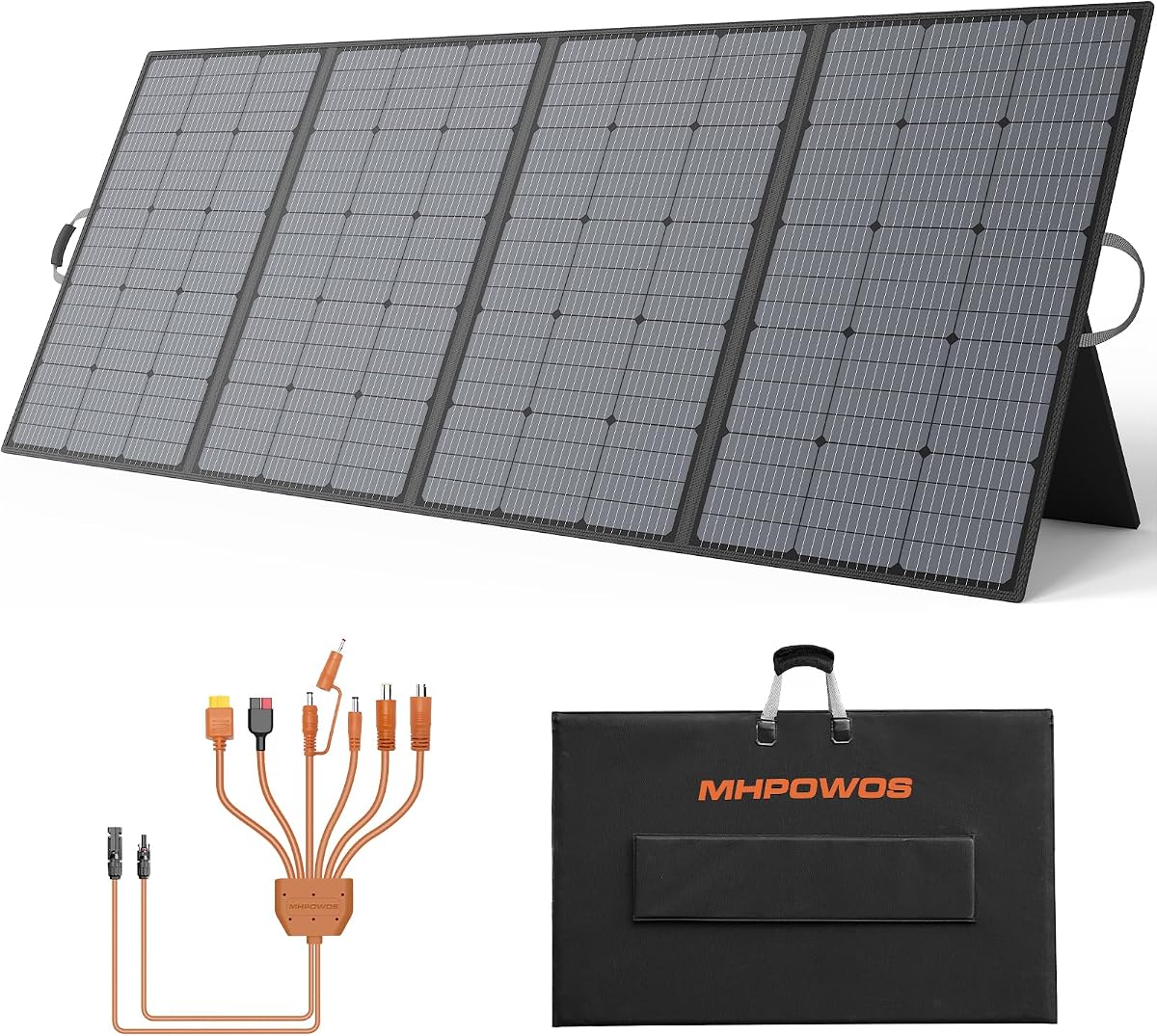
The MHPOWOS 400W Portable Solar Panel is a high-output folding charger rated 4.1 in the supplied listing. It uses A+ monocrystalline cells with a claimed 23.5% conversion rate, making it a practical choice for RV travelers, campers, and emergency kits that need more charging capacity than a compact 100W or 200W panel provides.
We may earn a commission when you buy through this link, at no additional cost to you.
Its broad connector support is a major advantage. The solar connector supports Anderson, XT60, DC7909, DC5521, DC8020, DC5525, and DC35135 formats, covering many common portable power stations. Four incorporated kickstands provide stable positioning and adjustable orientation, while the zippered accessory pouch helps organize the panel and cable during transport or storage.
The panel is advertised with IP67 waterproof and dustproof protection for outdoor use. Its plug-and-play design reduces setup complexity, and the adjustable supports let users improve the angle between the sun and the panel. As with any large solar charger, real charging speed still depends on direct sunlight, temperature, shading, the power station's charge controller, and its maximum solar input rating.
The most important limitation is explicitly noted by the manufacturer: a power station with a lower input ceiling will not accept the full 400W, even under ideal conditions. That does not necessarily indicate a panel defect. Buyers should check the maximum solar input of their station and ensure its connector format is covered. For someone with a suitably capable high-capacity station, this panel offers strong output and flexible hookup options.
A 400W rating provides more useful headroom for refrigerators, tools, communications equipment, and repeated power-station charging. It is a better match for multi-day trips than a small panel, provided the connected station can accept the input.
Supporting seven connector formats is useful for people who may change stations or own equipment from different brands. Check the physical plug shape and electrical requirements rather than assuming every similarly labeled port is interchangeable.
We may earn a commission when you buy through this link, at no additional cost to you.
The PECRON 500W Portable Solar Panel is the highest-output model included in this guide and the choice for buyers building a serious RV, van-life, or emergency energy setup. It uses monocrystalline silicon cells with a stated 25.1% conversion rate, a 500W maximum output, a 42.5V maximum-power voltage, and a 49.3V open-circuit voltage.
We may earn a commission when you buy through this link, at no additional cost to you.
Despite its considerable rated power, the four-panel folding structure weighs 22.5 pounds. A built-in thick carry handle and integrated adjustable kickstands aid transport and setup. The kickstands can tilt the panel vertically at a 90-degree angle, a useful feature when winter or midday sun approaches the horizon. A clean panel surface and angle adjustment support more consistent daily generation.
Environmental specifications include an IP67 dustproof and waterproof rating, a stated operating range of -10°C to +70°C, and a corrosion-resistant surface. The package includes an MC4 extension cable and an MC4-to-XT60 adapter. Standard MC4 output makes the panel suitable for many portable power stations and RV solar systems, although users must confirm their station's voltage and input limits.
This premium recommendation comes with a clear trade-off: the four-panel design occupies more space than the smaller alternatives, and a modest station may accept only a portion of the available output. It is most appropriate for owners of high-capacity stations who want faster replenishment, have sufficient vehicle or camp storage, and value high rated power more than minimum packed size.
The 500W rating can meaningfully reduce charging time when paired with a station that accepts high solar input. The actual gain still depends on weather, available sunlight, wiring, and the power station's controller, so buyers should verify both sides of the connection.
The vertical adjustment option is valuable during periods when overhead sun is limited. Adjustable stands allow users to follow the sun more closely and can also help achieve a cleaner setup on uneven ground.
We may earn a commission when you buy through this link, at no additional cost to you.
The VEVOR 300W Foldable Monocrystalline Solar Panel occupies a useful middle ground in this comparison, with a 4.2 rating and a 300W output. It is aimed at users who want more capacity than a 100W or 200W model without committing to the footprint of a 400W or 500W panel.
We may earn a commission when you buy through this link, at no additional cost to you.
The panel uses premium monocrystalline cells with a claimed conversion efficiency of 22% to 23%. Its built-in MC4 cable is supplemented by a 4-in-1 connector cable for XT60, Anderson, DC5521, and DC5525, plus a 10-in-1 DC adapter set. That makes it compatible with many portable power stations while keeping the main connection method recognizable and widely supported.
Durability is another strength. It has an IP67 rating, a tempered glass surface, and a stated operating range from -4°F to 149°F, or -20°C to 65°C. Its folding design is intended for storage and transport during camping, RV travel, hiking, fishing, home use, and emergency preparation. The tempered surface may be particularly attractive to buyers who want a robust alternative to fabric-heavy portable panels.
Compared with the Renogy 300W, the VEVOR offers a lower claimed efficiency and has no listed direct USB charging outputs. It remains a solid fit for buyers who prioritize output, broad adapters, and rugged construction. Confirm connector shapes and your station's maximum input before ordering, particularly if your setup includes smaller devices that would otherwise benefit from USB charging.
A 300W panel can support a broader mix of portable electronics and medium-sized station charging without reaching the physical bulk of higher-wattage choices. It works especially well for users who need a flexible daily replenishment option rather than maximum charging speed.
The tempered glass and ETFE construction are designed to withstand routine outdoor use. As with every panel, protection ratings do not eliminate the need to keep connectors dry and avoid prolonged exposure to severe standing water.
We may earn a commission when you buy through this link, at no additional cost to you.
The VEVOR 200W Foldable Solar Panel with Frame is a 4.0-rated option that differentiates itself through a frame, an integrated 30A PWM controller, MC4 output, and alligator clips. It is particularly relevant for campers or RV users who want to charge a battery directly rather than relying only on a portable power station.
We may earn a commission when you buy through this link, at no additional cost to you.
Its monocrystalline cells are claimed to provide at least 23% conversion efficiency. The built-in MC4 cable and 30A PWM controller create a recognizable charging chain, while the included alligator clips make connection to compatible battery terminals straightforward. For users familiar with solar battery charging, the integrated controller simplifies the component list compared with a panel that requires a separate controller.
The panel also has a durable frame and an IP67 protection rating. Its stated operating range is 14°F to 149°F. It folds for transport and is marketed for camping, hiking, RV trips, fishing, biking, and emergency use. However, the specifications do not list direct USB-A or USB-C outputs, so small electronics generally need another charging route.
This is the model to consider when battery charging and a supplied controller matter more than direct device ports or a universal power-station adapter bundle. The 4.0 rating is the lowest numerical rating among the products with supplied ratings, so buyers should inspect current customer feedback and confirm electrical compatibility. Within that niche, the integrated 30A PWM controller is a meaningful convenience.
Including a 30A PWM controller removes the need to source that component separately for many straightforward solar-battery installations. Buyers must still follow correct battery and charge-controller settings, and should not assume every battery type is directly supported.
The frame gives the panel a more substantial feel and can help protect the panel during transport. Its 200W rating still makes it better suited to steady replenishment than emergency charging of several large appliances.
We may earn a commission when you buy through this link, at no additional cost to you.
The Renogy 300W Portable Solar Panel is a 4.2-rated option for RV travelers and power-station users who want a relatively high efficiency rating without moving to a 400W or 500W panel. It uses 16BB N-type cells with a claimed 25% conversion efficiency and a 300W rated output.
We may earn a commission when you buy through this link, at no additional cost to you.
Renogy states that this N-type construction provides more usable power than a standard 9BB 300W panel rated at 22.5% efficiency. That claim is particularly relevant in space-constrained RV installations and cloudy conditions, although actual production always varies with sunlight, temperature, orientation, and shading. The listing also states a sunlight-dependent daily generation figure of 960Wh under suitable conditions.
Portability is another advantage. The panel weighs 18.74 pounds and folds to 23.2 by 29.3 by 3.2 inches. Its IP67 waterproof construction uses a hail-resistant ETFE coating, and the stated temperature range is -40°F to 185°F. Tool-free rust-proof kickstands allow setup in about a minute, while IP68 connectors work with many portable power stations and batteries.
The company also describes parallel wiring that helps maintain output when individual panels encounter partial shading. Renogy backs the panel with a three-year output and material and workmanship warranty. This is a compelling choice for RV users who prioritize efficient conversion, relatively low weight, and fast deployment, though they should confirm connector compatibility and avoid interpreting the listed daily generation as guaranteed output.
A 25% claimed conversion rate can help buyers obtain more output from a limited mounting footprint. It is still important to orient the panel correctly and minimize obstruction from roof vents, trees, awnings, or other panels.
The folding construction and rust-proof kickstands allow a fast setup without permanent hardware. That convenience is valuable for travelers who must move between campsites or stow the panel quickly during bad weather.
We may earn a commission when you buy through this link, at no additional cost to you.
The E-POWO 400W Portable Solar Panel is a 4.2-rated high-output option built around a 23.5% claimed conversion rate. Its 400W rating makes it suitable for substantial portable power stations, RV battery charging, and multi-day outdoor use where a smaller panel would replenish reserves too slowly.
We may earn a commission when you buy through this link, at no additional cost to you.
ETFE coating is paired with high-efficiency monocrystalline cells to provide the stated 23.5% conversion rate and IP67 waterproof protection. The casing uses waterproof Oxford fabric, while the fiberglass structure is described as offering durability, corrosion resistance, and thermal stability. An accessory pouch and briefcase-like folded form make organization and transport more practical.
The panel supplies a seven-format connector covering DC7909, DC8020, XT60, DC5521, DC5525, DC35135, and Anderson. It also includes a 7-in-1 cable. Three built-in kickstands and a 40-, 50-, and 60-degree adjustment range offer multiple positions, while reinforced grommets provide mounting points for an RV or tent. The supplied information also mentions three kickstands and two in another construction detail, so users should visually confirm the included support arrangement upon delivery.
The 15.57-kilogram weight and 37.76-inch folded length make this a substantial panel rather than a lightweight travel accessory. Nevertheless, E-POWO includes an 18-month warranty and states that cloud cover and obstacles may reduce charging efficiency. It is best for buyers who prioritize high output, rugged materials, flexible mounting, and broad connector coverage over minimal packed size.
The ETFE layer and fiberglass structure are designed for regular outdoor exposure. Keeping the panel well ventilated, dry at the connectors, and free of debris will help preserve useful output over time.
Reinforced grommets expand the setup options beyond freestanding placement, while three angle settings make it easier to track available sunlight. RV users can use those points for secure attachment where appropriate.
We may earn a commission when you buy through this link, at no additional cost to you.
The MHPOWOS 400W Bifacial Portable Solar Panel is a 4.4-rated option that brings two-sided collection to a traditional power-station charging setup. It uses N-Type 16BB monocrystalline silicon cells with a claimed 25% conversion efficiency and can collect sunlight from both the front and rear surfaces.
We may earn a commission when you buy through this link, at no additional cost to you.
The rear-facing capability is its defining feature. According to the supplied data, bifacial collection can generate up to 20% more energy than a comparable single-sided panel. That advantage is greatest when the panel is elevated, with a reflective or bright surface behind it and the rear face receives useful diffuse light. On a shaded rear side, the extra contribution will be smaller.
Despite its 400W rating, the panel weighs 19.7 pounds, described as 35% lighter than traditional 400W panels. It folds to 22.4 by 38.3 by 2.8 inches, includes three reinforced brackets, and offers adjustable support from 30 to 60 degrees. A rubber handle improves carrying. The construction uses an anti-corrosive aluminum frame, ETFE-covered cells, and an IP68 waterproof rating.
A 7-in-1 cable supports DC7909, DC8020, XT-60, DC5521, DC5525, DC35135, and Anderson connections, making it suitable for many portable power stations and RV charging. MHPOWOS provides an 18-month warranty. The key caveat is that the panel cannot store electricity itself; it must charge a connected station or battery. It is an intriguing choice for RV users who can create favorable rear-side light conditions.
The bifacial rear surface can add useful output when the setup is elevated and exposed to indirect or reflected light. This makes mounting height and the ground or surface behind the panel important setup variables.
A weight of 19.7 pounds is relatively manageable for a 400W panel. The folding format and rubber handle help users move it between a vehicle, campsite, and suitable elevated mounting position.
We may earn a commission when you buy through this link, at no additional cost to you.
Choosing a foldable monocrystalline solar panel requires balancing rated output with weight, connector coverage, weather protection, charging options, and the power station or battery you intend to use.
Choose output that matches your equipment and trip duration rather than your wish list. Confirm how quickly you need the power station replenished and whether your station can accept the panel's rated input.
Prioritize efficiency when space is tight, but also consider weight, durability, and connector support. A slightly less efficient panel may be the better practical choice if it is easier to position in full sun.
Never rely on a generic-looking plug alone. Check both the station's input specification and the panel's cable arrangement before purchase.
For backpacking, weight may dominate. For RV storage or van life, folded width, carrying handles, and secure mounting may be more important than a small difference in weight.
Look for durable lamination, reinforced grommets, corrosion resistance, and secure stitching. After wet use, wipe the surface and store the folded panel only when it is dry.
Adjustable stands are useful, but they cannot overcome poor placement. Reposition the panel when shadows move, and secure it appropriately in wind.
Direct ports are a worthwhile convenience, not the only charging architecture you need. Match those outputs to small electronics and use a power station for larger devices.
Check the current warranty terms, included accessories, and certification documentation. Keep the purchase record and user manual with the panel for easier support.
Begin by identifying your power station's accepted connector, voltage, current, and maximum solar input. Connect the appropriate cable before exposing the panel to strong sunlight, and confirm polarity for any direct battery connection. If the station has an input limit below the panel's rating, the station will accept only the amount it can safely handle. Never use a connector that appears similar but does not match the required electrical specification.
Unfold the panel in an unobstructed location, deploy its kickstands or brackets, and select an angle that keeps the solar surface facing the available sun. Reposition it as shadows move, especially under trees, beside an RV, or near a tent. Elevated bifacial setups need light on both faces. Check the charging display periodically, but avoid interpreting a short charging pause as a fault because some power stations reduce or stop input when their battery is full.
After use, disconnect the panel before folding it, wipe away dirt and moisture, and inspect cables and connectors for damage. Let wet components dry before storing the panel in its pouch. Keep the surface free of heavy debris, use no abrasive cleaners, and never immerse the panel or junction box. Storing the unit dry and loosely folded helps protect its cells, laminates, hinges, and electrical connections.
No. Compatibility depends on both the connector and the power station's electrical input limits. Check whether the station accepts MC4 or another connector, confirm the supported voltage and current, and make sure its maximum solar input is high enough for the panel. A higher-rated panel can still work correctly, but the station will accept only the power it is designed to handle.
No. The wattage on a solar panel is its maximum rated output under specified test conditions, not a constant real-world charging rate. Clouds, shade, high temperatures, low sun angles, wiring losses, and the power station's controller can all reduce production. The connected station's maximum solar input is also an upper limit, so verify its specifications before relying on the panel's full rating.
Some models can. The Renogy 200W, ZOUPW 200W, and VEVOR 100W list USB-A, USB-C, or other direct outputs, while the remaining choices primarily use MC4-style connections for power stations or batteries. Direct charging speed depends on the port rating, sunlight, device requirements, and the panel's internal controller, so a phone may charge more slowly under weak conditions.
A bifacial panel can collect sunlight on its front and rear surfaces. The extra output is usually greatest when the rear side receives reflected or diffuse light, so elevation and a bright surface behind the panel matter. On a dark or blocked rear side, the additional contribution can be modest. The stated maximum bifacial gain should therefore be treated as a favorable-condition figure rather than guaranteed performance.
Many models have IP67 or IP68 protection and are designed for outdoor exposure, but the ratings do not make every component submersible. Keep connectors elevated and dry, follow the manufacturer's guidance, and avoid prolonged heavy rain when advised. Water can still collect at folds or cable junctions and may cause corrosion or intermittent charging.
Higher efficiency can produce more power from the same active area, which is valuable on an RV roof or in a small carry bag. Real output still depends on sunlight, temperature, panel angle, shading, wiring, and the power station's acceptance. A highly efficient panel placed in partial shade may be outperformed by a lower-rated panel positioned in direct sun.
Place the panel in the most direct sunlight available and aim the active surface toward the sun. Use the kickstands or mounting brackets to support it securely, and reposition it when shadows move. Avoid placing it behind glass or beneath a vehicle canopy unless the manufacturer specifically permits that installation. Stable positioning prevents wind from tipping the panel or interrupting the connection.
Only if the manufacturer permits series or parallel operation and the voltage, current, and connector configuration are compatible. Some power stations accept only one solar input, while others have dedicated inputs for multiple panels. Check both manuals carefully because improper wiring can damage a charge controller. If parallel operation is supported, matching models and an appropriate combiner may be necessary.
The Renogy 200W is the most balanced overall choice because it combines a 25% claimed efficiency, manageable weight, direct USB charging, and broad power-station compatibility. The VEVOR 100W is the value-focused option for smaller stations and travelers who need a compact panel, while the PECRON 500W offers the greatest rated output for users with capable high-capacity systems.
Prioritize compatibility before every other feature. Confirm the station's solar input limits, connector type, and battery charging requirements, then choose the panel size that fits your storage and travel plans. Kickstands, ETFE surfaces, bifacial construction, and direct USB ports are useful refinements, but none can compensate for an unsuitable connection or poor sunlight exposure.
Finally, check the current listing, availability, included accessories, warranty, and price before purchasing. Technical specifications can change between product revisions, and prices fluctuate over time. A careful compatibility check will prevent most disappointments and help you select a foldable monocrystalline solar panel that fits both your equipment and the way you travel.