
ASRock Intel Arc A380 Challenger ITX
4.3Editor score
Compact two-slot ITX design
Six gigabytes GDDR6 memory
Four-display connector layout
Explore the best GPU for Small Form Factor Sff PC options, comparing compact sizing, memory capacity, cooling, display outputs, power use, and workload fit.
A graphics card for a small-form-factor PC must balance performance with strict limits on length, thickness, heat, and power. The best options provide useful gaming or professional capability while fitting comfortably inside compact cases without compromising cooling or leaving room for other essential components.
We compared the ten products using their documented dimensions, memory, clock speeds, cooling systems, display connectors, power requirements, and intended workloads. The list covers low-profile gaming cards, compact enthusiast models, workstation-oriented solutions, and value-focused options for everyday creative and media tasks.
Each review explains the strongest reasons to choose a particular card, along with important compatibility considerations and balanced limitations. Ratings and specifications can change as manufacturers revise products, so shoppers should verify current listings and exact dimensions before finalizing a compact build.
4.3Editor score

4.7Editor score

4.8Editor score
The comparison highlights each card's most important compact-build characteristics, including memory configuration, physical design, cooling approach, and display support. It is designed as a quick reference, with the full reviews below providing more detail about performance potential, use cases, and compatibility.




The MAXSUN GeForce RTX 3050 6GB is a highly compact graphics card designed specifically for Mini-ITX and small-form-factor systems. It has a 4.3 rating, and its defining strength is physical restraint: the documented dimensions are approximately 6.65 by 2.71 inches, making it one of the most space-conscious options in this guide.
We may earn a commission when you buy through this link, at no additional cost to you.
Power comes from an NVIDIA Ampere architecture implementation with 6GB of GDDR6 memory connected through a 96-bit interface. The listed core and boost clocks are 1042MHz and 1470MHz respectively, while the PCI Express 4.0 interface uses eight lanes. Display connectivity includes HDMI 2.1 and DisplayPort 1.4a, with support for high-resolution output and multiple monitors.
The main compromise is that the card's memory capacity and bus width are more modest than those of modern higher-tier alternatives. It may also require careful chassis and cooler compatibility checks because low-profile fitment alone does not guarantee that every SFF case offers sufficient clearance. A suitable power supply and adequate case airflow remain important.
This card makes the most sense for a builder who values a very small footprint, needs a dedicated GPU in a compact office or media PC, and wants a more capable upgrade than basic integrated graphics. For space-constrained esports systems and light gaming builds, it is a practical choice, provided the case supports the card's exact dimensions and required power connection.
The slim low-profile PCB is the feature that matters most in an SFF enclosure. Its stated footprint of 16.9 by 6.9 centimeters leaves room for storage, cooling, and cable routing in cases that cannot accept a full-height, multi-slot gaming card.
HDMI 2.1 and DisplayPort 1.4a provide flexible options for high-resolution monitors and multi-display arrangements. This makes the card relevant to compact productivity systems as well as smaller gaming PCs.
We may earn a commission when you buy through this link, at no additional cost to you.
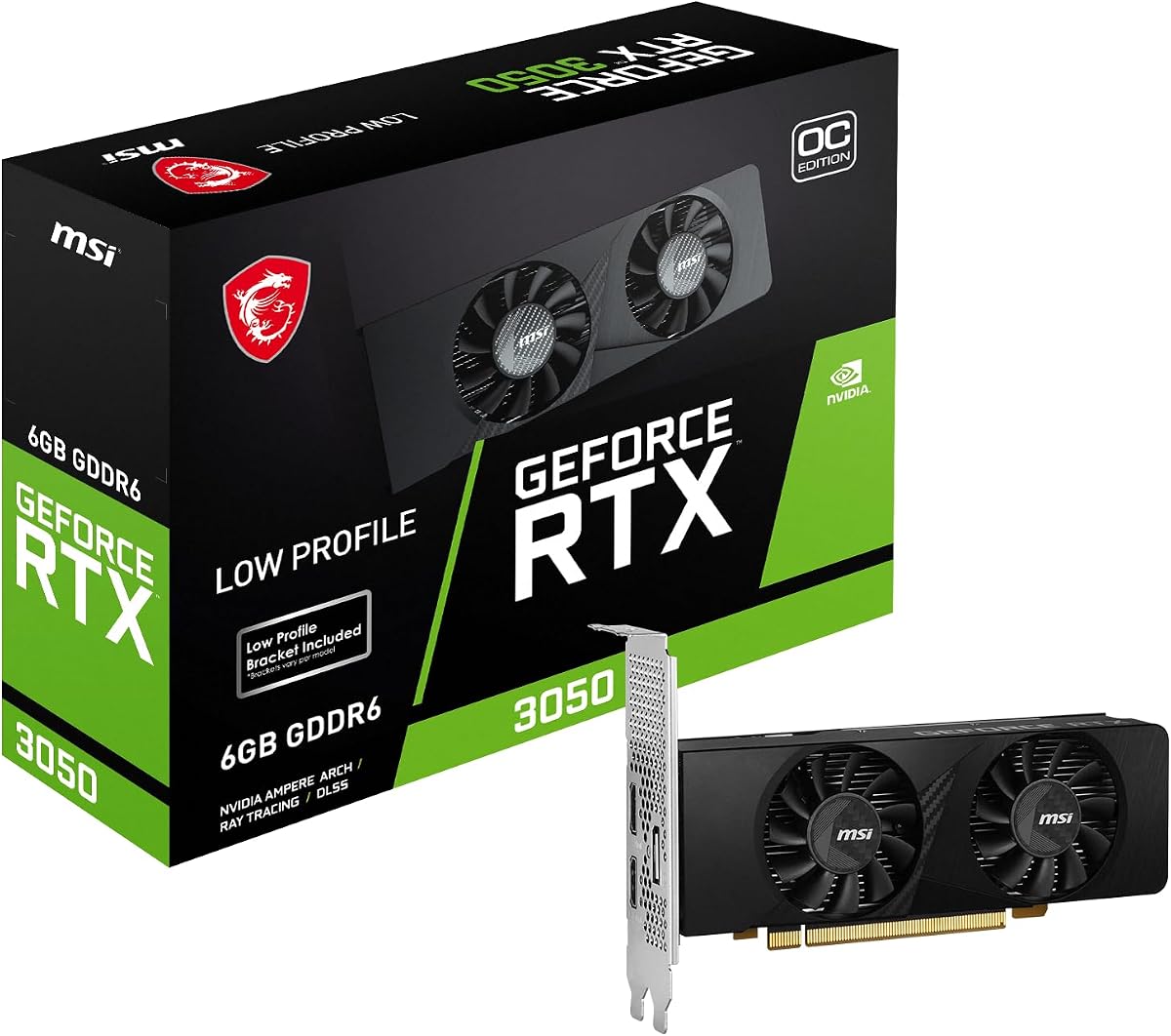
The MSI Gaming RTX 3050 LP 6G OC combines a familiar RTX 3050 configuration with the low-profile proportions needed by compact cases. Its 4.5 rating places it among the stronger-reviewed products in the list, and the 1492MHz boost clock gives it a modest factory overclock over the standard configuration.
We may earn a commission when you buy through this link, at no additional cost to you.
The card carries 6GB of GDDR6 memory operating at 14Gbps across a 96-bit interface. Display connections comprise one DisplayPort 1.4a and two HDMI 2.1a ports, which is a useful configuration for a compact workstation or a small gaming system using more than one monitor.
Its performance ceiling is defined by the underlying RTX 3050 platform and its six gigabytes of video memory. Modern games with elaborate textures may require lower settings, while the older generation also does not offer the newest framework features found in the Blackwell-based cards elsewhere in this guide.
This MSI model is best suited to an SFF gaming build that needs a dependable low-profile upgrade and versatile display support. Buyers should still compare its exact length and bracket design with their case, but the combination of a higher clock than the base configuration and a 4.5 rating makes it an attractive compact option.
The 1492MHz boost clock gives the OC model a small clock advantage over the reference RTX 3050. While it will not transform the tier of the card, that extra headroom can be useful in thermally constrained systems where stable boost behavior is desirable.
Two HDMI 2.1a ports and one DisplayPort 1.4a connector provide good flexibility for mixed-monitor setups. This is particularly helpful in compact offices, where a small workstation may need to drive several differently equipped displays.
We may earn a commission when you buy through this link, at no additional cost to you.
The ASUS Prime NVIDIA GeForce RTX 5070 stands out as the most balanced high-performance choice in this guide. It combines a 4.7 rating with an explicitly SFF-ready design, modern 12GB GDDR7 memory, PCIe 5.0 support, and the Blackwell architecture. It offers substantially more capability than the RTX 3050 selections without adopting a full-size three-slot footprint.
We may earn a commission when you buy through this link, at no additional cost to you.
Thermal engineering receives particular attention. Axial-tech fans use smaller hubs and longer blades to generate downward air pressure, while a phase-change GPU thermal pad is designed to improve contact and heat transfer. The 2.5-slot design is intended to preserve cooling performance while creating more room around the card in tightly packed systems.
The main limitation is power and thermal demand. A modern RTX 5070 is not a low-energy solution, so a compact build needs an appropriately sized power supply, sensible cable routing, and enough case ventilation. The 2.5-slot thickness may also be too deep for the smallest cases even though the card is marketed as SFF-ready.
For a builder seeking strong gaming, creative applications, and modern graphics features without a full-size enthusiast card, this ASUS Prime model is the most versatile recommendation. It is especially appropriate for SFF cases designed around SFF-ready components, and its dual BIOS feature adds flexibility for balancing performance with quieter operation.
The combination of a 2.5-slot chassis and 12GB of GDDR7 creates a useful balance between compactness and contemporary graphics capability. It is suited to builders who want more headroom for textures and modern workloads than a six-gigabyte RTX 3050 can offer.
Longer fan blades, a barrier ring, and a phase-change thermal pad form a focused cooling strategy. These details are particularly relevant in SFF systems, where every millimeter of clearance must contribute to airflow and reliable temperature control.
We may earn a commission when you buy through this link, at no additional cost to you.
The PNY NVIDIA RTX A400 is purpose-built for compact business and professional systems rather than gaming. Its 4.7 rating reflects a well-targeted design for workstation tasks, and the single-slot, low-profile form factor makes it one of the easiest options to accommodate in a tightly constrained chassis.
We may earn a commission when you buy through this link, at no additional cost to you.
The card uses NVIDIA's Ampere architecture with 768 CUDA cores and 4GB of GDDR6 memory. Four Mini DisplayPort 1.4a outputs are specified at resolutions up to 5120 by 2880 at 60Hz, giving professionals the ability to connect multiple high-resolution displays for video editing, modeling, and visualization.
A 50W power consumption rating is one of its most important advantages. Low energy use can simplify power-supply selection and reduce the heat introduced into an already crowded enclosure. The trade-off is a modest 4GB memory capacity and a design that does not target the performance expectations of current gaming GPUs.
The RTX A400 is a strong candidate for compact professional workstations where multiple displays, modest power draw, and reliable low-profile installation matter more than gaming frame rates. It is less appropriate for a gaming-focused SFF build, but for visualization, media, and general professional workflows, its physical design is exceptionally practical.
Four Mini DisplayPort 1.4a connectors make the A400 attractive for editing suites, financial workspaces, and visualization stations. The documented support for four 5120 by 2880 displays at 60Hz adds meaningful flexibility for professional setups.
The single-slot low-profile design and 50W consumption leave room for other components while limiting power and thermal demands. That makes the card especially useful in compact business systems with limited expansion and cooling capacity.
We may earn a commission when you buy through this link, at no additional cost to you.
The ASRock Intel Arc A380 Challenger ITX is the most compact gaming-oriented recommendation in the guide, with documented dimensions of 169.9 by 123.5 by 39.2 millimeters. It uses a two-slot layout and a single-fan cooler, making it well suited to Mini-ITX and other small systems where space is the priority.
We may earn a commission when you buy through this link, at no additional cost to you.
Its factory-overclocked Intel Xe architecture GPU runs at 2250MHz and is backed by 6GB of GDDR6 memory across a 96-bit bus. The specification list also includes PCIe 4.0, AV1 hardware encoding, Intel XeSS support, and a capable display configuration comprising three DisplayPort 2.0 connectors and one HDMI 2.0b port.
Cooling is handled by a striped axial fan that stops during low-temperature operation for silent use. The single-fan design saves room, although buyers should still provide case airflow and avoid positioning the card where its intake is obstructed. ASRock specifically recommends a 500W power supply and an eight-pin power connection.
The A380 is best for budget-conscious compact systems focused on esports, everyday graphics, media playback, and light creative work. It is not a high-end gaming solution, and actual software support can vary, but its clear dimensions, six gigabytes of memory, and four-output layout provide a compelling package for a small build.
Exact measurements of 169.9 by 123.5 by 39.2 millimeters make preliminary chassis checks much easier. This transparency is valuable in SFF builds, where small differences in bracket or cooler height can determine whether a card fits at all.
The fan-stop feature allows the card to remain silent during light workloads. That behavior is useful for office, media-center, and general-purpose PCs where background fan noise would otherwise undermine the benefit of a compact, tidy system.
We may earn a commission when you buy through this link, at no additional cost to you.
The MSI GeForce RTX 3050 LP 6G OC differentiates itself from simpler low-profile models through a two-fan cooling solution and a large heatsink. It carries a 4.6 rating, making it one of the most favorably reviewed products here, while its low-profile PCB preserves compatibility with slim and small-form-factor systems.
We may earn a commission when you buy through this link, at no additional cost to you.
The card provides 6GB of GDDR6 memory, a 1492MHz boost clock, a 96-bit memory interface, and PCI Express 4.0 connectivity. One DisplayPort 1.4a and two HDMI 2.1 connectors support 4K output, while MSI Center provides monitoring and tuning alongside more advanced overclocking controls.
The two-fan cooler is an advantage over single-fan alternatives because it spreads cooling work across two smaller fans and can move air more effectively through a large heatsink. The tradeoff is that the assembly may occupy more depth than a basic one-fan card. Exact fitment should therefore be checked against the chosen chassis and nearby components.
This MSI RTX 3050 LP is a strong option for a compact gaming PC where thermal headroom is limited but a basic card is still too large. It is particularly attractive for builders who want a recognizable low-profile design, flexible display outputs, quiet cooling features, and software-based control without moving to a much larger modern GPU.
Using two compact fans gives this model more cooling hardware than a typical single-fan design. In a tightly enclosed SFF case, that additional thermal capacity can help maintain stable performance while keeping individual fan speeds and noise levels manageable.
MSI Center gives users direct access to real-time monitoring, adjustments, and optimization. It also provides advanced overclocking controls, making the card easier to tailor to the thermal and acoustic conditions of an individual compact enclosure.
We may earn a commission when you buy through this link, at no additional cost to you.
The GIGABYTE GeForce RTX 5070 WINDFORCE OC SFF earns the highest rating in this roundup at 4.8. It combines NVIDIA's SFF-ready designation with the Blackwell architecture, DLSS 4, 12GB of GDDR7 memory, and a dedicated WINDFORCE cooling system, giving compact builders access to flagship-adjacent graphics capability.
We may earn a commission when you buy through this link, at no additional cost to you.
Its 192-bit memory interface is twice as wide as the interface used by the RTX 3050 and A380 models in the guide. The card also supports PCIe 5.0, while the WINDFORCE thermal design is intended to manage the considerable heat generated by a modern high-performance GPU within a smaller-than-standard enclosure.
Compactness does not eliminate the usual demands of a powerful graphics card. Buyers need a capable power supply, appropriate power and data cabling, a case with sufficient slot clearance, and good airflow around the card. Its SFF-ready status supports compatibility, but it should not be interpreted as a guarantee that every miniature chassis will accept it.
This GIGABYTE card is the premium choice for a compact PC that still needs strong gaming performance, modern features, and ample graphics memory. It is especially appropriate for builders with an SFF-focused chassis and modern power supply who refuse to sacrifice the performance envelope merely because the system is smaller than a conventional tower.
Twelve gigabytes of GDDR7 connected through a 192-bit interface provides a substantial working memory pool and bandwidth foundation. That combination is better suited to modern game textures, content creation, and high-detail visual work than the six-gigabyte cards in the guide.
The WINDFORCE cooling system reflects the challenge of fitting high-end graphics into restricted enclosures. Its dedicated design gives builders a more purposeful option than attempting to adapt a full-size desktop GPU into a chassis that was never built for it.
We may earn a commission when you buy through this link, at no additional cost to you.
The MSI Gaming RTX 5060 Ti 8G Shadow 2X OC occupies a useful middle ground for compact systems. It has a 4.5 rating, uses NVIDIA's Blackwell architecture with DLSS 4, and carries 8GB of GDDR7 memory. Crucially for this guide, it is described as an SFF-ready enthusiast graphics card.
We may earn a commission when you buy through this link, at no additional cost to you.
The Shadow design uses TORX Fan 5.0 technology, with linked fan blades and ring arcs intended to stabilize airflow and maintain higher pressure. A nickel-plated copper baseplate captures heat from the GPU and memory, while square-shaped core pipes maximize contact with that baseplate for more effective thermal transfer.
Display connectivity includes three DisplayPort 2.1a outputs and one HDMI 2.1b connector, giving the card flexibility for high-refresh displays and mixed setups. The supplied data leaves the memory bus width and some clock details as placeholders, so buyers should consult the final manufacturer specifications before making detailed comparisons.
This MSI card is a logical choice for an SFF build that wants a modern GPU without the footprint and power demands associated with the highest-tier models. Its 8GB of memory and Blackwell feature set make it particularly attractive for modern gaming, while the SFF-ready positioning gives compact-system builders a more relevant starting point.
Eight gigabytes of GDDR7 and Blackwell architecture place the RTX 5060 Ti Shadow above the six-gigabyte RTX 3050 options. It offers a modern platform for gaming and creative tasks without moving all the way to a 12-gigabyte enthusiast card.
The copper baseplate and square core pipes form an integrated approach to moving heat away from sensitive components. Those details complement the dual-fan Shadow layout and are especially relevant when internal case airflow is limited.
We may earn a commission when you buy through this link, at no additional cost to you.
The AMD Radeon Pro WX 4100 is a low-profile professional graphics card designed around efficiency and compact-system compatibility. Its 4.4 rating and 50W maximum power consumption make it especially interesting for small business workstations where power, expansion, and cooling limitations are more important than gaming performance.
We may earn a commission when you buy through this link, at no additional cost to you.
The card carries 4GB of GDDR5 memory over a 128-bit interface and delivers up to 2.4 TFLOPS of compute performance. Its documented capabilities include single-precision video effects, rendering, signal processing, transcoding, and digital rendering applications, all within a form factor intended for compact professional installations.
Display capabilities are impressive for its class. Radeon Pro WX 4100 can drive one 5K display at 5120 by 2880 and 60Hz or up to four 4K displays. AMD PowerTune dynamically optimizes power use, while ZeroCore Power further reduces consumption in appropriate states.
This card is a good choice for media editing, general visualization, signal-processing, and multi-monitor office systems in restricted cases. It is not intended to compete with modern discrete gaming GPUs, and its older architecture may show its age in heavily accelerated applications, but its low power draw and low-profile construction remain highly practical.
A 50W maximum power requirement is unusually approachable for a discrete professional card. It leaves more thermal and power headroom for the rest of a small workstation, which can be decisive in cases with limited cooling capacity.
Support for one 5K monitor or four 4K displays makes the Radeon Pro WX 4100 useful for professional workspaces that rely on multiple panels. It offers a practical alternative to using several integrated display adapters in a compact chassis.
We may earn a commission when you buy through this link, at no additional cost to you.
The ASUS Dual Radeon RX 9060 XT stands out for its 16GB of GDDR6 memory, the largest memory capacity in this guide. With a 4.7 rating, it appeals to compact gaming builders who want additional memory headroom without moving directly to the physical demands of the most premium graphics cards.
We may earn a commission when you buy through this link, at no additional cost to you.
Its 2.5-slot design balances cooling capacity with build compatibility, while the axial-tech fans use smaller hubs, longer blades, and a barrier ring to improve downward air pressure. The dual BIOS switch provides Quiet and Performance profiles, making it easier to choose between lower acoustic output and stronger performance settings.
The included OC mode lists boost and game clocks up to 3250MHz and 2640MHz, while the default mode lists up to 3230MHz and 2620MHz respectively. Dual ball fan bearings are stated to last up to twice as long as sleeve-bearing designs, an appealing longevity feature for a card expected to remain in a compact system for years.
This ASUS Radeon is a compelling choice for a small gaming PC that prioritizes memory capacity and flexible operating profiles. However, the supplied specifications do not explicitly label it as a low-profile card, so physical fitment must be confirmed carefully. Its modern graphics hardware also calls for a suitable compact power supply and adequate cooling.
The 16GB configuration offers considerable room for demanding textures, creative applications, and future workloads. It is a notable advantage for builders who want a compact card without accepting the memory limitations common among entry-level and older low-profile designs.
The dual BIOS switch makes it simple to select a quieter profile for general use or a performance profile when sustained graphics demand justifies it. That flexibility is useful in small systems where acoustics and thermals may require different compromises at different times.
We may earn a commission when you buy through this link, at no additional cost to you.
Choosing a compact graphics card starts with the physical limits of the case and power supply, followed by the workloads you expect to run. A useful purchase should fit without blocking airflow or expansion slots while providing enough graphics memory, cooling, connectors, and software support for your specific needs.
Choose a card whose documented dimensions leave room for power cables and airflow. A narrow card that barely fits may still restrict adjacent components or make installation unnecessarily difficult.
A low-profile card must have a low-profile mounting bracket if the enclosure expects flat or shallow cards. Some manufacturers include interchangeable brackets, while others require the user to change or remove parts. Check the bracket height, screw alignment, and whether the supplied I/O bracket matches the case. A card marketed as SFF-ready may still be taller than the low-profile bracket available with another model.
The key is to compare the complete installed configuration, not just the printed circuit board dimensions. Bracket and cooler height both determine whether the card can sit safely inside the enclosure.
Graphics memory influences texture quality, scene complexity, video editing, and the ability to handle modern applications without frequent swapping. Cards in this guide range from 4GB to 16GB. The RTX 3050, Intel Arc A380, and RTX 5060 Ti provide 6GB, 6GB, and 8GB respectively, while the RTX 5070 models offer 12GB. The ASUS Radeon RX 9060 XT provides 16GB. Memory interface width also matters: the 192-bit GIGABYTE RTX 5070 offers substantially more bandwidth than the 96-bit configurations in several RTX 3050 models.
Match memory capacity to the workload rather than to the card name alone. More memory is useful for demanding games and creative work, while bus width influences how efficiently that memory is accessed.
A compact case does not necessarily need a compact power supply, but the graphics card still has to operate within the system's available wattage and connector arrangement. The ASRock Arc A380 requires an eight-pin connection and recommends a 500W PSU. Modern RTX 5070 cards can demand considerably more, making the power supply and any modular cables central to the purchase decision. Verify connector type, required adapter, cable routing space, and the capacity of the manufacturer's recommended unit.
Do not choose a card solely because its physical size looks manageable. A build that fits but cannot supply stable power is not a successful compact graphics upgrade.
Cooling in an SFF enclosure must move heat through a restricted path. Single-fan designs save room but place more responsibility on a small fan, while dual-fan low-profile cards can distribute airflow across a larger heatsink. The ASUS Arc A380 stops its fan at low temperatures for quiet operation, whereas the MSI RTX 3050 LP combines two fans with a large heatsink. Enthusiast cards such as the ASUS Prime RTX 5070 use axial-tech fans, thermal pads, and a 2.5-slot cooler designed to maintain performance within tighter enclosures.
Consider both card design and case airflow. A strong cooler cannot compensate fully for a chassis that recirculates hot air, so leave room for intake and exhaust as well.
Connector selection should reflect the monitors already in use and the number of displays the system needs to drive. Several RTX 3050 options combine HDMI and DisplayPort, while the ASRock Arc A380 provides three DisplayPort 2.0 outputs and one HDMI 2.0b port. The PNY RTX A400 offers four Mini DisplayPort connectors, and the AMD Radeon Pro WX 4100 can drive one 5K display or up to four 4K displays. Check both connector type and the resolution, refresh rate, and power-management features required by each monitor.
Modern connector standards are useful, but compatibility matters more than novelty. Ensure the correct cable or adapter is available and that the operating system recognizes the selected output arrangement.
The graphics architecture determines available features such as DLSS, XeSS, hardware encoding, ray tracing, and professional acceleration. Blackwell-based cards in this guide support DLSS 4, while the Arc A380 includes Intel XeSS and AV1 hardware encode. The RTX A400 emphasizes professional workflows such as modeling, rendering, and video production, while the Radeon Pro WX 4100 targets visualization and media tasks. Consider whether the necessary applications and operating systems are supported by the card's current driver stack.
For a gaming system, compare the graphics features that your chosen games use and the value of upscaling. For professional work, prioritize application compatibility, memory needs, and multi-display behavior.
The fastest or most memory-rich card is not automatically the best match for a small PC. A modest processor, system memory, storage speed, and case cooling all influence the result. A modern graphics card paired with a limited platform may not deliver its full potential, while a balanced system can make an RTX 3050 or Arc A380 feel more capable in actual use. The AMD Radeon Pro WX 4100 and RTX A400 illustrate the value of matching power efficiency and connector layouts to professional requirements rather than maximizing gaming performance.
Build around the complete machine and your most common tasks. The right compact GPU should improve the experience without causing thermal, power, or compatibility problems elsewhere in the chassis.
Before installation, power down the compact PC, disconnect the power supply, and remove the side panel. Confirm that the card's length, thickness, bracket, and connector requirements match the case. Install the correct power cable if the card requires one, seat the card firmly in the PCIe slot, secure the bracket, and connect any DisplayPort or HDMI cables before attempting to route them through the tight interior.
After the first boot, install the graphics driver recommended for the card and verify that the operating system recognizes it. Use the manufacturer's monitoring or tuning software to check clocks, fan behavior, temperature, and memory use. If the card includes selectable BIOS profiles, begin with the quiet or default setting and move to a performance profile only after confirming adequate cooling and stable operation.
Compact systems benefit from regular airflow maintenance. Keep intake paths and nearby dust filters clean, avoid positioning the graphics card directly against a drive cage or cable bundle, and listen for unusual fan noise. Monitor behavior under sustained graphics loads, and do not ignore persistent throttling, unexpected shutdowns, or display artifacts, as these can indicate inadequate chassis airflow or power delivery.
The best GPU depends on the case dimensions, power supply, cooling, and intended workload. For general compact gaming, a modern SFF-ready card such as the ASUS Prime RTX 5070 or GIGABYTE RTX 5070 WINDFORCE OC SFF offers the strongest performance, while the ASRock Arc A380 is a more restrained option. Professional multi-display systems may favor the single-slot PNY RTX A400 or low-profile AMD Radeon Pro WX 4100.
Some modern gaming cards are specifically engineered as SFF-ready models, but many standard desktop cards remain too long or too thick. You should compare the exact card dimensions with the case's maximum GPU length and available slot width. Also account for power connectors, data cables, and the space needed to route them without obstructing fans.
Low-profile generally describes a card designed with a shorter cooler and mounting bracket for slim cases. SFF-ready is a more specific compatibility designation that can involve coordinated card and chassis design. The terms are often used together, but shoppers should still verify exact dimensions and case-manufacturer compatibility lists.
Yes, provided the enclosure, power supply, and cooling system support it. Modern cards such as the RTX 5070 options in this guide are substantially more demanding than entry-level models, so their SFF design does not eliminate the need for a capable power supply and good case airflow. A full-size desktop case is generally easier to cool than a miniature enclosure.
Four gigabytes may be adequate for display-heavy office work, older games, and some professional applications, while six gigabytes offers a more comfortable minimum for modern gaming and creative tasks. Eight to 16 gigabytes is preferable for demanding games, high-resolution media, 3D work, and future-proofing. Memory should be considered alongside the processor and workload because a faster card cannot fully compensate for other major bottlenecks.
They can, because compact coolers and restricted case airflow leave less room for heat dissipation. Cards with two fans, larger heatsinks, effective vapor chambers, or thermal pads are often better suited to these environments. Keeping the card unobstructed and maintaining clean filters is essential, particularly with dual-fan designs and high-performance GPUs.
A workstation card can be ideal when the system needs professional acceleration, stable multi-display operation, and low power consumption. The PNY RTX A400 and AMD Radeon Pro WX 4100 both emphasize compact, efficient professional designs. They are less appropriate for modern gaming, but they can be excellent choices for media, visualization, modeling, and business applications.
The decision should be driven by application compatibility, required graphics features, display needs, and the rest of the system. NVIDIA options in this guide offer DLSS and broad gaming recognition, AMD provides strong multi-display and professional alternatives, and Intel Arc brings a compact modern option with XeSS and AV1 encoding. Check software support and current driver compatibility before making the final choice.
The ASUS Prime NVIDIA GeForce RTX 5070 is the most versatile overall recommendation, combining SFF-ready engineering, 12GB of GDDR7 memory, PCIe 5.0, and Blackwell features in a 2.5-slot design. The GIGABYTE GeForce RTX 5070 WINDFORCE OC SFF is the premium alternative, offering the guide's highest rating, a 192-bit memory interface, and a dedicated compact cooling system.
For builders with tighter budgets or power limits, the ASRock Intel Arc A380 provides a clearly dimensioned two-slot design, 6GB of memory, a quiet single-fan cooler, and four display outputs. The MAXSUN and MSI RTX 3050 models remain relevant for low-profile gaming, while the PNY RTX A400 and AMD Radeon Pro WX 4100 serve compact professional systems more effectively than gaming-oriented alternatives.
Before purchasing, compare the final card dimensions, bracket, power connector, display configuration, and cooling requirements against the exact chassis and power supply. Review current listings, manufacturer documentation, and updated compatibility information, since hardware revisions and market availability can change even when the fundamental product category remains the same.