
Inductive Hour Meter for Gas Engine Generator Lawn Mower Black
4.7Editor score
Battery-free inductive operation
Waterproof epoxy construction
Runtime display to 9999.9 hours
Our guide compares the best hour meter for outboard motor options, including inductive and mechanical gauges for accurate runtime tracking and maintenance.
An hour meter for an outboard motor gives owners a dependable record of engine operating time, helping schedule oil changes, inspections, and other maintenance before small issues become major problems. The most useful gauge is one that matches the motor’s electrical system, installation method, exposure level, and the amount of information you need while working on the water.
The products in this guide include inductive meters that read engine pulses, mechanical meters driven by the electrical system, and multifunction digital gauges that combine runtime with RPM or service reminders. We compared their stated compatibility, recording ranges, accuracy, environmental protection, power requirements, display functions, and installation considerations rather than relying on product names alone.
Each review explains the best use for its meter, including why it may suit a particular outboard setup and where a buyer should check compatibility first. Ratings and specifications reflect the supplied product information, while availability and pricing can change, so readers should confirm current listing details and manufacturer guidance before making a purchase.
4.7Editor score
4.6Editor score

4.6Editor score
The comparison below highlights the operating method, recording capacity, environmental protection, and display functions of all ten meters, making it easier to identify an option that fits a specific outboard motor installation.


This battery-free inductive hour meter is a straightforward runtime tracker for compatible gasoline engines, including marine engines and other small equipment. Its supplied rating is 4.7, making it one of the strongest-rated options in this guide. It records and displays operating time to 9,999.9 hours, while the flashing hourglass indicates when the engine is running. The display operates in 0.1-hour increments, which is useful for routine maintenance rather than minute-by-minute analysis.
We may earn a commission when you buy through this link, at no additional cost to you.
The main attraction is the installation method. Instead of requiring a connection to the outboard’s electrical system, the meter senses pulses through a wire that connects to the spark plug. It can then be secured with screws or a zip tie. This makes it attractive for a simple replacement, a rental motor, or a boat where permanent dashboard wiring would be inconvenient. Because the meter draws no operating power from a separate battery, there is no coin cell to replace and no concern about battery drain during storage.
Environmental protection is another strength. The ABS body and epoxy-encapsulated casing are described as waterproof, shockproof, and able to withstand temperatures up to 85 degrees. Those traits suit the vibration, moisture, and temperature changes associated with marine use. However, the total accumulated time cannot be reset or erased. That is beneficial for ownership history, but it means the meter is less useful when a motor is sold, rebuilt, or transferred to another boat and the new owner wants a fresh maintenance baseline.
This is a compelling choice for an owner who wants uncomplicated runtime tracking and values a straightforward installation. Before buying, confirm that the outboard’s ignition arrangement is compatible with inductive sensing and that the supplied wire can reach the meter’s mounting position. It is best suited to basic service-life tracking rather than RPM analysis or automatic oil-change prompts. For those priorities, the meter provides a practical, low-complexity solution.
The 9,999.9-hour capacity and 0.1-hour resolution provide a useful long-term record for scheduled servicing. The flashing symbol gives immediate visual confirmation that the meter is sensing an active engine.
The sealed ABS and epoxy casing are intended to withstand vibration, moisture, and heat. Secure mounting remains important because an inductive meter still needs a stable connection to the ignition lead.
We may earn a commission when you buy through this link, at no additional cost to you.
The Runleader RL-HM011F combines an hour meter, tachometer, and programmable service timer in one digital display. It carries a supplied rating of 4.3 and is aimed at owners who want more than a lifetime engine counter. Total run time remains visible when the engine is off, and 0.1-hour accuracy is sufficient for tracking oil changes, inspections, and other scheduled work. The total-hour figure can also be reset, making it easier to establish a new baseline after service or ownership changes.
We may earn a commission when you buy through this link, at no additional cost to you.
Its most useful feature for routine upkeep is the SERVICE countdown. A user can program a maintenance interval, after which a warning icon flashes to signal that service is due. The tachometer measures RPM while the engine runs and can be configured for different firing patterns. That makes the gauge useful for checking idle behavior and verifying that a repair has restored smooth operation. The replaceable internal CR2450 battery adds convenience, and the stated data retention means runtime and programmed information should remain after a battery change.
The trade-off is that this model is more complex than a basic mechanical or single-function inductive meter. It requires programming and correct setup of engine parameters. Its IP65 rating offers dust protection and resistance to water jets from any direction, but it is not described as fully submersible. The manual shutdown control can reduce standby drain, which is particularly useful for seasonal boats, although owners should make this part of their routine if the motor remains in storage for long periods.
Choose the RL-HM011F when you want service reminders and RPM information in a single compact unit. It is less compelling for someone seeking a completely battery-free, nonprogrammable counter, but it rewards owners who regularly inspect an outboard and value visible alerts. Confirm the specified firing-pattern compatibility and complete the programming instructions before relying on the tachometer readings.
A programmable countdown can mirror the manufacturer’s recommended service schedule or the owner’s usage pattern. The flashing warning removes the need to remember every inspection date manually.
Live RPM can help an owner monitor idle consistency and compare performance before and after maintenance. Correct programming is essential for the most meaningful readings.
We may earn a commission when you buy through this link, at no additional cost to you.
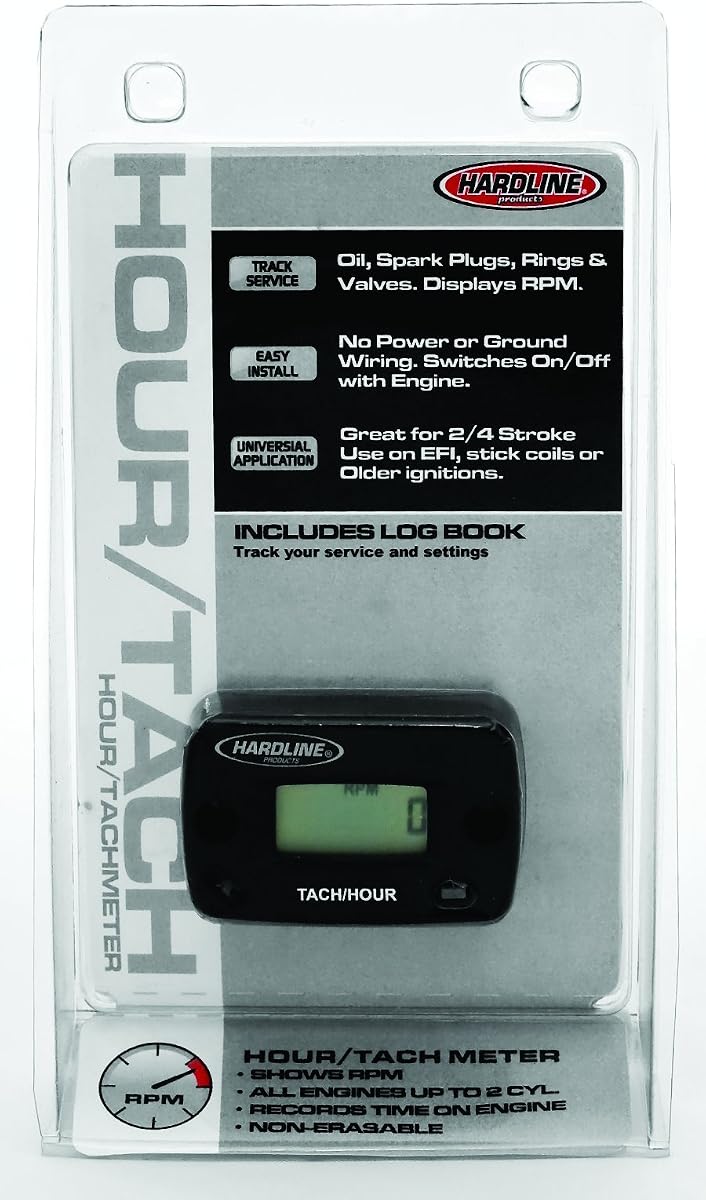
The Hardline Products USA HR-8061-2 offers one of the most complete monitoring packages in this roundup. Its supplied rating is 4.6, and it combines a digital tachometer with a persistent hour-meter display. While the engine is running, the gauge shows RPM; once it stops, the screen presents accumulated runtime. RPM is displayed up to 16,000, and the automatic operating-mode change makes it convenient to use for both quick diagnostics and long-term service tracking.
We may earn a commission when you buy through this link, at no additional cost to you.
Installation is based on a patented one-wire inductive pickup. The wire wraps around the spark-plug lead, avoiding cutting, splicing, or direct connection to the motor’s electrical system. This approach is particularly appealing for an outboard because it reduces installation complexity and leaves the original wiring intact. The unit supports gasoline engines with one or two cylinders, whether two-stroke or four-stroke, and is specifically listed as compatible with outboards. That makes the core compatibility more clearly defined than the broad claims associated with many generic meters.
The HR-8061-2 also stands out for physical protection. Its epoxy-encapsulated enclosure has an IP-68 rating and is described as waterproof, dustproof, and vibration-resistant. Such sealing is especially valuable in a marine environment, where spray, salt, vibration, and changing humidity are routine. A sealed internal lithium battery is stated to have a 10-year lifespan, while the meter draws no current from the outboard’s battery. The included peel-and-stick mounting tape simplifies placement, and the maintenance log book adds a useful recordkeeping component.
It lacks a programmable service alert, so owners must still interpret the runtime and plan maintenance themselves. It is also limited to engines with no more than two cylinders, excluding some larger multi-cylinder outboards. Even so, it offers an unusually balanced combination of installation simplicity, marine-focused sealing, runtime data, and RPM monitoring. For a compatible one- or two-cylinder outboard, this is the strongest all-around choice in the guide.
The gauge changes between RPM while running and total hours after shutdown. One unit can therefore serve both immediate engine checks and long-term maintenance planning.
The IP-68 epoxy enclosure is designed to resist water, dust, and vibration. Secure mounting and careful lead routing remain necessary to preserve that protection.
We may earn a commission when you buy through this link, at no additional cost to you.
This 12–36V quartz hour meter is a mechanical runtime counter with a broad electrical range and a large recording capacity. Its supplied rating is 4.2, and the stated counting accuracy is ±0.01, while the approximate range reaches 99,999.9 hours. The compact gauge is listed for boats, marine equipment, cars, ATVs, UTVs, snowmobiles, tractors, generators, and other small engines, making it versatile for a mixed equipment fleet.
We may earn a commission when you buy through this link, at no additional cost to you.
The wide AC/DC voltage range is the defining feature. It can accommodate many 12-, 24-, and 36-volt systems, subject to the motor’s actual electrical output and the meter’s detailed instructions. Unlike a digital unit with a replaceable coin cell, a mechanical quartz counter derives its timing from the connected electrical supply. That can make it a sensible option for a permanently powered outboard that the owner wants monitored without introducing a separate battery-maintenance task.
The housing is described as waterproof, completely sealed, low-power, and equipped with automatic rollover. Its approximate diameter is 2.2 inches, with a total height of 2.9 inches. Those dimensions should be checked against the available space on the engine cowl, console, or mounting panel. The counter’s mechanical nature also means there is no RPM display or programmable service timer, making it more focused than the multifunction digital options.
One important limitation is the explicit recommendation to use the meter indoors or in a car to avoid prolonged rain exposure. Even though the product is described as sealed, that guidance calls for caution in exposed marine installations. The buyer should follow the stated usage recommendations and protect the wiring connection from standing water. This model is best for owners who prioritize wide voltage support and a large mechanical counter over advanced alerts or a compact digital interface.
The 12–36V range provides more flexibility than a meter designed around a single nominal voltage. Confirm polarity and the manufacturer’s wiring diagram before installation.
A capacity of approximately 99,999.9 hours makes rollover a distant concern for most recreational engines. The sealed quartz mechanism avoids routine coin-cell replacement.
We may earn a commission when you buy through this link, at no additional cost to you.
The AIMILAR Vibration Hour Meter counts operating time by detecting engine vibration rather than connecting to the ignition or charging system. It has a supplied rating of 4.2 and is described as compatible with gas and diesel engines, generators, air compressors, lawn mowers, and other equipment. The digital LCD records up to 99,999 hours with 0.1-hour precision, while a flashing screen confirms that the meter is actively registering engine movement.
We may earn a commission when you buy through this link, at no additional cost to you.
The wiring-free approach is the central advantage. There is no need to identify a switched power source, route a harness through the engine cowl, or modify the outboard’s electrical circuitry. The meter includes mounting screws and can also be secured with double-sided tape, although tape is not included. The back contains a wire loop that must be clipped to activate the unit. Mounting it face up improves sensitivity, so the physical location should be chosen where the engine consistently produces enough vibration.
The compact body measures 2.24 by 1.42 by 0.68 inches, making it easy to place on an engine cover or accessible mounting surface. Its sealed waterproof housing contains a maintenance-free CR2430 battery stated to last more than two years. That internal battery supports the digital display and vibration sensor, but unlike a purely mechanical meter, the product does eventually require a battery replacement. The stated environmental sealing is useful for outdoor equipment, although appropriate placement and cable-free operation remain critical.
This is a practical option for an owner who wants a straightforward meter and does not want to connect it to the outboard’s wiring. It may be less precise than an ignition-sensing model in unusual installations, particularly if the mounting surface receives weak or inconsistent vibration. Confirm that the chosen location is exposed to engine movement and follow the activation instructions carefully. It is best suited to simple preventive-maintenance tracking rather than RPM analysis.
Because the sensor reacts to vibration, the gauge needs only a secure mounting point. This reduces installation work and makes it convenient for older or unusual engine layouts.
The small sealed housing and clear LCD suit engines where dashboard space is limited. Face-up placement helps the sensor respond consistently while the engine operates.
We may earn a commission when you buy through this link, at no additional cost to you.
The AIMILAR DC 6–80V mechanical hour meter is designed for a broad range of electrically powered equipment and is explicitly recommended for tracking an outboard motor or boat service life. It has a supplied rating of 4.4. The counter reaches 99,999.9 hours, features automatic rollover, and uses a completely sealed, dustproof, and damp-proof design. Its mechanical format concentrates on one dependable function: recording time rather than providing a dashboard of engine data.
We may earn a commission when you buy through this link, at no additional cost to you.
The 6–80V DC compatibility is highly useful for varied engine fleets. It covers voltages found in many small gasoline and diesel engines, generators, tractors, trucks, and marine applications. The gauge does not require a digital battery, which reduces ongoing maintenance. A boat owner can therefore select it when the motor’s switched or charging output falls within the supported range and the installation instructions can be followed correctly.
Its dimensions are 2.17 by 1.22 by 2.8 inches, with mounting holes spaced 1.77 inches apart. The flush-mount format is particularly helpful in tight engine compartments where a bulky gauge would be inconvenient. Its stated net weight is 1.6 ounces, so it should not be difficult to secure once the proper opening and wiring route are prepared. A mounting panel may be needed if the selected area does not already have a prepared hole.
The product does not include a tachometer, programmable service countdown, or flashing service icon, so maintenance still depends on the owner referring to the displayed runtime. Its mechanical display also lacks some of the convenience of a digital gauge, but that can be an advantage for buyers who prefer fewer controls and simpler ownership. This is a strong choice for a compatible outboard where durability, compact flush mounting, and voltage range matter most.
A 6–80V range covers an unusually broad collection of engine systems. Check the outboard’s output and connection requirements before committing to this counter.
The compact housing is designed to sit within a prepared panel opening. It is useful where engine-cowl space is limited and a protruding display would be inconvenient.
We may earn a commission when you buy through this link, at no additional cost to you.
This two-piece inductive hour meter set provides separate runtime trackers for two compatible engines. Its supplied rating is 4.4, and the package includes two meter units, two wires, and four screws. The meters are intended for generators, lawn mowers, dirt bikes, motorcycles, ATVs, boats, snowmobiles, and other small gas engines. That makes the set especially practical for a boat with an auxiliary outboard, a marine generator, and another piece of equipment that also needs time tracking.
We may earn a commission when you buy through this link, at no additional cost to you.
Each meter uses inductive sensing and connects to the spark-plug wire rather than drawing power from a separate battery. The LCD records up to 9,999.9 hours, measures RPM up to 99,999, and flashes during operation. A standby life exceeding 20,000 hours is also stated. Although the display includes an RPM indication, the primary described function is engine-hour tracking, and the product does not offer programmable service alerts.
Construction uses ABS with an epoxy-encapsulated casing that is described as waterproof, shock-resistant, and capable of withstanding temperatures up to 85 degrees. These traits suit marine and high-vibration environments. Installation involves connecting each wire to the appropriate spark plug and securing the corresponding meter with screws or zip ties. The inclusion of both components makes the set useful for maintaining multiple engines or keeping a spare available.
Its limitations mirror those of a conventional single inductive meter. Total accumulated hours cannot be reset or erased, so it is best for continuous service-life records rather than resetting after a major rebuild. It also does not directly connect to the outboard’s electrical system, which is convenient but means installation depends on spark-plug-lead access. This set is a strong choice for owners with multiple compatible engines who value simple, battery-free monitoring.
The set allows separate installation on two compatible machines or provides a ready spare. It is useful for owners maintaining an outboard and a generator or several small engines.
The sealed construction is intended to tolerate moisture, shock, vibration, and elevated temperatures. Each lead still needs careful routing so it cannot chafe or interfere with moving components.
We may earn a commission when you buy through this link, at no additional cost to you.
The Runleader RL-HM011E is a three-function digital gauge that combines an hour meter, tachometer, and service timer. Its supplied rating is 4.3, and it supports one- or two-cylinder two-stroke engines as well as one-, two-, or four-cylinder four-stroke gasoline engines. This broad cylinder compatibility makes it relevant to more outboard configurations than meters limited to one or two cylinders, while the hour counter extends to 99,999 hours at 0.1-hour accuracy.
We may earn a commission when you buy through this link, at no additional cost to you.
Real-time RPM is displayed up to 20,000, making this one of the strongest tachometer-oriented choices in the guide. Owners can compare idle readings, check whether an engine is running smoothly, and investigate performance changes. The service timer supports custom intervals, and the display flashes when an oil change or inspection is due. Total hours can also be reset, giving the owner flexibility when a new maintenance baseline is needed.
The gauge is powered by a CR2450 battery with a one-click manual shutdown intended to reduce standby consumption. That feature is valuable for a boat that may sit unused through the winter. The stated IP65 protection provides dust sealing and protection against water jets from any direction, making the unit suitable for dusty engine areas and light splashing. It is not presented as a fully submersible marine instrument, so a sheltered position remains preferable.
The tradeoff is that this model requires more configuration than a basic counter. Firing pattern, service interval, and operating settings must be programmed correctly, and the internal battery eventually needs attention. Nevertheless, it offers a broad engine range, high RPM capacity, programmable alerts, and resettable runtime in one unit. It is a strong option for owners who want active maintenance prompts and a tachometer without choosing between separate instruments.
The stated compatibility includes several one-, two-, and four-cylinder gasoline configurations. Confirm the exact engine and firing pattern before installation and programming.
Custom service intervals turn accumulated time into an actionable prompt. Resetting total hours adds flexibility, although the owner should preserve a separate ownership record if a complete history matters.
We may earn a commission when you buy through this link, at no additional cost to you.
The Yamaha Standard Engine Hour Meter, part number ENG-HOURS-00-00, is a brand-specific runtime display for compatible Yamaha engines. Its supplied rating is 4.6, and it is listed for all Yamaha two-stroke and four-stroke engine models, including gasoline generators, pumps, and marine engines. The focused compatibility can reduce uncertainty when a boat owner knows the motor is a supported Yamaha model and wants a purpose-designed gauge rather than a universal device.
We may earn a commission when you buy through this link, at no additional cost to you.
The meter performs one primary function: tracking engine operating hours for maintenance scheduling. It does not provide service-alert programming, RPM readings, or a tachometer display. Instead, it uses an integrated flash alert system for enhanced visibility. The exact alert behavior should be confirmed with the product instructions and Yamaha documentation, particularly if the owner expects the flash to represent a specific service interval rather than general operating status.
Installation is described as taking minutes with minimal effort, which is valuable for a component intended for marine and outdoor use. Its durable construction is stated to withstand harsh marine and environmental conditions. Yamaha-specific fitting also means the buyer should verify the model compatibility, connector layout, and available mounting location before ordering. The stated universal Yamaha compatibility should not be interpreted as compatibility with competing engine brands.
This option is best for a Yamaha outboard owner who values manufacturer-specific fit and a clean hour-meter function over multifunction diagnostics. It is less versatile than the universal digital and inductive meters, but it may be the most appropriate premium choice when the engine is a supported Yamaha and straightforward hour tracking is the goal. Confirm the part number and installation requirements with the motor’s service documentation before purchase.
Brand-specific compatibility can simplify connector and installation expectations. It is an advantage for a supported Yamaha motor and a limitation for owners of other brands.
The dedicated display keeps the operating-hours information prominent, while the flash system adds visual notice. It is best for owners who primarily need a service-life record.
We may earn a commission when you buy through this link, at no additional cost to you.
The 2-inch, 52mm engine hour meter combines a large runtime range with adjustable illumination. Its supplied rating of 4.8 is the highest among the products in this guide. It records from zero to 99,999.9 hours and operates on 12 or 24 volts DC, making it suitable for many cars, boats, trucks, motorcycles, and other electrical systems within those limits. The packaging includes the hour meter, wiring harness, and installation instructions.
We may earn a commission when you buy through this link, at no additional cost to you.
Its most noticeable feature is the backlight system. Red is the default color, and green, blue, white, yellow, yellow-green, orange, and purple are also available. This is useful for matching a dashboard, improving nighttime readability, or making the gauge easier to locate in a dark engine compartment. The 52mm diameter and 70mm depth should be measured before installation because the unit requires a correctly sized opening or suitable mounting arrangement.
The IP67 waterproof and dustproof rating supports use in demanding environments, while the sealed electronic counting mechanism provides a large long-term capacity. The meter is described as adjustable, and the included harness simplifies the electrical connection. Because it requires power from the vehicle or motor system, routing, grounding, and switching behavior should be handled according to the instructions. It is not a self-contained pulse-sensing unit.
This gauge is best for an owner who values visibility and long-term capacity but does not need RPM or a service countdown. Its 52mm format is more dashboard-oriented than the smallest compact meters, so measuring the available space is important. With a proper opening, secure mounting, and correctly configured electrical connection, it is an attractive choice for a boat console or other accessible panel.
Eight backlight options make the display easier to see at night and allow visual coordination with the surrounding panel. The chosen color should also remain legible in daylight.
A 99,999.9-hour range makes rollover a distant concern for most recreational engines. The 52mm body is compact, but the required opening and 70mm depth should be measured first.
We may earn a commission when you buy through this link, at no additional cost to you.
The right hour meter depends less on display size than on electrical compatibility, sensing method, environmental exposure, and the maintenance information you want. These factors help separate a convenient runtime counter from a gauge that may not install cleanly or function reliably on a particular outboard.
Choose inductive operation when a minimal, reversible installation is the priority. Choose a wired system when the motor has a dependable switched supply and the owner wants a conventional dashboard instrument. Verify the outboard’s ignition arrangement and electrical output before either approach.
Match the meter to the outboard’s actual electrical system, including polarity and whether the unit expects AC or DC. Do not rely on voltage alone when the manufacturer specifies additional connection requirements.
Prioritize an easy-to-read hour display and 0.1-hour resolution. Choose a larger capacity when the motor accumulates substantial annual use or the meter will remain installed for many years.
For an exposed engine cowl, prioritize the strongest stated ingress rating available and a sealed housing. For a protected console, a well-mounted IP65 model may be sufficient, but read the manufacturer’s exposure guidance carefully.
Choose a dedicated meter for simplicity and a stable service-history record. Choose a multifunction gauge when RPM monitoring and programmable service reminders will actually be used.
Choose battery-free operation for the lowest ownership hassle. If selecting a digital or powered counter, account for battery replacement, shutdown behavior, and data retention before installation.
Measure the intended location before ordering and follow the included template or hole-spacing instructions. Choose the display that remains easy to read from the operator’s position.
Decide whether the meter is a permanent ownership record or a rolling maintenance tracker. Preserve important history elsewhere if the selected model permits a reset.
Begin by identifying the correct power source, ignition arrangement, and mounting location. Read the included instructions before cutting, connecting, or drilling anything. For an inductive meter, route the sensing wire around the spark-plug lead without interfering with the plug cap, and position the gauge where it is visible but protected from moving parts. For a powered model, confirm voltage, polarity, grounding, and whether the chosen circuit switches on with the engine.
After installation, start the motor and verify that the display changes as described. A running engine should produce a flashing operating indicator on models with that feature, while the total should remain visible after shutdown. Set the service interval, cylinder count, firing pattern, display mode, or other programmable options before relying on the readings. Record the initial hour reading in a maintenance log and compare later readings with the manufacturer’s service schedule.
Care for the meter by keeping the case, display, and connectors clean, inspecting the mounting screws, and checking the wiring for chafing or corrosion. Do not expose a product to conditions beyond its stated rating. Replace a digital battery promptly if readings become unstable, and record service events before resetting a resettable total. Periodic inspection helps ensure that the displayed runtime continues to reflect the actual service life of the outboard.
Not every meter suits every motor, so compatibility must be checked first. Consider the engine brand, cylinder count, ignition system, electrical output, mounting space, and whether the product uses inductive sensing or needs a wired power connection. Yamaha-specific models should only be selected for supported Yamaha engines, and inductive meters should be verified against the outboard’s ignition-lead arrangement.
An inductive meter is often simpler because it senses the ignition pulse and may not need separate power or a grounded connection. A wired meter can be preferable when the outboard has an accessible, dependable switched supply and the owner wants a conventional powered display. The better choice depends on wiring access, installation preference, and the level of diagnostic information required.
Many inductive meters, including the battery-free models in this guide, draw their operating information from the engine’s ignition pulses and do not require a separate battery. Digital gauges often use a replaceable coin cell or other internal battery, while mechanical electrical counters generally operate from the connected equipment supply. Check the specific power requirements before installation.
On a programmable digital hour meter, a flashing SERVICE icon usually indicates that the chosen maintenance interval has elapsed. The exact behavior can vary by model, so the instructions should be consulted before interpreting the alert. On some meters, a flashing display during engine operation instead indicates that runtime is actively being counted.
For oil-change and inspection scheduling, 0.1-hour precision is generally practical because it records time in six-minute increments. Accuracy can also depend on correct installation, stable connections, and compatible engine settings. Owners should compare a new meter’s behavior with the manufacturer’s guidance and avoid using a questionable reading as the sole basis for critical maintenance decisions.
Some models allow the total to be reset, while others use a non-resettable memory that preserves service life. Resetting can create a useful new baseline after maintenance, but it may also erase valuable ownership history. Record the previous total and relevant service dates in a separate log before resetting a resettable meter.
Choose a location that is visible, protected from moving components, and compatible with the meter’s environmental rating. A vibration-activated model should be mounted face up where it can detect engine movement, while an inductive model needs a stable sensor lead around the ignition wire. Avoid obstructing cooling paths, controls, fuel components, and access to routine engine service points.
Check the reading and installation whenever routine engine service is performed. Inspect the mounting hardware, sensor connection, and wiring for looseness, corrosion, or damage, and confirm that the display changes when the engine starts. For a digital model, replace the battery as needed and retain the runtime and service history in a separate record if the counter can be reset.
The best budget-oriented choice is the battery-free inductive meter for its uncomplicated installation and long runtime display. The Hardline HR-8061-2 is the strongest overall option because it combines runtime and RPM monitoring with exceptional IP-68 sealing and a one-wire installation. The Yamaha Standard Engine Hour Meter is the premium option for owners with a supported Yamaha engine who want a brand-specific, marine-oriented unit with visible alerts.
Before choosing, prioritize electrical compatibility, environmental protection, and the type of information you will actually use. A simple non-resettable counter is sufficient for continuous ownership history, while a multifunction digital gauge is more useful for RPM checks and programmed service reminders. Measure the installation area, follow the wiring instructions, and consider whether the meter will be mounted in an exposed marine location or behind a protective console.
Ratings provide a useful initial comparison, but they should not replace compatibility checks or the manufacturer’s documentation. Availability, configuration, and pricing may change, so review the current listing and confirm the included parts before purchasing. With the correct match between the meter and the outboard, a properly installed hour meter becomes a valuable tool for maintaining engine life and keeping service work on schedule.