
940nM Invisible IR Illuminator Bulb
3.2Editor score
Five 3W infrared LEDs
Invisible 940nm illumination
E26 and E27 base
Up to 20-foot stated range
Discover the best IR LED light bulbs for security cameras, comparing wavelength, coverage, wattage, installation, compatibility, and night-vision performance.
IR LED light bulbs provide the infrared illumination that security cameras need to produce useful night-vision images. A good bulb should match the camera’s infrared sensitivity, spread light evenly across the monitored area, fit the available socket, and operate without interfering with dimmers. Wavelength, power, beam angle, and installation method are the most important considerations.
This guide compares ten products ranging from screw-in 850nm and 940nm illuminators to circuit-board modules and individual 940nm emitter diodes. The evaluation considers the supplied specifications, camera compatibility, effective illumination distance, coverage angle, electrical requirements, ease of installation, and the amount of information available for evaluating each design.
Each pick represents a different practical approach to infrared camera lighting. The top selections stand out for broad room coverage, invisible 940nm output, and useful low-cost project options, while the full list also explains the limitations of specialized DIY products. Product availability, ratings, and prices can change, so confirm current listing details before purchasing.
3.2Editor score

4.4Editor score

4.2Editor score
The comparison below organizes every product by its most decision-relevant attributes, including wavelength, power, beam angle, effective range, socket type, and installation method.


This 850nm E26 illuminator is the strongest all-around choice in the list for a conventional home security camera setup. It carries a 4.4 rating, and its most useful combination of features is easy installation, a focused 45-degree spread, and a stated maximum range of 30 feet. The product uses three high-power 3W LEDs inside a standard screw-in lamp format.
We may earn a commission when you buy through this link, at no additional cost to you.
The main strength is straightforward compatibility with the cameras people most often want to improve. The listing says it supports 850nm, 940nm, and 980nm IR-capable cameras, although its actual output is 850nm. A polycarbonate diffuser promotes more uniform illumination across the beam, helping reduce the harsh, concentrated appearance associated with bare infrared emitters. The bulb is rated for an E26, 120V American socket and operates continuously whenever it has power.
Its trade-offs are typical of a focused 850nm source. The narrower 45-degree beam may require more careful placement than a 180-degree model when illuminating a large, irregular room. The supplied information also indicates that 850nm products may produce a faint red glow, which can be less discreet than 940nm illumination. There is no light sensor, so users must switch the bulb off manually if continuous operation is not wanted.
This is a strong recommendation for homeowners or installers who want meaningful infrared reach without replacing their entire camera. It works especially well for a porch, entryway, driveway section, or another defined area viewed by a compatible camera. Choose it when range and focused coverage matter more than completely invisible output. For a broad room with several dark corners, the 15W 180-degree bulb may be easier to position.
The 45-degree beam is well suited to directing infrared energy toward a doorway, path, or other specific target. Position the bulb near the camera and adjust its direction so the monitored subject remains within the illuminated area.
Because the product uses an E26 base, installation requires no special fixture or low-voltage wiring. It also has no automatic sensor, making its operation predictable once the socket switch is turned on.
We may earn a commission when you buy through this link, at no additional cost to you.
This 15W 850nm bulb stands out for its unusually broad 180-degree illumination pattern. Its 3.6 rating is lower than that of several other screw-in options, but the listed specifications make it appealing for rooms, yards, and driveways where one centrally placed source needs to cover a large area. The total output comes from five high-quality LEDs.
We may earn a commission when you buy through this link, at no additional cost to you.
A milky diffuser is central to the product’s value proposition. It creates a broad field of infrared light intended to reduce central hot spots and dark corners, which can be valuable when a security camera has a wide field of view. The stated range reaches 25 feet, and the product is designed to improve black-and-white footage in darkness. Its E26/E27 base fits common household sockets, while an 85-265V operating range makes it more flexible than a fixed-voltage design.
The main compromises involve both appearance and customer feedback. Because it is an 850nm source, it emits a faint red glow when operating. It also has a 3.6 rating, so buyer confidence is lower than for the top-ranked product. The always-on design lacks a sensor, and the 15W total output is not accompanied by detailed information about heat dissipation, enclosure materials, or service life.
This bulb is a sensible candidate for a camera with a broad view in a room or outdoor area where even coverage is the priority. It may be less appropriate for a hidden camera location where visible light is unacceptable. Before buying, verify that the camera detects 850nm infrared illumination and that the socket is rated for the product’s operating requirements.
The 180-degree distribution is the defining advantage. Compared with a narrow spotlight, it can cover a larger scene from a single socket and may reduce the need for multiple supplementary illuminators.
An E26/E27 base and 85-265V range allow the bulb to fit many common lamp sockets. Always confirm that a fixture is suitable for the product and that a dimmer is not connected.
We may earn a commission when you buy through this link, at no additional cost to you.
This 9W 850nm illuminator is a straightforward supplementary light for indoor cameras. No customer rating is available, so the evaluation relies on the supplied specifications rather than a history of buyer feedback. The product uses three 3W high-power IR LED chips and produces a 180-degree beam intended to cover an entire indoor room.
We may earn a commission when you buy through this link, at no additional cost to you.
Its aluminum-alloy housing is notable because infrared LED arrays generate heat during operation. The listing says the metal body improves heat dissipation and contributes to a service life of up to 50,000 hours. An E26/E27 screw base and 85-265V operating range make installation uncomplicated, while the wide-angle pattern suits homes, pet cameras, and general CCTV monitoring setups.
The strongest limitation is scope. It is explicitly designed for indoor use, so it should not be treated as a weatherproof outdoor fixture without additional enclosure and electrical protection. It also cannot make an ordinary phone or a camera without infrared sensitivity work in the dark. A faint red glow during operation is normal for 850nm light and should not be interpreted as a defect.
The bulb is a practical option for supplementing an existing camera inside a bedroom, hallway, living room, or similar space. It is best for installers who understand basic lamp-socket installation and want broad, low-voltage-free illumination. Because no rating is available, buyers should pay particular attention to current customer feedback and the final dimensions before installation.
The aluminum housing gives heat a path away from the LED chips. This is a useful design consideration when the bulb is expected to remain on continuously alongside a security camera.
The product only illuminates areas that a compatible IR-sensitive camera can detect. It cannot add night vision to a non-IR phone camera or replace a camera’s built-in illuminator.
We may earn a commission when you buy through this link, at no additional cost to you.
The CHANZON 100-piece set is the most flexible DIY option in this guide and holds a 4.5 rating. It contains 5mm 940nm infrared emitter diodes rather than a finished lamp, making it appropriate for electronics builders who want to integrate infrared illumination into a custom board, sensor, remote, or communication project. The output is described as invisible to human eyes.
We may earn a commission when you buy through this link, at no additional cost to you.
Each diode operates from a 1.2 to 1.5V DC supply and is rated for 20mA. The 45-degree emission angle provides a more directed source than the 180-degree finished bulbs. Polarity is easy to identify: the longer leg is the anode and the shorter leg is the cathode. The through-hole DIP format is accessible for breadboards, perfboards, and permanent soldered projects when the current is properly controlled.
This product demands more care than a screw-in illuminator. A hundred emitters draw substantial current when all are active, so a suitable regulated supply, wiring, and current management are necessary. A novice looking for a simple room enhancement may find the amount of assembly and electrical planning excessive. The listed compatibility with phototransistors, IR beam sensors, communication equipment, Arduino, Raspberry Pi, and night-vision CCTV cameras makes the set useful well beyond surveillance.
Choose this set when customization matters more than simple installation. It is a strong choice for learning electronics, prototyping an IR detector, designing a custom security-camera light, or building a multi-emitter array. It is less suitable for a homeowner who wants a bulb that can be screwed into a household socket and immediately begin supporting a camera.
Because the diodes use a standard through-hole format, multiple emitters can be arranged around a camera lens or aimed toward a specific subject. Spacing and aiming determine whether coverage is even or concentrated.
Do not connect all 100 emitters directly to a battery without a regulated supply and current control. The stated voltage and current describe each diode, and a suitable circuit should keep both within their operating limits.
We may earn a commission when you buy through this link, at no additional cost to you.
This five-LED 940nm bulb is the premium selection for shoppers who prioritize invisible illumination and broad coverage. It has a 3.2 rating, the lowest numerical score among the rated products, but its defining feature is 940nm infrared output without the visible red glow associated with many 850nm sources. A milky polycarbonate diffuser spreads the light across a stated 180-degree pattern.
We may earn a commission when you buy through this link, at no additional cost to you.
The total output is 15W across five 3W LEDs. The listing gives a maximum effective distance of 20 feet and an optimal distance of 15 feet, making it more suited to enclosed rooms and medium-sized spaces than very long outdoor approaches. Installation is straightforward: the bulb fits E26 and E27 sockets, operates on 120V, and stays on continuously whenever powered.
Compatibility is the decisive constraint. A camera must be sensitive to 940nm infrared for this light to improve its night-vision images. The lower customer rating may reflect dissatisfaction that cannot be diagnosed from the listing, so it is sensible to review recent buyer feedback carefully. The product also offers no light sensor, and a visible-light dimmer could malfunction or prevent the illumination from operating normally.
This bulb is a good fit for a hidden indoor camera, discreet hallway installation, or business entrance where a visible glow would reveal the lighting system. It is less appropriate for a camera specified only for 850nm illumination. Users who want the strongest balance of customer feedback and range may prefer the top-ranked 850nm model, while those with extensive space to cover may consider the 15W 850nm option.
The 940nm wavelength is the core reason to choose this model over an 850nm bulb. It is intended to avoid a visible glow, making the source less conspicuous in dark indoor or sheltered locations.
The wide beam and polycarbonate diffuser work together to spread illumination across the scene. For best results, place the source near the camera and avoid aiming it directly through reflective windows.
We may earn a commission when you buy through this link, at no additional cost to you.
The 48-LED 850nm board is the best budget-oriented choice for someone building or modifying a CCTV camera rather than adding a standalone room lamp. It has a 4.2 rating and packs 48 F5-type LEDs onto a compact circular board. The board measures 53mm in diameter and is intended to fit camera shells with an approximately 50mm opening.
We may earn a commission when you buy through this link, at no additional cost to you.
The design offers a high emitter count in a small area, making it potentially useful for close-range night vision around a camera lens. Because the board operates on 12V, it can be integrated into a camera housing with an appropriate regulated power source. This approach may produce a more integrated installation than a screw-in bulb positioned nearby.
The trade-off is that this is not a ready-to-use household light bulb. There is no E26 base, no mains-voltage input, and no built-in sensor described in the supplied information. Installation requires access to a suitable 12V supply and some care with polarity and wiring. The listing also provides fewer details about the diffuser, operating temperature, weather resistance, and usable illumination distance.
Choose this board for a compact DIY surveillance build where a standard 850nm illuminator can be physically attached to or placed inside the camera housing. It is a better fit for an electronics-oriented installer than for someone who wants a simple screw-in solution. Buyers should verify the camera’s internal dimensions and available voltage before ordering.
The 48-LED arrangement concentrates a large number of emitters around a small diameter. That density can be useful when the source needs to sit close to a camera lens.
A 12V board is more adaptable inside a powered camera system than a household bulb. It does, however, require the installer to provide a safe regulated supply and suitable connections.
We may earn a commission when you buy through this link, at no additional cost to you.
This three-LED 940nm bulb offers invisible illumination in a compact E26 format. Its 3.6 rating places it behind the higher-rated products, but it remains a distinct option for indoor cameras that need discreet supplemental lighting. The three 3W emitters are covered by a milky polycarbonate diffuser designed to create a uniform 180-degree spread.
We may earn a commission when you buy through this link, at no additional cost to you.
The product states a maximum effective distance of 20 feet and an optimal distance of 15 feet. Because it uses 940nm light, it is especially relevant to cameras capable of detecting that wavelength. The E26, 120V design fits common American lamp sockets, and the bulb remains on whenever its power is applied. A milky diffuser also helps avoid a concentrated spotlight effect.
Its limitations are relatively clear. The shorter optimal range makes it less appropriate for long driveways or expansive outdoor grounds. It is explicitly not compatible with dimmers, and it has no automatic light sensor. As with every invisible infrared product, its effectiveness depends entirely on the camera’s sensor and internal IR-cut filtering behavior.
This bulb suits a room-scale security camera, indoor pet camera, or small business camera where discreetness is important. It is less compelling when a long throw is needed; in that case, the top-ranked 850nm product offers a greater stated maximum range. Install it in a standard socket, keep the camera’s IR filter configured correctly, and avoid using a dimmer switch.
The invisible output preserves a dark appearance around the camera. This can be preferable in bedrooms, hallways, and other occupied spaces where a visible red lamp would be distracting.
The stated optimal distance is 15 feet, which suits many indoor environments. Close placement near the camera can also reduce the amount of ambient light the lens must gather from distant surfaces.
We may earn a commission when you buy through this link, at no additional cost to you.
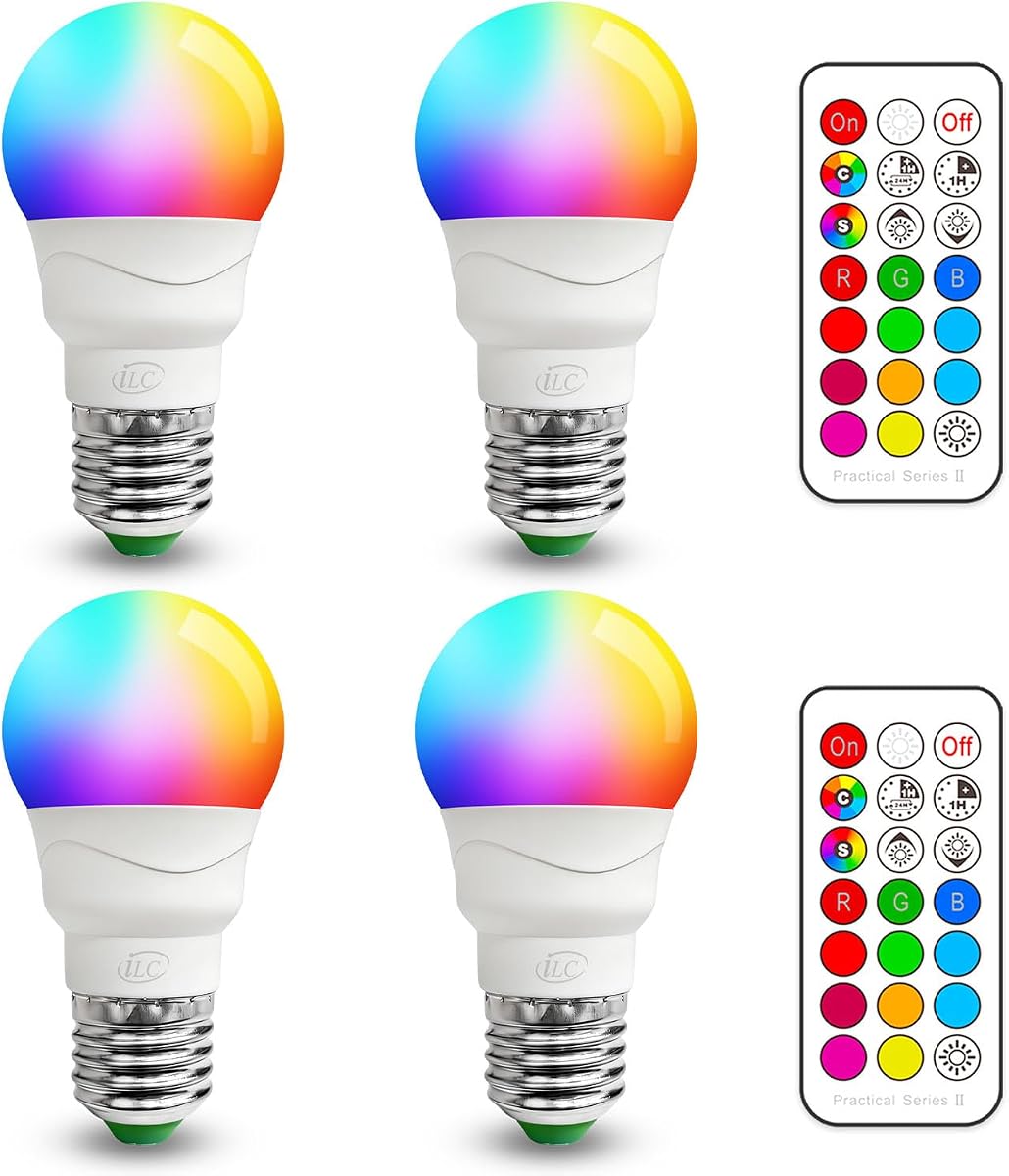
The ILC RGBW set is a visible color-changing lighting product rather than a conventional infrared surveillance illuminator. It has the highest customer rating in the dataset at 4.7, and it may be useful to someone searching broadly for LED bulbs with an infrared remote. However, its light is designed for decorative RGBW illumination, not for invisible night-vision support.
We may earn a commission when you buy through this link, at no additional cost to you.
The four A15-style bulbs use an E26 screw base, consume 5W, and produce 450 lumens of visible light. A remote controls 12 colors, three brightness levels, warm white, flash and smooth modes, and timing functions. The remote itself communicates through infrared, but that control technology should not be confused with the bulbs emitting invisible 940nm camera illumination.
For surveillance use, the product has major limitations. Visible RGB, warm-white, or colored light can change the appearance of a security camera’s image, create reflections, and make an installation more conspicuous. The bulbs are also not compatible with dimmer switches. They are therefore not direct substitutes for the 850nm or 940nm illuminators in this guide.
This set makes sense for accent lighting, a porch, a children’s room, or a chandelier where remote color control and timing are desired. It may also help someone locate a remote-controlled bulb without expecting a visible indicator. It should not be purchased as the primary source of IR illumination for a night-vision camera unless testing confirms the camera responds usefully to its emitted light.
The remote provides access to 12 colors, three brightness levels, and automatic timing. These features make the set more appropriate for ambient decoration than covert surveillance support.
The remote uses an infrared signal to control the bulbs, but the bulbs themselves are RGBW visible-light products. Buyers should distinguish control technology from the wavelength emitted into the monitored area.
We may earn a commission when you buy through this link, at no additional cost to you.
This 980nm spotlight illuminator is a specialized alternative for cameras that can detect 980nm infrared light. It carries a 4.5 rating, tied for the second-highest customer score in the group, and combines three 3W LEDs with a stated maximum range of 30 feet. Like the top-ranked model, it uses a 45-degree beam and a polycarbonate diffuser.
We may earn a commission when you buy through this link, at no additional cost to you.
Its long-distance claim and focused spread make it most useful when illuminating a specific outdoor target, such as a gate, path, driveway entrance, or entry point. The E26, 120V base allows simple installation in a standard socket, and the absence of a light sensor means predictable always-on operation. The product is also listed as supporting cameras sensitive to 850nm, 940nm, and 980nm wavelengths, although its actual emission is 980nm.
The important caveat is that most buyers need to verify 980nm camera support before choosing this model. A high rating and long stated range cannot compensate for a sensor that does not respond effectively at this wavelength. Its 45-degree angle also concentrates the output, so it may not fill a broad room as evenly as a 180-degree model. As with other mains-powered bulbs, it should only be placed in a suitably rated fixture.
Choose this product when your camera documentation explicitly supports 980nm illumination or when testing confirms a strong response. It is a compelling option for long, defined outdoor approaches. For broader or more conventional installations, an 850nm wide-angle bulb or a 940nm invisible source may offer easier compatibility and placement flexibility.
The 45-degree pattern concentrates the available infrared energy in a defined area. This is useful when a distant subject matters more than filling an entire room with even light.
Because 980nm support is less common than 850nm support, camera compatibility should be established before installation. Consult the camera specifications or perform a controlled comparison in darkness.
We may earn a commission when you buy through this link, at no additional cost to you.
The final listing cannot be evaluated as a conventional product because the supplied data contains no title, description, rating, image, or technical specifications. The only usable identifiers are the ASIN B07TDP67LR and the direct Amazon URL. Any recommendation based on the product’s output, camera compatibility, or installation requirements would therefore be speculative.
We may earn a commission when you buy through this link, at no additional cost to you.
That lack of information is the decisive issue for a technical category such as infrared camera lighting. Buyers need to know the emitted wavelength, electrical input, socket type, beam angle, heat management, and intended environment. Without those details, a shopper cannot determine whether the item is a 850nm, 940nm, or 980nm source, whether it supports a smart camera, or whether it is safe in the intended fixture.
It is also impossible to assess the listing’s construction or expected value. There is no product image in the supplied dataset, no verified customer feedback, and no explanation of what is included in the package. Those omissions make meaningful pros-and-cons analysis impossible beyond the general observation that a live listing exists.
This entry should be treated as an unverified placeholder rather than a recommended purchase. If considering it, open the current product page and confirm the wavelength, power source, dimensions, base type, weather suitability, and camera compatibility before ordering. Among the documented products, the top-ranked 850nm E26 model, the five-LED 940nm bulb, and the 48-LED board offer far clearer paths to a suitable purchase.
Because the dataset provides no details, the product page must be used to establish wavelength, voltage, base style, beam angle, and environmental limits. A generic infrared label is not enough for a camera installation.
For most buyers, one of the fully specified screw-in bulbs or boards is a safer starting point. Clear compatibility information reduces the risk of buying an unsuitable illumination source.
We may earn a commission when you buy through this link, at no additional cost to you.
The right IR LED light bulb depends primarily on camera sensitivity, the size and distance of the monitored area, and whether discreetness matters more than maximum reach.
Infrared illuminators are not interchangeable in every camera system. An 850nm source is widely used and often produces a faint red glow, while 940nm is intended to be invisible. The 980nm option is more specialized, and the camera’s documentation or testing should confirm that it can detect the chosen wavelength. A bright illuminator will not help if the camera’s sensor or IR-cut filter prevents it from recording the supplied light.
In short, confirm the camera’s supported IR wavelength before buying, and favor a model with matching or explicitly compatible output.
Range figures should be treated as stated operating scenarios rather than guaranteed visibility in every environment. The 850nm products claim maximum reaches of 30 feet, the 15W wide-angle bulb lists 25 feet, and the 940nm bulbs list 20-foot maximum and 15-foot optimal ranges. Actual performance depends on camera sensitivity, angle, reflective surfaces, ambient light, subject distance, and how close the illuminator sits to the camera.
Choose a stated range that comfortably exceeds the farthest important subject area, while recognizing that very long claims deserve cautious interpretation.
A narrow 45-degree beam concentrates infrared energy and can reach a defined target, but it may leave the edges of a wide camera view dark. A 180-degree model is better for filling a room, yard, or driveway, especially when mounted near the camera. The diffuser also matters because it spreads the emitters and reduces visible hot spots. Consider both the camera’s field of view and the shape of the area that must be illuminated.
For broad rooms, favor a wide-angle diffuser; for gates, paths, and distant focal points, a narrower spotlight may be more efficient.
E26 and E27 screw-in bulbs offer the simplest installation and can be repositioned between ordinary lamp sockets. Integrated boards require a 12V source, wiring knowledge, and a camera housing that can accommodate them. Individual 940nm emitter diodes provide the most customization but require circuit design, soldering or prototyping, and controlled current. The best format is the one your installation skill and camera design support without compromising safety.
Choose screw-in models for simple retrofits, boards for integrated camera builds, and loose diodes for custom electronic projects.
Visibility is a meaningful difference between wavelengths. The 850nm bulbs may show a faint red glow, while 940nm products are specifically marketed as invisible. Discreetness can be important in bedrooms, hallways, storefronts, and locations where visible lighting would undermine the appearance of an unobtrusive camera. It is less important in a dark utility area where the primary goal is simply to improve image clarity.
Prioritize 940nm illumination when the source must not be seen, and accept the 850nm glow when compatibility, reach, or overall feedback is more important.
Mains-powered bulbs should only be used in properly rated E26 or E27 fixtures, and the product voltage must match the supply. The 12V board needs a regulated source and should be enclosed appropriately if installed near exposed electronics. The 100-piece diode set requires especially careful current control because every LED has a stated operating current. None of the screw-in options should be assumed compatible with a dimmer unless the listing explicitly permits it.
Match the fixture and power source to the product, avoid unsupported dimmers, and include appropriate protection for outdoor or exposed installations.
Security illumination may operate for many hours, making heat management important. The 9W 850nm model explicitly uses an aluminum-alloy housing to improve heat dissipation, while the other finished bulbs mention quality LEDs but provide less thermal detail. A housing that dissipates heat effectively can support more stable long-term operation. Ventilation, fixture clearance, and the manufacturer’s guidance should be considered before sealing a bulb into a tight enclosure.
For continuous use, favor documented heat-dissipation features and leave the recommended clearance around the bulb.
Customer ratings and complete specifications help reveal whether a product is a practical choice. The 48-LED 850nm board has a 4.2 rating, clear voltage requirements, and exact dimensions. By contrast, the final listing has no usable details, making it impossible to compare safely. A low customer rating is not automatically disqualifying, but it is a reason to investigate recent feedback and understand whether complaints concern compatibility, heat, construction, or expectations.
Use ratings, recent reviews, and complete specifications together; a low-cost item with unclear compatibility is not necessarily a good value.
Begin by confirming that the camera can detect the illuminator’s wavelength and by testing the setup in darkness. Screw-in products require a standard, properly rated E26 or E27 fixture. The 850nm and 940nm models operate whenever they receive power, so a reachable switch or smart control is useful if illumination is needed only at certain times.
Position the bulb near the camera when possible and aim it toward the subject rather than toward reflective windows, walls, or glass. A diffuser and a broad beam can improve uniformity, but excessive reflected infrared may create bright patches. For the 12V board, use an appropriate regulated supply and verify the board fits the camera housing. For individual diodes, follow the stated voltage and current limits and use a correctly designed circuit.
After installation, inspect the image at different times of night and look for dark corners, glare, hotspots, and image color or contrast changes. Clean dust from exposed diffusers with a dry, soft cloth, and do not open powered products. Keep fixtures dry when the manufacturer has not designated them for outdoor use, and avoid enclosing a bulb so tightly that heat cannot dissipate.
No. The camera must have infrared sensitivity and must be configured to accept external IR illumination. A bright bulb cannot add night vision to an ordinary phone camera or a camera whose sensor and IR-cut filtering do not respond to the chosen wavelength. Test compatibility before buying or permanently installing a product.
An 850nm bulb often produces a faint red glow that some people can see, while a 940nm source is designed to be invisible. The available models also differ in stated range, beam angle, and output configuration. Camera support is the deciding factor because 940nm offers no advantage if the camera cannot detect that wavelength.
They are designed to emit infrared light with no visible glow as described in the product listing, but the camera can still detect the illumination. Depending on the device and viewing conditions, a camera display or image may reveal the infrared lighting. A faint glow can also result from manufacturing variation, reflections, or a nearby visible indicator.
Do not assume so. The 940nm DIY bulb explicitly states that it is not compatible with dimmers, and the remote-controlled RGBW product does not support dimmer switches either. A dimmer may reduce output unpredictably, cause flicker, or prevent the bulb from operating correctly. Use a standard on-and-off switch unless the manufacturer explicitly approves another control method.
Placing it close to the camera often produces more even illumination and reduces reflections from nearby walls or windows. Aim the beam at the important subject area and test for hotspots, glare, and dark edges. The exact distance depends on the beam angle, camera sensitivity, environment, and the bulb’s stated range.
The supplied specifications identify it as a 12V camera illuminator board but do not provide a weather-resistance rating. It should not automatically be considered waterproof or suitable for exposed outdoor use. Keep it protected from moisture and environmental exposure unless the current manufacturer documentation confirms otherwise.
It depends on the room dimensions, camera field of view, and selected beam angle. A 180-degree bulb may cover a moderate room from one central position, while a long or irregular area may need more than one source. A focused 45-degree model is better aimed at one distant target than used to fill every part of a large room.
The problem may involve wavelength mismatch, an IR-cut filter, reflections, insufficient illumination, or excessive foreground infrared reflection. Check the camera’s manual for external IR-light settings, disable any conflicting filter only as directed by the manufacturer, reposition the bulb, and test in complete darkness. A high product rating cannot compensate for an incompatible camera configuration.
The 850nM E26 Spotlight Illuminator is the best balanced pick because it combines a 4.4 rating, three 3W LEDs, a 45-degree diffuser beam, and a stated range of up to 30 feet. The Five-LED Invisible 940nm Bulb is the premium option for discreet operation and 180-degree coverage, while the 48-LED 850nm board is the budget choice for compact camera integrations.
Prioritize camera compatibility first, then match wavelength visibility preferences to the installation environment. Choose a broad 180-degree source for rooms and open areas, a 45-degree spotlight for a defined long-range target, and a 12V board or loose diode set only when you can safely integrate it. A screw-in model remains the simplest option for most homeowners.
Ratings, availability, and prices change, and stated range does not guarantee identical performance in every room. Before buying, review the current product page, verify the wavelength and electrical requirements, check customer feedback, and confirm that your camera is compatible. Those checks will help ensure that the selected IR LED light bulb actually improves the intended night-vision scene.