
Apple MFi Certified iPhone Car Charger Fast Charging + 6FT Lightning Cable
4.3Editor score
Dual USB-A charging ports
Built-in six-foot coiled cable
MFi-certified Lightning connection
Lightning car chargers keep phones powered on the road; this guide compares charging speed, ports, cables, safety, build quality, and device compatibility.
Lightning car chargers combine a 12-volt vehicle adapter with charging ports and often a built-in or bundled Lightning cable. A useful model should deliver dependable charging, fit the socket securely, protect connected devices, and suit the phones, tablets, and accessories used during a drive.
The products in this guide were compared using their stated power ratings, port configurations, charging protocols, cable details, compatibility, safety features, physical construction, and customer ratings. The list includes compact adapters, multi-port chargers, coiled-cable designs, and bundles that add USB-C to Lightning or CarPlay cables.
Each review explains the strongest reason to consider a charger, as well as limitations that may matter to a particular driver. Ratings and product details can change over time, and current prices, promotions, and vehicle compatibility should always be checked before making a purchase.
4.3Editor score

4.7Editor score

4.6Editor score
The comparison below highlights the output, ports, cable arrangements, and stated safety features of all ten chargers, making it easier to match a model to a particular iPhone, vehicle, and travel routine.


The Caiinei Apple MFi Certified iPhone Car Charger Fast Charging + 6FT Lightning Cable earns a 4.3 rating and stands out as a budget-oriented option for drivers who want the charger and a Lightning cable in one package. Its built-in cable retracts to approximately 1.3 feet and extends to six feet, reducing cable clutter while still reaching a mounted phone. The additional USB-A port allows another device to charge at the same time.
We may earn a commission when you buy through this link, at no additional cost to you.
Maximum output is stated at 2.4 amps and 12 watts when one port is used, increasing to 4.8 amps and 24 watts when both ports operate simultaneously. That makes it more appropriate for conventional Lightning iPhone charging and older or lower-power accessories than for demanding USB-C workloads. The MFi-certified cable uses a C89 terminal and a 56-ohm pull-up resistor, while the charger includes device recognition, temperature monitoring, surge protection, short-circuit prevention, and over-current protection.
The main tradeoff is that the design is built around Lightning and conventional USB-A rather than newer USB-C Power Delivery. A current iPhone with a USB-C port would require a separate compatible USB-C to Lightning cable, which is not included here. The combined output is also lower than the 67-watt, 70-watt, and 90-watt alternatives, so this is not the strongest option for tablets, power-hungry phones, or several high-output devices used together.
This charger makes the most sense for an iPhone owner who wants a straightforward car setup without carrying a separate cable. The long coiled lead is especially helpful for dashboard or windshield mounts, while the second USB-A port adds practical flexibility for headphones, older phones, or a passenger's accessory. For basic, dependable Lightning charging at a budget-focused level, it is a sensible recommendation.
The integrated coiled cable keeps the primary connection attached to the adapter, while the second USB-A port provides room for another USB-powered device. Automatic power distribution is intended to adjust output as connections change.
The cable's six-foot extension reaches a dashboard or windshield mount more comfortably than a short fixed lead. Its natural retraction also helps keep unused cable from sliding around the center console.
We may earn a commission when you buy through this link, at no additional cost to you.
The YEAHFUN 3-Port 70W Fast Car Charger has a 4.6 rating and is one of the most versatile designs in the guide. It combines one USB-C port and two USB-A ports in a compact body, allowing an iPhone, passenger device, and accessory to be connected without carrying multiple adapters. The stated total output is 70 watts, with up to 36 watts available through USB-C and 17 watts through each USB-A port.
We may earn a commission when you buy through this link, at no additional cost to you.
Support for PD, PPS, and QC makes this a better all-purpose option for a mixed collection of modern phones, tablets, and accessories. The package also includes a three-foot USB-C to Lightning cable and a three-foot USB-A to Lightning CarPlay cable. That second cable is particularly useful for compatible vehicles because the listing says it can support CarPlay syncing, music, GPS, and data transfer, although actual CarPlay behavior depends on the car and phone.
Although 70 watts sounds substantial, it is shared rather than provided independently at full capacity to every port. Heavy use across several devices may reduce individual charging speeds, and the three-foot cables are shorter than the long coiled leads offered by the Syncwire and Caiinei products. The compact body is a clear advantage, however, and it sits relatively flush in the vehicle socket instead of projecting far into the cabin.
This is a strong choice for families, rideshare drivers, or anyone carrying more than one type of device. It is especially useful when a USB-C phone must be charged alongside a Lightning iPhone, since both connector types are supported. Choose it for port flexibility and protocol coverage rather than for a permanently attached long cable, and verify the vehicle's CarPlay connection type before relying on the included data cable.
USB-C and two USB-A ports cover newer phones, Lightning accessories, older devices, and many smaller electronics. The adapter is designed for simultaneous charging without occupying more than one socket.
The two included three-foot cables cover a USB-C-to-Lightning charging path and a USB-A-to-Lightning CarPlay path. They are short enough to stay organized but may be less convenient for distant passenger seating.
We may earn a commission when you buy through this link, at no additional cost to you.
The Syncwire iPhone Car Charger – Upgrade [Apple MFi Certified] 4.8A/24W Car Charging Adapter with Built-in Coiled Lightning Cable has a 4.5 rating. It combines an MFi-certified built-in cable with a second USB-A port, offering a familiar two-device arrangement. The integrated lead extends to five feet and retracts to approximately 1.3 feet, making it well suited to a mounted iPhone or a passenger who does not want to carry a separate cable.
We may earn a commission when you buy through this link, at no additional cost to you.
The charger intelligently adapts its combined 4.8-amp output to connected devices. Its compatibility list includes current and older Lightning iPhones, iPads, iPods, AirPods, and a broad range of phones and tablets from other manufacturers. The built-in connector is designed to fit aftermarket cases, including the examples named in the product information, which avoids the common problem of a fixed case connector preventing a direct cable connection.
Its main limitation is charging speed relative to newer USB-C Power Delivery products. The maximum stated output is 24 watts across the charging arrangement, so it cannot provide the 45- or 90-watt performance offered by the LISEN or newer three-port adapters. The attached cable also cannot be removed and replaced if it is damaged, although the product is built around that convenience rather than modularity.
For an iPhone-centric driver who prioritizes cable management, this Syncwire is a more refined alternative to a basic adapter with a permanently exposed lead. The MFi certification, retractable range, case compatibility, and second port create a particularly useful combination. It is best suited to Lightning devices and conventional charging needs rather than demanding USB-C workflows.
The coiled lead pulls out to reach a mounted device and contracts when not needed. This can reduce tangles and keep the center console clearer than a long loose cable.
The connector is designed to reach through compatible aftermarket cases. That makes the built-in cable more practical for users who routinely carry a rugged protective case.
We may earn a commission when you buy through this link, at no additional cost to you.
The 67W 3-Port Super Fast Type C Car Charger has the highest rating in this guide at 4.7. It offers a balanced mix of modern charging power and device flexibility: one USB-C port, two USB-A ports, and a stated total output of 67 watts. Maximum output is listed as 37 watts through USB-C and 30 watts through USB-A, making it a strong performer for newer phones, tablets, and other USB-powered devices.
We may earn a commission when you buy through this link, at no additional cost to you.
The product information claims that supported devices can charge from zero to 50 percent in about 30 minutes and that speed can reach three times that of an earlier charging approach. Those figures depend on the device, cable, battery condition, and accepted charging rate, so they should be treated as maximum-use-case claims rather than universal results. The charger supports PD and QC technology, and its intelligent chip is designed to identify connected devices and distribute power accordingly.
Protection features include over-current, over-voltage, over-heating, and short-circuit prevention. The listing also says charging stops when the battery is full and describes an ABS-and-PC fireproof shell. Despite those claims, the package includes only a three-foot USB-C to USB-C cable, not a USB-C to Lightning cable. An iPhone owner who still relies on Lightning therefore needs to supply a compatible cable.
This is a compelling all-round charger for drivers who want meaningful USB-C power without moving to a 90-watt dual-port design. Its three ports allow mixed-device charging, and the 4.7 rating is reassuring, although customer feedback alone does not replace hands-on evaluation. Choose it for modern USB-C-first devices or for users willing to add a Lightning cable, rather than expecting a complete Lightning-specific bundle.
A 37-watt USB-C allocation gives the charger room to serve demanding phones and tablets. The two USB-A outputs add flexibility without requiring separate adapters.
The described protections cover common electrical and thermal risks, while device recognition and power distribution help adapt output to connected equipment. These systems are especially relevant when multiple ports are used.
We may earn a commission when you buy through this link, at no additional cost to you.
The LISEN 90W Car Charger USB C Fast Charge,USB C Car Charger for iPhone 18 Pro earns a 4.6 rating and delivers the highest stated total output in the guide. Its two USB-C PD 3.0 ports are rated to provide 45 watts each, or 90 watts in total, while the compact body measures 2.1 inches long by 0.9 inches wide. That combination of power and size is the product's main appeal.
We may earn a commission when you buy through this link, at no additional cost to you.
The bundle includes a 60-watt USB-C to USB-C cable and a 27-watt USB-C to Lightning cable. That makes it more immediately useful for owners of both USB-C and Lightning iPhones than many competing adapters. It is also positioned as a charger for Samsung Galaxy devices, Google phones, iPads, MacBook Air, and other compatible USB-C products. The all-aluminum body is described as scratch-resistant, durable, and resistant to the heat concerns often associated with plastic housings.
Because both ports are USB-C, there is no dedicated USB-A socket for older accessories or cables. Users who rely on a legacy USB-A connection would need an appropriate adapter. The claimed tenfold speed advantage over a 30-watt charger and a zero-to-80-percent figure in 30 minutes for certain Samsung devices are device-specific claims, and actual performance depends on the phone's accepted charging rate and thermal management.
The LISEN is most appropriate for a modern device ecosystem where USB-C is the preferred connection and fast charging matters. Its compact proportions help it fit neatly into a crowded console, while the aluminum construction and high output distinguish it from simpler adapters. For Lightning users, the included cable removes an extra purchase, but those with many USB-A accessories may prefer the YEAHFUN or three-port alternatives.
Ninety watts of aggregate capacity is concentrated into a small all-metal body. That makes the charger useful for travelers or families who need to replenish several compatible USB-C devices.
The included USB-C-to-USB-C and USB-C-to-Lightning cables cover both major iPhone connection eras. Drivers can charge without searching for a separate cable after installation.
We may earn a commission when you buy through this link, at no additional cost to you.
The iPhone Car Charger Fast Charging, 60W Car Charger+Two Types of Cables, 2PCS has a 4.5 rating and offers one of the most complete Lightning-focused bundles. It includes a 60-watt dual USB-C car adapter, a three-foot USB-C to USB-C cable, and a three-foot USB-C to Lightning cable. This lets a household cover both Lightning and USB-C iPhones without buying separate charging leads.
We may earn a commission when you buy through this link, at no additional cost to you.
The adapter can charge two devices simultaneously. According to the product information, a single USB-C PD port can provide up to 3.0 amps and 30 watts, while both ports together can provide 6.0 amps and 60 watts. The included USB-C to Lightning cable uses a C94 terminal and an embedded E-Marker chip, while the product is also described as MFi certified with UL, ETL, FCC, CE, and RoHS certification.
The main technical compromise is that the 60 watts are divided between both ports, so one device will not receive the full 60-watt capacity while another is charging. The three-foot leads may also be shorter than ideal for a passenger in the rear seat or for a phone mounted far from the console. Nevertheless, the bundle's convenience offsets those limitations for most solo drivers and couples.
Its smart chip, temperature control, over-current and over-voltage protection, short-circuit prevention, and automatic stop at full charge form a reassuring safety package. The blue ring indicator is also convenient in a dark cabin. This is a strong choice for iPhone households that want dual-device charging and both cable formats in the box without needing a built-in coiled lead.
Including a USB-C to Lightning cable makes the charger directly useful with Lightning iPhones, while the USB-C to USB-C lead supports newer models. The two included leads also provide a spare for different seating positions.
The blue ring light around the socket makes the ports easier to locate in a dim vehicle. It provides a simple visual cue that the adapter is powered without requiring a separate display.
We may earn a commission when you buy through this link, at no additional cost to you.
The Rombica Apple MFi Certified iPhone Car Charger Fast Charging 4.8A Car Phone Charger carries a 4.5 rating and is built around a straightforward 24-watt dual-port design. It includes two braided Lightning-to-USB cables, which is unusual in this category and useful for keeping one cable in the vehicle while placing another in a bag or at another socket.
We may earn a commission when you buy through this link, at no additional cost to you.
Maximum output is listed as 2.4 amps and 12 watts for one port, with combined output rising to 4.8 amps and 24 watts when two devices are connected. The C89-terminated cables are MFi certified and include surge protection and a 56-ohm pull-up resistor. Compatibility covers a broad range of Lightning iPhones, iPads, and AirPods, including older supported generations.
Its charging speed is modest compared with the USB-C PD chargers in this guide, and the adapter has no USB-C port. That means it cannot take advantage of the higher output of newer phones and tablets, although a modern iPhone can still be charged through a compatible USB-C-to-Lightning cable. The product also makes a four-times charging-speed claim, but that comparison depends on the baseline device and setup and should not be treated as a universal result.
The aluminum-alloy and ABS fireproof housing, gold-plated tubing, dynamic temperature sensor, and ring LED give it a more refined appearance. For someone centered on Lightning and looking for two durable replacement cables, the Rombica offers practical value. It is best for conventional charging needs and older iPhone ecosystems, not for users seeking USB-C power delivery or laptop charging.
The two braided leads provide a convenient way to charge in different vehicle positions or keep a backup within reach. Braiding also helps the cables resist everyday bending and tangling better than basic smooth leads.
The product description highlights an aluminum-alloy and ABS housing, gold-plated tubing, and active temperature monitoring. These elements are intended to support stable output and heat dissipation during charging.
We may earn a commission when you buy through this link, at no additional cost to you.
The Linocell 60W Dual USB-C Car Charger has a 4.5 rating and combines a 60-watt total output with two MFi-certified braided USB-C to Lightning cables. The two PD ports can charge two devices simultaneously at up to 30 watts each. This is a more current charging arrangement than the older USB-A designs while retaining the convenience of Lightning cables.
We may earn a commission when you buy through this link, at no additional cost to you.
The product information states that an iPhone 14 can reach 80 percent charge in approximately 35 minutes, though actual results depend on the model, battery condition, temperature, and charging protocol. Its Smart-iQ chip is described as detecting connected devices and identifying the appropriate current. The housing uses an aluminum alloy, gold-plated tubing, and a shrapnel-style contact design intended to remain firmly seated in the socket.
There is no dedicated USB-A port, so legacy accessories require an adapter. It also does not have a permanently attached cable, which some drivers may prefer because it allows either included lead to be positioned independently. The cables use a C94 terminal and MFi chip, and their braided construction is a practical improvement for a car environment where leads are frequently handled and bent.
This Linocell charger is a strong option for a household with two Lightning iPhones or a combination of Lightning and newer USB-C devices. It provides enough output for meaningful fast charging and includes two durable cables. It is less appropriate for a collection of older USB-A accessories, but for modern phones it offers a balanced mix of power, materials, and cable convenience.
The USB-C PD ports provide a higher-output charging platform, while the included USB-C to Lightning cables retain support for older iPhone connectors. This is a useful bridge for mixed device collections.
The listed shrapnel contact design is intended to keep the adapter firmly seated. An aluminum housing and ring indicator also make it easier to locate at night without taking up excessive console space.
We may earn a commission when you buy through this link, at no additional cost to you.
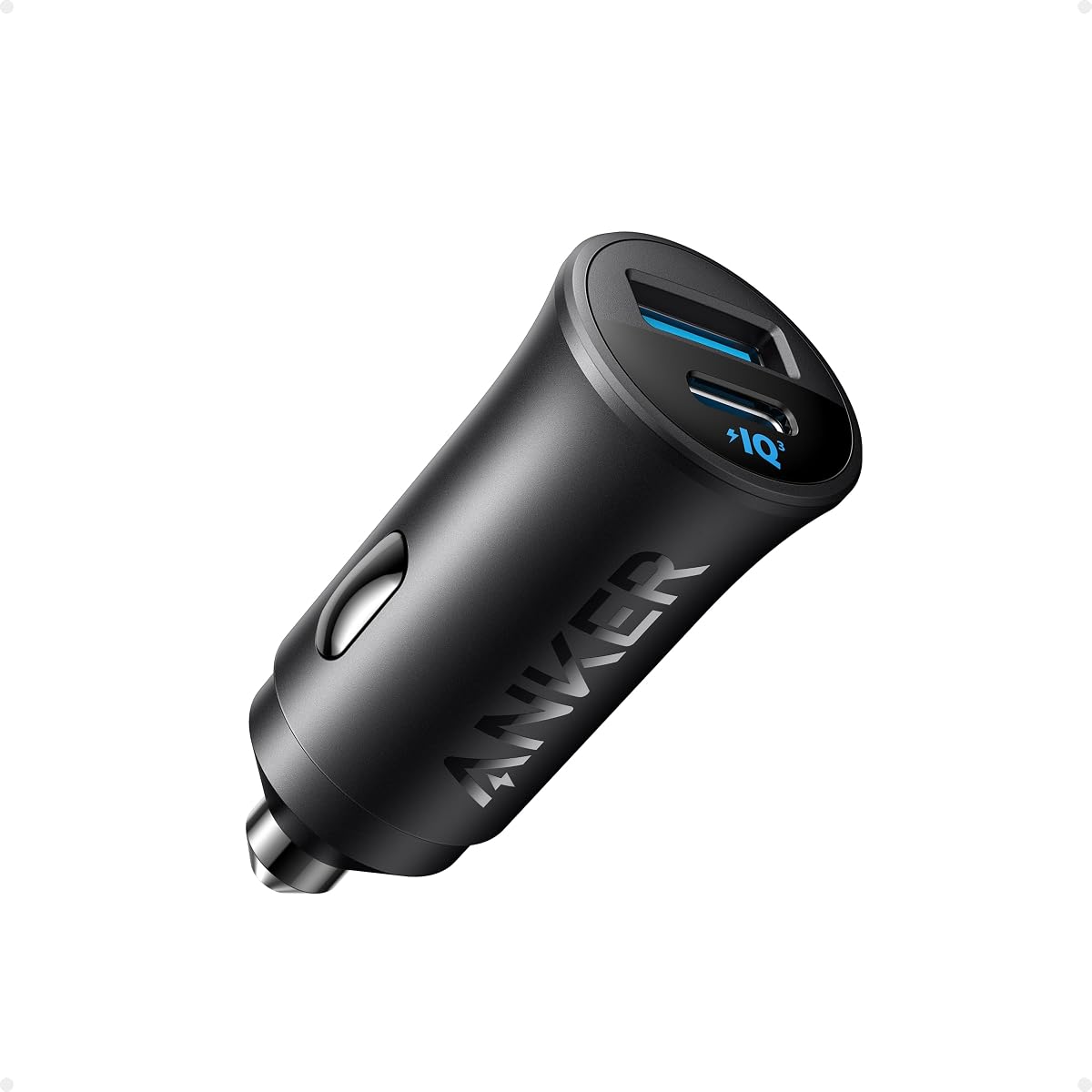
The Anker 30W 2-Port PowerIQ 3.0 USB C iPhone Car Charger has a 4.7 rating and is the most restrained option in the guide. Rather than bundling multiple cables or building in a long lead, it provides a compact adapter with one 30-watt USB-C port and one USB-A port. That simplicity makes it easy to carry, store, and pair with whichever charging cable is already in the vehicle.
We may earn a commission when you buy through this link, at no additional cost to you.
The USB-C output is positioned for rapid charging of compatible iPhone 15 and 15 Pro devices, and the listing describes it as three times faster than a standard 5-watt charger. Exact charging times remain device-specific. A USB-A port adds compatibility with older accessories and enables simultaneous charging of two phones, while intelligent power allocation determines how output is shared.
The charger also includes protection against over-voltage, under-voltage, over-current, and excessive temperature. These safeguards make it suitable for regular use, and the package includes a welcome guide, an 18-month warranty, and customer service support. The trade-off is that no Lightning cable is included, so users with Lightning iPhones need a suitable USB-C-to-Lightning cable, and current USB-C iPhone users need a USB-C-to-USB-C cable.
This is an excellent general-purpose adapter for a driver who values compactness, established brand support, and straightforward dual-device charging. It does not offer the total output or bundled accessories of the 60-, 67-, 70-, or 90-watt models, but many daily charging needs do not require them. For an organized setup using cables already owned, it is a particularly clean recommendation.
The miniature body is intended to fit into tight vehicle sockets and take up little dashboard space. It can also be removed easily and stored in a glove compartment or travel bag.
The adapter focuses on a USB-C power port and a universal USB-A port rather than a collection of bundled leads. This keeps the package simple for users who already own suitable cables.
We may earn a commission when you buy through this link, at no additional cost to you.
The Syncwire 32W Super Fast Car Phone Charger with built-in 5FT Coiled Lightning Cable has a 4.6 rating and offers a more refined alternative to basic dual-port adapters. Its primary connection provides 20 watts through PD, while the secondary USB-A output is rated at 12 watts. Together, the built-in Lightning cable and auxiliary port make it suitable for charging an iPhone and a smaller accessory at the same time.
We may earn a commission when you buy through this link, at no additional cost to you.
The MFi-certified C94 cable extends to five feet and naturally retracts to approximately 1.3 feet. The product states that it can charge an iPhone from zero to 58 percent within 30 minutes, although real charging speed varies by model and condition. The built-in connector is designed to work with aftermarket cases, including the examples listed in the product information.
The 32-watt total output is meaningful for Lightning phones but modest beside the 60- to 90-watt alternatives. The secondary connection is also USB-A rather than USB-C, so modern phones require a suitable cable. On the positive side, the integrated design eliminates the need to carry a separate Lightning lead, and the sturdy polycarbonate housing, smart IC, and thermal design are intended to resist overheating and overload.
Among chargers with an attached Lightning cable, the Syncwire offers an attractive balance of reach, retraction, fast charging, and dual-device capability. It is best for an iPhone owner who wants a permanent dashboard setup and values a case-compatible connector. The choice is less compelling for USB-C-first device collections, where the Anker or LISEN would provide a more forward-looking connection strategy.
The five-foot coiled lead reaches a mount or passenger without leaving a long cable permanently draped across the console. Retraction keeps the unused portion compact and less likely to tangle.
The primary PD path can deliver 20 watts to a compatible Lightning device, while the USB-A port serves a second accessory. This balances useful performance with a simpler two-device arrangement.
We may earn a commission when you buy through this link, at no additional cost to you.
The right Lightning car charger depends on your iPhone generation, the number of devices you need to charge, the available socket position, and whether you prefer a permanently attached cable or a conventional adapter with separate leads.
A Lightning charger is designed around Apple's Lightning connector, but the charger body and the cable attached to the phone are separate decisions. Several products in this guide use USB-A or USB-C ports in the car and include a USB-C-to-Lightning cable for the phone. That arrangement lets the vehicle-side port support faster protocols while retaining compatibility with Lightning iPhones. Verify the included cable's direction and connector type, because a USB-A-to-Lightning cable and a USB-C-to-Lightning cable are not interchangeable.
The oldest supported iPhones and newer USB-C iPhones may both appear in a product's compatibility list, but that does not mean the same included lead works for every model. Check the exact iPhone numbers, charging protocol, and required adapter before ordering.
Total wattage describes the adapter's maximum combined output, while the per-port rating tells you what one device may receive under favorable conditions. A 90-watt dual-port charger does not necessarily provide 90 watts to each phone, and a 60-watt total rating may be divided between two connected devices. A 24-watt adapter is generally more appropriate for conventional Lightning charging, while 30 watts and above is useful for compatible phones that accept faster rates.
Compare like with like by checking volts, amps, and supported protocols such as PD, PPS, and QC. The cable must also support the intended rate, and the phone's own charging system determines the maximum speed it will accept.
The number of people in the vehicle and the devices they carry should determine the port count. A two-port adapter is enough for a driver and one passenger, while a three-port model can also serve headphones, a watch, or a power bank. USB-C is the more forward-looking choice for newer phones and tablets, while USB-A remains useful for older accessories. Products with both are often the most versatile, although they can be larger than a single-port model.
Do not count the attached Lightning cable as a separate charging path. A charger with an integrated Lightning lead and one USB-A socket has two usable connections, not three.
A built-in cable reduces the chance of leaving a required cable at home and keeps the charging lead physically attached to the adapter. Coiled versions extend to reach a mounted phone while retracting to conserve space. Separate cables offer more flexibility because the user can choose a longer, shorter, braided, CarPlay-enabled, or higher-rated lead. They also allow a damaged cable to be replaced without replacing the entire charger.
Built-in cable designs are especially convenient for permanent vehicle installations. Separate-cable bundles are often better for travelers, families, and drivers who move devices between the car and other locations.
A car charger converts vehicle power into regulated device power, making temperature control, over-current protection, over-voltage protection, and short-circuit prevention important. Intelligent power management can also reduce unnecessary power consumption and help maintain stable output during vehicle ignition. Look for a clearly described protection system rather than relying on an unspecified claim of being safe. Certification marks can provide additional context, but they should be verified on the relevant listing when authenticity matters.
A charger that becomes unusually hot, behaves inconsistently, or has a loose socket connection should not be used. Proper fit, clean contacts, and avoiding damaged cables are equally important parts of safe daily operation.
Compact adapters sit closer to flush with the socket and are less likely to interfere with a console lid or nearby controls. Larger high-wattage models may project farther from the dashboard. Check whether the charger blocks the socket, shifter, cup holder, or climate controls. All products in this guide are described for conventional 12- to 24-volt vehicle sockets, but drivers of unusual vehicles should verify the socket specification before purchasing.
Retractable cable length matters just as much as the body size. A lead that extends far enough to reach a windshield or passenger-side mount can be more valuable than extra wattage that the phone cannot use.
Some iPhone cases have a raised rim or a port opening that makes a normal cable connector difficult to insert. Products with case-compatible built-in connectors are especially useful for owners of rugged or aftermarket cases. The Synwire products in this guide specifically mention compatibility with examples of such cases, while the included separate cables can also fit through compatible openings.
A tight connector is not worth forcing. If a case blocks the plug, use a compatible cable or a case with a suitable cutout rather than pushing the connector against the phone's edge.
Bundled accessories can make a charger more useful immediately, but their quality and length should be considered carefully. Three-foot cables work well near the console, while longer leads help passengers in the rear. Braided cables tend to be easier to manage in a vehicle, and a CarPlay-capable USB-A-to-Lightning lead can be valuable in compatible cars. USB-C-to-USB-C cables are the natural choice for current USB-C iPhones and many Android devices.
Avoid judging the adapter only by the number of items in the box. A well-made single-port charger with no cable can be better than a larger model with underspecified accessories if the user already owns the correct leads.
Begin by confirming that the vehicle socket is a compatible 12- or 24-volt DC accessory socket and that the charger is fully inserted. Connect the phone before or after insertion, depending on the design, and use a Lightning cable that fits the port on both the charger and the phone. With a built-in cable, pull the coiled lead out only far enough to reach the device so that it remains easy to retract.
During a drive, route the cable away from sharp edges, pedals, gear controls, and hot surfaces. Do not leave a cable hanging where it could distract the driver or snag a passenger's belongings. For mounted devices, connect the cable before positioning the mount and check that the connector does not press the phone screen against the holder. Keep unused cable coiled or secured rather than stretched across the cabin.
For care, unplug the adapter when it is not needed, particularly in extreme heat, and keep the socket and connector free of dust, crumbs, and moisture. Never use a cable with a torn sheath, bent connector, or discoloration around the plug. If charging becomes unusually slow, the adapter grows excessively hot, or a connection becomes intermittent, stop using it and inspect the socket, cable, and phone for damage.
Yes, when the charger, cable, and iPhone support the appropriate fast-charging standard. Many Lightning iPhones respond well to USB Power Delivery through an MFi-certified USB-C-to-Lightning cable, but the exact speed depends on the phone model, battery condition, temperature, and power-sharing demands. A basic USB-A adapter may charge more slowly even if the vehicle supplies enough power.
A built-in cable is permanently attached to the car charger, which is convenient and discourages the user from leaving the necessary lead behind. A bundled cable is separate, allowing it to be replaced, routed differently, or used with another charger. Built-in coiled cables are especially useful with dashboard and windshield mounts because they extend and retract cleanly.
Newer USB-C iPhones use USB-C to USB-C cables for charging. A Lightning car charger in this guide may still work for them through a USB-C-to-Lightning cable and a compatible charging port, but that setup is unnecessary if the adapter already has USB-C output. Check the charging protocol and cable direction before assuming compatibility.
No. A phone only charges as quickly as its charging circuitry, the cable, and the available protocol allow. Higher-wattage chargers are most useful for tablets, USB-C phones, laptops, or multiple demanding devices. A 24-watt Lightning charger can be perfectly adequate for a standard iPhone charging routine while costing less and potentially fitting more neatly in a crowded console.
Most models in this guide can charge two devices simultaneously, either through two external ports or through an integrated Lightning cable and an auxiliary port. Total wattage is usually shared, so two phones connected at once may each charge more slowly than they would on a dedicated charger. Check the per-port ratings and supported power-sharing behavior for the best expectations.
It depends on the case design and the connector. Cases with a narrow or raised port opening may not accept a standard Lightning plug, while several built-in connectors in this guide are specifically designed to fit aftermarket cases. A separate cable with a slim connector can sometimes be easier to insert than a bulky integrated plug.
USB-C is generally the more flexible long-term choice because it supports newer iPhones, many Android devices, tablets, and other accessories. Lightning remains relevant for older iPhones and accessories that use that connector. Drivers with a mixed collection often benefit from an adapter containing both USB-C and USB-A ports plus appropriate cables.
Some vehicles briefly change electrical output during ignition or when the alternator adjusts voltage. A quality charger should manage ordinary vehicle fluctuations, but persistent interruptions can indicate a socket, fuse, wiring, or adapter problem. Stop using the charger if it becomes hot, smells unusual, shows visible damage, or repeatedly disconnects, and have the vehicle socket checked if the issue continues.
The Caiinei MFi charger is a budget-focused choice for a straightforward Lightning setup with a long built-in cable, while the Anker PowerIQ 3.0 adapter is the most compact and versatile everyday option for a driver who already owns suitable cables. The Syncwire 32W model is the premium integrated-cable choice, combining a case-compatible five-foot coiled lead with a second charging port.
The right charger for most buyers depends on connection style. Choose a built-in or coiled design for a permanent mounted-phone setup, a dual USB-C model for newer devices, and a multi-port adapter when passengers or passengers' accessories need power. Pay attention to per-port output rather than total wattage alone, and confirm that the included cable works with the exact iPhone generation and the adapter's port.
Before buying, verify the current product details, customer feedback, included accessories, safety information, and compatibility with the vehicle's socket. Prices, promotions, software support, and product revisions can change, so checking the live listing ensures that the selected charger still meets current needs and remains a good value.