
QIQQIKIN Paper Corner Rounder 3 in 1
4.3Editor score
Three corner radii included
Sharp stainless steel blade
Works below 2mm thickness
A paper corner rounder turns ordinary cardstock, photographs, envelopes, and scrapbook pieces into polished craft projects with smooth, repeatable curves. The best tool depends on corner size, material thickness, cutting capacity, and how often you expect to use it, from occasional card making to high-volume production work.
We compared all ten corner cutters by examining their available radii, blade and housing construction, stated material limits, operating method, storage needs, and appropriate crafting tasks. The list includes compact handheld punches, multi-style tools, Japanese stationery models, and heavy-duty machines for schools, studios, or professional production.
Each review highlights the product's strongest contribution and any practical limitations so you can choose with confidence. Ratings and specifications reflect the supplied product information, while prices and availability can change, making it worthwhile to confirm the current listing and its latest customer feedback before buying.
4.3Editor score

4.7Editor score
4.7Editor score
As an Amazon Associate we earn from qualifying purchases.
The comparison covers ten options ranging from lightweight handheld punches to high-capacity floor-friendly machines, with particular attention to corner styles, material limits, blade construction, and intended workflow.


The QIQQIKIN 3 in 1 Paper Corner Rounder combines three corner radii in a compact handheld tool, earning a 4.3 rating among buyers. Its 4mm, 7mm, and 10mm options cover everything from subtle business-card rounding to visibly curved scrapbook and card-making edges, making it a versatile first paper corner rounder for most home crafters.
We may earn a commission when you buy through this link, at no additional cost to you.
Construction combines ZBS and zinc alloy with a stainless steel cutter blade. The stated blade sharpness is intended to produce clean cuts, while the simple operating process is easy to learn: select a slot, insert the paper corner, slide it against the internal guides, and press the handle. That straightforward design makes the tool approachable without eliminating the range provided by three interchangeable cutting positions.
The main limitation is material tolerance. It is designed for regular paper, craft paper, foil, and EVA foam below 2mm, with a recommended paper weight of 70g to 230g. Very thin stock can catch or jam, so the instructions advise stacking two or three layers. Adhesive-backed material should also be avoided because residue may cause the punch to stick.
This is an excellent choice for card makers, scrapbookers, journalers, and anyone who wants several corner profiles without operating a large machine. Choose it when compact storage, manual precision, and versatile shaping matter more than industrial throughput. For heavier card stacks or continuous production, a higher-capacity cutter would be more appropriate.
Its combination of three radii, a sharp metal blade, and straightforward handling makes this model a strong all-around option for everyday paper crafts. It offers particularly good value for users who expect to work with standard craft-weight paper and want one compact tool to cover several common rounded-corner sizes.
The 4mm, 7mm, and 10mm choices let you coordinate corner curves with cards, photographs, tags, and scrapbook layouts. A smaller radius offers a restrained professional look, while the larger options provide a more playful decorative finish.
Inserting the corner until it rests against the guides helps keep the cut repeatable. The sharp stainless steel blade and light handle action make this an accessible alternative to cutting curved profiles by hand.
We may earn a commission when you buy through this link, at no additional cost to you.
The Sunstar Stationery Kadomaru Pro is a highly rated, traditional handheld corner cutter with a 4.7 rating. It is designed for people who want consistently rounded paper edges without the complexity of a large lever punch. The tool is particularly relevant to card makers and scrapbookers who regularly finish business cards, photographs, invitations, and other polished paper pieces.
We may earn a commission when you buy through this link, at no additional cost to you.
Its key strength is useful material flexibility. The cutter can process up to three sheets of 20lb bond paper and laminated film up to 3.9 mils thick. That makes it more capable for small stacks than many lightweight craft punches, while remaining compact enough for a home office, school, or professional craft workspace.
Operation is refreshingly direct. Material enters from the back of the body, and the user presses down the handle to make the cut. There is no complex adjustment system to master, making it easy to add rounded edges during a busy card-making session or when processing a batch of identical pieces.
The main trade-off is shape flexibility. Unlike three-in-one models that visibly offer multiple radii or mixed cutting designs, the Kadomaru Pro focuses on a consistent standard curve. Users who need several corner sizes in one tool may prefer a multi-style punch, whereas buyers who want a straightforward, dependable finisher will find this design more focused.
Overall, the Kadomaru Pro earns recognition for its clean results, compact footprint, and useful ability to cut small paper stacks and laminate. It is an especially attractive choice for personal crafters and small-business card work where appearance, consistency, and straightforward handling matter.
The restrained design creates rounded edges without distracting from the finished card. Its familiar stationery format suits professional presentation without occupying the workspace demanded by a bench-mounted machine.
The ability to cut up to three sheets improves efficiency when producing matching cards or photo pieces. Laminated-film support expands the range beyond plain office paper.
We may earn a commission when you buy through this link, at no additional cost to you.
The ECOHU Round Corner Punch has a 4.5 rating and focuses on clean, compact corner shaping for paper crafters. It provides 4mm, 7mm, and 10mm radii in one housing, giving users a useful range of curves without requiring several separate punches or a table-mounted cutter.
We may earn a commission when you buy through this link, at no additional cost to you.
The plastic body is described as smooth and burr-free, which should make the tool comfortable to handle and less likely to catch edges during repeated work. A sharp stainless steel blade supports precise cuts, and the stated suitability for 180g craft paper makes it a solid option for typical cardstock, vellum, photographs, and scrapbook components.
The product guidance emphasizes correct positioning. The paper edge should be flat and square, and the corner should enter at the top of the tool. Very thin paper should be layered two or three sheets deep, while adhesive-backed material should be avoided because it may cause the mechanism to stick. These cautions are important when judging whether the punch suits a specific stock.
There is no indication that it can process the small stacks or heavier materials supported by the Sunstar models. It is therefore better viewed as a dedicated craft punch than a production cutter. Its multi-radius design also differentiates it from simpler single-style corner finishers, allowing one tool to serve several project aesthetics.
For scrapbookers, card makers, and home crafters who value a smooth housing, sharp blade, and three common corner sizes, the ECOHU punch is a convincing choice. It is particularly helpful for mixed projects where finished pieces need coordinated but differing edge profiles.
The smooth plastic housing fits comfortably in the hand and avoids exposed sharp edges around the gripping area. That makes it suitable for repeated personal crafting sessions and straightforward storage.
Flat, 90-degree paper corners help the cutting guide work as intended. Taking a moment to align the sheet reduces the chance of uneven curves or imperfect placement.
We may earn a commission when you buy through this link, at no additional cost to you.
This two-piece paper corner rounder set provides a standard 4mm, 7mm, and 10mm punch plus a second punch designed for irregular angles. With a 4.3 rating, it appeals to crafters who want a broader collection of edge treatments and the convenience of keeping two tools together in a craft kit.
We may earn a commission when you buy through this link, at no additional cost to you.
The standard punch provides three radii for cards, scrapbook pages, photos, gift tags, and business cards. The second irregular-angle tool adds creative possibilities for decorative projects. This combination gives users more options than a conventional three-way punch, especially useful when several visual styles appear in the same album, invitation set, or craft series.
Both tools are compact and lightweight enough for a craft bag, backpack, workshop, or desk drawer. Their metal blades are described as producing smooth, precise cuts with a light press. The standard unit supports paper and cardstock up to 2mm, providing a practical working range for common craft stock.
The visible alignment holes are a useful design detail. Turning the punch over gives the user a clear view of where the paper should meet the guide, which can improve consistency over repeated cuts. As with other entry-level punches, however, very thin or adhesive-backed sheets may perform poorly or stick inside the mechanism.
This set is a good choice for a scrapbooker, educator, or paper-craft hobbyist who values multiple tools and portability. It may be unnecessary for someone who only needs one conventional rounded corner, but it offers greater creative coverage and better backup than a single compact punch.
The irregular-angle companion expands the set beyond ordinary rounded corners. It is useful for layered embellishments, scrapbook borders, and projects that benefit from a less conventional silhouette.
Flipping the tool over makes the alignment marks easier to see before pressing. Consistent placement helps matching pieces receive the same treatment, especially when completing a larger batch.
We may earn a commission when you buy through this link, at no additional cost to you.
The QIQQIKIN Pink Corner Punch brings color and practical versatility to a home craft area. It has a 4.3 rating and includes 4mm, 7mm, and 10mm cutting radii, so its cheerful appearance does not come at the expense of the range normally expected from a multi-style paper punch.
We may earn a commission when you buy through this link, at no additional cost to you.
Its ABS housing is sturdy and easy to hold, while the metal cutter is designed to produce a smooth edge without excessive burrs or scraping. The anti-slip mat on the bottom helps keep the punch stable while the handle is pressed, a useful detail when working at a kitchen table or shared craft desk.
Material guidance is clear. The tool works with standard paper, EVA foam, foil, craft paper, cardstock, laminated pieces, and photographs up to 2mm, with best performance stated between 70g and 230g. Thin sheets should be stacked, and adhesive-backed paper should be avoided to reduce the chance of the mechanism sticking.
The listed applications extend well beyond basic card corners. The punch can be used for scrapbook layouts, birthday cards, planners, journals, wedding invitations, pictures, business cards, and gift tags. That makes it a flexible first tool for a new paper-crafting setup, although professionals making many pieces may need a higher-capacity cutter.
This model is best for home crafters and journalers who enjoy an approachable tool that looks inviting on the desk. Its stable base, compact dimensions, and three selectable radii support regular use, while the bright finish adds a little personality to a practical workspace.
The anti-slip base reduces movement while the corner is aligned. Greater stability is especially helpful when trimming small photos, narrow tags, or delicate invitation pieces.
Foils, EVA foam, standard paper, photographs, and laminated sheets provide varied project possibilities. Multiple radii let you match the curve to different layouts and occasions without changing tools.
We may earn a commission when you buy through this link, at no additional cost to you.
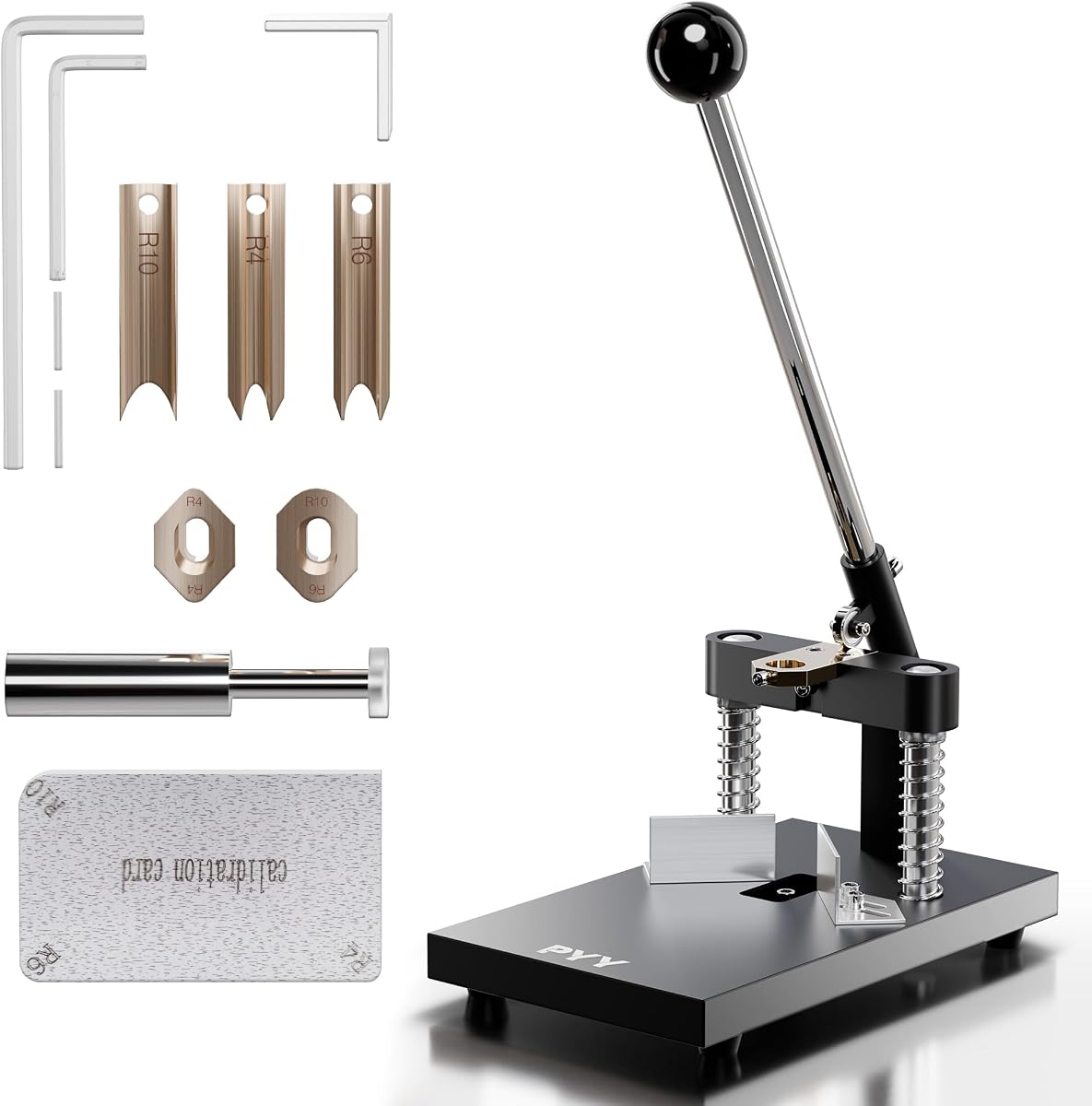
The PYY Corner Rounder Punch Cutter is the premium choice for users who need professional capacity and exacting control. It carries a 4.7 rating and separates itself from handheld craft punches with a weighted A3 steel body, an adjustable cutting height of up to 30mm, and a long lever intended to make substantial cuts manageable.
We may earn a commission when you buy through this link, at no additional cost to you.
The stated capacity reaches approximately 300 sheets in one cutting operation. Three interchangeable dies provide 4mm, 6mm, and 10mm radii, while adjustable positioning plates help control the angle of the material. The A3 tool steel blade is rated by the manufacturer for up to one million cuts, making this a serious option for sustained production.
Material versatility extends beyond ordinary craft paper. The listed capabilities include aluminum sheet, PVC plastic paper, leather, magnet sheets, foam core, and booklets, as well as standard paper. The package includes three blades, blade holders, positioning blocks, calibration cards, a manual, hex keys, and other components needed for setup and maintenance.
The trade-off is size and weight. Dimensions of 6.1 by 9.8 by 6.3 inches, a 35cm handle, and an eight-pound weight make it substantially more substantial than a desktop craft punch. Installation, disassembly, cleaning, and die changes are also more involved, so the machine is best suited to a permanent workspace rather than mobile crafting.
Despite that complexity, the PYY model is a compelling premium purchase for schools producing large quantities of cards, photography studios standardizing photo prints, or small businesses that repeatedly round business cards and presentation materials. Its combination of capacity, adjustable geometry, and replaceable dies makes it a long-term production investment.
The extended handle uses leverage to reduce the effort required for thicker stacks. A cutting height of 30mm and the stated 300-sheet capability make it suitable for repeat work rather than occasional trimming.
Positioning plates can be adjusted for the cutting angle, helping maintain accuracy across differently sized pieces. Calibration cards support setup and make repeatable results more achievable.
We may earn a commission when you buy through this link, at no additional cost to you.
The Sunstar Kadomaru Pro NEO combines a 4.7 rating with a compact, professional-looking design. Its three corner sizes—3mm, 5mm, and 8mm—are carefully selected for common uses such as business cards, message cards, playing cards, photographs, posters, and menu lists.
We may earn a commission when you buy through this link, at no additional cost to you.
This model handles material up to 0.4mm and can cut laminated material as thick as 200µ. That makes it useful for polished cards and photos, although the capacity is much lower than the PYY and BEAMNOVA heavy-duty machines. It occupies a middle ground between a simple craft punch and a production cutter.
The operating principle remains simple: insert the desired material into the back of the body and press the handle. Its compact measurements of 4.8 by 10.2 by 7.7cm allow convenient drawer storage, while the black finish gives it a restrained appearance that suits an office, design studio, or refined craft desk.
Users should recognize that the smaller radii may not create the pronounced curve associated with 10mm punches. It is better for subtle, precise finishing than large decorative corners. The tool also has a limited cutting area, so oversized posters or long laminated boards are outside its practical purpose.
The Kadomaru Pro NEO is best for a card maker who values branded stationery, multiple sensible sizes, and a tool capable of handling laminate. It offers a particularly polished way to finish invitation suites, business cards, photographs, and small presentation pieces without occupying much desk space.
The 3mm, 5mm, and 8mm options align with recognizable paper applications. This makes selecting a curve straightforward when preparing coordinated stationery or photograph sets.
The small black housing fits easily into a stationery drawer and maintains a restrained appearance. It suits workspaces where a large mechanical punch would feel visually and physically out of place.
We may earn a commission when you buy through this link, at no additional cost to you.
The QIQQIKIN Mixed-Style Corner Punch is designed for crafters who want more than conventional rounded edges. It has a 4.3 rating and combines a 5mm round corner, a straight 10mm cut, and a scalloped profile in one compact punch.
We may earn a commission when you buy through this link, at no additional cost to you.
The scallop option is the distinguishing feature. It adds a decorative repeated curve suitable for borders, greeting cards, journal elements, and scrapbook pages. The straight profile can also be useful for tabs or squared-off edges, although it is not a conventional 10mm radius. This makes the punch more versatile for mixed design treatments.
The ABS housing and metal blade are intended to deliver a smooth cut without burrs or scraping. The tool is described as easy to grip and squeeze, and the stated 70g to 230gsm cardstock range covers many common craft applications. Laminated paper, photographs, business cards, and junk journal materials are also listed as suitable.
The main limitation is that this is a manual craft punch rather than a high-capacity machine. It may require patience when processing many pieces, and very thin paper can catch in the cutting area. Users should also keep the material flat and verify that the desired decorative style suits the project before committing to a full batch.
For paper crafters making cards, scrapbook layouts, planners, or decorative journals, this model is a strong choice. It stands apart from the other three-way punches by adding scalloped and straight designs, giving the user a broader decorative vocabulary in one tool.
A scalloped cut creates a playful repeated edge that works well on invitations, scrapbook borders, and journal pages. It is a simple way to make a flat paper corner feel more decorative.
The rounded, straight, and scalloped choices can be mixed across a project. This is useful for matching different page elements without buying a separate punch for every pattern.
We may earn a commission when you buy through this link, at no additional cost to you.
The QIQQIKIN Circle Corner Punch offers a distinctive combination of a 4mm circular hole and 7mm and 10mm corner radii. Its 4.3 rating reflects a tool aimed at crafters who want both decorative edge shaping and small punched details from one device.
We may earn a commission when you buy through this link, at no additional cost to you.
The circular option is useful for border art, photo decoration, journal elements, and small accent holes. Combined with the two rounded-corner choices, it gives a scrapbooker or card maker more ways to coordinate shapes within a single layout. The product listing specifically mentions photos, borders, edges, business cards, and gift cards among its applications.
Its construction uses zinc alloy and plastic, and the tool is described as sturdy, easy to use, and capable of clean clipping. The recommended material range includes regular paper, EVA foam, foil, and craft paper below 2mm, with 70g to 230g paper identified as the practical working range.
Users should avoid adhesive-backed paper and stack very thin sheets to prevent sticking. Those limitations mirror those of many compact multi-function punches: flexibility comes with a need to prepare the material correctly. The absence of a smaller rounded radius may also matter for finely detailed business cards.
This punch is best for creative scrapbookers and journal makers who appreciate the ability to add circles and curved corners with the same tool. It is less focused than a standard corner rounder but more varied, making it a useful addition to an eclectic paper-crafting kit rather than a dedicated finishing machine.
A small circular punch can echo the shapes used in a scrapbook page, card, or journal spread. Matching both curves and circles produces a more cohesive decorative theme.
Use flat stock within the recommended weight range, and layer thin paper when necessary. Avoiding adhesive-backed material helps keep the cutting mechanism moving freely.
We may earn a commission when you buy through this link, at no additional cost to you.
The BEAMNOVA Heavy Duty Corner Rounder is built for users who need more durability and throughput than a handheld craft punch can provide. It has a 4.3 rating, a commercial-grade metal design, a 30mm maximum cutting height, and two included dies for 6mm and 10mm rounded corners.
We may earn a commission when you buy through this link, at no additional cost to you.
The machine uses hardened-carbide top and bottom cutting blades to support fast cutting and clean edges. Its heavy-duty A3 steel body is described as wear-resistant and rust-resistant, while the iron-casting base provides a stable foundation. A paper-pressing device helps prevent material from sliding as the cut is made.
Its material range includes foam core, PVC and ABS plastic sheets, paper, cardboard, pads, booklets, magnet sheets, and aluminum sheets. An adjustable metal baffle secures cards at the desired angle and helps prevent deviation. These features make it relevant to print shops, schools, sign-making businesses, and high-volume craft operations.
The included options are limited to R6 and R10 dies. Additional cutting dies are available separately, which is worth considering if smaller radii are essential. As with any bench machine, the user must also account for its larger footprint, stored tools, and the learning curve involved in setting blade alignment and material position.
The BEAMNOVA is an excellent choice for a workshop that rounds large quantities of cards, boards, booklets, or mixed materials. It combines industrial-style construction with practical adjustments, making it a specialized solution for users who have moved beyond occasional handheld crafting.
The iron-casting base and paper-pressing system help control movement during heavy cuts. Stability is crucial when handling larger sheets that would shift under a lightweight punch.
The supplied 6mm and 10mm dies cover two common curve sizes, and additional blades can be purchased separately. Buyers should plan for that expense if their work requires other radii.
We may earn a commission when you buy through this link, at no additional cost to you.
The right paper corner rounder depends on the shapes you need, the thickness of your materials, the volume of your projects, and how much space you can dedicate to the tool. These factors help separate lightweight craft punches from production-oriented machines.
Choose a corner size that complements the scale and purpose of your paper pieces. A 3mm to 5mm radius creates a restrained professional edge for business cards and formal stationery, while 7mm to 10mm options look more visible and decorative. Some punches also include straight, scalloped, or circular cuts, which can add useful variety but may not be necessary if you only need classic rounded corners.
Paper punches are not interchangeable in the materials they can cut. Compact tools commonly support standard paper, cardstock, photos, foil, EVA foam, or light laminate up to around 2mm, while the Sunstar Kadomaru Pro states support for up to three 20lb sheets and certain laminated film. Heavy-duty machines advertise far greater cutting heights and can handle plastics, leather, foam core, and other tougher materials. Always check both physical thickness and paper weight because either can affect performance.
A sharp metal blade is important because a dull or poorly aligned blade can leave burrs, scrape the surface, or produce uneven curves. Compact punches commonly combine a steel cutting edge with plastic or alloy housing, while heavy-duty models use thick steel bodies, hardened-carbide blades, or replaceable A3 tool steel dies. The housing should also feel smooth around the handle and opening, since rough edges and exposed hardware are uncomfortable during repeated use.
A small manual punch is sufficient for greeting cards, scrapbook pages, and occasional photo finishing. A machine with a long lever, adjustable cutting height, and paper clamp becomes more valuable when you routinely process dozens or hundreds of matching pieces. High-volume users should also consider how quickly they can change dies, position materials, and clear scraps. The most appropriate tool should improve workflow rather than turn a simple task into a setup-heavy process.
Accurate results depend on positioning the paper squarely in the tool. Guides, alignment holes, positioning plates, calibration cards, and adjustable baffles can all reduce guesswork. A visible guide is particularly useful for small cards and photos, while a movable platform helps with larger sheets. If you will use the tool frequently, test it on scrap material first to learn how far the corner should be inserted and how firmly the handle should be pressed.
Compact punches are easy to keep in a craft bag, drawer, classroom, or travel kit. Heavy machines require a stable bench or table and sufficient clearance for their handles and dies. Anti-slip pads help prevent movement, while extended levers can make forceful cuts safer and more efficient. Keep fingers clear of the cutting area, use the intended paper stop or clamp, and make sure the machine is stable before applying substantial pressure.
Paper residue and tiny offcuts can reduce the effectiveness of any punch. A tool that opens easily or includes cleaning guidance will be easier to maintain, particularly if adhesive material is accidentally used. Heavy-duty models should also be checked for blade alignment and worn components. Replaceable dies and tool steel blades can extend the useful life of a machine, but their availability and cost should be considered when comparing long-term ownership.
The ideal tool differs depending on whether you make greeting cards, scrapbook layouts, planners, photographs, business cards, laminated invitations, or commercial presentation pieces. Formal stationery usually benefits from a small, consistent radius, while scrapbooks and journals may reward scalloped or mixed designs. Production businesses should prioritize capacity, stability, and repeatability over compactness. A well-chosen corner rounder should match the most common job you already have, not merely offer the largest number of features.
Begin on a clean, stable surface and place a scrap sheet beneath the tool if you are learning its alignment. Trim the paper edge so it is flat and square, select the desired radius, and insert only the corner that needs to be cut. Move the sheet until it rests squarely against the internal guide or alignment marks, then press the handle with even pressure rather than forcing the material.
Use the material range specified for your particular punch. If the paper is unusually thin, stack two or three sheets to give the blade a stable edge. Avoid adhesive-backed paper on compact punches because it may leave residue and cause sticking. For heavy machines, install the correct die, set the positioning plate, tighten the assembly as directed, and test the setup on scrap material before processing a full batch.
After use, remove loose scraps and paper particles from the cutting area. Wipe the blade and guides with a dry or lightly damp cloth, avoiding excessive moisture around the mechanism. Store a compact punch with the handle closed, and keep heavy machines stable and clear of clutter. Periodically check blade alignment and replace damaged cutting components before they produce uneven edges.
A 3mm to 5mm radius generally gives business cards a restrained, professional appearance without making the corners appear overly rounded. The Sunstar Kadomaru Pro NEO includes a 3mm option, while larger tools can provide 4mm or 6mm curves. Consider the card's thickness and whether it is laminated, and test a duplicate card before finishing the entire batch.
Many compact punches can cut light cardstock, often up to about 2mm or around 180g to 230g depending on the model. Dense chipboard, laminated board, and thick craft sheets may require a heavier-duty machine. Always follow the product's stated thickness and weight limits, because a sharp blade does not guarantee clean cutting through unsupported material.
The most common causes are adhesive-backed stock, paper dust, or a very thin sheet curling into the cutting path. Use clean, non-sticky paper, layer thin sheets as recommended, and remove debris from the opening after each session. If the problem continues, stop forcing the handle and check whether the material falls within the tool's specified range.
A handheld punch is compact, inexpensive, and intended for occasional card, photo, and scrapbook work. A heavy-duty rounder has a metal frame, longer lever, larger cutting capacity, adjustable positioning, and replaceable dies for repeated production. The heavier models can also cut thicker or non-paper materials, but they require more workspace and setup.
Use flat, square paper edges and push the corner fully against the tool's guide before pressing. Tools with visible alignment holes, positioning plates, or calibration cards make placement easier. Apply steady, even pressure and test on a spare piece if you are changing the paper thickness, radius, or machine setup.
Some models can cut light laminate, while the Sunstar Kadomaru Pro states support for laminated film up to 3.9 mils and the Pro NEO up to 200µ. Other compact punches are described as suitable for laminated paper, but material limits vary. Confirm the exact laminate thickness and avoid adhesive-backed sheets on tools that warn against sticking.
A single-radius or focused tool can be simpler and may feel more consistent for one type of finished project. A three-way punch is more flexible when you make cards, scrapbooks, planners, and invitations with different visual styles. Multi-style tools can also include straight, scalloped, or circular cuts, which add creative options but do not necessarily improve cutting capacity.
Remove paper scraps and dust after use, especially around the guide and cutting edge. Keep the mechanism dry, and avoid leaving adhesive residue on the blade. Heavy-duty machines should have their blade alignment and fasteners checked periodically, while replaceable dies should be stored carefully to prevent damage.
The QIQQIKIN 3 in 1 punch is the strongest budget-oriented all-rounder because it combines 4mm, 7mm, and 10mm radii with a sharp stainless steel blade in a compact format. The Sunstar Kadomaru Pro stands out for polished results, small-stack capacity, and excellent suitability for card and photo finishing, while the PYY machine leads high-volume users with its 30mm capacity, steel construction, and adjustable dies.
For most home crafters, corner radius, paper thickness, and ease of alignment should determine the choice more than maximum specifications. Lightweight multi-way punches are convenient for scrapbooks and cards, whereas workshops and small businesses benefit from long handles, stable bases, paper clamps, and larger cutting heights. Mixed-style tools can be especially useful for creative layouts that need scallops or circles alongside conventional curves.
Before making a final purchase, confirm the product's current listing, included accessories, dimensions, and latest customer feedback. Prices and availability can change, and manufacturer specifications may also evolve, so reviewing the current listing ensures that the selected paper corner rounder still matches your material, workflow, and project requirements.