
APEXEL 200X Phone Microscope Lens
3.7Editor score
200X advertised magnification
Four-layer glass optics
LED and CPL lighting
Lightweight 17.5g build
Phone microscope lens attachment options are compared for magnification, lighting, compatibility, portability, and ease of use in this expert guide.
A phone microscope lens attachment turns a compatible smartphone camera into a compact tool for examining leaves, coins, fabrics, insects, jewelry, minerals, and other tiny subjects. The best models combine useful magnification with focused illumination, secure camera alignment, straightforward controls, and enough portability for field, classroom, workshop, or travel use.
This guide compares ten attachments using the supplied product specifications, including magnification, optical construction, working distance, lighting, filters, battery life, weight, device compatibility, and installation requirements. It covers dedicated phone microscopes, modular multi-lens systems, a general-purpose macro attachment, and an adapter designed to work with an existing optical instrument.
Each numbered review explains the product's strongest capabilities, practical limitations, and most suitable user. The top selections represent the strongest overall, budget-conscious, and premium options in this group, although the right choice ultimately depends on subject distance and required magnification. Product specifications, ratings, availability, and prices can change, so readers should verify current details before purchasing.
3.7Editor score

4.5Editor score

3.9Editor score
The table below compares all ten options by advertised magnification, illumination, portability, and attachment style, making it easier to identify the product that matches your subjects and phone setup.


The MIAO LAB 300X combines advertised 300X magnification, an integrated LED system, a 395nm UV source, and a CPL filter in a compact clip-on design. With a 4.5 rating, it combines one of the stronger customer ratings in this comparison with an unusually broad lighting package. Its slide-rail and modular construction also distinguish it from simpler fixed-lens alternatives.
We may earn a commission when you buy through this link, at no additional cost to you.
The main attraction is the combination of high advertised magnification and controllable illumination. Twelve high-brightness LEDs offer 13 modes, allowing users to adjust the light for reflective or translucent subjects, while the CPL filter can suppress glare and improve perceived contrast. A recommended working distance of 6–10mm makes it more appropriate for carefully positioned close-up work than general-purpose long-range zooming.
The attachment requires some attention to placement. Users are instructed to disable camera macro mode for the best performance, and the product is not designed to magnify distant objects. Its adjustable hollow clip accommodates phones from 2.5 to 4.0 inches, although iPhone mini owners should choose another model. The 46.5g weight and built-in 100mAh battery improve portability, with up to 5.5 hours of stated continuous operation.
This is a strong all-around choice for collectors, students, photographers, engineers, and curious users who want a higher magnification ceiling without giving up UV and polarized lighting. It is particularly suitable for insects, plant surfaces, minerals, jewelry, and currency. Buyers should remove or account for phone-case clearance, stabilize the phone, and maintain the specified working distance to get the most consistent results.
The 12-LED system and 13 selectable modes are valuable when reflective jewelry, pale plant material, or currency would look harsh under a single bright source. The CPL filter and UV option expand the range of surfaces and details that can be examined.
The advertised 300X level is useful for reaching finer details, but it also makes stability and focus more demanding. Keeping the lens between 6 and 10mm from the subject provides the most practical path to a consistently sharp image.
We may earn a commission when you buy through this link, at no additional cost to you.
The APEXEL 200X is a lightweight, no-app microscope attachment offering advertised 200X magnification, four glass layers, six LEDs, and a polarizing filter. Its 3.7 rating is lower than several alternatives, but the specification sheet presents a capable and particularly portable package for close-up inspection. It is well suited to nature, jewelry, banknotes, tobacco, ore, and small everyday specimens.
We may earn a commission when you buy through this link, at no additional cost to you.
Its four-layer glass lens construction is the key optical detail, while the built-in CPL filter helps control excessive reflection and glare. Two lighting modes make it simpler to operate than elaborate multi-color systems. The recommended working distance is approximately 6mm, so the attachment must be held close to the subject and the phone should remain steady for the clearest results.
Some compromises come with the simple design. APEXEL recommends removing the phone case, and users with iPhone 13 or newer models and Samsung Galaxy S22, S23, or Ultra models should disable the camera's macro feature. The lens cannot magnify distant objects. Despite those restrictions, installation takes only a few steps, and no app is required.
For buyers seeking a capable close-up microscope without a large accessory kit, this is a practical budget-oriented selection. Its 17.5g weight and 100mAh rechargeable battery, stated to deliver up to 5.5 hours of continuous use, make it easy to carry in a pocket or small bag. It is a better fit for casual exploration and general collecting than for laboratory-grade measurement work.
At 17.5g, the APEXEL 200X places less burden on a phone and in a pocket than many powered microscope attachments. Its rechargeable illumination removes the need to replace disposable batteries during mobile use.
Two lighting modes keep operation approachable, while the CPL filter adds a useful layer of glare control. This balance works especially well for jewelry, coins, printed material, and other reflective subjects.
We may earn a commission when you buy through this link, at no additional cost to you.
The APEXEL 100X is a straightforward macro and microscope lens for users who want a simple way to view small details. It uses four quality glass lenses with three to five coating layers, includes an automatic LED ring, and works without an app. Its 3.7 rating places it in the middle of this group, while its low-instruction design makes it approachable for beginners and children.
We may earn a commission when you buy through this link, at no additional cost to you.
The automatic LED activates when the lens cover is opened, removing the need to manage a separate light source. Its integrated clip and slide rail attach to the primary camera without screws or springs. The maximum clip opening is stated at 0.78 inches, allowing use with many phone cases, and the manufacturer suggests retaining the case when the camera is convex.
This model is intended for extreme close-up work rather than distant magnification. Its stated working distance is only 0.14–0.17 inches, so precise positioning becomes essential. The LED provides roughly two hours of use and needs about 1.5 hours to charge. Cleaning precautions are also important because the manufacturer warns against alcohol, which may damage the lens coating.
It is a sensible choice for examining plant trichomes, skin, coins, stones, and similarly small objects when 100X is sufficient. It may lack the reach of 200X or 300X products and offers fewer lighting choices, but its automatic illumination, no-app operation, and relatively accommodating clip make it a good general-purpose close-up tool.
Opening the lens cover activates the LED ring, so the user can begin observing with minimal setup. This is convenient for children, classroom demonstrations, and spontaneous inspections of small objects.
The very short working distance shows that this is a dedicated macro attachment. It rewards steady hands and careful placement, making it more appropriate for tabletop studies than quick field observations.
We may earn a commission when you buy through this link, at no additional cost to you.
This 200X pocket microscope combines a 4.5 rating, embedded CPL lens, LED illumination, and a 17.5g rechargeable body. It is designed for users who want to reduce glare and ghosting without adding another app or complicated accessory. The stated use cases include coins, jewelry, plants, minerals, insects, and other small objects.
We may earn a commission when you buy through this link, at no additional cost to you.
Its polarizing element is intended to eliminate unwanted reflections, improve color saturation, and increase contrast under high magnification. The universal clip is straightforward to attach, and users are instructed to use the main camera, position the lens close to the subject, and zoom the phone camera to 2x to fill the screen. The product operates without an app, which reduces setup friction.
The stated battery life is more than two hours of effective use when fully charged, which is shorter than the 5.5-hour figure listed for several higher-end models. The product also depends on the phone's own zoom function to realize its advertised magnification, so results can vary with camera software and device processing. A thick case may interfere with positioning.
This is a compelling choice for students, hobbyists, teachers, and collectors who value glare reduction and a lightweight form. It performs particularly well on reflective objects such as coins and jewelry. For people wanting more selectable illumination or a longer battery window, one of the multi-mode or modular models may be a better fit.
The embedded CPL lens targets the reflections and ghosting that can obscure fine details on shiny surfaces. It is a meaningful advantage when examining jewelry, polished stones, printed currency, or coated leaves.
The attachment works with the phone's native camera zoom, so reaching the stated magnification may require a 2x camera setting. Users should use the main camera and avoid placing the subject too far from the lens.
We may earn a commission when you buy through this link, at no additional cost to you.
The APEXEL 40x/80x/120x 3-in-1 is the most feature-oriented premium selection in this list. It combines a rotating magnification wheel, fully multi-coated optical glass, dual-color LEDs, UV illumination, an adjustable universal clip, and pass-through charging. Its 3.9 rating reflects a positive but not exceptional customer score, yet the specification set is especially developed for varied observation needs.
We may earn a commission when you buy through this link, at no additional cost to you.
The rotating wheel lets users move among 40x, 80x, and 120x without carrying separate attachments. The stated optical system uses four groups and four elements at 120x, with multi-coated surfaces and aviation-grade glass. Lighting includes 16 LEDs and eight UV LEDs, a 5800K white mode, a 3200K yellow mode, and a stated CRI above 92 for natural-looking color.
Its advantage is flexibility rather than maximum magnification. A working distance of 8.26–34.3mm is more forgiving than the very tight focus required by some close-up models. The adjustable clip spans 6.5–10cm, accommodates cases, and uses an anti-slip pad positioned away from side buttons. The 47.9g aluminum and ABS body remains portable, and the battery supports up to 5.5 hours of stated operation.
This model is ideal for users who need several magnification levels, more deliberate white or yellow illumination, and occasional UV inspection. It also suits tablets and a wide range of phones. Those needing 200X or 300X should consider the modular APEXEL 100X/200X/300X instead, but this product's broad lighting and focus range make it the stronger premium all-rounder here.
The rotating design makes it possible to move from broad close-up observation to greater detail without changing attachments. It is useful for projects that range from larger material surfaces to smaller structures.
White and yellow color temperatures suit different subjects and ambient conditions, while UV adds value for currency marks, jade textures, and fluorescence-related observations. CRI above 92 supports more natural color reproduction.
We may earn a commission when you buy through this link, at no additional cost to you.
The APEXEL 100X/200X/300X 3-in-1 is a highly adaptable microscope with three advertised magnification levels, 18 lighting modes, a CPL filter, and UV illumination. Its 4.0 rating places it among the stronger-rated products in the comparison. A slide rail and modular design allow quick switching, making it suitable for users whose subjects range from broad macro details to very fine structures.
We may earn a commission when you buy through this link, at no additional cost to you.
Twelve high-brightness LEDs provide more control than a simple ring light. The lighting selection includes a 395nm UV source, while the CPL filter helps manage reflections and glare. The recommended working distance of 6–10mm applies across the product's close-up use, and the 100mAh rechargeable battery is stated to provide up to 5.5 hours of continuous operation.
The hollow universal clip spans 71–105mm, or 2.8–4.1 inches, and supports major phone brands, though it does not fit the iPhone mini. APEXEL recommends removing the case for optimal optical performance and advises disabling native macro mode on recent iPhone and Galaxy S22 or S23 models. As with the other close-focus models, it is not intended for distant objects.
This is a compelling all-in-one package for collectors, teachers, photographers, and advanced hobbyists. The modular format is particularly useful because a user can select 100X for easier framing, then move to 200X or 300X when finer detail is needed. It is more complex than a fixed 100X or 200X lens, but that complexity creates meaningful flexibility for varied subjects.
The 100X setting offers a more forgiving starting point, while 200X and 300X support closer inspection. This range is valuable for projects involving both recognizable patterns and minute details.
Eighteen modes, 12 LEDs, UV illumination, and a CPL filter give users several ways to handle color, texture, and reflection. The options are useful when comparing living material, polished objects, and fine printed markings.
We may earn a commission when you buy through this link, at no additional cost to you.
The APEXEL 300X is a dedicated high-power pocket microscope aimed at users who want the maximum advertised magnification in this comparison without carrying multiple lenses. It has a 4.0 rating, a 300X specification, 12 LEDs, 13 lighting modes, a CPL filter, and 395nm UV illumination. Its slide-rail design supports quick, controlled positioning.
We may earn a commission when you buy through this link, at no additional cost to you.
The 6–10mm recommended working distance is practical for insects, natural materials, coins, jewelry, ore, tobacco, and currency. Polarization helps control glare on reflective subjects, while the UV mode provides an additional way to examine certain surfaces and markings. The product needs no app, reducing the chance of software-related setup problems.
Its fixed 300X approach is the main trade-off. Users who need a broader field of view or easier subject placement may prefer a multi-level model. The product weighs 46.5g and includes a rechargeable 100mAh battery with up to 5.5 hours of stated use. The clip supports phones between 71 and 105mm but does not fit the iPhone mini.
Choose this option when 300X is a priority and you will work with tiny specimens at a consistent distance. It is a good match for enthusiastic collectors, students, photographers, and inspectors who want UV and CPL without the complexity of choosing among three optical levels. Keeping the phone still and removing the case will help with alignment and image consistency.
The fixed high-power configuration keeps the tool focused for users who already know that fine inspection is the goal. It avoids the need to carry or change between multiple lens elements.
The 12-LED array, selectable modes, UV source, and polarizing filter offer useful control over otherwise difficult subjects. These features are especially relevant for jewelry, mineral surfaces, and printed security details.
We may earn a commission when you buy through this link, at no additional cost to you.
The Universal Phone Scope Adapter is a different kind of phone microscope accessory: it connects a smartphone to an existing telescope, microscope, binocular, monocular, night-vision spotting scope, or similar eyepiece. With a 3.7 rating, it offers a practical solution for people who already own optical equipment but want to capture images through a phone.
We may earn a commission when you buy through this link, at no additional cost to you.
The adapter supports phone widths from 55–85mm, or 2.16–3.35 inches, and eyepiece diameters from 22–44mm. Compatible phones named in the specifications include several iPhone, Samsung Galaxy, and Galaxy Note models, along with Sony, LG, HTC, and other brands. Soft EVA pads contact the phone and eyepiece to reduce the risk of scratching.
Unlike the dedicated microscope attachments, this product does not contain its own magnification, lighting, or battery. Its capability comes entirely from the optical instrument to which it is attached. The 75g housing is comparatively heavy for a small accessory, although the design is intended to reduce pressure on the eyepiece. Installation guidance is required, and buyer compatibility checks are important.
This adapter is ideal for an existing microscope owner, an amateur astronomer, or a nature observer who wants to photograph the moon, cells, birds, or other subjects seen through a scope. It should not be compared directly with a 200X or 300X standalone lens, since it functions as a bridge rather than a complete microscope.
The adapter lets a compatible phone camera become a capture device for an existing microscope or spotting scope. It can therefore be valuable when a dedicated optical instrument already provides the needed magnification and illumination.
Compatibility depends on both the phone width and the eyepiece diameter. Buyers should measure both before ordering, especially when using a tablet or an eyepiece with an unusual adapter size.
We may earn a commission when you buy through this link, at no additional cost to you.
The Xenvo Pro Lens Kit is a broader mobile photography package rather than a dedicated high-power microscope. It includes a 15x macro lens, a 0.45x wide-angle lens, a clip, a rechargeable LED fill light, a lanyard, a travel case, an additional clip, and a cleaning cloth. Its 4.1 rating is among the better results in this comparison.
We may earn a commission when you buy through this link, at no additional cost to you.
The 15x Clarus macro lens is intended for subjects around half an inch away and can reveal fine surface details without the extremely close positioning required by 100X–300X devices. The 0.45x TruView wide-angle lens expands the camera's field of view for travel scenes, architecture, group photographs, and landscapes, making the kit useful beyond microscopy.
The GlowClip LED light provides warm continuous illumination with three brightness settings. It can be positioned independently of the lens, which is useful when the phone's built-in flash would be too harsh. The primary trade-off is that the macro lens is far less powerful than the dedicated microscope products in this list, so it cannot provide comparable laboratory-style detail.
This kit is best for photographers who want one portable system for wide-angle travel photography and moderate close-up work. It is also suitable for parents documenting crafts, textures, plant material, or small objects. Buyers prioritizing a dedicated microscope should choose a higher-power model, while those wanting a complete mobile lens ecosystem may find this kit more versatile.
The wide-angle element complements the macro lens by addressing a completely different photographic need. The result is a compact kit for both broad scenes and moderate close-up details.
The included case, lanyard, clips, LED light, and cleaning cloth reduce the need to buy accessories separately. It is a polished option for travel and everyday mobile photography.
We may earn a commission when you buy through this link, at no additional cost to you.
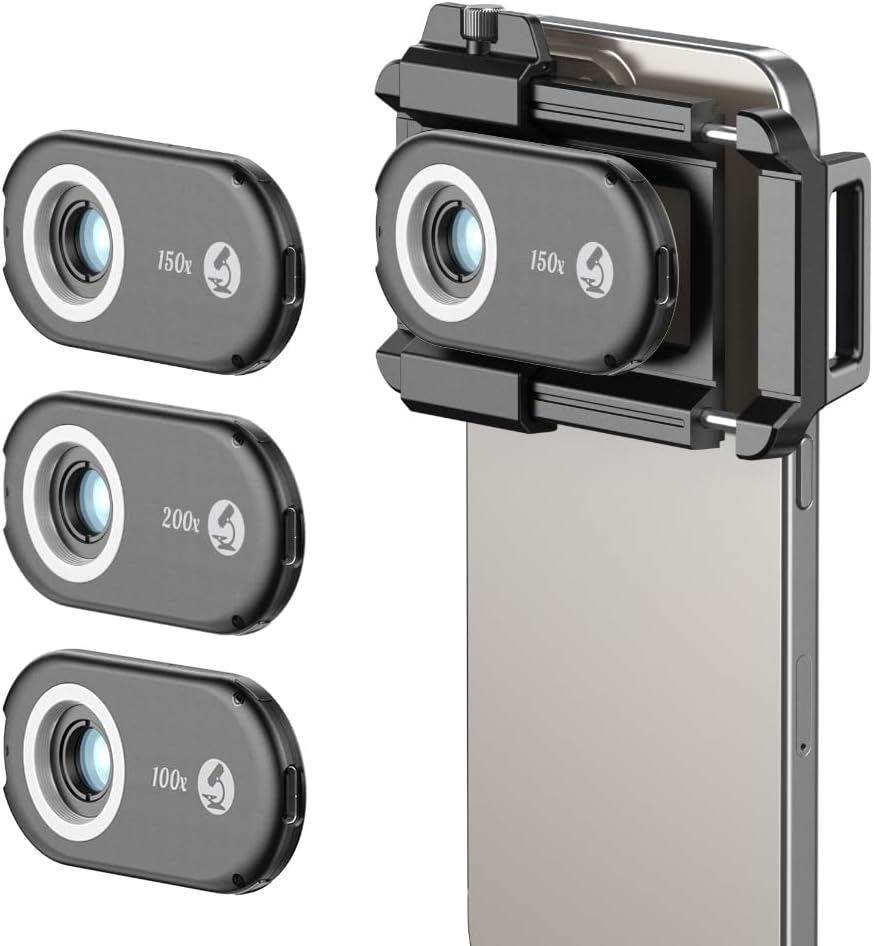
The generic 3-in-1 Phone Microscope Lens Attachment offers 100x, 150x, and 200x magnification in a compact clamp design. It includes LED and UV lighting, a CPL filter, and compatibility with most smartphones and tablets. Although it does not have an available rating, its straightforward feature set makes it a potentially accessible option for close-up experimentation.
We may earn a commission when you buy through this link, at no additional cost to you.
The three magnification levels give users a choice between easier framing and closer detail. LED and UV modes can improve visibility across different subjects, while the CPL filter is intended to improve clarity by reducing reflections. The secure universal clamp is useful for devices not covered by the fixed-width configurations of some competing products.
The product information is less detailed than that available for the ranked APEXEL and MIAO LAB options. No battery runtime, weight, working distance, optical glass specification, charging method, or phone-width range is stated. That makes it harder to compare durability and real-world portability. The lack of a customer rating also provides less purchasing reassurance than the numerical scores available for nine other products.
This attachment is best for a buyer seeking multiple magnification levels and UV capability in a basic phone clamp. It may appeal to students, hobbyists, and travelers who want a compact tool without a large accessory bundle. For greater confidence in specifications or stronger evidence of customer satisfaction, one of the better-documented models is the safer recommendation.
The 100x, 150x, and 200x options let users balance subject framing against final detail. This range is suitable for natural specimens, printed details, jewelry, and small components.
The CPL filter targets glare, while UV mode expands the available inspection techniques. These are useful additions for reflective surfaces and subjects that reveal additional features under ultraviolet light.
We may earn a commission when you buy through this link, at no additional cost to you.
A useful phone microscope should match your subjects, phone design, and level of control. Magnification is only one consideration because working distance, illumination, optics, filters, and installation can determine whether an image is clear and practical.
Match magnification to the task rather than choosing the largest advertised number. Moderate magnification is usually more practical for learning, demonstrations, and mixed-size collections.
Choose a comfortable working distance if you will inspect uneven or living specimens. Reserve the shortest distances for stationary objects and controlled photography.
Prioritize documented glass optics and coatings over magnification alone. A better optical system can produce more usable detail at a lower setting.
Select a model with adjustable light for varied subjects. A simple LED is adequate for coins and fabric, while UV and selectable color temperatures offer more control.
Choose a CPL-equipped model if reflective objects are central to your intended work. For mostly matte natural specimens, adjustable lighting may offer greater day-to-day value.
Check the exact phone dimensions, camera position, and case thickness before buying. If the manufacturer recommends removing the case, do not force the attachment into place.
For travel and field use, favor a light body, rechargeable light, and all-day stated runtime. For stationary work, weight matters less than focus and illumination control.
Choose a dedicated model for one clear use case. Choose a modular system for varied tasks, and choose an adapter only when you already own a compatible microscope or scope.
Begin by charging the attachment if it has a built-in battery, then install the phone app normally if you want your images saved in the camera gallery. Remove a thick case when the manufacturer recommends it. Align the microscope lens directly over the phone's main rear camera, secure the clip without forcing it, and confirm that the lens is parallel to the device.
Choose the required magnification, activate the appropriate lighting mode, and place the subject within the stated working distance. Move the phone slowly while watching the camera's focus indicator, then lock focus when the intended detail becomes sharp. For steadier results, support the phone on a stand, stack of books, tripod, or stable surface. Avoid moving the subject and lens independently once focus is locked.
After use, switch off the LEDs, disconnect any charging cable, and return the lens cover to its protected position. Clean the glass with a soft microfiber cloth and avoid alcohol unless the manufacturer specifically approves it. Store the attachment in its case or a dust-free pouch, keep the optical glass away from abrasive surfaces, and check the clip and battery periodically for looseness or damage.
Most support a wide range of modern phones, but compatibility depends on the clip width, camera placement, and whether a case is attached. Some products exclude the iPhone mini, and several recommend removing a thick case. Users should also check whether their phone's native macro mode needs to be disabled. Older or unusually large phones may require a different adapter.
No. The products in this guide are close-focus attachments and generally state that they are not intended to magnify distant objects. A 300X label describes the close-up magnification capability, not a telephoto zoom. For distant subjects, a separate telescope, spotting scope, or the Universal Phone Scope Adapter used with compatible optical equipment would be more appropriate.
Blurriness commonly results from an incorrect working distance, an unstable phone, autofocus shifting, or a case preventing proper camera alignment. Dark images can result from inadequate lighting, an obstructed light source, or a subject that does not reflect enough light. Move the subject to the specified distance, use a support, select suitable illumination, and clean the optical glass before changing equipment.
A CPL filter is especially useful for shiny or reflective subjects such as jewelry, coins, polished stones, and coated plant material. It can reduce glare and improve perceived contrast and color. It is less essential for matte, evenly illuminated specimens, so buyers with those subjects may prioritize adjustable LED brightness, UV lighting, or multiple magnification levels instead.
All ten products described here operate without a required companion app. The attachments feed the magnified image into the phone's normal camera, allowing users to take photos and videos through the standard camera interface. Some phones may still need camera or gallery permissions, but the microscope hardware itself does not depend on specialized software.
Yes, if the product instructions recommend it. Native macro processing can change the field of view, focus behavior, or image presentation, making it harder to obtain a consistent result from an external microscope lens. Recent iPhone models and Samsung Galaxy S22, S23, and Ultra models are specifically mentioned by some APEXEL products as models on which macro mode should be disabled.
Yes, provided the illumination and observation method are suitable for the subject. The dedicated microscope models list insects, plants, trichomes, and natural materials among their intended uses. Keep the device steady, avoid excessive heat from prolonged lighting, and handle living specimens carefully. For specimens that must remain in a particular environment, a separate digital microscope may offer greater flexibility.
Use a clean, soft microfiber cloth and avoid touching the optical surface with bare fingers. Alcohol is specifically discouraged for the APEXEL 100X because it may damage the coating, so it should not be used unless the manufacturer of another model explicitly approves it. Keep dust and moisture away from the lens, and replace the protective cover when not in use.
The MIAO LAB 300X stands out as the strongest overall choice because it combines a high advertised magnification level, 13 lighting modes, UV illumination, a CPL filter, and a portable rechargeable design. The APEXEL 200X is the budget-conscious selection, with four glass layers, glare control, and a particularly light 17.5g body. The APEXEL 40x/80x/120x earns the premium designation for its rotating magnification system, multi-coated optics, dual-color lighting, and broad working range.
The right choice depends on what you will examine. Choose a fixed 100x or 200x model for simpler use, a 300x option for fine details, and a modular system when several magnification levels are valuable. Pay close attention to working distance, case clearance, lighting controls, and whether UV or polarization would improve the subjects you plan to photograph.
Specifications, customer ratings, product availability, and prices can change over time, so check the current listing and manufacturer instructions before ordering. Verify your phone model, case thickness, camera position, and intended subjects. Those checks will help you select an attachment that is compatible, comfortable to use, and likely to produce satisfying close-up results.