
TACTACAM Defend 360 Cellular Security Camera
4.0Editor score
Cellular connectivity without WiFi
Integrated solar charging
Remote pan tilt and zoom
4K still photographs
Cold and weather resistance
Our expert guide compares 10 security cameras for extreme cold, evaluating weather resistance, power options, night vision, coverage, and storage for home
Security cameras for extreme cold must tolerate snow, ice, low temperatures, condensation, and demanding outdoor conditions while still delivering useful alerts and clear footage. The right model combines dependable weather resistance, suitable power management, effective night vision, and a network connection that remains practical in remote locations.
We compared all ten products using the supplied specifications, focusing on temperature claims, IP weather ratings, battery or wired operation, solar support, recording options, detection features, and image performance. The list includes wireless, wired, cellular, and multi-camera systems suited to everything from a single yard to an entire property.
Each review identifies the product's strongest contribution to cold-weather monitoring and explains practical trade-offs without assuming personal testing. Ratings and features reflect the available information, while operational results can vary with temperature, placement, solar exposure, network conditions, and recording activity. Product prices also change over time.
4.0Editor score

4.3Editor score
4.3Editor score
The comparison below organizes each option by power design, cold-weather support, image capabilities, and storage approach, making it easier to identify the right camera for a particular property.


The Tapo C400 is a single-camera solution rated at 4.3 out of 5, combining 1080p video, full-color night vision, wireless battery operation, and an IP65 weather-resistant housing. Its advertised resistance to dust, rain, and heat makes it a practical candidate for exposed entrances, driveways, and yards, although the specification does not provide a minimum operating temperature.
We may earn a commission when you buy through this link, at no additional cost to you.
Its major advantage for cold climates is the claimed battery life of up to 180 days on a charge. A 5200mAh rechargeable battery and wire-free installation reduce the need to climb ladders during freezing weather, while the Tapo app supports custom person-detection zones, instant alerts, firmware updates, and local microSD storage up to 512GB. Two-way audio, adjustable light alarms, and compatibility with Alexa and Google Assistant add practical controls beyond basic recording.
The camera is less demanding to specify than some alternatives because IP65 protection covers common outdoor dust and rain exposure, and the stated climate suitability is broad. Nevertheless, owners should verify the manufacturer's current operating-temperature guidance for the specific region, since battery performance and internal heating can affect cold-weather operation. Storage choice is flexible, with Tapo Care available when cloud retention is preferred.
The Tapo C400 is a strong choice for a homeowner who wants a simple, wire-free camera with long advertised battery life and no subscription required for local person-detection features. It is especially useful where a conventional WiFi signal is reliable and the camera can be positioned to reduce unnecessary motion triggers. For confirmed subzero specifications, a model with explicit freezing-cold operation should be preferred.
Wireless power removes exposed cables and allows the camera to be repositioned away from snowbanks, wind-driven rain, and areas likely to accumulate ice. The long battery claim also reduces winter service visits, provided activity levels and temperature do not accelerate power consumption.
Custom detection zones let users focus alerts on doors, driveways, or other relevant areas. Local microSD recording avoids making a cloud subscription mandatory for the core detection features.
We may earn a commission when you buy through this link, at no additional cost to you.
The ANNKE 3K Lite eight-camera system holds a 4.4 rating and offers a dependable wired alternative for owners who want continuous surveillance without depending on batteries. Its eight included 1080p cameras, DVR, and preinstalled 1TB hard drive create a complete recording package designed for 24/7 use.
We may earn a commission when you buy through this link, at no additional cost to you.
Cold-weather suitability comes primarily through consistent wired operation, an IP67 housing, and cameras described as capable of braving both cold and hot conditions. The dual-light system can switch between full-color night vision, infrared mode, and color night vision, while H.265+ compression helps conserve storage and bandwidth. AI motion detection supports human and vehicle classification, detection zones, and smarter searching through recordings.
The main compromise is installation complexity. Eight cameras require cable runs, a suitable DVR location, and weather-conscious cable protection, making the system more appropriate for a planned property-wide installation than a quick weekend project. The DVR also supports several camera formats, which offers expansion flexibility, but buyers must ensure that added cameras match the intended recording resolution and supported connection standards.
This system is a strong recommendation for a cabin, workshop, large yard, or commercial property where reliable continuous recording is more important than wire-free placement. It avoids winter battery maintenance and offers generous local storage, making it one of the most dependable cold-region choices in this roundup.
A fixed power connection removes battery degradation and recharge trips during severe weather. It also supports constant recording without tying camera uptime to motion-trigger frequency or seasonal sunlight.
Eight cameras and a 1TB hard drive provide a scalable foundation for monitoring driveways, entrances, outbuildings, and other outdoor zones. H.265+ encoding extends the footage retained within the available storage.
We may earn a commission when you buy through this link, at no additional cost to you.
This four-camera Techage package has a 4.4 rating and stands out for its explicit claim that its IP65 cameras can withstand rain, snow, high temperatures, and extreme cold. It combines 2K resolution, color night vision, AI motion recognition, and continuous 24/7 recording in a wired configuration.
We may earn a commission when you buy through this link, at no additional cost to you.
Because the cameras must remain plugged in, they avoid the reduced endurance commonly associated with rechargeable batteries in low temperatures. Dual-band 2.4GHz and 5GHz WiFi support offers more network flexibility than many competing wireless models. The cameras also provide two-way audio, user sharing, push notifications, and detection ranges stated at approximately 33 to 66 feet.
This package is less attractive for remote sites because a power source is required for every unit. Installers must plan cable routes carefully and ensure the WiFi signal reaches each intended position. Local continuous recording is supported on microSD cards up to 128GB, but the card is not included, and cloud storage introduces a subscription after the stated trial period.
The Techage four-pack is well suited to buyers who explicitly prioritize cold tolerance and continuous power but still want modern app controls and dual-band connectivity. It is a particularly relevant option for properties where a four-camera layout can be wired economically. Buyers should include the cost and weatherproofing of suitable power infrastructure in the installation plan.
The supplied product information directly identifies extreme cold among the conditions the IP65 housings are designed to withstand. That makes the claim more directly relevant than a general year-round weather claim.
Support for both 2.4GHz and 5GHz can improve placement flexibility on crowded home networks. The five-gigahertz band may provide additional bandwidth, while the two-point-four-gigahertz option often offers broader range.
We may earn a commission when you buy through this link, at no additional cost to you.
The AlkiVision solar camera carries the highest listed rating in the group at 4.6 out of 5. It combines a 2K sensor, full-color night vision, an adjustable 360-degree housing, an integrated 5000mAh battery, and a supplied solar panel in a single outdoor camera.
We may earn a commission when you buy through this link, at no additional cost to you.
Its IP67 enclosure and stated operation in freezing winter cold make it a compelling option for off-grid points around a property. The manufacturer says two hours of direct sun can provide enough daily power for operation, while the modular panel continually recharges the battery. A full charge is advertised as supporting up to six months of use, although actual longevity will depend on activity and winter conditions.
The camera supports person, vehicle, pet, and package recognition, although those AI features require a subscription. The core system also offers PIR-triggered recording, real-time notifications, a 20-second automatic recording after motion, two-way audio, a siren, and a spotlight. Local microSD storage up to 128GB is available, and the Vicohome app provides the viewing interface.
This is a good fit for a driveway, yard, gate, or outbuilding where broad coverage and off-grid power are priorities. Winter users should consider the reduced solar contribution from snow, cloud cover, and short daylight hours, and should orient the panel where it can receive the strongest available sunlight. Its broad feature set makes it an especially strong all-around wireless choice.
The integrated battery and modular panel remove the need to run electrical cable to the camera. This is particularly useful at gates, sheds, and remote corners where winter excavation or exposed wiring would be inconvenient.
A spotlight, audible siren, two-way talk, and adjustable 360-degree housing provide several ways to observe and respond to activity. The wide field of view can reduce the need for multiple cameras around a compact monitoring area.
We may earn a commission when you buy through this link, at no additional cost to you.
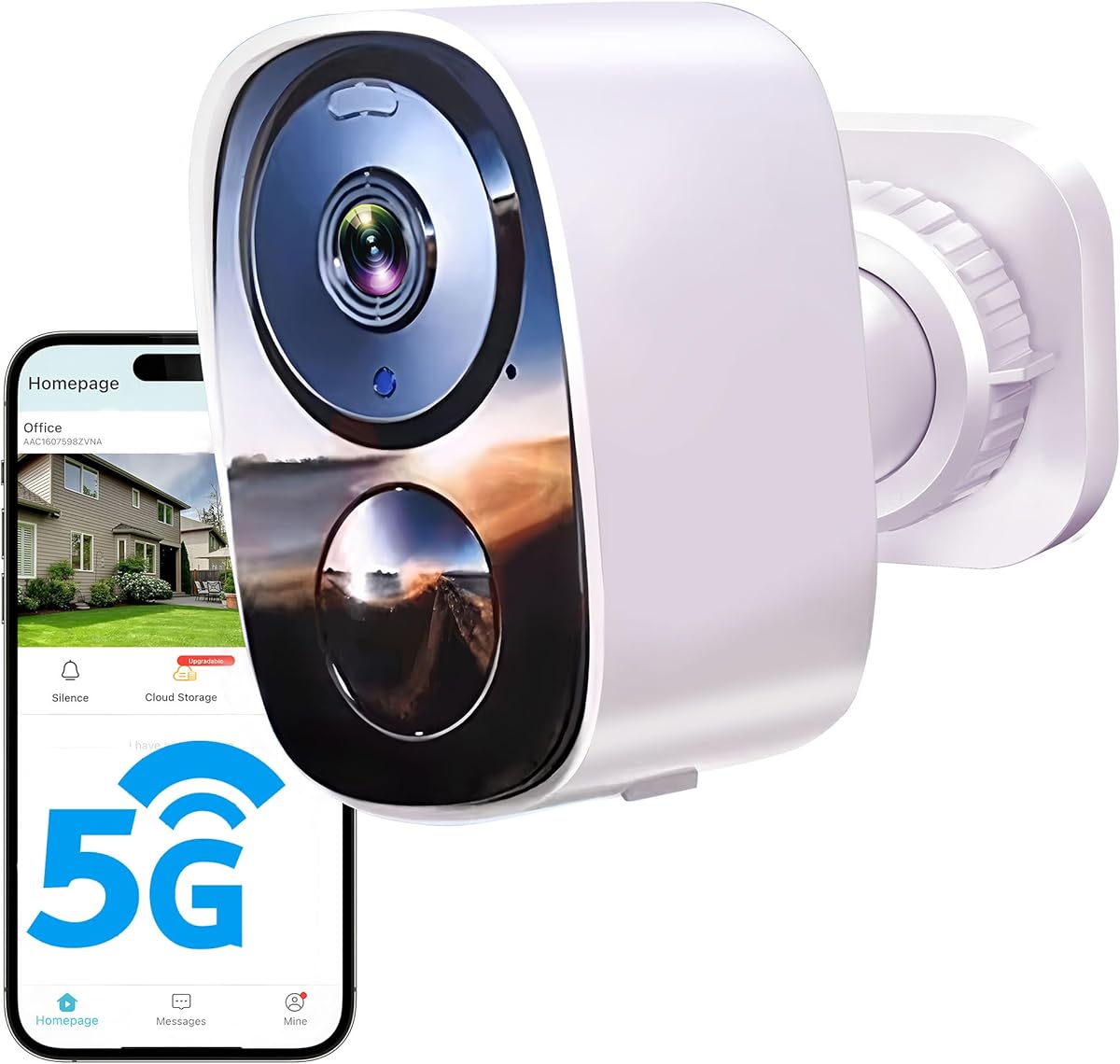
This 2026-upgraded wireless outdoor camera has a 4.3 rating and offers one of the broadest combinations of network, storage, and power features. It delivers 2K UHD video, full-color night vision, dual-band WiFi, an IP66 dust- and water-resistant housing, and a rechargeable battery advertised to last as long as six months.
We may earn a commission when you buy through this link, at no additional cost to you.
Its storage arrangement is unusually flexible. A free cloud plan is included, albeit at SD quality according to the supplied information, while local microSD cards up to 256GB can provide higher-quality storage. AI motion detection sends phone alerts, and a built-in microphone and speaker support two-way communication. A spotlight, siren, Alexa support, and power-saving mode broaden the day-to-day feature set.
The battery estimate requires careful interpretation. Test data cited by the manufacturer describes up to 60 days with 100 motion triggers per day and theoretical extension to six months at lower activity. The specification also notes that environmental temperature, recording mode, and trigger frequency affect performance, making cold-weather expectations less certain than the headline number suggests.
This camera is a strong value-oriented choice for a household that wants modern connectivity without paying for dual-band support elsewhere. It suits users willing to manage battery levels, notification settings, and storage access through the app. For locations with harsh exposure, placement under an eave or in a protected housing may be sensible, although it is explicitly marketed as an outdoor camera.
Supporting both two-point-four and five-gigahertz networks can make installation easier on crowded properties. Users can choose a less congested band where signal conditions permit.
The camera can retain footage on a microSD card, use the included cloud plan, or combine both approaches. Buyers should note that the free cloud tier is described as SD quality, while higher-quality cloud access may require a paid plan.
We may earn a commission when you buy through this link, at no additional cost to you.
The Jet Black 2K camera has a 4.6 rating and offers a compact wireless package for homes and businesses. It includes a rechargeable battery, IP65 weather resistance, 2K wide-angle video, color or infrared night vision, AI-based detection, two-way audio, a spotlight, and a siren.
We may earn a commission when you buy through this link, at no additional cost to you.
The claimed battery life ranges from one to five months, making this a practical option where running a cable is undesirable. The camera's AI motion system can distinguish people, vehicles, pets, and packages, and the app supports multiple users. Footage can be stored on a microSD card up to 128GB or through cloud storage, giving users a choice between local and remote access.
Its network limitations deserve attention. The camera does not support five-gigahertz WiFi, so it must operate on the two-point-four-gigahertz band. That band often provides better range but can be more crowded in residential settings. The microSD card is also not included, and the one-to-five-month battery range suggests that activity and temperature will have a meaningful effect on service intervals.
This is a good pick for a porch, garage, side entrance, or small yard where a compact camera, alert accuracy, and active deterrence are more important than five-gigahertz connectivity. It also works well for owners who want to share access with relatives. Users in deep cold should monitor battery health closely and keep the camera's firmware and motion settings current.
The included bracket and screws allow placement without a network cable, while the battery removes the need for a nearby outlet. This simplifies monitoring isolated areas around a property.
AI classification can reduce the inconvenience of alerts caused by irrelevant movement. The combination of push notifications, siren, light, and two-way audio allows a homeowner to assess and respond to detected activity.
We may earn a commission when you buy through this link, at no additional cost to you.
The ANNKE 16CH system is designed for larger surveillance projects, combining eight 2MP cameras with a DVR and a preinstalled 2TB hard drive. Its 4.2 rating reflects a capable, expandable wired platform rather than a compact single-camera solution.
We may earn a commission when you buy through this link, at no additional cost to you.
The IP67 housings are described as capable of withstanding extreme heat, cold, and rain, providing one of the clearest cold-weather claims among the wired systems. Built-in spotlights produce color night vision up to 66 feet, while infrared mode extends to 100 feet. AI Motion Detection 2.0 identifies people and cars, supports custom zones, and makes recorded events easier to locate.
H.265+ compression is said to save more than half the storage space associated with H.264 without sacrificing clarity, making the large drive useful for extended continuous recording. The 16-channel DVR can also accommodate more cameras as the property grows. Remote viewing through the ANNKE Vision app works on smartphones, tablets, and computers once the DVR is connected to a router.
This system is most appropriate for owners of large properties, farms, warehouses, or multibuilding sites who want centralized footage and room to expand. Installation is the largest hurdle because outdoor cameras require protected cabling and network routing. In return, buyers gain continuous power, substantial local storage, and a high camera count without depending on winter battery performance.
A two-terabyte hard drive supports extended footage retention while keeping the system independent of ongoing cloud subscriptions. H.265+ encoding is particularly useful when multiple high-resolution cameras operate continuously.
Sixteen-channel capacity gives users room to add cameras as monitoring needs change. Centralized remote access also simplifies reviewing several property zones through one app.
We may earn a commission when you buy through this link, at no additional cost to you.
The GMK four-camera system combines a 4.3 rating with a flexible approach to cold-weather power. Each camera can operate on a rechargeable battery or connect to constant power, allowing users to place cameras in remote corners or keep high-traffic entryways permanently powered.
We may earn a commission when you buy through this link, at no additional cost to you.
The system produces 2K 3MP video with a wide-angle lens, advanced color night vision, and infrared night vision. It is rated IP65 for resistance to rain, snow, and extreme heat. The battery specification advertises one to six months of standby time and more than 3,000 motion triggers per charge, with a six-to-eight-hour charging period.
Hybrid power is the most important feature for severe climates because it removes battery endurance as a constraint where reliable power can be run. It also includes a siren, flashing light, two-way audio, AI PIR detection, and mobile alerts. A privacy mode and custom sleep schedules can deactivate recording when residents are home, and multiple users can view feeds without taking over administrative control.
The main limitation is two-point-four-gigahertz-only WiFi, which may be less convenient on congested networks. Cloud and advanced AI features are associated with a subscription, although local memory-card storage is available. Even with those trade-offs, the GMK system offers the most balanced combination of multi-camera coverage, weather resistance, and power flexibility in the roundup, making it the top overall recommendation.
Battery power is useful at remote locations, while the wired option is better for busy entrances where frequent activity would otherwise drain a battery quickly. This makes one four-camera package suitable for several kinds of outdoor placements.
Local memory-card recording supports a subscription-free path to stored footage, while cloud access offers an additional option. Privacy and sleep modes let users control when the cameras are active.
We may earn a commission when you buy through this link, at no additional cost to you.
The TACTACAM Defend 360 is a premium cellular camera designed for properties where WiFi is unavailable or unreliable. It has a 4.0 rating and uses LTE connectivity, making it suitable for remote gates, barns, cabins, and other locations without a home network.
We may earn a commission when you buy through this link, at no additional cost to you.
Solar charging and a built-in rechargeable battery remove the need for a wall outlet. The remotely controllable pan, tilt, and zoom functions let users inspect a broad area without installing several fixed cameras. The camera provides 4K still photographs, 1080p video, and instant motion alerts sent to a phone.
Its weather-resistant construction is described as capable of handling rain, heat, cold, and prolonged outdoor exposure, although the supplied data does not include a numeric IP rating or minimum operating temperature. Cellular service quality and the camera's camera-to-signal placement therefore deserve special attention. Users must also consider the continuing cellular service requirements associated with cellular-connected alerts and remote access.
This camera is best for a remote outbuilding or isolated perimeter where a conventional WiFi camera would be impractical. It offers greater positioning flexibility than a fixed camera and avoids a site-wide network installation. Those benefits make it a specialized premium pick, while its lower listed rating and dependence on cellular coverage place it behind the GMK system for broad, whole-property coverage.
LTE operation is the defining advantage for remote monitoring. A suitable cellular signal replaces the need to extend WiFi across a barn, gate, cabin, or distant section of a property.
Pan, tilt, and zoom controls allow a single unit to be checked on demand. Solar power and a rechargeable battery remove the electrical-cable requirement, although snow cover can affect winter charging.
We may earn a commission when you buy through this link, at no additional cost to you.
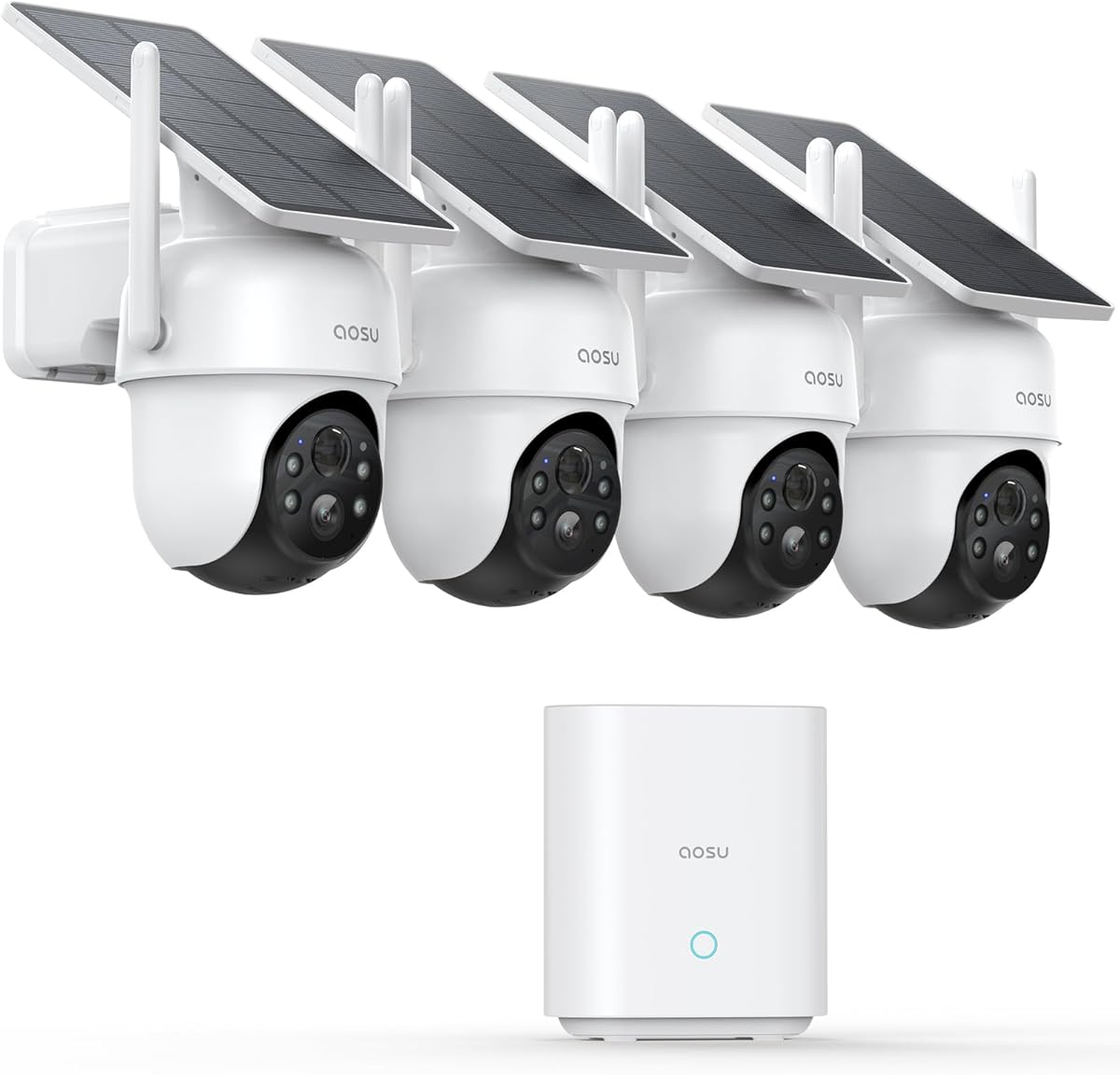
The aosu D1 Classic four-camera kit has a 4.3 rating and centers on a local-first solar system. Cameras connect to an aosuBase unit with 32GB of storage, providing encrypted loop recording without a required subscription and retaining footage even if a camera is damaged or lost.
We may earn a commission when you buy through this link, at no additional cost to you.
Each outdoor camera has an integrated solar panel, 360-degree pan and tilt, automatic motion tracking, and 2K described as 3MP resolution. Four LED lights improve low-light visibility and support color night vision. The stated charging requirement is three hours of sunlight daily, and the system remains operational through rainy or cloudy periods using stored battery power.
Users can watch four camera areas on one screen, and cross-camera tracking relates videos showing the same event across different views. That makes the kit useful for monitoring a larger property without juggling separate applications. Local storage removes a recurring cloud fee, although keeping the aosuBase connected and powered remains essential to the system's design.
This kit is a compelling choice for homeowners who want four solar cameras and do not want subscription-based storage. Automatic tracking and simultaneous viewing provide a more integrated experience than several unrelated single-camera products. Winter users should prioritize unobstructed solar exposure and periodically verify camera alignment, because snow accumulation and changing sun angles can reduce charging efficiency.
Encrypted recordings are stored on the included aosuBase rather than requiring a paid cloud plan. The ability to retain footage after camera damage or loss adds resilience that cloud-only systems may not provide.
Cross-camera tracking links related event footage, while four simultaneous live views simplify awareness around a property. The coordinated presentation is especially useful for yards with several approaches and entrances.
We may earn a commission when you buy through this link, at no additional cost to you.
The most important considerations are temperature tolerance, dependable power, weather sealing, network availability, and the amount of footage the installation must retain. A camera that performs well in mild weather can become unreliable in freezing conditions if its battery, seal, or wireless link is not designed for the environment.
Choose the camera with the clearest documented cold-weather claim, and give extra weight to models that specify outdoor operation across both cold and hot conditions.
Prioritize a clearly stated outdoor IP rating, sealed connections, and a lens position that is less likely to collect ice or snow.
Use continuous power in busy areas, solar for remote sites, and hybrid power when long-term reliability is the priority.
Favor a camera with a stated charge duration, adequate battery capacity, and a panel that can be positioned away from recurring snow buildup.
Verify the actual signal or cellular coverage at the camera location and confirm that the app supports the network configuration you intend to use.
Choose 2K or better, useful color night vision, and an illumination method suited to the monitored distance and angle.
Favor intelligent classification, adjustable detection zones, and realistic notification controls over unsupported or overly broad claims.
Compare storage costs, retention periods, local capacity, privacy controls, and subscription requirements before choosing a system.
Choose a mounting location that balances visibility with protection. Avoid aiming directly into bright snow glare, but do not hide the camera behind a window or under a roof where condensation and reflections can distort the image. Check the intended field of view in daylight and at night, confirm that the camera cannot be easily reached or obstructed, and use the supplied bracket or mounting hardware as intended.
Test each component before winter weather arrives. Update the app and camera firmware, confirm WiFi or cellular service, set detection zones, adjust motion sensitivity, and verify that recordings can be opened from the intended devices. Test notifications, two-way audio, the spotlight, siren, and night illumination. For wired systems, inspect cable routes and outdoor connections; for solar cameras, check panel alignment and confirm that accumulated snow can be removed safely.
During cold weather, inspect cameras periodically for ice, condensation, snow buildup, loose mounts, and physical damage. Keep lens glass clean with a soft cloth and avoid abrasive cleaners. Recharge or replace batteries as needed, and watch for reduced endurance caused by low temperatures and increased motion events. Clear solar panels when conditions permit, keep vents unobstructed, and review logs for missed alerts or connectivity failures.
Some outdoor cameras are explicitly designed for freezing conditions, but the safe operating range varies by model. A weatherproof IP rating protects against water and dust and does not establish a minimum temperature. Check the current manufacturer specifications, allow extra battery margin, and use continuous or hybrid power when reliable winter uptime is essential.
Wired cameras generally have the advantage because they do not depend on battery performance in low temperatures. They also provide consistent power for continuous recording and avoid wireless signal changes caused by ice buildup. The tradeoff is more complex installation, protected cable routing, and potentially greater impact from a damaged outdoor connection.
It can, provided the panel receives enough sunlight and the battery retains sufficient charge. Short days, cloud cover, snowfall, and panel obstruction can reduce charging, especially when the camera records frequently or operates its lights. Clear the panel safely, aim it toward strong daylight, and monitor battery levels throughout the season.
No. IP67 primarily describes ingress protection against dust and temporary water immersion under specified test conditions. Extreme-cold suitability is a separate operating-temperature claim. Look for both an outdoor IP rating and an explicit temperature range or statement about freezing conditions before installing a camera in a severe climate.
That depends on the product. A cellular connection can provide remote access and alerts without WiFi, but footage storage may still be local, cloud-based, or both. Review the camera's storage options, subscription terms, and any capacity limits. The TACTACAM Defend 360 uses cellular connectivity, while its supplied information does not describe its storage configuration in detail.
Start by using custom detection zones that exclude trees, roads, and areas where snow or ice moves frequently. Adjust motion sensitivity, enable AI classification when available, and avoid pointing the camera directly at reflective snow. Test notifications during different weather conditions and fine-tune them gradually rather than disabling every potentially useful alert.
Local storage is useful because footage remains available without a cloud subscription and may survive camera theft or damage. It also supports continuous recording, although card or hard-drive capacity must match the number of cameras and activity level. Cloud storage can be added for easier off-site access, but it may introduce recurring costs and service dependencies.
Place them where they have a clear view while avoiding direct accumulation of snow and ice. An eave, protected wall, or elevated mounting point can help, but the location should not become so sheltered that people can easily reach the camera. Check night visibility, WiFi or cellular signal, solar exposure, and cable protection before finalizing each position.
The GMK four-camera system stands out as the most balanced overall option because it combines IP65 outdoor construction, 2K imaging, color and infrared night vision, and the flexibility to run on batteries or constant power. The TACTACAM Defend 360 is the premium option for remote properties that lack WiFi, while the 2026 Upgraded 2K camera is a compelling budget-oriented choice with dual-band connectivity and flexible storage.
For buyers prioritizing continuous uptime, the two ANNKE wired systems and the Techage four-pack deserve close attention. The AlkiVision and aosu kits are better for off-grid solar deployments, while the Jet Black camera offers a compact single-camera solution with detection and deterrence features. Before buying, prioritize explicit cold-weather claims, suitable power, unobstructed placement, and storage that matches the number of cameras being monitored.
Ratings, software features, product bundles, and prices can change, so verify the current listing and manufacturer documentation before ordering. Check the exact operating-temperature range, included accessories, network requirements, storage limits, and subscription terms. Most importantly, evaluate how the camera will be powered and protected at the precise location where it will be used.
