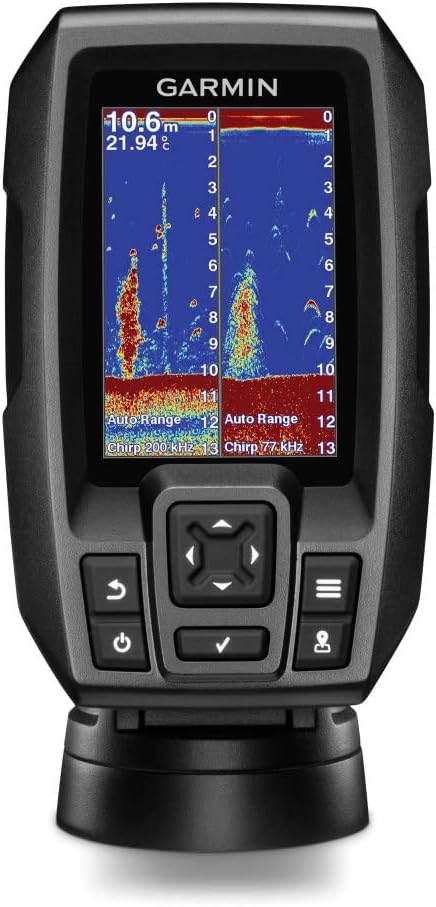
Garmin Striker 4 with Transducer
4.6Editor score
Clear Vu scanning sonar
Built-in waypoint mapping
Freshwater depth to 1,600 feet
A small boat depth finder can make an unfamiliar lake, shallow creek, or coastal water much easier to navigate. The best unit combines readable sonar information, dependable mounting, and controls that remain useful while fishing from a compact boat, kayak, or shoreline. Features such as GPS, waypoints, fish arches, and contour mapping can be valuable without making the setup overly complicated.
The products in this guide range from portable wired and wireless fish finders to permanently mounted in-dash units and full-featured color displays. We compared their listed sonar technologies, depth capabilities, screen formats, mounting options, navigation features, and intended environments. The comparison emphasizes practical differences rather than treating every feature as equally important on every boat.
Each review identifies the strongest reason to consider a particular model and also explains where it may fall short for another angler. The top recommendations cover a budget-oriented approach, a versatile all-around choice, and a more advanced navigation platform. Product availability, promotions, and prices change over time, so check the current listing and specifications before making a final purchase.
4.6Editor score

4.6Editor score

4.5Editor score
As an Amazon Associate we earn from qualifying purchases.
This side-by-side comparison highlights the major differences in sonar capability, mounting style, portability, navigation, and mapping features so buyers can find a depth finder suited to their particular small boat.



The Garmin Striker 4 combines a compact 3.5-inch display with a surprisingly capable set of sonar and navigation features. It carries a 4.6 rating and stands out for offering ClearVu scanning sonar, CHIRP, GPS waypoint marking, and a built-in flasher in a package designed for straightforward installation and operation. That combination makes it a practical starting point for an angler who wants more than a basic depth display.
We may earn a commission when you buy through this link, at no additional cost to you.
Its principal strength is the balance between information and simplicity. ClearVu is described as producing near-photographic images with detailed representations of fish, structure, and underwater objects, while CHIRP sends a continuous frequency sweep for crisper arches and improved target separation. The keyed interface avoids the learning curve associated with touch-only controls, which is useful when the screen is wet, the boat is moving, or the angler wears gloves.
The main limitations concern display size and navigation depth. A 3.5-inch screen is manageable on a compact boat, yet it offers less visual working area than the larger Garmin and Humminbird models in the guide. The built-in waypoint map can record productive brush piles, stumps, docks, and other landmarks, but it is not a full chartplotter with an extensive basemap. Buyers who need detailed lake or coastal charts may prefer a more advanced unit.
This is an especially strong recommendation for anglers fishing relatively shallow freshwater from a small motorboat, jon boat, or kayak. Its specified maximum depth reaches 1,600 feet in freshwater and 750 feet in saltwater, covering far more range than most anglers need. Choose the Striker 4 when clear structure imagery, simple controls, and dependable navigation matter more than a large screen or sophisticated chart library.
The combination of ClearVu scanning sonar and continuous-sweep CHIRP gives this small unit visual detail that can help identify fish-holding structure. Although the 3.5-inch screen limits the amount of information visible at once, it remains appropriate for close-range navigation and checking familiar fishing spots.
The built-in GPS and waypoint map let an angler mark and revisit locations without adding a separate navigation device. It is a practical middle ground for small boats, although it should not be confused with a full mapping chartplotter.
We may earn a commission when you buy through this link, at no additional cost to you.
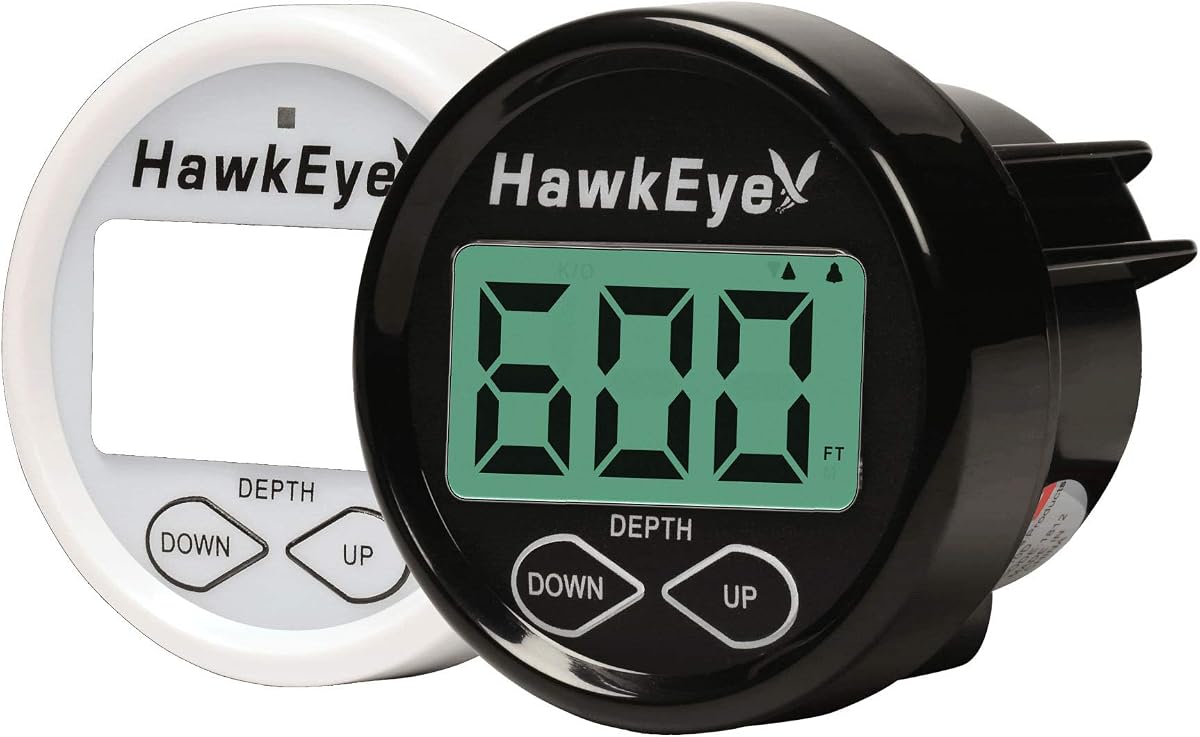
The DepthTrax 2B is designed for a different purpose from most color fish finders: providing a permanent, dedicated depth readout inside the dashboard. Its 4.2 rating reflects a straightforward instrument that focuses on depth, warning alerts, and reliable mounting rather than fish identification or full marine navigation. For a boat owner who wants the essentials permanently incorporated into the console, it remains a specialized option.
We may earn a commission when you buy through this link, at no additional cost to you.
Depth readings are specified from 2.5 to 600 feet, and the unit can operate on boats traveling up to 60 mph. Its three-stage advanced warning system combines an audible alarm, a bright red LED, and LCD alarm indicators. The polarized icon display is designed to remain readable without glare, including while wearing polarized sunglasses, while algorithmic programming is intended to reduce false readings and improve precision.
Installation is the central trade-off. The package includes options for transom or glue-in mounting, and the supplied transducer can shoot through solid fiberglass or aluminum hulls up to 1/8 inch thick. However, glue-in installation is limited to non-cored fiberglass or aluminum hulls thinner than 1/8 inch. It is not suitable for every vessel, so inspecting the hull and understanding the electrical layout are essential before installation.
The right buyer is someone who prioritizes a clean, permanent depth gauge over colorful sonar imagery and GPS navigation. It may also appeal to boaters who already understand marine installation and want readings available whenever the boat is powered. For anglers seeking fish arches, structure mapping, or wireless portability, another product in this guide would be a better fit.
With a specified operating limit of 60 mph, the DepthTrax 2B is suited to boaters who monitor changing depth while underway. The in-dash format leaves the display in a predictable location and avoids carrying a separate handheld unit.
The included transducer options create flexibility, but they also require care. Non-cored fiberglass and thin aluminum hulls meet the stated glue-in conditions, while other hull structures need a different installation plan.
We may earn a commission when you buy through this link, at no additional cost to you.
The Humminbird PiranhaMAX 4 is a focused sonar unit for anglers who want fish and structure information without a larger navigation package. It has a 4.6 rating, a four-inch diagonal display, and a dual-beam sonar system that lets the user choose between narrow detail and wide coverage. The included transom transducer and adjustable tilt-and-swivel mount make it a natural fit for a small fishing boat.
We may earn a commission when you buy through this link, at no additional cost to you.
Its dual-beam design is the most important feature. A narrow beam concentrates the sonar view for detail, while a wide beam covers a larger area around the boat. That flexibility helps when fishing a known drop-off, searching a shallow flat, or transitioning between very different bottom conditions. The tilt-and-swivel bracket also makes it easier to aim the display and transducer toward the area being scanned.
This model does not emphasize the GPS, waypoint, or chart functions found in several other selections. Buyers should therefore consider whether a dedicated fish finder is enough for their needs. It is also a step below the advanced CHIRP units in the list in terms of target separation and navigation, although its stated sonar functions remain useful for ordinary small-boat fishing.
The PiranhaMAX 4 is a good fit for an angler who values a straightforward four-inch screen and flexible beam coverage more than mapping or connected features. It may be especially useful on boats where simple operation, a compact bracket, and a standard transom installation matter. Buyers who expect to navigate unfamiliar waterways should look toward a GPS-equipped alternative.
Dual-beam sonar allows the angler to balance precision against coverage. Narrow mode is useful when examining structure closely, while wide mode helps cover more water when searching for fish or following a bottom edge.
The tilt-and-swivel mount allows the display to be repositioned for visibility and the transducer adjusted for the intended viewing area. It is a simple but important feature on a boat where every piece of equipment must share limited space.
We may earn a commission when you buy through this link, at no additional cost to you.
The Venterior Portable Wireless is built for anglers who want to cast a sonar sensor rather than permanently mount a transducer. It has a 4.3 rating and offers a portable color LCD paired with a rechargeable wireless probe. The sensor can be tethered with fishing line and cast into the water, eliminating the need to drill holes in a boat hull and extending the readable depth beyond what can be seen directly below the craft.
We may earn a commission when you buy through this link, at no additional cost to you.
The handheld display reports water depth, temperature, fish size category, fish depth, and bottom contour. Its 105-degree sonar beam and 2.6-to-164-foot depth range cover many lake, river, and sea fishing situations. Maximum sensor-to-unit distance is 262 feet, or 80 meters. This arrangement is also appropriate for shore fishing, kayaking, and ice fishing, giving it broader use than a conventional transom-mounted display.
There are limitations to the wireless approach. The unit cannot provide readings once the sensor is beyond its stated communication range, and the castable probe is exposed to water, line contact, and accidental drops. Its battery display behaves unusually when the sensor is dry: the indicator is incorrect while off, and the correct status appears only when the sensor is placed in water. Users should understand that behavior before drawing conclusions from the display.
This is the pick for a boater who prioritizes portability and installation freedom. It is also useful for anglers who want to probe an area in front of the boat, around structure, or from shore without carrying a full electronics package. It is less appropriate when continuous GPS navigation, detailed mapping, or guaranteed deep-water coverage is the primary objective.
Two small tethering holes allow the wireless probe to be cast with fishing line, placing it ahead of the boat or beside a target. This provides more placement freedom than a permanently fixed transom transducer.
The display can switch between black and white backgrounds, helping preserve contrast in bright sunlight or at night. The manufacturer specifically recommends changing to the white background in strong sunlight for easier reading.
We may earn a commission when you buy through this link, at no additional cost to you.
The Garmin STRIKER Vivid 4cv is a compelling all-around choice for a small boat that needs both sonar and navigation without the largest display or most advanced mapping ecosystem. Its 4.6 rating reflects a well-balanced feature set, including a four-inch color screen, high-sensitivity GPS, CHIRP traditional sonar, CHIRP ClearVü scanning, and built-in Quickdraw Contours software.
We may earn a commission when you buy through this link, at no additional cost to you.
Vivid scanning sonar color palettes are intended to make fish and structure easier to distinguish. The included GT20 transducer supports both traditional CHIRP and ClearVü, allowing the angler to use different sonar views according to the task. GPS functions cover waypoint marking, route creation, and boat-speed display, while Quickdraw Contours makes it possible to create maps with one-foot contours as the boat moves.
Compared with the Striker Plus 4, this model also provides ClearVü scanning sonar through its included transducer, which broadens the available sonar imagery. Compared with the larger 7cv, however, it has less screen area. It also lacks the Wi-Fi connectivity and ActiveCaptain features listed for the 7cv, so it is not the right choice for someone who wants phone notifications or community contour transfers.
The STRIKER Vivid 4cv is our most versatile recommendation because it addresses the common needs of a compact angler: detailed sonar, readable color, GPS landmarks, and self-generated contour mapping. It fits well on a medium-small boat where a five-, six-, or seven-inch screen would crowd the console. It also makes more sense than a basic depth-only unit for anglers who will repeatedly return to productive structure.
The combination of GT20 sonar and Quickdraw Contours turns the display into more than a fish-location screen. An angler can examine structure and then save a custom map of the area for the next trip.
Four inches provides enough space for color structure and navigation information without taking over a compact helm. The included tilt-and-swivel bailmount bracket allows the angler to fine-tune the viewing angle.
We may earn a commission when you buy through this link, at no additional cost to you.
The Venterior Portable Wired offers a straightforward way to add depth and fish information to a kayak, dock, or small boat without installing permanent electronics. It holds a 4.3 rating and includes a handheld LCD, a wired sonar sensor, and a neck strap. The display identifies depth, approximate fish location, fish size categories, short and tall weeds, and bottom features such as sand and rocks.
We may earn a commission when you buy through this link, at no additional cost to you.
Five user-selectable sensitivity levels allow the angler to tune the display for different conditions, while battery-save and backlight modes help manage use away from power. Settings are retained after shutdown. Powered by four AAA batteries, the stated continuous runtime is four to five hours with new batteries, which is suitable for many outings but may be modest for a full day of fishing.
The main limitation is the physical connection between the display and sensor. Unlike the castable wireless model, the wired sensor cannot be placed arbitrarily far from the screen. Its 45-degree beam and 3-to-328-foot depth range cover many shallow and moderate fishing environments, but it is not designed to provide the broad, sophisticated sonar presentation of a color chartplotter.
This product makes the most sense for budget-conscious anglers who fish from a kayak, shoreline, dock, or ice and value a simple screen over GPS navigation. The neck strap and compact size support mobility, and the stated freshwater and saltwater suitability broaden its usefulness. Boaters wanting wireless casting, chart overlays, or deeper navigation should look to another option.
Five sensitivity settings give the angler a way to adapt the display to changing water and bottom conditions. This is useful in areas with vegetation, rocks, or other clutter that can complicate interpretation.
The handheld console, neck strap, and stated ability to fit inside a tackle box support use away from a fixed console. Battery life becomes the main constraint on longer trips, so spare batteries are a sensible accessory.
We may earn a commission when you buy through this link, at no additional cost to you.
The Humminbird Helix 5 Chirp GPS G3 is the most navigation-focused model in the guide and a strong choice for a small boat that will explore unfamiliar water. Its 4.5 rating is supported by Dual Spectrum CHIRP sonar, a built-in basemap covering more than 10,000 lakes and the continental U.S. coastline, and AutoChart Live mapping. It is more of an electronic navigation platform than a basic depth instrument.
We may earn a commission when you buy through this link, at no additional cost to you.
The sonar system offers Wide Mode for maximum coverage and Narrow Mode for detailed scanning, with low-Q transducer technology providing precise two-dimensional target separation. The mapping features are particularly attractive to owners who want to build maps of depth contours, bottom hardness, and vegetation while boating. AutoChart Live includes eight hours of built-in recording time and can be expanded with compatible AutoChart Zero Line SD cards.
The premium navigation capability comes with added complexity and potential expense. Premium LakeMaster, CoastMaster, and Navionics charts are supported, but the basic basemap may be sufficient for many inland anglers. The keypad control system is designed for reliable use in any weather, which is an advantage over touchscreens, though the broader menu structure is less direct than that of a simple fish finder.
Choose the Helix 5 Chirp GPS G3 when navigation, custom mapping, and detailed sonar matter as much as finding fish. It is well suited to a small or midsize boat used across multiple lakes or coastal areas, provided the helm can accommodate a five-inch unit. It is less compelling for a casual kayaker who only wants a quick depth reading or for a buyer who prefers a very simple interface.
Wide Mode searches a larger area, while Narrow Mode concentrates on precise structure and target separation. Having both options available makes the system adaptable to different fishing stages and bottom contours.
AutoChart Live records depth contours, bottom hardness, and vegetation during navigation. That makes the Helix 5 particularly useful for anglers who want to preserve information about areas that may not have detailed third-party charts.
We may earn a commission when you buy through this link, at no additional cost to you.
The Garmin Striker Plus 4 combines a 4.3-inch color display, dual-beam sonar, GPS navigation, and Quickdraw Contours in one conventional small-boat unit. Its 4.6 rating makes it one of the strongest all-around options, particularly for anglers who want detailed traditional sonar and touch controls. The included dual-beam transducer supports 50, 77, 83, and 200 kHz traditional frequencies.
We may earn a commission when you buy through this link, at no additional cost to you.
Garmin describes the CHIRP traditional sonar as providing clear images and remarkable target separation. Multiple supported frequencies let the angler select an appropriate view for different depths and structures. At the same time, the built-in GPS supports waypoints, routes, and boat-speed display, so this unit can function as both a fish finder and a simple navigation aid.
Quickdraw Contours can store maps using one-foot contours for as many as two million acres, a substantial capacity for a compact display. Bluetooth is another distinguishing feature, although the product data does not specify connected functions. Compared with the STRIKER Vivid 4cv, the Plus 4 does not list CHIRP ClearVü scanning sonar, while its touch interface may be less convenient for some users in wet conditions.
This model is well matched to a small boat with enough console space for a 4.3-inch screen and a need for both mapping and fish structure. It is also a sensible choice for buyers who want familiar Garmin controls and extensive custom contour storage. Choose the STRIKER Vivid 4cv instead if scanning sonar and physical buttons are higher priorities.
Support for 50, 77, 83, and 200 kHz gives the angler flexibility in how the transducer reads different depths and structures. CHIRP technology and dual-beam operation support clear separation between fish and the surrounding bottom.
Quickdraw Contours can save one-foot maps across up to two million acres. That capacity is particularly appealing to owners who repeatedly fish large areas not covered by detailed commercial charts.
We may earn a commission when you buy through this link, at no additional cost to you.
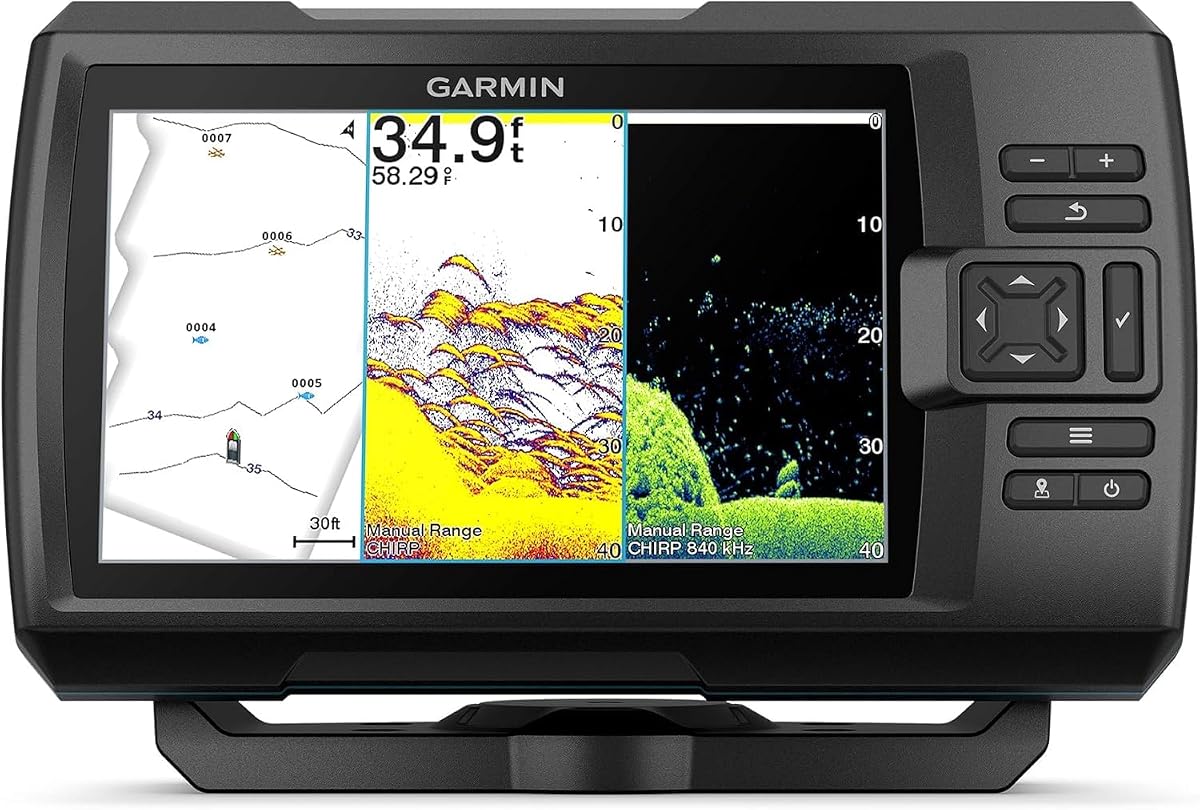
The Garmin Striker Vivid 7cv is built for anglers who want maximum visibility and enough screen area to examine detailed sonar, speed, waypoints, and routes at the same time. Its 4.5 rating reflects a feature-rich unit with a seven-inch color display, CHIRP traditional and ClearVü scanning sonar, high-sensitivity GPS, Quickdraw Contours, and Wi-Fi connectivity.
We may earn a commission when you buy through this link, at no additional cost to you.
The GT20-TM transducer supports both traditional CHIRP and ClearVü scanning, giving the user more ways to interpret structure and fish. Vivid color palettes are intended to make differences in the bottom and returning signals easier to distinguish. The large display is especially valuable when navigating complex water, comparing multiple sonar views, or reviewing a newly recorded contour map.
Wi-Fi expands the feature set through the ActiveCaptain app on a compatible smartphone. Listed capabilities include transferring waypoints, receiving smart notifications and software-update notices, and accessing the Garmin Quickdraw Community. These extras require the appropriate phone and account environment, so buyers should not treat connectivity as a reason to choose this unit without considering their broader device setup.
The seven-inch screen is the decisive issue for small boats. It may be ideal on a console with adequate space, but it could dominate the helm of a compact skiff, jon boat, or kayak. Buyers with limited room may find the four-inch STRIKER Vivid 4cv more practical. For a boat that can accommodate it, the 7cv offers the best combination of Garmin sonar, mapping, navigation, and connected functions in this guide.
The seven-inch display gives the angler room to read detailed sonar, speed, and navigation information simultaneously. It is especially helpful on a boat where quick visual comparison of multiple data types is important.
ActiveCaptain connectivity supports waypoint transfer, smart notifications, update notices, and community contour access. The phone becomes an optional companion rather than a required part of basic sonar operation.
We may earn a commission when you buy through this link, at no additional cost to you.
The Garmin Striker 4cv delivers several of the most desirable Garmin fish-finder features in a 4.3-inch package. It has a 4.6 rating and includes CHIRP traditional sonar, CHIRP ClearVü scanning sonar, a bright sunlight-readable color display, built-in GPS, and Quickdraw Contours software. It is a strong alternative for buyers who want more detail than the smaller Striker 4 but do not need the much larger Vivid 7cv.
We may earn a commission when you buy through this link, at no additional cost to you.
Its included transducer supports both traditional and scanning sonar, allowing the angler to view detailed structure and fish arches in different formats. The listed 300-watt RMS transmit power provides a clear specification for judging the unit's class. Quickdraw lets users create one-foot contour maps, while GPS handles waypoints, routes, and boat-speed display.
Compared with the STRIKER Vivid 4cv, this model shares core mapping and sonar concepts but does not list Wi-Fi connectivity or the broader ActiveCaptain functions. It also has a smaller screen than the Striker Vivid 7cv, which is likely to be important on a small boat. As with the other Garmin units in the guide, its waypoint map is not a substitute for a detailed nationwide chart library.
The Striker 4cv is most appropriate for an angler who wants a bright, compact display, strong scanning sonar, and the ability to make custom contour maps. It works particularly well for structure fishing and repeat exploration of familiar waters. Buyers prioritizing phone connectivity should consider the 7cv, while those needing the smallest footprint should compare the 3.5-inch Striker 4.
Traditional CHIRP gives a focused view of fish and bottom structure, while ClearVü creates detailed scanning imagery. Using both can make it easier to distinguish a fish arch from the surrounding bottom or vegetation.
The sunlight-readable 4.3-inch screen is designed for visibility on open water under bright conditions. Its relatively compact footprint also makes it more realistic for a small console than a seven-inch unit.
We may earn a commission when you buy through this link, at no additional cost to you.
The right depth finder depends on your boat layout, fishing locations, and navigation priorities. Consider portability, sonar type, installation, screen visibility, and mapping features before choosing a model.
A portable system gives you flexibility and usually avoids modifying the hull. The Venterior wireless model can be cast ahead of the boat, while the wired portable unit supplies basic depth and fish information through a tethered sensor. These approaches suit kayaks, rental boats, shore fishing, and anglers who move between several craft. A permanently mounted unit is more convenient once installed and provides a stable display, but it requires appropriate wiring, mounting space, and a compatible hull. The DepthTrax 2B is specifically oriented toward an in-dash installation, while most Garmin and Humminbird systems use a transom or bracket arrangement.
Traditional sonar sends a conventional beam that can reveal fish arches, contours, and structure. CHIRP sweeps across a range of frequencies, which the listed products use to improve target separation and image clarity. ClearVü and other scanning sonar methods provide highly detailed views of objects and bottom features. A dual-beam model lets you select narrow detail or wide coverage. More advanced sonar is not automatically better for every situation, but it can help when separating fish from vegetation, rocks, or drop-offs. Match the technology to the water you fish and the amount of screen space available for interpreting it.
A compact three- to four-inch screen saves helm space and is common on small boats. Larger displays make it easier to compare sonar, speed, waypoints, routes, and contour information without moving between views. Bright sunlight and nighttime use also matter: a sunlight-readable color screen helps during daytime fishing, while adjustable backlighting is valuable after dark. The portable Venterior models offer selectable black or white backgrounds for different light conditions. Consider whether you will fish mainly from a seated position, whether the screen can be angled toward you, and whether a larger unit would obstruct access to other controls.
The stated maximum depth should comfortably cover your fishing area. The Garmin Striker 4 supports up to 1,600 feet in freshwater and 750 feet in saltwater. The DepthTrax 2B reads from 2.5 to 600 feet, while the portable wireless model reaches 164 feet and the wired portable model reaches 328 feet. Also consider the minimum readable depth, because very shallow water can present challenges for some sonar systems. Saltwater, rivers, reservoirs, and deep lakes have different conditions, so choose a unit whose range and transducer installation suit the environment rather than focusing only on the largest advertised number.
A depth finder with GPS can mark productive locations, create routes, and show boat speed. Quickdraw Contours allows supported Garmin models to create and store custom maps with one-foot contours. The Humminbird Helix 5 Chirp GPS G3 goes further with a built-in basemap covering more than 10,000 lakes and the continental U.S. coastline, plus AutoChart Live generation of depth, hardness, and vegetation maps. Decide whether basic waypoint marking is enough or whether detailed charts and live mapping justify a more advanced electronics package.
A transom mount is the easiest common arrangement for small boats because it can move with the motor and often requires fewer permanent changes. Bracket-mounted displays can be tilted or swivelled for visibility. Glue-in transducers may look cleaner and can shoot through some hulls, but they are not compatible with every hull construction. The DepthTrax 2B specifically states that glue-in mounting is suitable only for non-cored fiberglass or aluminum hulls thinner than 1/8 inch. Before buying a fixed system, inspect the hull, transom, console, wiring route, and available mounting space.
Power requirements vary dramatically between portable and fixed systems. The wired portable Venterior runs for a stated four to five hours on four AAA batteries. The wireless model uses a rechargeable sensor and communicates over a maximum distance of 262 feet or 80 meters, which defines how far the probe can be cast. A fixed display draws power from the boat and therefore needs a reliable electrical connection. Think about battery replacements, charging routines, cable management, wireless range, and whether the sensor can be recovered easily after a cast.
Some units focus on depth, bottom contours, and approximate fish size, while others emphasize detailed arches, target separation, and color structure. A simple portable display may be enough for finding drop-offs and weed edges. A color scanning unit is better when you need to distinguish subtle bottom changes or inspect structure in detail. A chartplotter-oriented model makes sense if navigation occupies a large share of every trip. Listing the information you actually use prevents an advanced model from becoming cluttered with features that add size, cost, or complexity without improving your fishing.
Begin by installing the transducer where it can view the intended bottom without being blocked by the hull, motor, or bubbles. Transom-mounted units should sit at a stable height and angle, while portable sensors need enough line and cable freedom to reach the desired area. Secure every cable, confirm that connectors are fully seated, and position the display where it is readable without interfering with steering or access to other controls. Before relying on readings, compare the displayed depth with known shallow areas or a separate reference to confirm that the installation is producing sensible results.
Learn the basic controls before fishing. Adjust beam width, sensitivity, color palette, and zoom according to the task rather than leaving every setting at its default. Use narrow or detailed views for structure, wide coverage for searching, and lower sensitivity when vegetation or clutter creates excessive returns. For mapping units, begin recording when the GPS has a stable fix and save the finished contours under a clear name. Portable wireless sensors should be checked for battery status in water because the display may not provide an accurate off-water reading.
Clean and protect the equipment after each outing. Rinse the transducer and removable sensor with fresh water, especially after use in salt water, and dry the connections before storage. Keep the display away from prolonged direct sun when it is not in use, protect portable units from impact, and replace batteries before a long outing if they have been stored for a while. Periodically inspect the mount, cable, and power connection. A loose bracket or damaged cable can reduce performance before the electronics themselves fail.
A depth finder is not essential for every small boat, but it becomes valuable as soon as you fish water with changing depth, submerged hazards, or structure that is difficult to identify visually. It can help identify drop-offs, weed edges, channels, and bottom changes, while GPS features can also record productive locations. For very shallow or familiar water, a basic portable depth display may meet most needs. For navigation-heavy boating, a unit with mapping features offers more value than a basic depth-only gauge.
A depth finder primarily reports water depth and may include bottom contour information. A fish finder uses sonar to display returning signals, often identifying fish arches and underwater structure along with depth. Many modern units combine both functions, so terminology often overlaps. If your priority is shallow-water safety or basic navigation, depth information may be sufficient. If you want to identify structure and fish-holding areas, look for CHIRP, scanning sonar, or another capable sonar system.
Yes. Portable systems are particularly suitable because they do not require drilling into the hull. The wireless Venterior model can be cast ahead or beside the kayak, while the wired model includes a neck strap and a compact display for docks, ice fishing, and shoreline use. Keep the wired sensor within the cable's reach and make sure it cannot snag underwater structure. For a permanently mounted unit, verify that the kayak's weight capacity, hull construction, and available battery system can support it.
CHIRP sweeps across a range of frequencies and generally provides better target separation and more detailed images than basic traditional sonar. That can help distinguish fish from vegetation, rocks, and drop-offs. Traditional sonar remains useful in simpler units and may be sufficient for basic depth and structure detection. If the available screen is small, advanced sonar still benefits from a display large enough to show the details clearly.
It depends on how you plan to use the depth finder. If the chartplotter already displays live depth and supports the sonar information you need, a separate GPS fish finder may add little. However, a dedicated fish finder can provide brighter color imagery, clearer sonar detail, easy waypoint marking, and a more focused control interface. Choose a separate GPS unit when you value quick access to fishing information or want integrated custom contour mapping.
Start with the transducer and mounting method specified for the boat, because hull construction affects whether a transom, through-hull, or glue-in installation is appropriate. The DepthTrax 2B explicitly limits glue-in installation to non-cored fiberglass or aluminum hulls thinner than 1/8 inch. Other manufacturers may have different requirements, so check the full installation instructions. Also consider whether the transducer will shoot through the hull, how it will be positioned, and whether the wiring can reach the display without creating a trip hazard.
Larger screens provide more room for sonar images, navigation data, routes, and speed, which can improve readability on a busy console. They are not automatically better on a small boat, however, because they may crowd the helm, require more mounting space, and be harder to view from certain seating positions. A four-inch display is often a practical balance for compact boats, while a five- or seven-inch model makes more sense when detailed scanning sonar and mapping are central to the setup.
Rinse the sensor with fresh water after fishing, especially in salt water, and make sure the connector is completely dry before storage. Keep the handheld unit protected from impact and direct heat, and carry spare batteries for models that use replaceable cells. Check the wireless sensor's charge in water because its indicator may not display correctly while dry. Before every trip, inspect the connector, cable, battery compartment, and mounting arrangement for damage.
The Garmin Striker 4 is the strongest budget-oriented recommendation because it combines CHIRP, ClearVü scanning sonar, GPS waypoints, and a compact keyed interface without requiring a large screen. The Garmin STRIKER Vivid 4cv is the most versatile choice, adding color palettes, a GT20 transducer, and Quickdraw Contours in a balanced four-inch format. For buyers who need a fuller navigation system, the Humminbird Helix 5 Chirp GPS G3 provides built-in charts, live mapping, and flexible CHIRP modes.
Prioritize the features that match how the boat is actually used. Kayak and shore anglers may value a portable or castable sensor, while a permanently installed boat can accommodate a dedicated in-dash depth gauge. Larger consoles have room for detailed color units and mapping, whereas compact helms often benefit most from a four-inch display with simple physical controls. Confirm transducer compatibility, depth range, power requirements, and navigation needs before finalizing the installation.
Ratings and feature sets provide a useful shortlist, but current availability and prices can change. Review the latest product listing, included accessories, warranty terms, and installation requirements at the time of purchase. Comparing the current listing against the priorities in this guide will help identify the most suitable small boat depth finder without choosing a model based on screen size or feature count alone.