
Westinghouse Dual-Pump System
4.6Editor score
1/2 HP primary pump
Automatic DC backup pump
5,200 GPH maximum flow
Stainless steel construction
Compare the best sump pump battery backup systems for capacity, runtime, installation, monitoring, and dependable basement flood protection.
A sump pump battery backup system provides a second line of defense when a primary pump fails or household electricity goes out. The right unit should match your sump pit, pump capacity, battery chemistry, and need for remote monitoring while delivering enough power to keep water moving during severe weather.
This guide compares ten battery backup systems using the supplied specifications, customer ratings, pump output, inverter power, battery compatibility, controls, installation requirements, and protective features. The list covers complete dual-pump systems, standalone DC backup pumps, and UPS-style inverters designed to operate an existing sump pump.
Each review explains which households the product is best suited to and where its compromises matter. Ratings reflect available customer feedback, while technical claims come from the listed product information. Availability, installation conditions, and product prices can change, so confirm the current specifications and terms before buying.
4.6Editor score

4.8Editor score

4.3Editor score
The comparison below highlights the major differences among complete pump systems, inverter-based backups, and standalone DC pumps, including rated output, power capacity, monitoring, and battery support.



The Wayne Preassembled Primary & Battery Backup Sump Pump Combo System combines a 1/2 HP primary pump with a battery-ready backup arrangement. It carries a 4.5 rating, and its standout quality is the emphasis on a drop-in installation in a basin measuring at least 16 inches in diameter. This makes it especially attractive to homeowners who want coordinated components rather than a separate inverter and pump assembly.
We may earn a commission when you buy through this link, at no additional cost to you.
The primary system can move up to 5,100 gallons per hour, while the battery backup can remove up to 10,000 gallons on one charge when used with the recommended WSB1275 75 AH battery. The preassembled design is intended to reduce installation time, and the listed description says it can be installed in 15 minutes or less without drilling a weep hole. A top-suction-style approach also helps avoid the debris and air-lock problems associated with some conventional pit designs.
The main limitation is that the necessary backup battery is not included. It is also explicitly designed for indoor use, so it is not the appropriate choice for an outdoor pit exposed to weather. Buyers should also verify the exact model configuration, basin clearance, discharge arrangement, and local code requirements before installation. The claimed testing of one million cycles and three-year warranty add reassurance, but they do not replace correct sizing and routine maintenance.
This is a strong recommendation for households with an indoor basement sump pit that want a combined primary and backup system without assembling every component from scratch. It is especially convenient for installers or homeowners comfortable with basic electrical work. Confirm that the recommended battery fits the available space and that the pump specifications align with the drainage demands of the property.
The coordinated pump, float, and backup arrangement reduces the number of separate components that must be matched. Its listed drop-in design and no-weep-hole approach can also shorten installation and reduce sediment accumulation in the pit.
With the specified 75 AH battery, the backup section is claimed to evacuate up to 10,000 gallons on a single charge. Actual runtime will vary with water volume, pumping head, battery condition, and cycle frequency.
We may earn a commission when you buy through this link, at no additional cost to you.
This 2500W sump pump battery backup system is an inverter-based emergency power center rather than a pump-and-battery bundle. It earned a 4.8 rating, tied for the highest among the listed products. Its principal appeal is flexibility: 2500 watts of continuous pure sine wave output can run a sump pump and potentially other essential loads during an outage, while three AC outlets, a USB port, and a Type-C port expand its usefulness.
We may earn a commission when you buy through this link, at no additional cost to you.
The unit automatically transfers to a compatible 12V deep-cycle battery when utility power fails and recharges when power returns. Its 25A smart charger includes selectable charging modes plus overcharge, low-voltage, overload, short-circuit, and overheat protection. Compatibility with LiFePO4, AGM, gel, and flooded deep-cycle batteries gives owners more options than a system designed around only one chemistry.
Installation is straightforward for conventional plug-in pump connections, but the hardwire output deserves careful attention. The floating neutral design and labeled L, N, and PE terminals should be handled by someone comfortable with AC wiring. The listing explicitly warns that the hardwire terminals must not be connected to utility or generator power. Space for ventilation and wiring is also necessary, so the enclosure should not be crammed into a sealed area.
This is the most versatile option in the roundup for homeowners who want broad outage support rather than only a dedicated backup pump. It is a particularly good fit for a finished basement where a compact, centrally mounted inverter can serve a sump pump and selected household devices. Buyers must add a deep-cycle battery and should confirm that the existing pump's start and run requirements fall within the inverter's capabilities.
Pure sine wave output closely resembles utility AC, making it a sensible choice for motors and electronic equipment sensitive to abrupt or irregular waveforms. The higher 2500W capacity also provides more headroom than the smaller inverter options in the guide.
The wired remote controller displays battery voltage, load status, and operating mode without requiring a phone. Selectable charging and extensive electrical protections make the system easier to manage through extended storm periods.
We may earn a commission when you buy through this link, at no additional cost to you.
The VEVOR 2500W Sump Pump Battery Backup System provides inverter power for a sump pump and can also support a two-pump arrangement, described as a 1 HP main pump paired with a 1/3 HP backup. Its 4.3 rating is solid, though lower than the two 4.8-rated systems. The product is designed for homeowners who want a high-capacity inverter and quick plug-in installation without hardwiring a complex controller.
We may earn a commission when you buy through this link, at no additional cost to you.
Pure sine wave output, a three-stage charging process, and compatibility with lead-acid, AGM, gel, and LiFePO4 batteries cover several core needs. The LCD display and LED indicators expose voltage, battery level, and operating status, helping owners identify problems without opening the enclosure. A circuit breaker and protections for overcurrent, overvoltage, short circuits, reverse polarity, and high temperature add several layers of safety.
As with most inverter kits, the battery is not included, and the user must supply appropriate wiring and connections. The dual-pump claim should be interpreted carefully: running a 1 HP and 1/3 HP pair places substantial demand on the inverter, especially during startup. Households should compare surge demand and simultaneous runtime rather than relying only on the stated wattage. Physical placement should also preserve airflow around the unit.
This is a good choice for a household already operating a sizable AC primary pump and needing an inverter to transfer essential loads to a battery. It may be particularly useful where an accessible receptacle simplifies installation. It is less attractive for buyers seeking an all-in-one pump package or detailed remote monitoring, and electrical work should still follow local requirements.
The standard three-prong plug reduces the need for permanent rewiring when existing outlets are appropriately placed. It helps simplify setup, although the battery, proper conductors, and code-compliant connections remain essential.
Protection against reverse polarity and temperature extremes is particularly relevant in a damp sump environment. The added circuit breaker provides another visible point of control for system resets and electrical safeguards.
We may earn a commission when you buy through this link, at no additional cost to you.
The Viopumpo 2500W system is a pure sine wave inverter designed to transfer a sump pump from grid power to a deep-cycle battery during an outage. It has a 4.5 rating and distinguishes itself through a high-definition remote controller that shows voltage, output power, and battery charge status. That visibility is useful for households that want to confirm backup readiness without approaching the unit during bad weather.
We may earn a commission when you buy through this link, at no additional cost to you.
Its integrated 25A battery charger supports fast and trickle charging for deep-cycle lithium, AGM, and other compatible deep-cycle battery types. The supplied information specifically says it is not intended for non-deep-cycle batteries. Protection functions include overcharge, overload, low voltage, overheat, and short-circuit handling, while a cooling system helps manage heat during extended operation.
Installation requires assembling the AC and DC cables and plugging the sump pump into the unit. Side mounting holes allow the enclosure to sit flat or hang on a wall, which can make it easier to place near the sump pit while preserving access for service. A 12-month warranty is included, and the package contains cables, a remote control, and a user manual. As with other battery-powered options, the battery itself is not listed as included.
This system is best suited to homeowners with a conventional AC sump pump who want straightforward outlets and useful remote diagnostics. It fits well in a utility room, garage, or other accessible indoor location with adequate ventilation. Users should size the deep-cycle battery for the desired runtime and verify that the sump pump does not exceed the inverter's electrical limits.
A remote screen reduces the need to open or touch a unit that may be mounted near a wet, confined pit area. It also helps distinguish a low battery condition from an overloaded or disconnected circuit.
The 25A charger can restore energy quickly after an outage and maintain the battery afterward. The correct charging mode and battery type should be selected according to the manufacturer's instructions.
We may earn a commission when you buy through this link, at no additional cost to you.
The Briidea system is a standalone DC backup pump that connects alongside an existing sump pump and takes over when the primary fails or water rises unusually high. It has a 3.9 rating, the lowest among these ten products, but its defining advantage is connected monitoring. Support for both 2.4 GHz and 5 GHz WiFi improves compatibility with more home networks than a system limited to one band.
We may earn a commission when you buy through this link, at no additional cost to you.
Through the GeniLife app, users can review water level, system status, fault alerts, and power outage notifications. The control box uses nine LED indicators and dual water-level sensors, while a dry-contact interface can integrate with alarms, security systems, or auto dialers. This is a valuable feature for owners who want a notification when a problem occurs in an unoccupied property or finished basement.
The pump is rated to remove up to 2,700 gallons per hour at zero feet of lift and 1,900 gallons per hour at a 10-foot lift. An electronic level switch supports prompt activation, and dry-run protection adds another layer of safety. A recommended 80 AH lead-acid battery is not included. The lower rating may reflect uncertainty around real-world reliability, installation, or app experience, so buyers should examine recent customer feedback closely.
This product makes the most sense for a homeowner who prioritizes remote awareness and a smart-home-style control box. It is less suitable for someone wanting a complete replacement primary-and-backup system or an inverter that can power other household devices. Confirm network availability, pit clearance, discharge compatibility, and battery size before installation.
App-based water-level and outage notifications can reduce the uncertainty that comes with a conventional backup pump. Dual-band support helps keep the system connected across different router configurations.
Dual sensors, nine status lights, and dry-contact output create several ways to identify trouble. The contact interface can extend alerts to equipment already used for property monitoring.
We may earn a commission when you buy through this link, at no additional cost to you.
The Wayne ESP25n is a 12V DC backup pump for indoor sump pits, carrying a 4.5 rating. It delivers up to 2,700 gallons per hour at zero feet of lift and 1,680 gallons per hour at 10 feet, making it a credible standalone option for properties with a moderate-rise discharge line. The pump uses coated steel and cast iron construction for demanding pit conditions.
We may earn a commission when you buy through this link, at no additional cost to you.
The backup configuration is designed around a WSB1275 battery, which is recommended but not included. According to the product information, the pump can remove up to 10,000 gallons per hour on a single charge under the manufacturer's test conditions. A premium reed float switch controls automatic activation, while the protective battery case has an LED display and audible alarm for indicating a problem.
Its top-suction design is intended to reduce clogging and eliminate air lock without relying on a traditional weep hole. That can mean less sediment buildup and fewer maintenance routines. The trade-offs are functional rather than cosmetic: there is no app-based monitoring, remote controller, or inverter capability, and the product is explicitly for indoor installation only. Battery runtime varies with actual head, inflow, battery age, and the number of pumping cycles.
This pump is a good fit for homeowners who already have a functioning AC primary and want a simple, dedicated battery backup without networking. It is particularly appealing where audible and visual fault indications are sufficient. Proper float positioning, discharge compatibility, and battery maintenance will have a direct effect on protection quality.
The automatic float removes the need for manual pump activation when water rises. Its adjustability also allows the switching point to be matched to the homeowner's preferred alarm threshold.
Top suction is designed to reduce debris intake and air-lock problems. The absence of a weep-hole requirement can also limit sediment accumulation and associated maintenance.
We may earn a commission when you buy through this link, at no additional cost to you.
The VEVOR 1500W backup inverter is a value-focused option for operating a sump pump and a limited collection of essential devices during an outage. Its 4.3 rating is respectable within the group. It supplies 1500 watts of pure sine wave output and is intended for pumps up to 3/4 HP, covering many common residential installations while offering less headroom than a 2500W model.
We may earn a commission when you buy through this link, at no additional cost to you.
A standard three-prong plug simplifies setup, and the LCD display with LED indicators provides basic voltage, battery-level, and operating-status information. The three-stage charging process supports 12V lead-acid, AGM, gel, and LiFePO4 batteries. Built-in protections cover overcurrent, overvoltage, short circuits, reverse polarity, and high temperature, with a circuit breaker for an additional control and safety layer.
The battery is not included, so the complete ownership cost also depends on a suitable deep-cycle battery and appropriate wiring. A 1500W inverter may not safely operate a large primary pump and backup pump simultaneously, and startup surge can reduce usable capacity. Unlike some competing units, it does not include the detailed wired remote controller offered in the 2500W models. Buyers should also preserve ventilation around the enclosure.
This system is best for a smaller or mid-sized sump pump on a budget, particularly in a home where the backup inverter only needs to handle the pump and a few essential devices. It is less suitable for very large pumps, extensive loads, or users who want granular remote monitoring. Verify the pump's running and starting requirements before installation.
At 1500 watts, the inverter targets pumps up to 3/4 HP and avoids the greater installation complexity of oversized systems. It can be an effective balance when only one pump and essential loads need backup.
The combined LCD and LED interface communicates operating state, voltage, and battery level at a glance. It is less detailed than a wired remote controller, but still useful for routine readiness checks.
We may earn a commission when you buy through this link, at no additional cost to you.
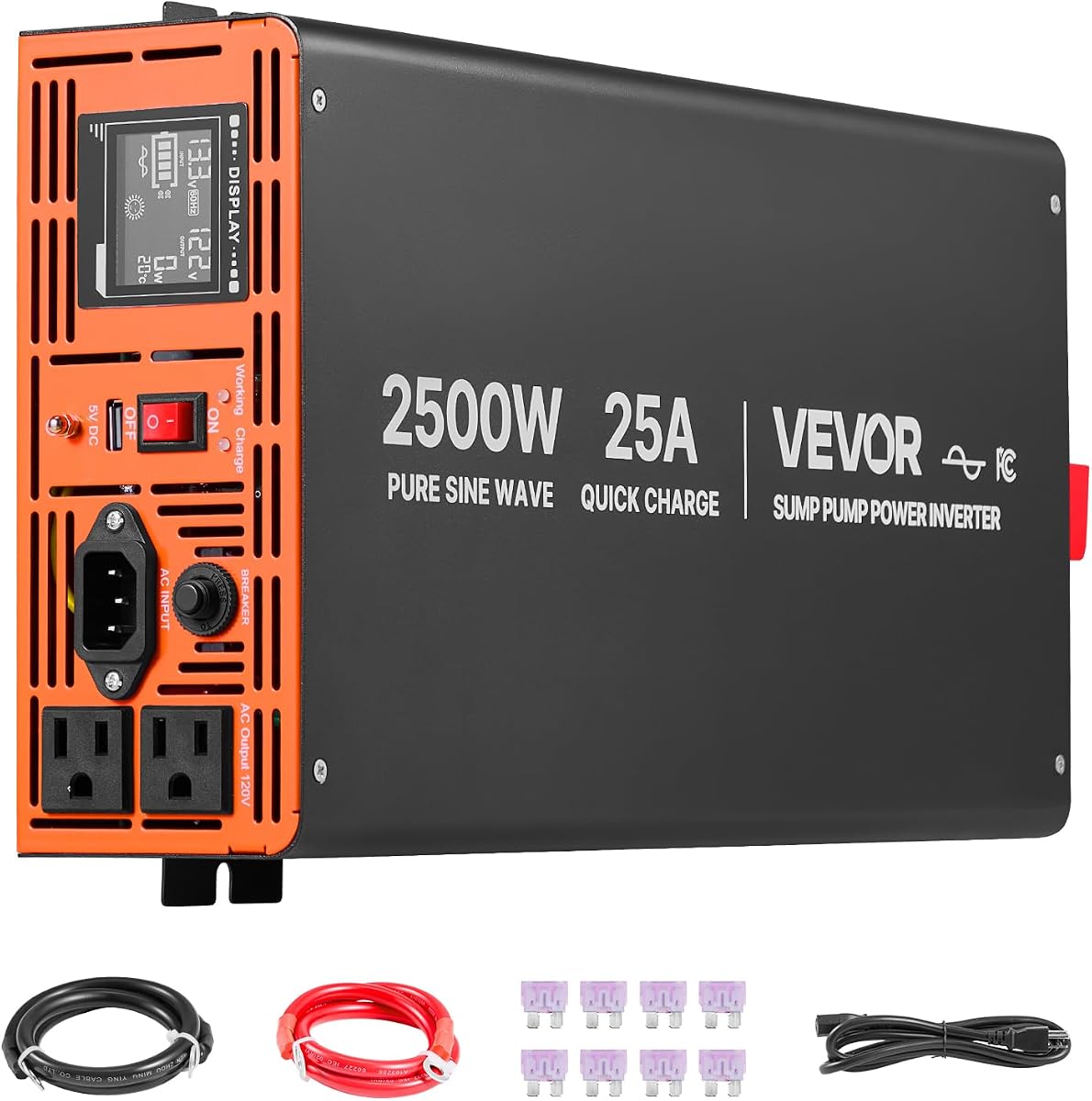
This 1500W sump pump battery backup system combines a 1500-watt pure sine wave inverter, a 25A smart charger, and a wired remote controller. It received a 4.8 rating, matching the highest rating in the roundup. The product is positioned as a compact UPS-style power source that can run a standard residential sump pump and selected essential devices when utility electricity fails.
We may earn a commission when you buy through this link, at no additional cost to you.
Three AC outlets, one USB port, and one Type-C port make the unit more useful than a single-purpose inverter. The remote LCD provides real-time information about battery voltage, load level, and operating mode. Battery support includes LiFePO4, AGM, gel, and flooded deep-cycle types, while the charger includes overcharge, overload, short-circuit, low-voltage, and overheat protections.
Mounting options include wall placement or a flat position, and the supplied battery cables are 31.5 inches long with an approximate 5 AWG size. Its smaller overall dimensions may help in utility rooms with limited space. However, the hardwire output has a floating neutral arrangement, and its L, N, and PE terminals must not be connected to utility or generator power. Installation involving mains wiring should be handled appropriately.
This is a strong recommendation for homeowners who want a 1500W inverter with better outlet flexibility and remote diagnostics than many similarly sized units. It is particularly suitable for homes with a standard pump and several low-to-moderate essential loads. Confirm the total connected load, available battery space, and required wiring method before purchasing.
The 1500W format offers a balance between output capacity and physical footprint. Wall or flat mounting makes it easier to place near a sump area while keeping controls accessible.
Three AC outlets and both legacy and modern USB connections allow the inverter to support selected household essentials. Users should avoid overloading it and should prioritize the sump pump during severe weather.
We may earn a commission when you buy through this link, at no additional cost to you.
The Westinghouse WH50BBU integrates a 1/2 HP AC primary pump with a 12V DC battery backup pump. It carries a 4.6 rating and delivers up to 5,200 gallons per hour. Rather than requiring an inverter to convert battery energy into AC for a separate pump, this system gives each pump an appropriate power source and switches the backup into action when electricity fails.
We may earn a commission when you buy through this link, at no additional cost to you.
Both pump housings use corrosion-resistant stainless steel. The primary motor is a PSC design with thermal overload protection, lubricated ball bearings, and a sealed shaft, while the motor is encased in dielectric oil to improve cooling. The integrated vertical float switch and top-suction design support automatic operation, reduced air-lock risk, and less debris buildup. These are meaningful advantages in a wet, enclosed sump environment.
The battery is not included, and the system does not provide smartphone or remote monitoring. Its compact engineering is aimed at residential basements and light commercial applications, but buyers must confirm actual basin dimensions and local code requirements. A complete dual-pump system also creates a larger installation project than a plug-in inverter, and the battery must be sized carefully to preserve useful runtime.
This is the premium pick for a homeowner who wants a coordinated high-output primary and battery backup assembly with durable construction. It is particularly suitable for properties where pump capacity, automatic switching, and long-term resistance to a damp sump pit matter more than app-based alerts. Professional installation may be worthwhile for anyone unfamiliar with the required electrical and discharge connections.
The AC primary and DC backup pumps are designed as a coordinated system. This avoids the losses and complexity of running an AC pump from a battery through an inverter when dedicated backup power is the priority.
Stainless steel housings, a sealed shaft, and oil-assisted cooling support durability. Top suction further helps preserve flow by limiting air lock and debris accumulation.
We may earn a commission when you buy through this link, at no additional cost to you.
The Zoeller 508-0005 Aquanot 508 is a dedicated 12V battery backup system with a 4.4 rating. Its supplied information is concise, emphasizing efficient noncorrosive pump construction, an integrated check valve, and a quick-disconnect discharge. It is best understood as a purpose-built sump backup rather than a general-purpose inverter with extensive monitoring and multi-outlet controls.
We may earn a commission when you buy through this link, at no additional cost to you.
The noncorrosive construction is useful in environments where moisture and airborne contaminants can shorten the life of exposed metal parts. An integrated check valve helps maintain proper flow direction and reduce the chance of reverse drainage, while the quick-disconnect discharge allows separation of the pump for installation or service. The pump is described as hand built and 100% tested in the United States.
The limited technical information requires more buyer diligence than the specification-rich systems in this guide. Prospective owners should confirm flow rate, vertical lift capacity, required battery size, float-switch behavior, dimensions, and included components on the current listing and manufacturer documentation. There is no indication of app connectivity, LCD remote monitoring, or multiple output outlets, so it is less flexible as an outage power center.
This system is a practical choice for a homeowner seeking a straightforward, established-style DC backup pump without a large inverter. It may fit particularly well in a compact indoor pit or as a secondary pump alongside an existing primary. Before buying, verify that the discharge connection and battery are included or separately available as required.
The quick-disconnect discharge can simplify pump removal and maintenance. It also helps users inspect and service the unit without dismantling the entire sump connection.
Noncorrosive construction supports dependable operation in damp sump environments. The integrated check valve complements that design by helping control reverse flow through the discharge line.
We may earn a commission when you buy through this link, at no additional cost to you.
The best sump pump battery backup system is not simply the one with the highest wattage or flow number. A sound purchase matches the pump, pit, battery, discharge route, and monitoring needs while allowing a safe installation.
There are three common approaches: a complete primary-and-backup pump system, a standalone DC backup pump, and an inverter that supplies AC power to an existing sump pump. Complete systems coordinate both pumps and are convenient for a full installation. Standalone DC pumps provide efficient dedicated backup pumping but usually lack inverter features. Inverter systems offer flexible outlet support, remote monitoring, and compatibility with a wide range of AC pumps, although they introduce battery-to-AC conversion considerations and may require more careful wiring.
Maximum zero-foot flow is useful for comparing headline capacity, but actual performance at the required vertical lift matters more. A household with a high discharge point needs adequate flow at that height, not merely a large figure measured at zero feet. The Wayne and Westinghouse systems advertise maximum outputs of 5,100 and 5,200 GPH, while the Briidea and Wayne ESP25n list 2,700 GPH at zero feet and lower figures at 10 feet. Consider basin size, drainage area, expected rainfall, and the frequency of pump starts.
Most products in this roundup require a deep-cycle battery that is not included. Battery capacity, age, charge state, and pumping demand determine how long water can be removed. A larger battery generally extends runtime but requires more space and may need a charger rated for its chemistry. The Wayne preassembled system specifically references a WSB1275 75 AH battery, while the Briidea system recommends an 80 AH lead-acid battery. Verify chemistry, terminal arrangement, physical dimensions, ventilation, and charger compatibility before ordering.
For inverter-based systems, compare both continuous running power and startup surge. A pump's motor can draw more power momentarily when starting, so a nominal wattage figure should not be treated as unlimited headroom. The 1500W options are described for pumps up to 3/4 HP, while the 2500W models offer more capacity. Confirm voltage, running amperage, starting behavior, and whether the pump may run simultaneously with other loads.
Monitoring can reveal a failed pump, low battery, high water, or outage before damage becomes extensive. LCD displays and LED indicators are useful for local checks, while the Briidea system adds app-based water-level, fault, and outage notifications through 2.4 GHz and 5 GHz WiFi. A wired remote controller on two inverter systems provides voltage, load, and operating-mode data. Choose the level of visibility that matches how you manage the property, while recognizing that no display replaces routine inspections.
Preassembled systems can reduce installation complexity, while inverter kits may offer plug-in operation but still require secure battery connections and correct conductor sizing. Standalone pumps need suitable float-switch positioning and a compatible discharge. Installation is indoors for all products explicitly described that way, and ventilation is important for inverters. Before beginning, verify basin dimensions, clearance, discharge height, electrical service, local code, and whether professional electrical or plumbing work is required.
Sump pits are harsh environments with moisture, grit, corrosion, and frequent cycling. Stainless steel housings, coated steel, cast iron, dielectric oil, sealed shafts, and top-suction designs can improve longevity or reduce debris-related failures. The Zoeller unit emphasizes noncorrosive construction, the Westinghouse system uses stainless steel, and both Wayne products use heavy-duty metal construction. Match material and pump design to the debris, water chemistry, and service frequency of the installation.
Warranty length can provide some protection against defects, although coverage terms and service availability should be reviewed before purchase. The Wayne preassembled combo lists a three-year warranty, the 2500W battery backup inverter lists 24 months of product support and 24/7 customer service, and the Viopumpo system includes a 12-month warranty. Warranty length alone does not establish suitability, so use it as one factor alongside specifications, installation requirements, and customer feedback.
Begin by reading the complete instructions for the selected system, its pump, and the battery manufacturer. Confirm that the battery is a compatible 12V deep-cycle type, the pit is clear, the discharge is unobstructed, and the pump or inverter has the required clearance. Before a storm, test normal operation and simulate or otherwise verify automatic transfer according to the manufacturer's procedure. Never improvise electrical connections or operate an inverter in a location without ventilation.
Operate the system as intended: the AC primary handles normal drainage, while the DC backup or inverter supplies emergency power during an outage. Do not use the inverter for loads beyond its capacity, and prioritize the sump pump during severe weather. If the system provides a smart plug, confirm that the pump remains connected during utility outages and that a water sensor is correctly positioned above the normal waterline but low enough to provide protection.
Test the battery, float switch, alarm, and transfer mechanism at the manufacturer's recommended intervals. Clean accessible debris from the pit, inspect the discharge for obstructions, and check cable connections for corrosion or looseness. Keep the battery terminals clean and follow battery-specific charging and storage guidance. Record water-removal events and replace batteries that no longer hold a usable charge. If flow drops, the unit cycles unusually often, or an alarm sounds, investigate the cause promptly rather than relying on the backup indefinitely.
Yes, especially where heavy rain, storms, aging electrical service, or frequent power interruptions make basement flooding plausible. A backup provides another way to remove water if the primary pump fails or loses power. It is not a substitute for a correctly sized primary pump, a maintained battery, routine testing, or professional repair of persistent flooding problems.
No product in this roundup is listed as including the required battery. Most call for a 12V deep-cycle battery, with some products recommending lead-acid models of a particular capacity. Check the current package contents carefully because separate battery systems sometimes include leads or a protective case without including the battery itself.
The correct size depends on the pump's power draw, starting current, desired runtime, available space, and how often the pump operates. A larger battery can extend runtime, but it must have the correct chemistry, terminal arrangement, and charger compatibility. Follow the battery capacity and cable guidance in the pump or inverter instructions rather than estimating from battery case size alone.
A DC backup pump is efficient and purpose-built for water removal, usually pairing with an existing AC primary. An inverter is more flexible because it can operate an AC sump pump and selected essential devices during an outage. Inverters add conversion losses, electrical connection considerations, and more outlets to manage, while dedicated DC pumps generally provide a simpler protected-pump arrangement.
Test it at the interval specified by the manufacturer, and increase testing frequency during storm seasons or before extended vacations. A useful routine checks that the primary pump starts, the float switch activates the backup, the battery reads a healthy state, and any alarm or remote notification works. Testing under safe, controlled conditions is more meaningful than simply confirming that a light turns on.
Some inverter models are advertised for dual-pump operation, but the combined running and starting load must remain within the inverter's limits. A large AC primary pump can create a substantial surge at startup, and simultaneous operation reduces available runtime. Check the stated pump horsepower and inverter capacity, then size the battery for the load that actually needs to remain online.
Yes. A DC backup pump is designed to operate from a charged 12V deep-cycle battery, while an inverter-based system converts a battery's DC output to AC for a compatible sump pump. Either approach continues operating after utility electricity fails, provided the battery is adequately charged, connected correctly, and large enough for the expected load.
Only the smart monitoring features require network connectivity. The Briidea system's remote status, water-level alerts, and fault notifications use its app and compatible 2.4 GHz or 5 GHz WiFi, while local pump operation does not depend on the internet. Systems with LCD displays or wired remote controllers provide local status information without a wireless connection.
The top recommendations serve different needs. The 2500W Battery Backup Inverter is the most flexible all-purpose option, with a high customer rating, 25A charging, pure sine wave output, several outlets, and remote monitoring. The Westinghouse Dual-Pump System stands out as the premium integrated solution for high-output automatic protection, while the VEVOR 1500W Backup Inverter offers a more compact, value-focused path to emergency pump power.
When comparing the remaining products, prioritize the architecture that suits your installation. A preassembled combo can simplify a full system, a standalone DC pump can protect an existing primary efficiently, and a higher-capacity inverter can support more essential loads. Match flow at the actual discharge height, leave inverter headroom for startup, and choose a battery with the correct chemistry and physical dimensions.
Before ordering, verify current specifications, included accessories, warranty terms, battery requirements, and local installation rules. Ratings and customer experiences can change over time, while sump conditions, pump requirements, and available space vary considerably. Check current product availability and pricing at the time of purchase, and use qualified installation help whenever the connection involves unfamiliar electrical work.