
Nikon COOLPIX P1100
4.2Editor score
125x optical zoom reach
4K UHD video capture
Bird-watching mode
Customizable control ring
Our Superzoom Bridge Camera guide compares 10 models for optical reach, stabilization, video, controls, connectivity, and overall value.
A superzoom bridge camera combines the long focal reach of a telephoto lens with the convenience of a point-and-shoot body. The right model can bring distant wildlife, performers, landmarks, and celestial subjects closer while still offering automatic shooting modes, image stabilization, and useful video features.
We compared the 10 available models by examining optical zoom range, sensor resolution, stabilization, viewing options, video formats, connectivity, battery configuration, and specialized shooting modes. The list covers models for different priorities, including long-distance wildlife, detailed travel photography, simple family use, and greater manual control.
Each pick reveals which use case it serves most effectively and where its compromises may matter. Product ratings and specifications can change over time, so readers should verify the latest listing details, accessories, warranty terms, and current availability before making a purchase.
4.2Editor score

4.4Editor score

4.1Editor score
The comparison below places all 10 models side by side, emphasizing the differences that most influence real-world shooting: maximum zoom reach, sensor and video capability, stabilization, and the camera's practical feature set.




The Panasonic Lumix FZ80 is a travel-oriented bridge camera that combines a 60x optical zoom with 4K video, a bright electronic viewfinder, and a flexible post-capture focus workflow. Its 4.2 rating reflects a generally capable package, particularly for travelers who want more creative control without moving to a full interchangeable-lens system.
We may earn a commission when you buy through this link, at no additional cost to you.
Its standout feature is Post Focus, which lets the photographer choose an area to place in focus after taking the picture. That flexibility is especially valuable in crowded travel scenes or when a subject moves unexpectedly. The camera also records 4K video and can extract an 8-megapixel still from a 4K recording, while its 2,360K-dot viewfinder helps maintain a clear view in bright sunlight.
POWER O.I.S. optical image stabilization is particularly important at the tele end, where hand movement can easily soften distant subjects. The FZ80 does not offer the extreme reach of the 83x and 125x Nikon models, and RAW capture is not identified in the supplied specifications. Those limitations matter most to experienced photographers who need greater cropping latitude or specialized long-range coverage.
This is a strong recommendation for travel, family documentation, and everyday creators who value 4K video, a clear viewfinder, and the ability to refine focus after capture. It is less convincing for serious birding or distant wildlife when maximum optical magnification is the deciding factor, but its overall flexibility makes it one of the most approachable bridge cameras in this roundup.
Post Focus changes the shooting process by delaying the final focus decision until after the photograph has been captured. It is particularly useful in busy tourist environments, group photographs, and scenes where a subject may pass behind another object.
The 4K video mode records at substantially higher resolution than Full HD, while the 8-megapixel photo extraction function adds another way to preserve useful still frames. The bright viewfinder also helps when composing outdoors on sunny days.
We may earn a commission when you buy through this link, at no additional cost to you.
The Nikon COOLPIX P950 is an exceptionally balanced superzoom bridge camera, combining an 83x optical zoom with a 16-megapixel sensor, 4K UHD video, RAW capture, Wi-Fi, and a rotating LCD. Its 4.4 rating places it among the strongest options here without requiring the extreme reach or larger proportions of the P1100.
We may earn a commission when you buy through this link, at no additional cost to you.
The P950 covers a broad range of photographic situations. Built-in Bird and Moon modes simplify two specialized subjects, while the vari-angle screen makes low-angle and self-facing compositions easier. RAW format provides greater latitude for editing, and 4K UHD recording gives creators more detail than conventional Full HD output. These features create a useful combination for both still photography and video.
Its most obvious limitation is the smaller 16-megapixel sensor, which can be less forgiving in difficult light than larger contemporary sensors. The maximum 83x optical zoom also falls short of the P1100's 125x reach. Even so, the P950 remains easier to carry and generally less specialized, making it a more balanced option for mixed-use photography.
For buyers who want serious zoom capability, modern video, and flexible composition tools without moving to a much larger interchangeable-lens camera, the P950 is an excellent recommendation. It is particularly well suited to wildlife, travel, concerts, and family occasions where one camera must handle subjects at dramatically different distances.
Bird and Moon modes provide useful starting points for subjects that can be challenging to expose and focus. They do not replace careful technique, but they make the camera more approachable when the goal is to capture a distant animal or a bright astronomical subject.
The rotating LCD supports low, high, and self-facing viewpoints, while RAW capture preserves more tonal information for later editing. Together with 4K UHD video and Wi-Fi, these functions suit travelers who want to shoot and share quickly.
We may earn a commission when you buy through this link, at no additional cost to you.
The KODAK PIXPRO AZ405 is a straightforward 40x optical zoom camera designed for users who want considerably more reach than a typical phone without navigating a complex camera system. Its 4.1 rating, 20-megapixel CMOS sensor, and automatic scene detection make it an accessible option for family photos, travel, and casual observation of distant subjects.
We may earn a commission when you buy through this link, at no additional cost to you.
Optical image stabilization is the most consequential feature for this camera's target audience. It helps reduce blur when shooting handheld at long focal lengths, which is useful at sporting events, concerts, and outdoor gatherings. A 24mm wide-angle starting point supports group portraits and landscapes, while automatic scene modes let point-and-shoot users concentrate on framing rather than menu adjustments.
Its limits are equally clear. Video tops out at 1080p Full HD, RAW capture is not listed, and 40x optical zoom cannot match the 83x or 125x reach of the Nikon models. It also uses AA batteries rather than a rechargeable battery, which simplifies replacement in many travel situations but can result in more ongoing battery expense.
The AZ405 is a strong recommendation for beginners and casual users who prioritize optical zoom, stabilization, and uncomplicated operation. A photographer needing 4K video, extensive manual controls, or extreme telephoto framing should look toward the P950 or P1100 instead.
Optical stabilization is especially valuable because it works directly with the lens rather than relying only on electronic correction. It helps produce more usable handheld frames when zooming toward birds, athletes, performers, and other distant subjects.
Automatic scene detection and straightforward point-and-shoot behavior reduce the learning curve. Standard AA cells can also be replaced in many locations, making the camera convenient for trips where carrying a proprietary charger is inconvenient.
We may earn a commission when you buy through this link, at no additional cost to you.
The KODAK PIXPRO AZ425 is a 42x optical zoom bridge camera with a 20-megapixel backside-illuminated CMOS sensor, optical image stabilization, and 1080p Full HD video. Its 4.0 rating makes it a viable all-purpose option, though it offers less zoom reach and video resolution than several higher-ranked alternatives.
We may earn a commission when you buy through this link, at no additional cost to you.
The BSI sensor is designed to gather light more efficiently, which can benefit golden-hour landscapes, indoor gatherings, and overcast conditions. Optical stabilization helps keep distant wildlife, athletes, and stage performers more consistently sharp, while the 24mm wide end handles group portraits. Panorama and custom modes add some flexibility for users who want to move beyond fully automatic operation.
Compared with the AZ405, this model upgrades the sensor design, battery system, and zoom figure, but it remains limited to Full HD video. Its 42x optical reach is useful yet modest beside the 60x, 68x, 83x, and 125x options elsewhere in the list. Buyers should also note that the supplied information does not identify RAW capture or a sophisticated manual-control system.
The AZ425 is best for users who want a rechargeable, stabilized bridge camera with a higher-resolution sensor without moving to a premium model. It suits everyday travel, family events, and moderately distant subjects, while photographers whose main goal is serious wildlife or concert reach may be better served by a Nikon with longer zoom.
The 20-megapixel backside-illuminated CMOS sensor is designed to capture light efficiently. That makes the AZ425 a sensible companion for mixed lighting, from bright outdoor scenery to family events held indoors.
Optical stabilization, panorama shooting, custom modes, and a rechargeable battery add practical flexibility. Full HD recording and a 42x zoom ceiling keep it below the feature level of the strongest long-reach models.
We may earn a commission when you buy through this link, at no additional cost to you.
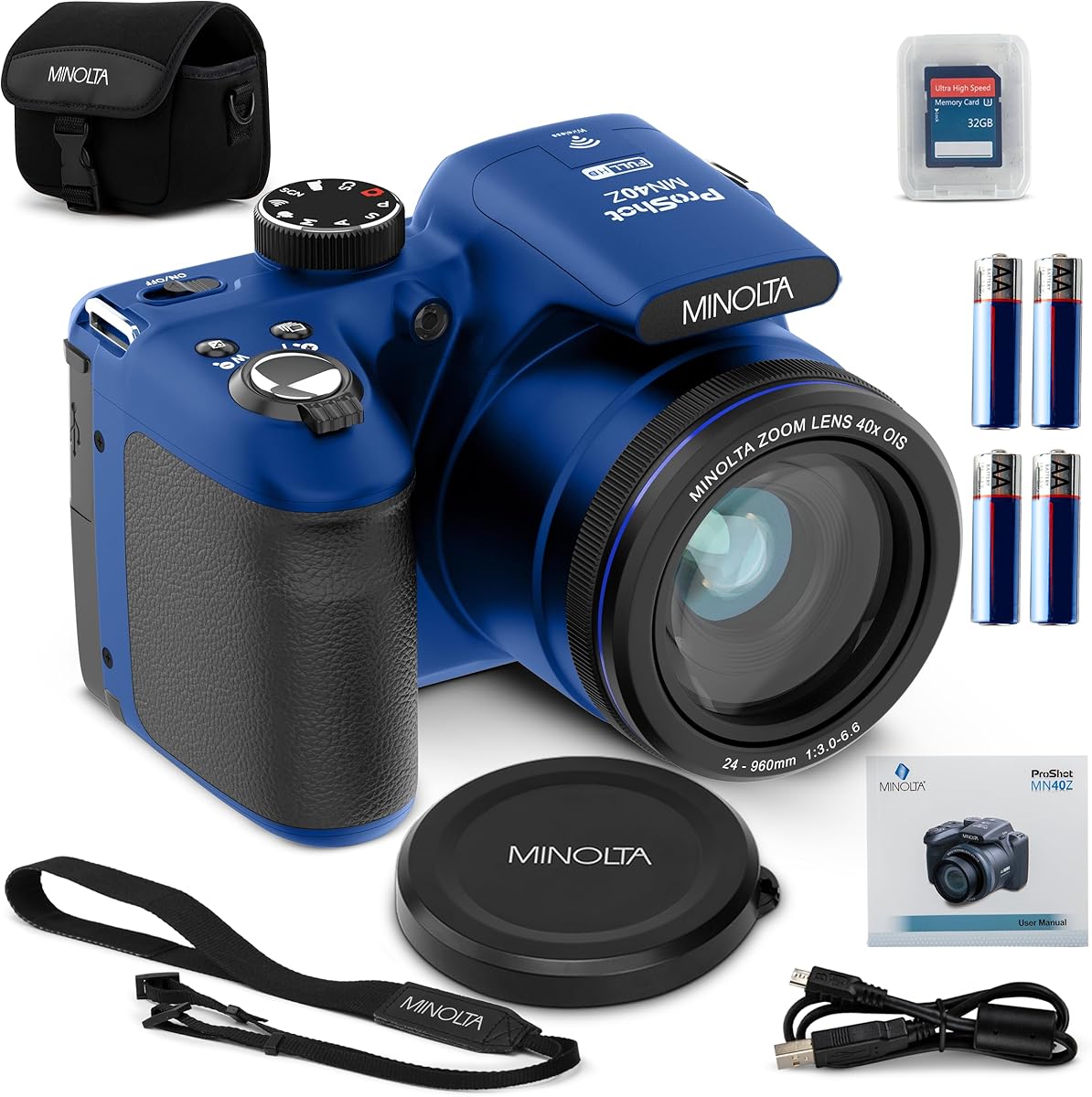
The Minolta MN40Z ProShot is a 20-megapixel bridge camera offering 40x optical zoom, 1080p Full HD recording, Wi-Fi, and app integration. Its 4.1 rating indicates a capable general-purpose model, while the supplied information presents it as suitable for both novice and experienced photographers.
We may earn a commission when you buy through this link, at no additional cost to you.
Connectivity is the camera's most appealing differentiator within its class. Wi-Fi and app integration can simplify moving images to a compatible phone or sharing finished files with others. The three-inch LCD provides a clear surface for composition, and the 40x zoom is sufficient for casual wildlife, travel details, school events, and subjects that cannot be approached closely.
The specification set is brief, so buyers should confirm details such as stabilization, RAW support, sensor format, and advanced video functions before relying on the camera for a specialized purpose. It records Full HD rather than 4K and does not offer the zoom reach of the higher-end Nikon and Panasonic options in this comparison.
The MN40Z ProShot is a sound recommendation for someone who values easy phone integration and a familiar point-and-shoot workflow. It may be less attractive for demanding wildlife photographers, 4K creators, or users who need extensive manual controls and exceptional stabilization performance.
Built-in Wi-Fi and app integration are useful for photographers who regularly move images to a smartphone. This can streamline everyday sharing without requiring a card reader or desktop workflow for every photo.
The large display, 20-megapixel output, and 40x optical zoom provide a manageable combination for everyday shooting. The camera is best viewed as a convenient 40x bridge model rather than a specialist for extreme telephoto work.
We may earn a commission when you buy through this link, at no additional cost to you.
The Minolta MN68Z combines 20-megapixel stills, 4K Ultra HD video, a 68x optical zoom, and optical image stabilization. It also includes a carrying case, a 32GB SD card, and a rechargeable battery. Although no customer rating is supplied, the feature set positions it as a well-equipped modern bridge camera.
We may earn a commission when you buy through this link, at no additional cost to you.
Its 68x zoom offers a meaningful middle ground between ordinary 40x models and the 83x or 125x Nikon cameras. Optical stabilization supports handheld framing at distance, while 4K video gives users a higher-resolution recording option. The included accessories make the package more immediately useful for travel or a first bridge-camera purchase.
The camera's main uncertainty is the absence of a published rating or more detailed information about its sensor, autofocus behavior, battery endurance, and viewfinder. It also lacks the extreme reach, RAW support, specialized wildlife mode, and control-ring customization highlighted on the Nikon P1100. Those omissions matter when the goal is advanced superzoom photography rather than general use.
The MN68Z is worth considering for buyers seeking substantial optical reach, 4K video, and a coordinated accessory package. Its 68x lens is suitable for wildlife, events, and distant travel details, but photographers who can identify their subject matter in advance may prefer a model with more documented long-range features.
A 68x optical lens provides enough magnification for many distant subjects without reaching the size and complexity associated with extreme telephoto bridge cameras. It is a practical middle tier for travel and events.
Wi-Fi, USB-C, and HDMI output support several transfer and display options. The included case, memory card, and rechargeable battery also reduce the need to purchase basic accessories immediately.
We may earn a commission when you buy through this link, at no additional cost to you.
The Nikon COOLPIX P1100 is the long-reach specialist of this group, offering a 125x optical zoom equivalent to a 24–3000mm range, 4K UHD video, RAW capture, Wi-Fi, and a rotatable screen. Its 4.2 rating reflects a capable package, and the 250x Dynamic Fine Zoom provides additional cropping flexibility when a distant subject cannot be enlarged optically enough.
We may earn a commission when you buy through this link, at no additional cost to you.
Bird-watching mode is a particularly valuable specialization. It adjusts camera settings for a type of photography where subjects are small, distant, and often surrounded by visually complicated backgrounds. Close Focus Macro Mode can bring the lens within approximately 1 centimeter of small subjects, while a customizable control ring can handle manual focus, exposure compensation, or white balance.
Dual Detect Optical VR stabilization is stated to be equivalent to a four-stop shutter-speed advantage, which is important because long focal lengths magnify hand movement. The trade-offs are size, handling demands, and a more substantial financial commitment than conventional bridge cameras. The 16-megapixel sensor also requires good light and careful exposure when heavy cropping is necessary.
The P1100 is the premium recommendation for birding, distant wildlife, celestial photography, and serious event work. It is less convenient for casual users who want a small everyday camera, but for anyone who truly needs superzoom reach, its 125x lens and specialized controls provide the clearest advantage in this roundup.
The 125x optical zoom can frame birds, distant buildings, performers, and landscape details that would appear tiny in a conventional point-and-shoot. Optical magnification also preserves more detail than relying exclusively on digital cropping.
Dual Detect Optical VR helps counteract the hand shake magnified at long focal lengths. The bird-watching mode and customizable ring give dedicated users faster access to settings that matter when the subject is moving and unpredictable.
We may earn a commission when you buy through this link, at no additional cost to you.
This Nikon COOLPIX P950 bundle packages the camera with a 64GB UHS-I memory card, a three-piece 67mm lens filter kit, a camera bag, and a compatible battery. It retains the core 83x optical zoom, 16-megapixel CMOS sensor, and 4K UHD capabilities of the standard model while offering a more complete accessory set.
We may earn a commission when you buy through this link, at no additional cost to you.
The 2.36-million-dot OLED electronic viewfinder is particularly useful in bright sunlight and at long focal lengths, where precise framing becomes more difficult. A 3.2-inch vari-angle LCD adds low-angle and overhead framing options. RAW capture, Wi-Fi, Bluetooth, and SnapBridge support provide additional flexibility for editing and sharing.
The listed image-processing performance includes continuous shooting at approximately seven frames per second, 4K UHD at 30p, and ISO sensitivity up to 6400. As with the standard P950, the 1/2.3-inch-class sensor is small by modern interchangeable-lens standards, and its 83x reach is below the P1100's maximum. Buyers should verify the included battery's condition and confirm that the filters suit their intended use.
This bundle is an attractive option for a new owner who wants the P950's balanced capabilities without separately sourcing basic accessories. It suits travelers and family photographers who want long zoom, 4K video, and a versatile screen. Experienced wildlife specialists should compare its 83x reach with the P1100's 125x range.
The memory card, filters, bag, and battery provide the core items a new camera owner is likely to need. The package is most useful for first-time bridge-camera buyers who do not already own compatible storage and power accessories.
The high-resolution OLED electronic viewfinder supports careful framing in bright conditions, while the vari-angle LCD assists with unusual shooting positions. These tools are particularly valuable when zooming toward distant subjects.
We may earn a commission when you buy through this link, at no additional cost to you.
The Nikon COOLPIX P900 is a proven 83x optical zoom camera with a 4.4 rating, a 16-megapixel CMOS sensor, a vari-angle display, an electronic viewfinder, and Full HD video at 60p. Although it lacks 4K recording, it remains a capable option for users who value zoom reach, familiar Nikon handling, and smooth high-frame-rate video.
We may earn a commission when you buy through this link, at no additional cost to you.
The NIKKOR super ED VR lens spans an equivalent 24–2000mm range, giving the camera substantial telephoto flexibility. Optical stabilization is important at this focal length, while the electronic viewfinder helps with framing distant subjects. Full HD at 60p is well suited to moving subjects and can provide a smoother look than 30p footage when the camera supports that frame rate.
The P900 predates newer 4K-focused models, and its 16-megapixel sensor is modest by current standards. It also lacks the P950's RAW capture and the P1100's 125x reach. For users focused on modern 4K workflows, the P950 or P1100 offers a more advanced video and still-photo feature set.
The P900 is a sensible recommendation for budget-conscious photographers who want an established 83x bridge camera and do not require 4K. It can handle travel, wildlife, events, and everyday family photography, although the newer P950 is the stronger all-around choice when its additional capabilities are important.
The 83x optical zoom offers enough reach for many wildlife and event subjects without reaching the physical bulk and cost associated with the P1100. It remains a practical middle ground among long-range bridge cameras.
Full HD recording at 60p can make motion look smoother, which is useful for sporting events, active children, and wildlife. The limitation is the absence of a listed 4K mode.
We may earn a commission when you buy through this link, at no additional cost to you.
This renewed Nikon COOLPIX P1100 combines the standard model's 125x optical zoom, 4K UHD video, RAW capture, Wi-Fi, and rotating screen with a 5.0 listing rating. It offers the same headline long-reach capability as the new P1100, making it appealing to photographers who want to obtain a specialized bridge camera through the resale channel.
We may earn a commission when you buy through this link, at no additional cost to you.
The 24–3000mm equivalent range is exceptional within this roundup and well suited to birding, distant wildlife, celestial subjects, sports, and architectural details. Dual Detect Optical VR helps counter the amplified effects of hand movement, and Bird-watching mode optimizes settings for a common long-range challenge. Close Focus Macro Mode also reaches approximately one centimeter for small subjects.
Renewed products vary in physical condition, accessory completeness, battery performance, and warranty coverage. Buyers should review the seller's condition description, inspect included items, and understand the return process before treating the listing rating as representative of every unit. The underlying 16-megapixel sensor and camera size remain the same as those of the standard P1100.
For a buyer who accepts renewed-equipment considerations, this listing may be a practical way to access exceptional superzoom reach. It is best recommended to experienced long-range photographers who understand the camera and can evaluate the individual unit. A buyer prioritizing predictability may prefer the new P1100 listing instead.
The renewed model retains the 125x optical zoom and 24–3000mm equivalent coverage that define the P1100. It remains one of the most capable choices for distant subjects in this comparison.
Condition, battery wear, accessory completeness, and warranty terms can differ among resale units. Reviewing the listing carefully and confirming the return policy are essential parts of making a confident purchase.
We may earn a commission when you buy through this link, at no additional cost to you.
A useful superzoom purchase should match the distances you expect to photograph, the type of light you encounter, and the amount of control you want. The most important choice is optical reach, but stabilization, autofocus, video, controls, battery life, and connectivity also shape everyday usability.
Optical zoom is the defining feature of a bridge camera because it enlarges the subject using the lens rather than cropping a smaller digital image. The models here range from 40x to 125x, creating major differences in framing. A 40x lens is useful for travel details and casual events, while 83x and 125x models provide more room for birds, performers, distant buildings, and astronomical subjects.
Choose based on realistic shooting distances rather than the largest headline number. A 125x camera is compelling for dedicated wildlife and astronomy, but it is bulkier and requires steadier handling. A 40x to 42x model is usually easier to carry and may meet the needs of families and travelers.
Long focal lengths magnify tiny movements of the camera, so optical stabilization is especially valuable at the far end of the zoom range. Every featured model has some form of stabilization or optical VR, although the claimed effectiveness varies. Dual Detect Optical VR on the Nikon P1100 is highlighted as equivalent to a four-stop advantage, while Panasonic POWER O.I.S. is designed to suppress shake at the tele end.
Look for stabilization implemented in the lens rather than relying only on digital correction. It improves handheld usability and makes distant subjects easier to keep framed. Even with stabilization, a tripod or solid support can help when zoom reaches the highest settings or exposure times become long.
The roundup includes 16-megapixel and 20-megapixel sensors. Resolution affects the amount of detail retained and the flexibility available for cropping distant subjects. The Kodak AZ405, AZ425, and Minolta models use 20-megapixel sensors, while the Nikon models use 16-megapixel sensors for a smaller overall body and more compact 1/2.3-inch-class format.
RAW support can be more useful than a headline megapixel figure for editing flexibility. The P950 and P1100 offer RAW capture, while RAW is not identified in the supplied details for the other models. Consider sensor size, image processing, autofocus, and light gathering alongside resolution when comparing the products.
The Panasonic Lumix FZ80, Minolta MN68Z, Nikon P1100, and P950 variants support 4K recording, while the Kodak, MN40Z, and P900 models are listed with 1080p Full HD. Higher resolution benefits travel footage, event coverage, and clips intended for later cropping. Frame rate matters too: the P900 can record Full HD at 60p, which may look smoother for moving subjects.
Check whether the camera offers microphone control, usable continuous autofocus, and stabilization during recording. A larger vari-angle LCD can also make filming easier by allowing low-angle, high-angle, and self-facing compositions. Video capability should be judged against the type of footage you expect rather than resolution alone.
A bright electronic viewfinder becomes important when shooting distant subjects in bright sunlight, because a rear screen can become difficult to see. The P950 and P1100 listings emphasize viewfinder performance, while the Panasonic FZ80 includes a 2,360K-dot large LVF. The P950 bundle specifically identifies a 2.36-million-dot OLED electronic viewfinder.
A vari-angle or rotating LCD adds value for low-level wildlife photographs, overhead compositions, and self-facing video. Consider both together: the viewfinder is better for long-distance framing, while the articulated screen is more convenient for creative angles and close-up composition.
Purpose-built modes can make a bridge camera easier to use for difficult subjects. The Nikon P950 and P1100 include dedicated Bird and Moon modes, which adjust camera behavior for wildlife observation and celestial photography. The P1100's close-focus macro mode can focus at approximately one centimeter, allowing small subjects to fill more of the frame.
These modes do not guarantee a perfect result, but they provide useful starting points when exposure and focus are challenging. Photographers who shoot one subject type regularly should look for a dedicated mode, RAW capture, adjustable controls, or a customizable ring. The P1100's ring can be assigned to manual focus, exposure compensation, or white balance.
Battery configuration affects convenience in different ways. The AZ405 uses widely available AA cells, which can be useful on long trips where outlets are scarce or spare batteries are easy to obtain. The AZ425 uses a rechargeable lithium-ion battery and is listed at roughly 240 shots per charge. The Minolta MN68Z bundle includes a rechargeable battery and 32GB memory card.
Look for the battery type, expected endurance, charging method, and availability of compatible spares. Cameras with larger lenses and screens may consume more power, particularly when using Wi-Fi, 4K video, or an electronic viewfinder. A compact battery system and easy charging options are especially valuable for travel.
Wi-Fi is included with several models, and the P950 listing specifically supports Bluetooth, SnapBridge transfer, and remote control. USB-C and HDMI output on the MN68Z provide additional ways to transfer or display files. The P950 bundle includes a 64GB UHS-I card, 67mm filter kit, camera bag, and compatible battery, reducing the need for immediate accessory purchases.
Check whether a memory card is included before ordering additional storage. For new owners, a suitable case and spare battery can make long outings easier. Remote control is useful for self-portraits, group photographs, and wildlife images where moving close would disturb the subject.
Before the first outing, charge the battery, insert a compatible memory card, and learn the zoom ring, shutter button, mode dial, and stabilization controls. Set the date and time correctly, then take practice photographs in both bright daylight and lower light. For distant subjects, frame at the widest setting before zooming in one controlled step, which can make it easier to locate and follow wildlife.
Use stabilization when shooting handheld at long focal lengths, but keep both elbows close to the body and move smoothly rather than pressing the shutter against resistance. For 4K or Full HD video, use a tripod when practical, clean the lens before recording, and avoid rapidly changing the zoom while filming. The articulating LCD can help with low-angle shots, while the electronic viewfinder is usually clearer for bright outdoor framing.
Clean the front and rear lens elements with a soft microfiber cloth, keep the camera away from sand and moisture, and protect the zoom barrel from impacts. Store it in a padded case with the battery and lens caps organized. Check the condition of the battery and memory card before travel, download important images regularly, and review the warranty and return terms, especially when purchasing a renewed model.
A bridge camera uses a fixed, built-in superzoom lens rather than interchangeable lenses. It generally offers less sensor size and manual control than a DSLR or mirrorless camera, but it provides broad focal coverage and point-and-shoot convenience. Bridge cameras are particularly useful when a photographer wants substantial telephoto reach without carrying several lenses.
A 125x optical zoom offers greater framing flexibility for distant subjects, but it does not automatically produce better results in every situation. Longer focal lengths magnify shake, may demand steadier handling, and usually involve a larger camera body. An 83x model can be more practical for travel, while 125x is advantageous for serious wildlife, astronomy, and remote events.
Optical stabilization is highly desirable because it reduces the visible effect of hand movement when using long focal lengths. It is particularly important for wildlife, sports, concerts, and moon photography. Even with stabilization, careful technique, good light, and a tripod can improve results at maximum zoom.
4K is useful if you plan to crop video, display it on a high-resolution screen, or want more latitude in editing. For ordinary family clips and online sharing, 1080p may be sufficient. Frame rate, autofocus, stabilization, and audio quality should also be considered because 4K alone does not guarantee better results.
The KODAK PIXPRO AZ405 and AZ425 are among the most approachable choices because they emphasize automatic scene operation and optical stabilization. The AZ405 also uses standard AA batteries, which can simplify travel preparation. Beginners should also look for clear zoom and stabilization controls, reliable autofocus, and a viewfinder suited to outdoor conditions.
It can replace a separate consumer telephoto lens for many travel and wildlife situations because the long lens is built in and always ready. It may not match the image quality, aperture control, focus precision, or weather resistance of a dedicated lens on a larger camera body. The P1100's 125x reach is particularly useful for subjects that cannot be approached closely.
Renewed purchases can provide strong value because they may offer advanced specifications at a lower cost than new examples. However, cosmetic wear, battery condition, included accessories, and warranty coverage can vary. Review the seller's grading, inspect the listing images, confirm the return policy, and keep the purchase within the return window if possible.
Prioritize optical reach, optical stabilization, dependable autofocus, a bright viewfinder, and a dedicated bird mode. The Nikon P950 and P1100 include relevant bird-oriented features, while the P1100 also offers greater zoom reach and a customizable control ring. A tripod, appropriate memory card, and spare battery can further improve a long birding session.
The Nikon COOLPIX P950 is the strongest all-around choice because it combines 83x optical zoom, 4K UHD video, RAW capture, a rotating display, Wi-Fi, and useful scene modes without becoming as specialized as the P1100. The renewed P1100 listing offers exceptional 125x reach for buyers comfortable with resale conditions, while the KODAK PIXPRO AZ405 is the most accessible option in the group.
Prioritize the feature that directly matches your photography. Choose greater optical reach for distant wildlife or astronomy, 4K for modern video, simple automatic operation for family travel, and a bright viewfinder for outdoor telephoto work. Also consider size, battery type, stabilization, and whether RAW capture matters before comparing the final details.
Ratings, bundle contents, accessory availability, and current product listings can change over time. Before purchasing, verify the exact model, camera condition, compatible memory card and battery requirements, warranty terms, and current availability on the linked product page.