
Eastman 61249 Dryer Cord
4.8Editor score
Compact four-foot length
30A 10 AWG conductors
Right-angle NEMA 10-30P plug
This 3 prong dryer cord guide compares 10 leading options by length, amperage, wire gauge, safety listing, plug design, durability, and installation ease.
A 3 prong dryer cord connects a 240-volt electric dryer to a compatible NEMA 10-30R wall outlet. Choosing the right replacement involves matching amperage, wire gauge, connector configuration, cord length, and safety certification rather than focusing on appearance alone.
We compared ten dryer cords across the factors that directly affect installation and daily use. The list covers options from four to fifteen feet, 30-amp and 40-amp constructions, flat and right-angle plugs, different conductor sizes, and cords with ring terminals or flanged spade connectors.
Each review explains the product's strongest qualities, practical compromises, and likely buyer profile. Ratings reflect the supplied customer feedback, while product details and prices can change, so confirm current specifications and listings before making a final purchase.
4.8Editor score

4.8Editor score

4.7Editor score
The comparison below highlights the major differences among all ten cords, including conductor size, electrical rating, length, connector style, safety certification, and outlet compatibility.




The POWGRN 6FT 3 Prong Dryer Cord is a compact replacement option for standard 30-amp, three-wire dryer outlets. Its supplied customer rating is 4.6, and the product stands out through pure copper wiring, an ETL listing, and a right-angle NEMA 10-30 plug designed for convenient placement near a wall.
We may earn a commission when you buy through this link, at no additional cost to you.
The cord uses three-conductor 10/3-gauge wiring and is described as suitable for 125/250-volt service and loads up to 3,750 or 7,500 watts depending on the operating configuration. Its STW jacket is presented as resistant to high temperatures, flame, corrosion, and moisture, while tin-plated copper ring terminals are intended to support clean electrical connections.
Practical installation details receive attention as well. The right-angle plug helps the dryer sit closer to the wall, while the flat-style gripping design is intended to simplify insertion and removal in confined spaces. A strain-relief bracket supports the cord's weight at the dryer plug, reducing stress on the terminal connections. The principal compromise is that six feet may not reach a distant outlet without rearranging the laundry room.
This cord is a sensible choice for a dryer positioned near its outlet, especially when the goal is a pure copper, ETL-listed replacement without an unnecessarily long cable. Buyers should verify the dryer's terminal arrangement and outlet type before ordering, and they should follow the appliance manufacturer's installation instructions closely.
The right-angle NEMA 10-30 plug can sit flush against a wall more effectively than a projecting plug, making this a useful choice in narrow laundry-room layouts. It helps preserve clearance without changing the cord's basic electrical design.
Tin-plated copper ring terminals, pure copper conductors, and a dedicated strain-relief bracket form a practical connection system. These details are especially valuable because daily plug movement and appliance positioning can place repeated stress on the dryer-end wires.
We may earn a commission when you buy through this link, at no additional cost to you.
This 10FT 3 Prong Dryer Cord combines a versatile length with a 4.8 customer rating. Designed for standard 30-amp, three-wire dryer outlets, it uses a NEMA 10-30P plug, 10 AWG wiring, and an ETL-listed construction that makes it a broadly appealing replacement for compatible residential dryers.
We may earn a commission when you buy through this link, at no additional cost to you.
Its pure copper core is described as providing strong conductivity, while the premium STW jacket is intended to withstand moisture, friction, and elevated laundry-room temperatures. The product is rated for 125/250 volts and up to 7,500 watts, giving it the heavy-duty profile expected from a dedicated dryer circuit.
Installation and everyday handling are the main selling points. Color-coded wires simplify terminal identification, while corrosion-resistant tinned copper ring terminals support secure connections. The right-angle plug fits neatly against a wall, its anti-slip surface helps with insertion and removal, and the strain-relief bracket is intended to reduce pull damage at the dryer end.
The trade-off is that ten feet can create excess slack when the dryer and outlet are close together. Even so, the added reach gives users more freedom when positioning a front-load, top-load, or steam dryer. For buyers who prioritize a balance of useful length, recognizable installation features, and third-party safety listing, this is a strong general-purpose selection.
Ten feet provides enough reach to accommodate more dryer positions than a four- or six-foot cord. It can be useful when moving the appliance, changing the room layout, or accommodating an outlet that is not directly behind the installation space.
Color-coded conductors reduce the chance of connecting wires to the wrong dryer terminal. The added tinned copper ring terminals are also designed for straightforward attachment, although installers must still confirm the machine's actual terminal diagram before working.
We may earn a commission when you buy through this link, at no additional cost to you.
The Eastman 6 Feet Electric Dryer Cord, model 61251, carries a 4.7 customer rating and offers a six-foot 30-amp, three-prong cord using three 10-gauge wires. Its core appeal is straightforward appliance-cord construction, UL listing, and compatibility with the prong configuration used by many major electric appliance brands.
We may earn a commission when you buy through this link, at no additional cost to you.
The supplied product information describes the cord as an electric range cord intended to connect an appliance to a three-conductor power source. It is rated at 30 amps and 125/250 volts, and its construction is designed to resist kinking and associated damage. The three-prong plug connects to a three-prong outlet.
Its main limitation is the range-oriented naming and the absence of stated convenience features found on many dryer-specific selections. No right-angle plug or side grips are identified, so users should compare the terminal arrangement and physical plug shape with their existing dryer connection before purchasing.
For someone seeking a six-foot, UL-listed, 30-amp appliance cord with conventional construction, the Eastman 61251 remains a credible option. It is especially relevant when the outlet and dryer are reasonably close together. The key recommendation is to verify that the model's three 10-gauge conductors and terminal layout satisfy the dryer manufacturer's requirements.
Eastman describes the prong configuration as compatible with most major electric appliance brands. That general approach can be useful, but it does not replace checking the voltage, amperage, conductor size, and terminal layout required by the specific dryer.
The stated kinking resistance is relevant in laundry rooms where cords are regularly moved, bent, and routed behind appliances. A six-foot length also reduces excess cable, which can make routing and plug access easier.
We may earn a commission when you buy through this link, at no additional cost to you.
The TOPDC 3 Prong Dryer Cord is a ten-foot, 30-amp replacement built around a NEMA 10-30P plug, pure copper conductors, and ETL listing. Its 4.6 customer rating reflects solid feedback, while reinforced plug blades and ring terminals distinguish it as a durability-focused option.
We may earn a commission when you buy through this link, at no additional cost to you.
The cord is described as suitable for electric dryers that use a three-prong connection and 10 AWG wiring. It operates at 125/250 volts, and the SDRT cable is stated to withstand temperatures up to 140 degrees Fahrenheit. Those details position it as a conventional heavy-duty dryer cord rather than a general-purpose light-duty appliance cable.
Installation is centered on quick and secure ring-terminal connections. Reinforced blades are intended to resist accidental bending or breakage, which matters in busy laundry rooms where the plug may be handled frequently. The manufacturer also states that it fits older and many newer dryer models that accept a 30-amp, three-prong cord.
This is a sensible option for buyers who value reinforced components and a ten-foot length, although it does not offer the same level of explicit plug-space management as selections with right-angle plugs. Buyers should compare the cord's wire identification, connector style, and their dryer's instructions. The listed warranty and service commitment also add reassurance after installation.
The plug's reinforced blades are intended to better resist bending during insertion, removal, and general handling. That makes the cord better suited to high-use laundry spaces than a design that relies on an unmentioned standard blade.
Ring terminals allow the three dryer-end conductors to be attached directly to the appliance's terminal block. The straightforward approach is useful for replacement work, provided the installer matches each wire to the diagram supplied with the dryer.
We may earn a commission when you buy through this link, at no additional cost to you.
The Cable Matters 10 AWG 30A 3 Prong Dryer Cord earns a 4.8 customer rating and stands out for its thorough feature set. It combines a ten-foot length, 30-amp, 250-volt configuration, 10 AWG three-wire copper conductors, and an SDRT thermoplastic jacket with extensive wear and heat protection.
We may earn a commission when you buy through this link, at no additional cost to you.
The plug is designed for NEMA 10-30R outlets commonly found in older homes and buildings constructed before 1996. The product information also notes compatibility with many newer dryers and dryers sold without a cord, giving it a broader potential audience than an appliance-specific replacement.
Several installation details improve usability. Side grips on the flat plug facilitate unplugging, ring terminals simplify dryer-end attachment, and strain-relief brackets improve stability where the cord meets the appliance. The jacket is stated to support up to 300 volts and 140 degrees Fahrenheit while resisting insulation wear and overheating concerns.
Cable Matters is a strong all-around choice for replacing a worn cord or relocating a dryer, especially when compatibility documentation is important. The only practical drawbacks are ordinary: the gray finish may not match every installation, and ten feet can be longer than necessary. The user should still confirm the existing outlet and dryer connection before purchasing.
The SDRT thermoplastic jacket is presented as insulation against wear and overheating, with stated support for 300 volts and temperatures up to 140 degrees Fahrenheit. This makes the cable suitable for the elevated temperatures and repeated movement associated with dryer operation.
Side grips give users a better grasp when inserting or removing the flat three-prong plug. This is a small feature, but it matters in cramped spaces where a conventional plug can be difficult to manipulate safely.
We may earn a commission when you buy through this link, at no additional cost to you.
The 3 Prong Dryer Cord 15 FT is the longest option in this comparison and is designed for standard 30-amp, three-wire NEMA 10-30R outlets. It combines 10 AWG pure copper conductors, a 30-amp and 250-volt rating, up to 7,500 watts of capacity, and an ETL-certified heavy-duty construction.
We may earn a commission when you buy through this link, at no additional cost to you.
Its most obvious benefit is reach. Fifteen feet can make it possible to reposition a dryer without moving the wall outlet or redesigning the laundry-room layout. The cord is also available in other lengths and styles, but this fifteen-foot configuration serves buyers who prioritize maximum distance between the appliance and outlet.
The STW thermoplastic sheath is intended to provide insulation and resist overheating and wear. A flat plug allows relatively easy insertion and removal, while the eyelet connectors at the dryer end are designed to fit securely to the terminal block. A stress-relief bracket supports the cord where it enters the appliance, reducing strain on the connections.
This is the most flexible placement option in the group, but length is not automatically a benefit. Excess cable may need careful routing to avoid pinching or crowding, and a flat plug may project farther from the wall than a right-angle model. Nevertheless, buyers seeking extensive reach and a certified, heavy-duty cable will find this model especially compelling.
A fifteen-foot cord gives users far more freedom than conventional six- or ten-foot options. It can connect a dryer to a farther outlet, reduce the need for extension devices, and permit more appliance positioning within an existing room.
The STW outer sheath is designed to shield the conductors from wear and overheating. Combined with the 10 AWG copper construction, it provides the appropriate foundation for a dedicated high-power dryer circuit when installed according to local requirements.
We may earn a commission when you buy through this link, at no additional cost to you.
The SRDT 4 FT Cord is a compact replacement with a 4.8 customer rating and a high-capacity 30-amp configuration. It is designed for appliances requiring a NEMA 10-30P three-prong connection and includes three ring terminals for attachment at the dryer end.
We may earn a commission when you buy through this link, at no additional cost to you.
Its 10 AWG conductors are rated for 30 amps, 125/250 volts, and up to 7,500 watts. The SRDT cable jacket uses insulated thermoplastic construction and is stated to support up to 300 volts and 140 degrees Fahrenheit, focusing on resistance to overheating during sustained appliance use.
The four-foot length makes this cord most appropriate when the dryer sits directly beside its outlet. Keeping the cord short reduces excess material behind the appliance and may make the plug more accessible. The flat NEMA 10-30P plug offers a direct three-wire configuration, and the included terminals make the dryer connection method explicit.
The trade-off is obvious but important: four feet offers less positioning flexibility than any of the longer options in the guide. It may not reach from a relocated dryer to an existing outlet without extending the wall receptacle. Within those close-range applications, however, it combines a strong customer rating, useful capacity, and a straightforward connection design.
The four-foot length is useful when an outlet is immediately adjacent to the appliance. It avoids the need to coil or route several extra feet of heavy cable, which can improve access to the plug and reduce clutter behind the dryer.
The stated 300-volt and 140-degree Fahrenheit jacket capabilities add margin around the cord's insulation. That focus on temperature resistance is relevant because dryer connections must tolerate sustained electrical load and a warm operating environment.
We may earn a commission when you buy through this link, at no additional cost to you.
The Eastman 61269 is explicitly an electric range cord rather than a dryer-specific model. It carries a 4.7 customer rating and provides a six-foot, 40-amp, three-conductor connection using two 8-gauge wires and one 10-gauge wire for a 125/250-volt appliance circuit.
We may earn a commission when you buy through this link, at no additional cost to you.
Its larger hot conductors distinguish it from the 30-amp dryer cords in the rest of the list. Eastman states that the middle conductor is neutral and the two outside conductors are hot. The design is intended to resist kinking, and the product is UL listed for use with compatible three-prong appliances.
Compatibility is the decisive issue. Some electric ranges use a 40-amp three-prong connection, but most residential dryers use a 30-amp configuration with three 10 AWG conductors. A higher rating does not automatically make a range cord interchangeable with a dryer cord, because the conductor sizes and appliance terminal arrangement must match the manufacturer's requirements.
As a result, this product is most suitable for a buyer replacing a compatible electric range cord rather than a standard dryer cord. It could suit a specialized dryer installation only if the appliance instructions explicitly call for this conductor and terminal configuration. Checking the existing cord, outlet, terminal block, and appliance manual is essential before ordering.
The two 8-gauge conductors provide a heavier hot-wire profile than the 10 AWG cords used by most dryers. That makes the model relevant to compatible 40-amp range circuits rather than a standard 30-amp dryer replacement.
A three-prong plug alone does not guarantee compatibility. The user must compare conductor size, ampacity, wire position, terminal shape, and outlet rating with the appliance's installation documentation before considering this range cord for a dryer.
We may earn a commission when you buy through this link, at no additional cost to you.
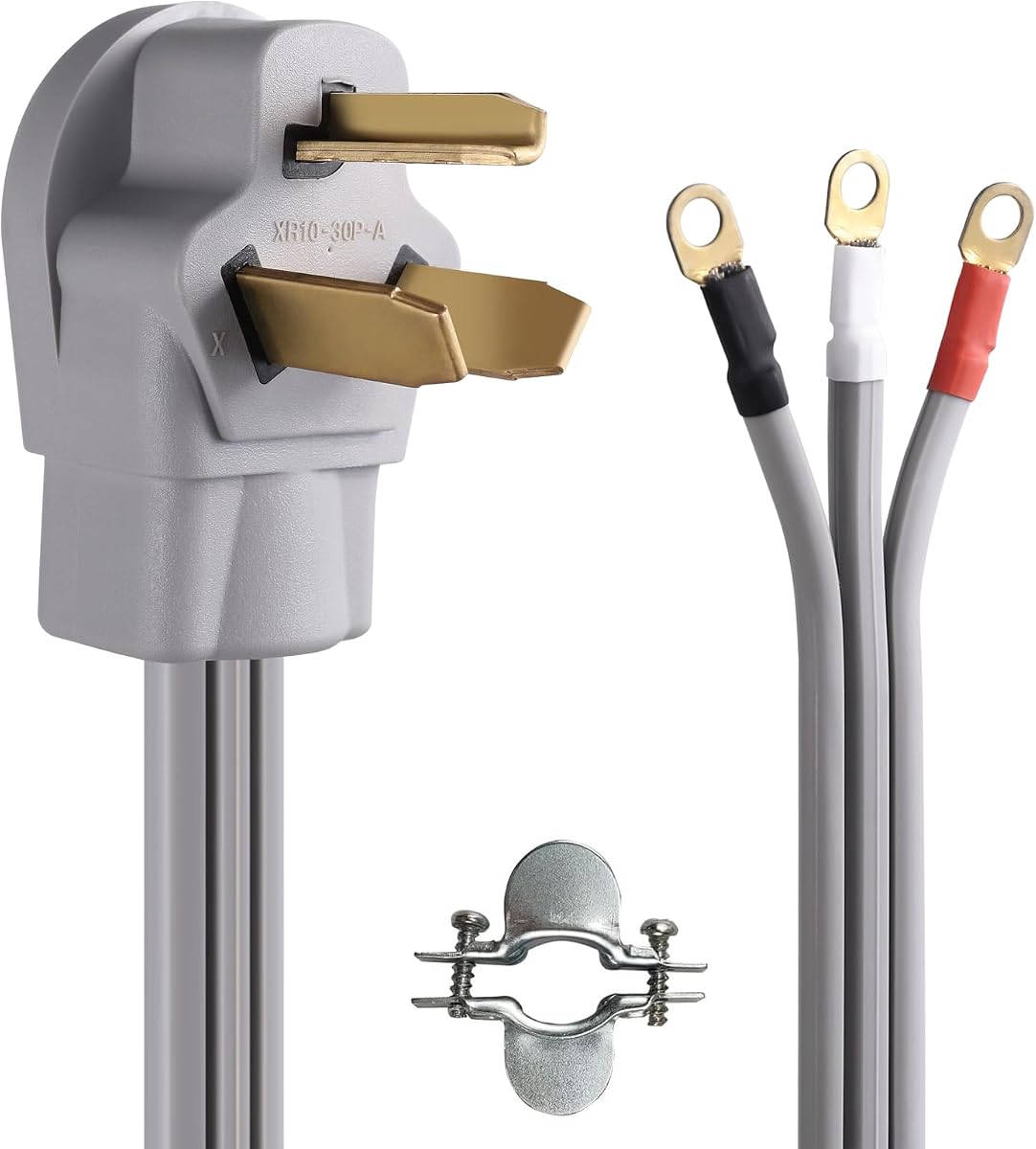
The Eastman 61249 is a compact four-foot dryer cord with a 4.8 customer rating and a conventional 30-amp, 125/250-volt configuration. It uses three 10 AWG bare copper conductors, a NEMA 10-30P right-angle plug, and flanged spade terminals with metal strain relief.
We may earn a commission when you buy through this link, at no additional cost to you.
The right-angle plug is one of its strongest practical features. It allows the dryer to sit closer to a wall than it might with a projecting plug, while the four-foot length further reduces excess cable in a close installation. The cord's compact form and gray finish give it a utilitarian appearance suited to a utility room.
At the appliance end, flanged spade terminals provide a clear method for connecting the bare copper conductors to the dryer's terminal block. Metal strain relief is designed to reduce mechanical stress where the cord meets the appliance. Those installation-focused components make the product more transparent than cords that leave the terminal style unspecified.
This is a compelling budget-oriented choice when the outlet is very close to the dryer, but the four-foot length is the decisive limitation. If the dryer must be moved farther from the wall or connected to a distant outlet, a six-, ten-, or fifteen-foot alternative will be more practical. Verify that flanged spade terminals match the machine before purchase.
Combining a short cable with a right-angle plug makes this cord well suited to appliances positioned immediately beside a wall outlet. The geometry can improve rear clearance and reduce the amount of cable trapped behind the dryer.
Flanged spade terminals and metal strain relief make the dryer-end construction easy to identify. Buyers can compare these features directly with the existing terminal block, reducing uncertainty during a replacement project.
We may earn a commission when you buy through this link, at no additional cost to you.
The RVMATE 3 Prong SRDT Dryer Cord is a five-foot option with a 4.8 customer rating. It is designed for standard 30-amp, three-wire dryer outlets and carries an ETL certification, with a stated 10 AWG, three-conductor, 250-volt, 7,500-watt configuration.
We may earn a commission when you buy through this link, at no additional cost to you.
Its right-angle plug is a meaningful advantage for installations close to a wall. The design reduces the gap between the dryer and outlet while avoiding the projection created by a conventional flat plug. The cord is also made with pure copper wires and a flame-retardant PVC sheath, and its SRDT cable is stated to withstand temperatures up to 140 degrees Fahrenheit.
Strain relief is another useful feature. It is intended to prevent the cord from placing stress on the wire connections at the terminal block, which helps protect the installation if the appliance is moved slightly. The product also states an easy installation process, although the actual time will depend on terminal familiarity and access to the dryer.
The RVMATE is best for a dryer positioned near its outlet and seeking a compact right-angle connection. Its five-foot length sits between the shortest and six-foot options, though it still cannot offer the placement freedom of ten- or fifteen-foot models. Users should follow the instructions carefully to ensure the strain-relief component is positioned correctly.
The right-angle NEMA 10-30 plug is designed to sit neatly against the wall and extend less distance outward than a projecting plug. This is especially helpful when the dryer needs to be positioned close to surrounding cabinetry or wall surfaces.
A flame-retardant PVC sheath surrounds pure copper conductors, providing both mechanical and electrical protection. The stated high-temperature tolerance supports use in a dryer environment where heat and repeated handling are common.
We may earn a commission when you buy through this link, at no additional cost to you.
A dryer cord must match the appliance, outlet, conductor layout, and available space. The following factors help narrow the field before installation begins.
Most electric dryers use a three-wire connection and a NEMA 10-30 outlet arrangement, but the appliance's manual is the authoritative source. Look for the required amperage, conductor size, wire colors, and terminal layout. Some newer appliances use a four-wire connection, while some range-style appliances require a 40-amp cord. The presence of three prongs alone does not prove that every three-prong cord is interchangeable.
A typical residential dryer circuit is 30 amps, and the cords in this guide generally use three 10 AWG conductors to meet that demand. The range cord is different: it is rated for 40 amps and uses two 8-gauge hot conductors plus one 10-gauge conductor. Select a cord whose amperage and conductor arrangement match the equipment rather than assuming a larger rating automatically means it is interchangeable.
Measure from the dryer connection point to the outlet with the appliance in its intended position. Four- and five-foot cords suit close layouts, six feet adds modest flexibility, and ten feet supports more rearrangement. A fifteen-foot cord provides maximum reach but may create excess cable that has to be routed carefully. A slightly longer cord can be helpful, but unnecessary length can crowd the space behind the dryer.
A right-angle plug can improve wall clearance and reduce the distance required behind the dryer. Flat plugs are easy to insert and remove and may be preferable when the outlet is exposed or located in an open area. Side grips can further improve handling in tight spaces. The plug must also match the wall receptacle configuration and the clearance available in the laundry room.
ETL and UL listings indicate that a product has been evaluated by an applicable safety certification organization. Both appear among the choices, but certification should complement, not replace, correct sizing and installation. Look for the mark on the actual product listing and ensure the cord's voltage, amperage, gauge, and connector configuration align with the dryer and outlet.
Dryer-end connection details vary among ring terminals, eyelet connectors, and flanged spade terminals. The correct connector must physically match the terminal block and the dryer's instructions. Metal or plastic strain relief is also valuable because it reduces bending and pull forces where the cable meets the appliance. A clear terminal design can make installation simpler and reduce connection errors.
SRDT and STW cable jackets are designed for high-temperature appliance environments and provide insulation around the conductors. Several selections state support for temperatures up to 140 degrees Fahrenheit, while one product emphasizes a 300-volt jacket rating. These features help protect against wear and overheating, but the cord should still be routed away from sharp edges and never used as a substitute for proper circuit protection.
Features such as color-coded wires, anti-slip grips, reinforced blades, and included strain-relief hardware can make installation and handling easier. Extra length or specialized plug geometry is valuable only when it suits the actual installation. Consider cord diameter, routing space, connector visibility, and how often the plug will be handled. The best replacement is the one that fits correctly and remains easy to maintain.
Before installation, disconnect the dryer at the breaker and confirm that the power is off. Remove the old cord without forcing damaged terminals, and compare the existing conductors, connector shapes, and wire positions with the replacement. Follow the dryer's service instructions and have a qualified electrician handle the work if the instructions are unclear or the outlet appears damaged.
Connect each conductor to the correctly labeled dryer terminal and attach the strain-relief hardware so the cable is supported without sharp bending. Fit the plug fully into the NEMA-compatible outlet, route the cord so it is not pinched, and keep it clear of moving parts, hot surfaces, standing moisture, and trip hazards. Restore power only after all terminals are secure and the cover is properly reinstalled.
For routine care, unplug the dryer before inspecting the cord and avoid pulling on the cable to disconnect it. Check periodically for discoloration, heat damage, pinching, corrosion, or a loose plug. Keep the cord dry and avoid sharp bends near the terminals. Replace it if the jacket is cracked, conductors are exposed, connections become loose, or the plug shows damage.
Most residential 30-amp electric dryers use a NEMA 10-30R three-prong receptacle. The cord's plug is commonly identified as NEMA 10-30P. Always compare the physical prong layout and the outlet marking with the dryer's installation instructions, because a three-prong appearance by itself does not guarantee compatibility.
No. Four-wire dryer cords include an additional equipment-grounding conductor, while many three-wire cords rely on an older bonding arrangement. Whether a dryer can use a three-wire cord depends on its terminal block, bonding configuration, and manufacturer instructions. Do not remove or bypass the ground to force an incompatible connection.
The best length is the shortest one that comfortably reaches the outlet without pulling or bending sharply. Four or five feet works for very close installations, while ten feet offers more placement flexibility. A fifteen-foot cord can solve difficult layouts but may require careful routing to keep excess cable from becoming crowded behind the dryer.
NEMA 10-30P identifies the male plug configuration used by many 30-amp, three-wire dryer connections. The P indicates a plug, while 10-30 describes the electrical configuration. The matching wall receptacle is generally identified as NEMA 10-30R, where R denotes a receptacle.
Replacing a dryer cord involves connecting high-voltage conductors to an appliance terminal block, so local rules and the manufacturer's instructions govern the work. Experienced DIY installers may be able to perform the replacement after completely disconnecting power. If you are uncertain, the existing cord is damaged, or the outlet needs work, consult a qualified electrician.
No. The outlet type, amperage, conductor size, temperature rating, terminal configuration, and dryer's wiring requirements must all align. A 40-amp range cord with larger conductors is not automatically interchangeable with a 30-amp dryer cord. Review the appliance manual and inspect the existing installation before selecting a replacement.
Both are thermoplastic cable jacket designations used for appliance wiring, and several cords in this guide feature one or the other. Their practical benefits include insulation, resistance to wear, and protection in elevated-temperature environments. Buyers should also examine the complete electrical specification rather than relying on the jacket designation alone.
A right-angle plug projects less from the wall, which can make it easier to position the dryer close to the wall or surrounding cabinets. It is especially helpful in narrow laundry rooms. It does not change the cord's electrical compatibility, so the outlet, amperage, and terminal configuration still need to match the dryer.
The ten-foot pure copper cord stands out as the most versatile general option because it combines a 4.8 rating, ETL listing, color-coded wiring, a right-angle plug, and useful placement flexibility. The compact Eastman 61249 is a compelling budget choice for close installations, while the fifteen-foot ETL-certified option provides the greatest reach.
Prioritize exact compatibility before considering any convenience feature. Confirm the dryer's amperage, outlet configuration, conductor size, terminal style, and required wire arrangement. Then choose the shortest length that works, consider whether a right-angle plug will improve clearance, and favor a cord with credible safety certification and effective strain relief.
Product availability, listings, and prices can change, so check the current listing before purchasing. Review the supplied specifications against the appliance manual, confirm the cord arrives with the appropriate dryer-end connectors, and inspect the package for damage before beginning installation.