
AIMILER 32A WiFi Level 2 EV Charger
4.6Editor score
Adjustable 16-to-32-amp output
NEMA 14-50 plug-in design
WiFi scheduling and monitoring
25-foot J1772 cable
Fast chargers for electric vehicles at home are compared for power, connectivity, installation needs, safety features, and vehicle compatibility.
Fast chargers for electric vehicles at home can turn an ordinary electrical outlet into a convenient overnight charging setup. The right station should match your vehicle, electrical panel, parking arrangement, and desired level of control while providing safe, dependable charging in daily use.
We compared ten home EV chargers based on maximum current, connection type, installation options, smart features, safety certifications, weather resistance, cable length, display capabilities, and compatibility with J1772 and NACS vehicles. The list includes hardwired models, plug-in chargers, and a portable option for flexible use.
Each review explains where a charger stands out, where compromises may arise, and which drivers are most likely to benefit from it. Actual charging speed depends on the vehicle, battery temperature, electrical service, and ambient conditions, while prices and promotional terms can change over time.
4.6Editor score
4.8Editor score

4.4Editor score
The comparison below highlights each charger's power level, installation method, connectivity, and connector configuration, making it easier to identify the model that fits your home and vehicle.
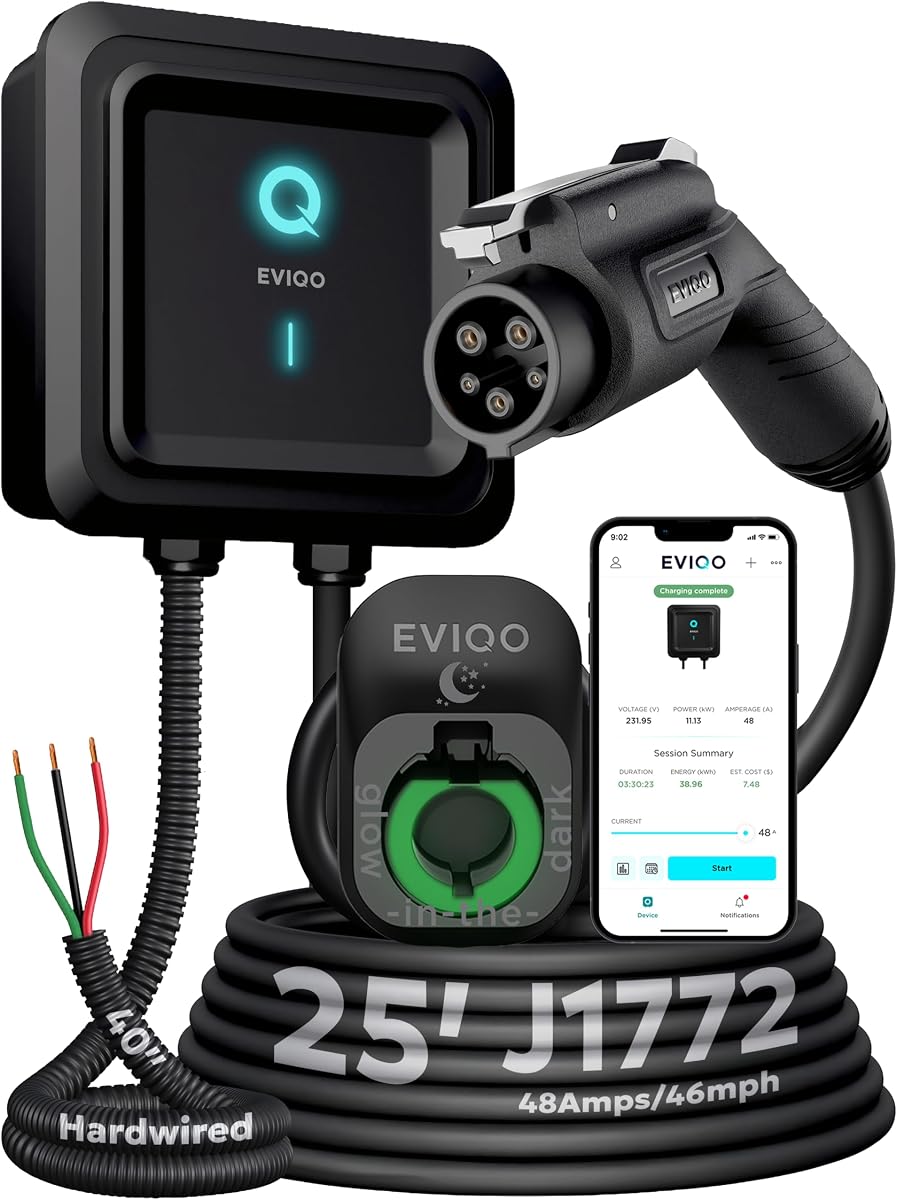


The EVIQO Level 2 EV Charger J1772 48A is a hardwired 240V wall station built for drivers who want strong overnight charging without giving up app-based control. Its 4.7 rating reflects a capable overall package, with a J1772 connector, a long cable, flexible amperage settings, and a fully sealed enclosure that suits garages and exposed locations.
We may earn a commission when you buy through this link, at no additional cost to you.
Maximum output reaches 48 amps on a dedicated 60-amp circuit, and DIP switches can unlock 50 amps when supported by a dedicated 70-amp circuit. That headroom makes the charger useful for larger EV batteries, although the vehicle's onboard charger may accept less power. The 25-foot cable provides practical reach across a garage, driveway, or multi-car parking arrangement.
Smart functionality is a major strength. The unit uses a 2.4GHz WiFi connection and an enhanced antenna designed to maintain connectivity inside a garage or basement. Through the app, owners can start or stop charging, adjust output from 6 to 48 amps, schedule off-peak sessions, review energy use, and receive reminders. A side reset button and over-the-air updates simplify maintenance.
The main trade-off is installation. Because it is hardwired, a licensed electrician should install it according to the National Electrical Code, and buyers with a constrained electrical panel may need to investigate capacity before purchasing. For drivers with suitable electrical service who value long-term controls, however, this is a particularly well-rounded home charging choice.
App-based scheduling, real-time energy tracking, and adjustable amperage make the station easy to tailor to daily routines and changing electricity demands. The physical controls also support straightforward operation without requiring a phone for every task.
The IP66 and NEMA 4 housing is sealed against dust and weather, while the included glow-in-the-dark holster makes the connector easier to locate at night. A 25-foot cable adds flexibility for unusual parking positions.
We may earn a commission when you buy through this link, at no additional cost to you.
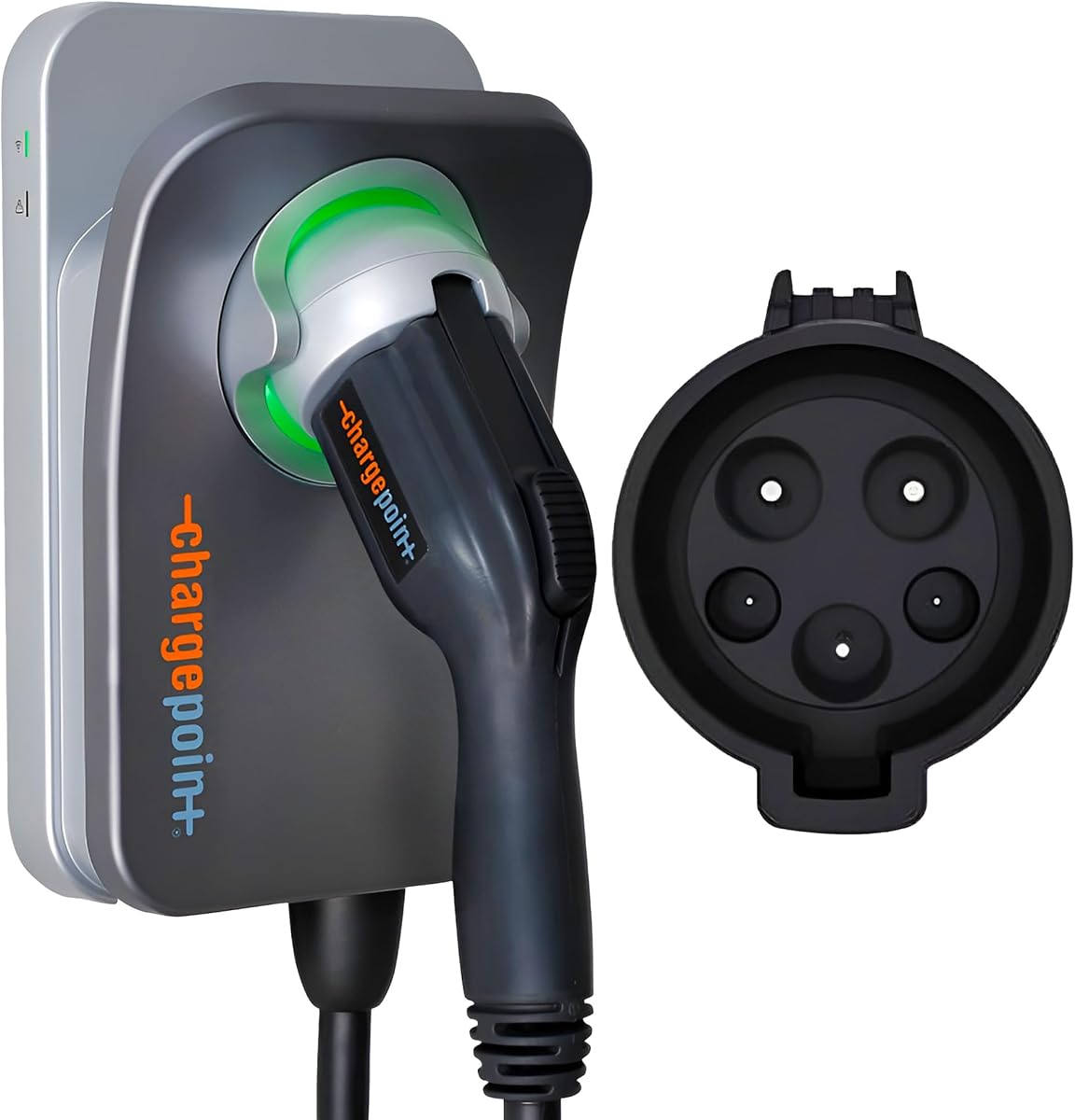
The ChargePoint HomeFlex is a hardwired Level 2 charger with a 50-amp configuration and a 4.3 rating. It is aimed at EV owners who value a familiar charging platform, straightforward 240V charging, and mobile control, particularly those who already recognize the wider ChargePoint charging ecosystem.
We may earn a commission when you buy through this link, at no additional cost to you.
The station uses a standard J1772 connector and supports the non-Tesla vehicles most common in North America. Tesla drivers need a compatible J1772-to-NACS adapter, which is not included. Its stated charging speed can be as much as nine times faster than a 120-volt outlet and may add up to 45 miles of range per hour, depending on the vehicle and operating conditions.
The ChargePoint Mobile App provides session controls, reminders, charging data, and connections with smart-home devices. WiFi is necessary for certain functions and troubleshooting, so a reliable 2.4GHz home network is an important part of the ownership experience. The unit is UL certified, includes a cold-resistant cable, and may be installed indoors or outdoors by an electrician.
The HomeFlex is a sensible option for drivers with adequate electrical capacity who want high-current hardwired charging. Its appeal comes less from unusually long feature lists and more from a clean combination of strong output, established support, and app-based convenience. Drivers should account for professional installation and the need for a Tesla adapter if applicable.
Remote session management, reminders, energy information, and smart-home integration make the charger practical for vehicles that regularly sit overnight. Keeping the station connected also makes support and troubleshooting easier.
The 50-amp configuration provides meaningful charging headroom for larger battery packs. Because the EV controls how much power it accepts, the exact range added per hour will vary by model.
We may earn a commission when you buy through this link, at no additional cost to you.
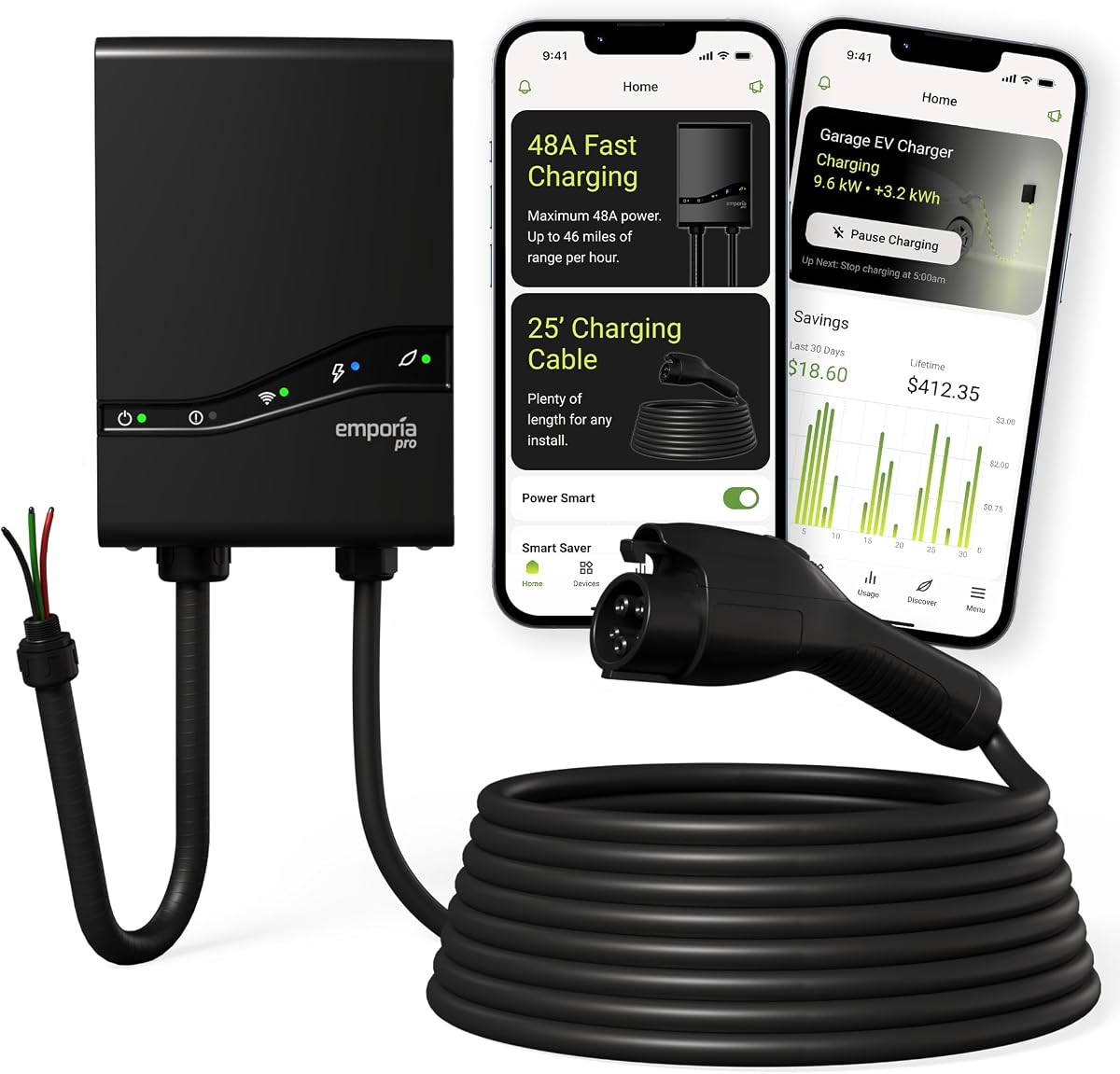
The EMPORIA Pro Level 2 EV Charger with PowerSmart earns a 4.8 rating and stands apart for its ability to coordinate EV charging with the rest of the home. Its 48-amp hardwired capability supports fast Level 2 charging, while PowerSmart technology can automatically balance charging load with existing electrical demand.
We may earn a commission when you buy through this link, at no additional cost to you.
That load-management feature addresses a common obstacle: an older or constrained electrical service may not comfortably support a dedicated high-amperage circuit without a panel upgrade. Rather than simply demanding the largest available charge, PowerSmart responds to household consumption and aims to use the maximum power the service can support safely. The result is a more flexible approach for eligible homes.
The included Emporia Vue adds deeper visibility into household energy use, allowing owners to see charging data in real time and make more informed scheduling decisions. The app supports automated charging schedules and off-peak charging, while Bluetooth and WiFi resources help guide setup. Installation can use a NEMA 14-50 plug or a hardwired connection, depending on electrical capacity and the desired permanence.
This is a particularly compelling choice for owners who want more than a basic wall box. The trade-off is complexity: the system depends on a suitable electrical configuration and benefits from some familiarity with home energy monitoring. For those who want a highly rated charger with proactive load management, the EMPORIA Pro is a leading option.
PowerSmart is designed to work with an existing panel and automatically balance charging load. That flexibility can make high-speed home charging more practical when household electricity use varies throughout the day.
The included Emporia Vue provides deeper insight into home energy consumption, pairing EV charging data with a broader view of household use. Schedules can then be aligned with periods that suit the driver's schedule and utility rate structure.
We may earn a commission when you buy through this link, at no additional cost to you.
The AIMILER 32A WiFi Level 2 charger combines a 4.6 rating with a plug-in format that can be easier to deploy than a hardwired station. It provides up to 7.68 kW of Level 2 output and uses a NEMA 14-50 plug, making it most suitable for homes with a properly configured 40-amp outlet.
We may earn a commission when you buy through this link, at no additional cost to you.
Output can be adjusted to match the available circuit: 32 amps for a 40-amp breaker, 24 amps for a 30-amp breaker, or 16 amps for a 20-amp breaker. Drivers can change amperage through the touch controls or app. The LED screen presents input voltage, charging speed, amperage, and delay information, while the app adds schedules, cost estimates, history, status tracking, and full-charge notifications.
The connector is SAE J1772, covering a broad range of North American EVs and plug-in hybrids. Tesla vehicles and newer vehicles built around the NACS plug require an appropriate adapter, which is not included. Compatibility with a 5-15P adapter can also be used, but it changes the unit to slow Level 1 charging, with a stated maximum of 1.32 to 1.8 kW.
The charger is ETL and FCC listed and includes built-in leakage protection. Its IP66-rated enclosure is suitable for many conditions, although the manufacturer advises against direct sunlight and heavy rain exposure. For drivers seeking app control, adjustable output, and a portable installation without a dedicated wall unit, this model offers a particularly useful balance of capability and convenience.
The ability to select 16, 24, or 32 amps allows the same charger to suit several breaker sizes. Matching the setting to the circuit is essential for safe operation and helps prevent nuisance breaker trips.
The app supports scheduling, energy-cost estimates, session history, and status notifications, while the physical display provides useful feedback without a phone. A factory-reset routine can help the device reappear after a WiFi or phone change.
We may earn a commission when you buy through this link, at no additional cost to you.
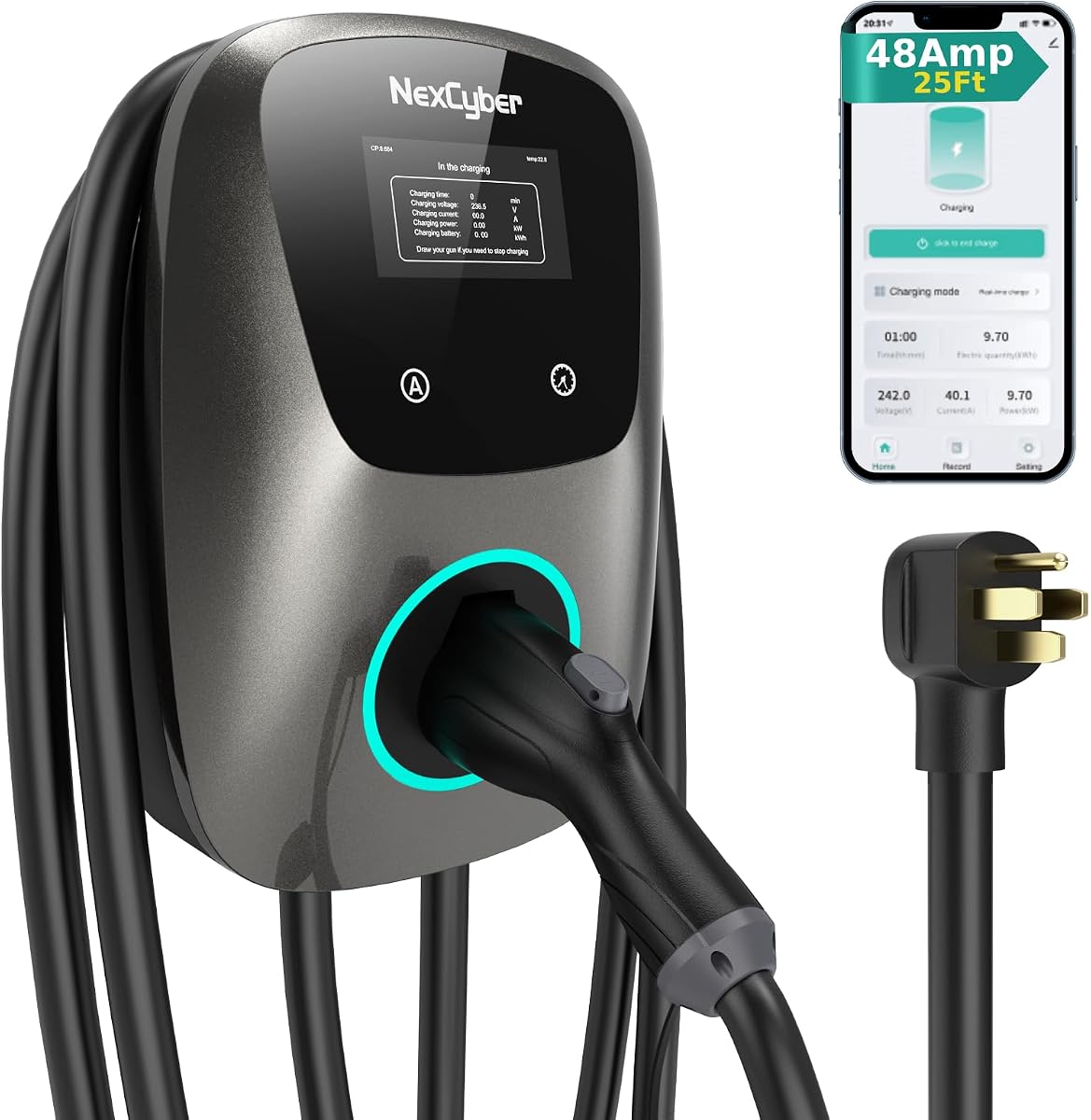
The NexCyber 48A WiFi Level 2 charger is designed to bridge two installation styles. It can operate from a NEMA 14-50 outlet at up to 40 amps or be hardwired for the full 48-amp configuration. Its 4.5 rating reflects a strong combination of power, smart control, and installation flexibility.
We may earn a commission when you buy through this link, at no additional cost to you.
In hardwired mode, the charger can deliver the stated equivalent of up to 46 miles of range per hour, while the plug-in configuration is advertised at up to 38 miles per hour. Actual results depend on the vehicle and charging conditions. The 25-foot cable reaches across a two-car garage or into many driveway positions, and the J1772 connector supports Ford, GM, Audi, Kia, Honda, Hyundai, Chevrolet, Volkswagen, Nissan, BMW, Jeep, and other compatible models.
Its touch screen displays amperage, charging speed, voltage, and delay status, and the amperage can be adjusted from 16 to 48 amps. An optional app experience adds schedules, charging costs, history, status tracking, and full-charge notifications. The default plug-charge mode also means the charger does not depend on an app for basic operation.
ETL, FCC, and Energy Star certifications support confidence in the safety design, and the product includes a three-year warranty. The primary drawbacks are the need for a Tesla or NACS adapter and the importance of using appropriately sized wiring. For a homeowner who wants high-current performance but may begin with a plug-in outlet, this is a versatile option.
The included NEMA 14-50 plug supports a faster initial setup, while the hardwiring path provides access to the station's highest output. That makes it easier to align the charger with the electrical improvements a household wants over time.
The built-in touch display shows operating information and permits adjustments without opening the app or disconnecting the vehicle. WiFi adds scheduling and history when remote management is desired.
We may earn a commission when you buy through this link, at no additional cost to you.
The EVDANCE 32A portable Level 2 charger is a straightforward option for owners who want 240V charging without a permanent wall-mounted installation. It has a 4.4 rating, uses a NEMA 14-50 plug, and can provide up to 7.68 kW while remaining small enough to move between a home, office, or travel destination.
We may earn a commission when you buy through this link, at no additional cost to you.
Current output can be set to 16, 24, or 32 amps depending on whether the home circuit uses a 20-, 30-, or 40-amp breaker. The control button makes the adjustment process direct, while the LED display presents amperage, voltage, charging speed, and delay status. A delayed-start feature allows charging to begin later, which can help shift usage away from peak periods.
The SAE J1772 connector works with most non-Tesla EVs and plug-in hybrids sold in North America, including vehicles from Ford, GM, Nissan, Kia, Hyundai, and BMW. Tesla owners need a J1772-to-NACS adapter, which is not supplied. Buyers should also note that the stated charging power is an upper limit; the EV's onboard charging electronics determine the accepted rate.
Durability features include an IP66-rated, NEMA Type 4 enclosure and a 25-foot drop-resistant cable. The included carrying case and wall bracket make storage tidier, while the one-year warranty offers limited protection compared with some premium alternatives. This charger works well for drivers who prioritize simple controls, portability, and straightforward 240V performance.
The NEMA 14-50 plug and 25-foot cable allow meaningful Level 2 charging from outlets that are otherwise impractical for a permanently installed wall box. The carrying case makes the unit easier to store between trips.
Adjusting the current to 16, 24, or 32 amps helps align the charger with available electrical capacity. Using the correct setting is essential for safe operation and stable charging.
We may earn a commission when you buy through this link, at no additional cost to you.
The EVDANCE 40A portable Level 2 charger is aimed at drivers who want more current than a basic plug-in model while retaining the convenience of a transportable design. Its 4.4 rating reflects a capable charger with up to 9.6 kW of output, a 25-foot cable, broad current adjustment, and a detailed 2.4-inch TFT display.
We may earn a commission when you buy through this link, at no additional cost to you.
The charger supports output settings from 10 through 40 amps, allowing it to operate at lower levels on smaller circuits and reach maximum output when a 50-amp circuit is available. A delay timer can postpone charging by up to 12 hours. The TFT screen displays current, voltage, power, elapsed charging information, and operating status, while separate LED indicators provide quick visual feedback.
Safety features include monitoring for leakage, grounding issues, overvoltage, undervoltage, overcurrent, overcharging, overheating, and short circuits. The unit is also designed to stop automatically when the vehicle reaches a full charge. Its IP66 rating and stated operating range of -22°F to 122°F make it suitable for many garages, carports, and outdoor conditions.
The standard J1772 plug supports most J1772-equipped EVs and plug-in hybrids, while Tesla owners need an adapter that is not included. Cable and control-box holders plus a carry bag make the unit easier to organize. The chief limitation is that maximum output requires proper electrical infrastructure, and the absence of a listed app makes it less attractive to drivers who prioritize remote scheduling.
The larger TFT display presents more operating information than a basic indicator panel, making it easier to confirm current, voltage, power, timer status, and charging state. This is particularly helpful when testing different amperage settings.
The 25-foot cable, included holders, and carry bag create a package that is easy to move between a home garage, workplace, or travel stop. Broad weather protection supports use beyond a climate-controlled space.
We may earn a commission when you buy through this link, at no additional cost to you.
The ApexCharger MACH 1 is a 48-amp Level 2 wall-mount station with a 4.6 rating and a notably broad compatibility package. It includes both a J1772 connector and a proprietary PRO 1 NACS adapter, allowing the station to serve J1772 and Tesla vehicles without requiring owners to find a separate compatible adapter.
We may earn a commission when you buy through this link, at no additional cost to you.
Installation flexibility is another advantage. A NEMA 14-50 plug supports a 40-amp configuration with a 50-amp breaker, while the included hardwiring kit and instructions allow the station to operate at the full 48-amp output with appropriate 60-amp protection. The 30-foot cable is longer than most of the alternatives in this guide and offers excellent reach for garages, parking lots, or multiple vehicle positions.
The station supports WiFi, Bluetooth, a mobile smart app, and two RFID cards. It also includes a connector holder, a 2.4-inch LED display, True Plug N' Play functionality, and 24-hour after-sales support. An anti-theft bolt and fittings are included, which can be useful for a shared driveway, parking area, or publicly accessible location.
The MACH 1 is more elaborate than a basic home wall box, and some of its access and connector features may be unnecessary for a single owner with one vehicle. It also requires appropriate electrical service, even when used with the plug-in option. For drivers who want broad connector support, a long reach, and stronger physical security, however, it delivers a capable package.
The included NACS adapter makes the station particularly useful for households that own both J1772 and Tesla vehicles. Keeping the main J1772 cable available reduces the need to search for an adapter during routine charging.
RFID cards, anti-theft hardware, a long cable, and a sturdy wall-mounted design suit spaces where multiple drivers may use the station. The app adds another layer of monitoring and control.
We may earn a commission when you buy through this link, at no additional cost to you.
The Autel MaxiCharger is the highest-output option in this guide, providing up to 80 amps and 19.2 kW when hardwired to a suitable circuit. Its 4.4 rating reflects a premium feature set that includes AI-integrated app control, dual-network connectivity, strong physical security, and a five-year warranty.
We may earn a commission when you buy through this link, at no additional cost to you.
Autel states that the charger can add about 70 miles of range per hour and operate up to 14 times faster than a standard Level 1 outlet, although real charging speed will be limited by the vehicle's maximum acceptance rate, battery state, and other conditions. A 100-amp circuit is recommended for full 80-amp output, making this an option primarily for homes with substantial electrical capacity.
The AI-integrated smart app can schedule charging around time-of-use utility rates, start or stop sessions remotely, adjust current, present real-time energy data, and issue alerts when unusual conditions are detected. Dual WiFi and Wi-SUN networking is designed to keep the station online, while the manufacturer advertises greater than 99.9 percent uptime. A 25-foot J1772 cable supports North American EVs and plug-in hybrids.
The enclosure includes internal temperature monitoring, flame-retardant materials, tamper-resistant screws, and remote locking. The station is CSA certified, and the listing notes rebate eligibility for many jurisdictions. It is backed by 24/7 support. For owners of large EVs, busy households, or future-oriented installations, it offers maximum charging headroom, though many drivers will pay for capability their vehicles cannot fully use.
The 80-amp design can serve current large-battery vehicles while preserving room for future charging demands. It is a meaningful choice for a permanent installation designed to last through several vehicle changes.
Remote locking, tamper-resistant hardware, temperature monitoring, and dual-network connectivity add layers of protection. Real-time data and alerts give owners better visibility into the station's behavior.
We may earn a commission when you buy through this link, at no additional cost to you.
The EMPORIA 48A WiFi Level 2 charger offers a 4.7 rating and a balanced combination of charging power, flexible installation, and smart monitoring. It can deliver up to 48 amps in hardwired mode or operate at 40 amps with its NEMA 14-50 plug, giving owners a way to begin with a simpler outlet and later move to permanent wiring.
We may earn a commission when you buy through this link, at no additional cost to you.
The charger is advertised as adding up to 46 miles of range per hour when hardwired and up to 38 miles per hour through the plug, though actual results depend on the vehicle. A 25-foot cable gives adequate reach in a typical garage or driveway. The J1772 connector is compatible with a broad range of North American EVs, including the Chevrolet Bolt, Volkswagen ID.4, Nissan Leaf, Ford Mustang Mach-E, IONIQ 5 and 6, BMW models, Audi vehicles, and Jeep Wrangler 4xe.
Smart functions are handled through a 2.4GHz WiFi connection. The app provides real-time energy data, remote charging management, and scheduling that can be aligned with utility rates. Because the station supports connected features, a stable home network and correct app setup are important for a smooth experience.
UL listing and Energy Star certification provide confidence in the safety and efficiency design, and the product references NEC 625, SAE J1772, and several UL standards. Professional installation is recommended for optimal safety and performance. For drivers who want proven 48-amp capability, useful scheduling, and an established charger brand, this remains a well-rounded home option.
The NEMA 14-50 plug offers a practical starting point, while hardwiring unlocks the full 48-amp configuration. This makes it easier for owners to select an installation path based on their panel capacity.
The app's real-time energy data and charging schedules help drivers coordinate vehicle charging with household demand and rate structures. A 2.4GHz WiFi network is required for the connected experience.
We may earn a commission when you buy through this link, at no additional cost to you.
Choosing a home EV charger involves balancing vehicle capability, electrical service, connector design, installation permanence, and smart features. These factors determine safe charging performance and which features you will actually use each day.
The charger's maximum amperage is only one part of the charging equation. The vehicle's onboard battery charger determines how much power can enter the pack, and it may accept less than the station can supply. A large-battery EV might benefit from 40 to 48 amps, while a vehicle with a lower onboard limit may charge just as quickly from a 32-amp unit. Check the vehicle's charging specifications before ordering so you can avoid paying for capacity the car cannot use.
A Level 2 charger typically requires a 240-volt circuit, and higher-current models need appropriately sized breakers and conductors. Some units operate on a 40- or 50-amp circuit, while full 48-amp operation may require a 60-amp circuit and an 80-amp model may need a 100-amp circuit. Have a licensed electrician evaluate available panel space, load capacity, grounding, and wiring before purchasing hardwired equipment. Plug-in models still require a correctly configured NEMA 14-50 outlet.
Most North American EVs and plug-in hybrids use the SAE J1772 connector, while Tesla vehicles use NACS. J1772 chargers can serve Tesla vehicles with the correct adapter, but the adapter is not included with every model. NACS-equipped vehicles require a J1772-to-NACS adapter, and compatibility should be checked against the vehicle's actual port rather than its make alone. Pay close attention to newer model years because connector configurations can change within a single lineup.
Hardwired charging is permanent, tidy, and suitable for high-current operation. Plug-in chargers are easier to move, can serve more than one property, and may simplify initial setup, but they still need a properly installed outlet. If you expect to change vehicles, rearrange the garage, or travel with the charger, portability may matter. If the station will remain in one position, a hardwired model can provide higher output and a cleaner finished appearance.
WiFi-enabled chargers can start or stop sessions, display energy use, and schedule charging around off-peak periods. These features can improve convenience and make EV charging easier to coordinate with household demand. They are not essential for every driver, though, and they add a network connection that must be configured correctly. Look for clear app controls, 2.4GHz WiFi compatibility, and useful session history rather than assuming every smart function works without a reliable connection.
Look for recognized safety certifications such as UL, ETL, or CSA, and confirm that the certification covers the complete charging station. Useful protections include ground-fault and leakage detection, overcurrent monitoring, temperature controls, and automatic shutdown when the vehicle finishes charging. A built-in reset function can also make troubleshooting easier. Certification does not eliminate the need for proper wiring, correct breaker sizing, and installation according to local electrical requirements.
A 25-foot cable is common and usually sufficient for a standard garage or driveway, while a 30-foot cable can help with larger properties, parking lots, or awkward parking positions. Cable length should improve reach without creating a trip hazard or making it difficult to reconnect the vehicle. Also consider connector storage, holsters, cable-management hardware, and where the control box can be mounted for easy visibility and protection.
A garage provides the simplest environment, but many EV owners need an outdoor outlet or carport installation. Check the charger's IP or NEMA weather rating and avoid placing it where direct sunlight or heavy rain could create avoidable stress. Even weather-resistant equipment benefits from a protected mounting location. Secure cable routing, drainage, and a durable holster are as important as the enclosure rating when using a station outdoors.
Before the first session, confirm that the charger's amperage setting matches the circuit and that the connector fully seats in the vehicle. A properly positioned plug should allow the vehicle to recognize a safe connection before charging begins. If the charger provides a delay or schedule, set it through the app or local controls and verify that the vehicle will remain connected long enough for the programmed start time.
During normal charging, monitor the charger and vehicle indicators rather than repeatedly plugging and unplugging the connector. A charging session may pause automatically for safety, battery-temperature management, or an on-board charging limit. If a fault occurs, read the charger's error display, check the breaker, and use the reset or factory-reset procedure in the manual before attempting a more involved diagnosis. Stop charging if you notice heat, odor, damaged wiring, or a loose connection.
For long-term care, keep the connector dry, clean the inlet and holster, and inspect the cable for cuts or pinching. Do not use high-pressure water or harsh chemicals on the control box. Update the app and firmware when prompted, preserve the connector in its holster when unplugged, and arrange periodic electrical inspections for hardwired systems. Following the manufacturer's installation and operating guidance remains the safest way to maintain performance.
Hardwired chargers should always be installed by a qualified electrician who can assess the panel, load, grounding, and conductor size. Plug-in models may be easier for owners to set up, but the NEMA 14-50 outlet still needs to be correctly installed and protected. Local codes and permit requirements can vary, so check with an electrical professional before connecting a new circuit.
A 48-amp charger is worthwhile when the vehicle supports that current and the home has the electrical capacity. It can meaningfully reduce charging time for larger battery packs, but many EVs have lower onboard charging limits. A 32-amp station may therefore charge a particular vehicle just as quickly while being easier for the electrical system to support.
Yes, a J1772 charger can charge a Tesla when paired with a compatible J1772-to-NACS adapter. The adapter is not included with most of the chargers in this guide, so it must be purchased separately. The ApexCharger MACH 1 is the exception in this roundup because its listing includes a PRO 1 NACS adapter.
A standard 120-volt Level 1 outlet generally charges much more slowly than a 240-volt Level 2 station. Some products in this guide advertise gains of approximately six to nine times, or even more, compared with a standard outlet. Actual performance depends on the vehicle's maximum acceptance rate, battery temperature, and the current selected.
A hardwired 48-amp charger normally requires a dedicated 60-amp circuit and appropriately sized wiring. Plug-in configurations often use a 40- or 50-amp circuit and are limited accordingly. Exact requirements depend on the charger instructions and local electrical code, so an electrician should verify the complete installation before energizing the equipment.
No. Most smart features, including remote control, charging history, and time-of-use scheduling, require WiFi and a properly configured app. Several products also provide local buttons and displays for setting current, delays, and operating status. If connectivity is unreliable or the vehicle is kept in a separate building, local controls can remain useful.
Many chargers have an IP or NEMA weather rating that makes outdoor installation possible, provided the model and installation instructions allow it. Even then, a garage wall, carport, or sheltered exterior location can reduce long-term wear. The outlet, mounting hardware, cable routing, and weather seals must all be installed correctly.
Routine user maintenance is mostly visual: inspect the plug and cable, keep the connector clean, and avoid exposing the unit to avoidable weather or physical damage. Firmware updates should be installed when offered. A hardwired charger should receive periodic professional electrical inspection under the guidance of the manufacturer and local safety requirements.
The EMPORIA Pro with PowerSmart leads for owners who want intelligent load management and whole-home energy visibility, while the AIMILER 32A WiFi model offers an accessible, flexible route to app-assisted Level 2 charging. The Autel MaxiCharger 80A represents the premium end of the list, supplying maximum output and extensive connectivity for homes prepared for a major electrical installation.
Prioritize the factors that directly affect daily use: electrical capacity, vehicle acceptance limits, connector compatibility, and whether a permanent or portable setup better fits your garage. Cable reach, scheduling, display quality, and weather protection are meaningful refinements, but they cannot compensate for an undersized circuit or an incompatible connector. Comparing specifications before purchasing helps prevent both overspending on unnecessary power and undersizing a charger for future needs.
Finally, review the latest product details, installation requirements, certification information, and current prices before making a purchase. Promotional pricing and electrical upgrade costs can change, and local utility rebates or incentives may also affect the overall decision. A careful compatibility check and professional electrical assessment remain the most reliable path to a safe and satisfying home charging setup.