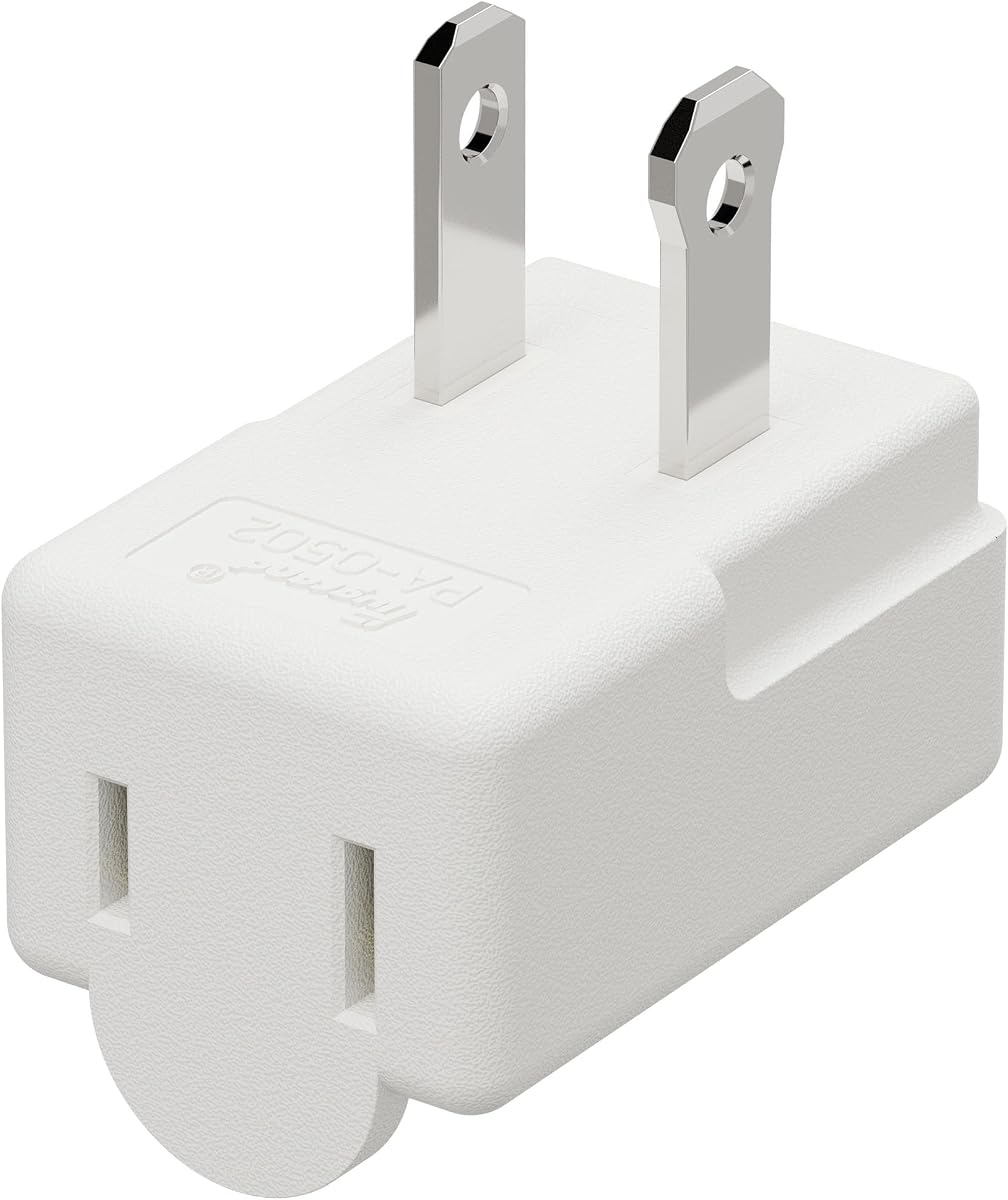
Polarized 2-Prong L Type Adapter
4.7Editor score
Compact down-angle design
Polarized two-prong connection
Single outlet adapter
Our 90 Degree Wall Plug Adapter guide compares angled plugs, multi-outlet extenders, rotating models, and compact solutions for tighter spaces at home.
A 90 degree wall plug adapter changes the direction in which a power cord leaves a receptacle, making it easier to use outlets hidden behind furniture, mounted TVs, cabinets, and other tight areas. The best models provide a secure connection, maintain electrical compatibility, and avoid forcing a straight plug into an awkward angle.
The products in this guide were compared using their stated plug configurations, current and voltage ratings, construction, outlet capacity, directional design, and practical fit. The list covers simple angled adapters, flat cords, three-outlet extenders, and rotating models rather than treating every outlet accessory as the same type of product.
Each review explains where a product is most useful, along with the compromises that shoppers should consider. Ratings and specifications reflect the available product information, while current prices and availability can change at any time. Always verify the connector type and load requirements before buying.
4.7Editor score

4.8Editor score

4.7Editor score
The comparison below highlights connector style, outlet count, directional flexibility, power limits, and the installation situations each product is designed to address.


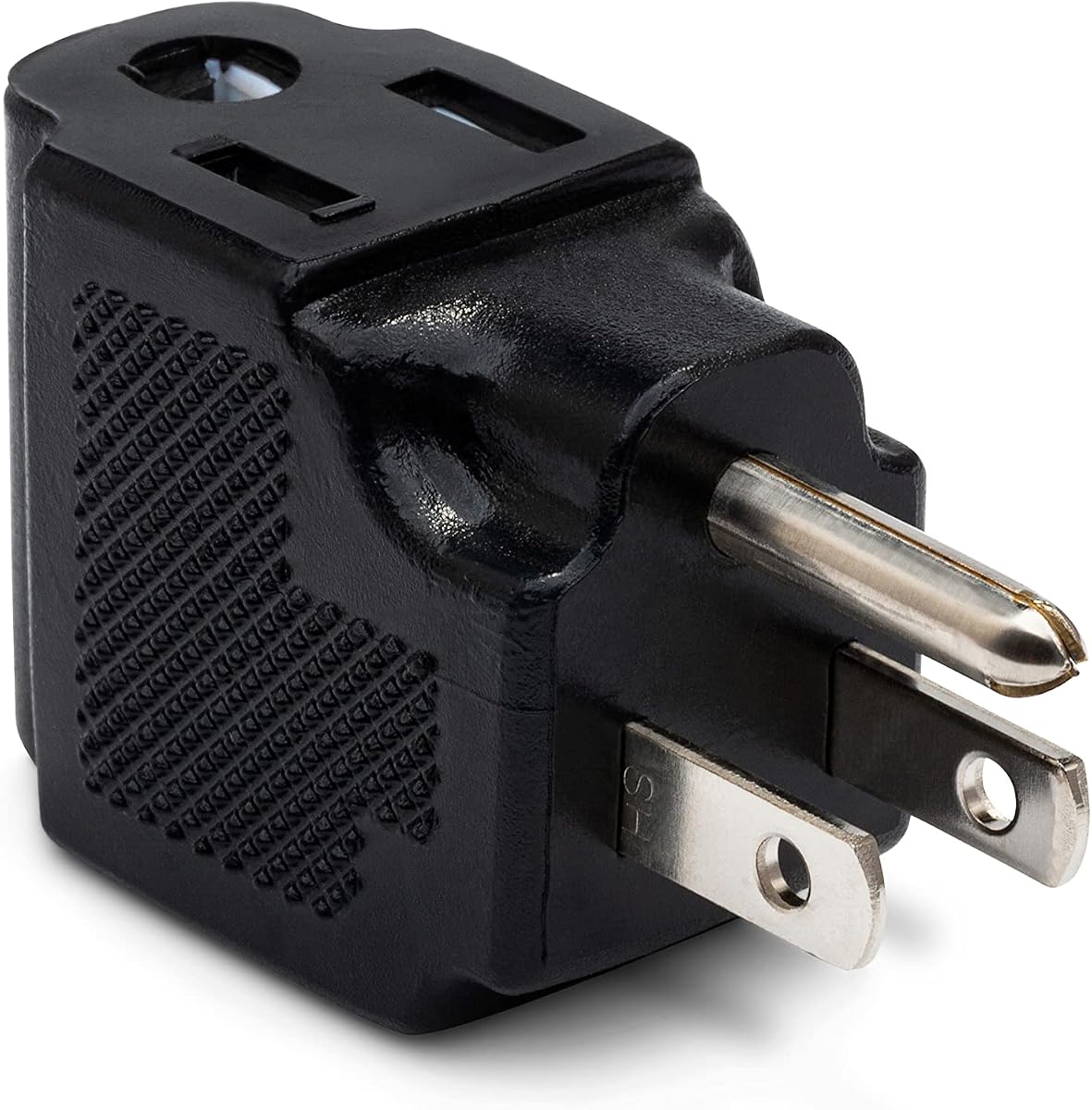


This flat, right-angle extension cord earns the Editor's Choice position because it combines a low-profile plug, a short cable, grounded three-prong support, and a two-pack format. Its 4.8 rating also makes it one of the strongest-rated options in the group. It is especially useful where a standard cord projects too far from the wall and prevents furniture from sitting neatly against the outlet.
We may earn a commission when you buy through this link, at no additional cost to you.
The most useful feature is the right-angle plug. According to the product information, it tilts 45 degrees left when inserted into a NEMA 5-15 receptacle, helping keep adjacent sockets accessible while directing the cord away from the wall. Its stated 0.35-inch profile is markedly slimmer than many cube-style extenders, making it a better fit behind a television, nightstand, bookshelf, cabinet, or sofa.
Electrical specifications include 16AWG pure copper conductors, NEMA 5-15P and 5-15R connectors, and a maximum rating of 125V, 13A, and 1625W. The cord is designed to work with both two-prong and three-prong devices. It is also equipped with a contoured grip edge for one-handed removal and is designed to fit more securely than an ordinary loose plug.
The main limitation is the one-foot length, which is helpful in confined areas but offers little reach. It also lacks the rotating freedom of the ETwinCoo and TROND products. Even so, the flat profile, two included cords, and ability to preserve neighboring outlet access make this a strong general recommendation for furniture-heavy rooms and hidden media connections.
The stated 0.35-inch housing is designed to slide into narrow gaps behind furniture. Unlike a bulky outlet cube, the flat construction preserves more of the available depth while routing the attached cord away from the receptacle.
The NEMA 5-15 configuration and three-prong construction support grounded household devices, while the product information also states compatibility with two-prong devices. Check the power requirements of the attached appliance before use.
We may earn a commission when you buy through this link, at no additional cost to you.
This polarized two-prong adapter is the budget-focused pick for shoppers who need to redirect one cord without adding a multi-outlet block. It holds a 4.7 rating and uses a vertical down-angle configuration intended to reduce the space a plug occupies behind furniture. It is a focused solution rather than a general-purpose charging hub.
We may earn a commission when you buy through this link, at no additional cost to you.
Its vertical orientation is particularly useful when a straight plug projects outward from a wall receptacle and interferes with furniture. Connecting the adapter changes the cord direction, allowing it to run more closely along the wall or furniture base. The product is designed around NEMA 1-15P and 1-15R connectors and uses a polarized two-pin arrangement.
The listed maximum rating is 15A at 125V, with support stated up to 1650W. Its material is described as fireproof, and it is ETL certified. The product information also notes a double-sided clip-type blade holder and oxygen-free copper stamping with riveting, emphasizing the electrical contacts as well as the compact shape.
This adapter does not offer extra sockets, surge protection, or a three-prong ground connection. Shoppers with grounded plugs will need a different product. Even with those limitations, it is a practical and economical answer for a polarized lamp, clock, charger, or other two-prong device positioned in a tight location.
The vertical down-angle body redirects a standard polarized plug without the depth of a multi-outlet extender. It works best where a single compact connection is needed near furniture.
This model uses NEMA 1-15 connectors and is not interchangeable with grounded NEMA 5-15 plugs. Confirm that the cord and device use a polarized two-prong connection before purchase.
We may earn a commission when you buy through this link, at no additional cost to you.
The Cable Matters 3-Pack combines a right-angle wall plug with three outlet positions per adapter. Its 4.6 rating reflects a practical design for homes, offices, travel bags, and hotel rooms where receptacle access is limited. The right-angle profile is designed to keep large wall warts and adapters from blocking adjacent outlets.
We may earn a commission when you buy through this link, at no additional cost to you.
One of the most important details is that a single unit does not block the neighboring receptacle on a standard wall outlet. That makes it more useful than a conventional horizontal power strip when depth, rather than the number of available plugs, is the main problem. The set includes three adapters, making it easy to place one in each room or carry one while traveling.
The product accepts grounded three-prong and polarized two-prong cords. Its outlet count makes it suitable for a bedside table, entertainment center, conference room, or other area where multiple low-power devices need access. The three-outlet cube shape is intended to add capacity without the length and bulk of a conventional power strip.
There is an important physical limitation: two of these right-angle adapters cannot be installed side by side on the same wall outlet. The product also provides no surge protection. Despite those limits, its three-outlet capacity, compact footprint, and three-unit bundle make it a strong choice for adding flexible power access.
Each adapter turns a single grounded receptacle into three AC outlet positions. That additional capacity is useful for chargers, lamps, and other everyday devices in rooms with limited wall access.
The angled input helps bulky charger bodies sit closer to the wall and makes it easier for a second device to use the neighboring receptacle. Two separate units still cannot be placed side by side.
We may earn a commission when you buy through this link, at no additional cost to you.
This Plugrand adapter offers an upward direction change for standard NEMA 5-15 connections. It is a single-outlet solution rather than an outlet expander, and its 4.7 rating reflects a well-defined niche: installations where the attached cord needs to travel upward instead of projecting directly from the receptacle.
We may earn a commission when you buy through this link, at no additional cost to you.
The upward orientation is useful when a receptacle is mounted high, located behind a television, or installed within a weather-protected housing that cannot close over a straight plug. The supplied information specifically highlights compatibility with an outside or weather-protected socket when a cover must remain in position.
The adapter is rated at 15A and 125V, with a stated maximum load of 1870W. It uses an NEMA 5-15P male plug and NEMA 5-15R female receptacle and is described as a PVC-molded construction. The product is ETL certified, which is an important consideration for a device designed to sit directly between a wall outlet and an appliance cord.
Its fixed direction and single outlet position make it less versatile than a rotating or three-outlet model. The product information mentions uses such as a stereo, microwave, and lights, provided the connected equipment does not exceed the adapter's rating. For a dedicated grounded appliance that needs upward routing, it is a precise and compact solution.
The upward angle can leave a protective outlet cover free to close while a grounded appliance cord travels in a less obstructive direction. This makes the adapter particularly relevant to outdoor or weather-protected installations.
Because the angle is fixed, this adapter works best with one device whose cord naturally runs upward. A swivel or rotating model offers more adjustment when multiple plug directions are needed.
We may earn a commission when you buy through this link, at no additional cost to you.
The ETwinCoo adapter is distinguished by a 270-degree rotating outlet body and a three-outlet configuration. Its 4.4 rating places it behind several other products in this guide, but the adjustable design offers a practical way to organize several cords in a confined area without relying on one fixed direction.
We may earn a commission when you buy through this link, at no additional cost to you.
The swivel construction allows the adapter to bend and rotate so plugged-in cables do not all pull in the same direction. This is valuable behind a sofa, television, bedside table, or desk where a rigid cube could force cords into sharp bends. The product is also described as accommodating three large plugs at once.
Its stated electrical rating is 125V, 15A, and a maximum of 1875W. The housing is described as PBT material rated to withstand 1382 degrees Fahrenheit, and the product is listed as ETL certified. Two adapters are included, allowing the same directional flexibility to be kept in more than one location.
The product's description includes both two-to-three-prong and three-to-two-prong conversion language. A three-prong-to-two-prong arrangement may involve a grounding-adapter configuration or a ground-down connection, so users should understand the electrical arrangement rather than treating every conversion as equivalent to a fully grounded outlet. The swivel and three-outlet capacity remain the principal attractions.
A 270-degree rotating body gives each attached cord more freedom than a fixed-angle cube tap. That flexibility can reduce crowding and awkward bending when several devices occupy one receptacle.
Two-prong and three-prong conversion options should be used only in a way consistent with the device's grounding requirements. If a ground connection is removed, it must never be improvised with a loose or bypassed grounding pin.
We may earn a commission when you buy through this link, at no additional cost to you.
The Fosmon cube tap combines a right-angle input with three grounded outlet positions in a compact white body. Its 4.6 rating reflects a balanced option for travel, bedrooms, kitchens, offices, and living rooms. It provides more outlet access without the extended footprint of a conventional power strip.
We may earn a commission when you buy through this link, at no additional cost to you.
Its right-angle construction is designed to leave neighboring outlets usable, while the cubic shape works with receptacles installed in either vertical or horizontal orientations. That versatility makes it useful in hotels and older homes where the position of the receptacle may not match the placement of available furniture.
The adapter supports both two-prong polarized cords and three-prong grounded cords. Its listed maximum rating is 125V, 15A, and 1875W, and the product is ETL listed. The compact size also makes it straightforward to carry in a laptop bag or suitcase for trips where a single hotel outlet must serve several devices.
The outlet body does not rotate independently, so all connected cords follow the primary right-angle direction. It also lacks surge protection, which should be remembered when connecting computers, televisions, or other valuable electronics. For users who need a portable outlet count and do not require a surge protector, it remains a capable option.
The cube-tap format adds three outlet positions while keeping the overall footprint much shorter than a typical strip. It is easier to pack and can fit behind furniture more readily.
This is an outlet expander rather than a surge protector. High-value or sensitive equipment should remain connected to a properly rated surge-protective device when surge protection is required.
We may earn a commission when you buy through this link, at no additional cost to you.
The Hosa PWA-486 is a compact right-angle adapter using NEMA 5-15R and NEMA 5-15P connections. Its 4.7 rating makes it a highly regarded simple solution for changing cord direction behind equipment racks, furniture, and other installations where every fraction of clearance matters.
We may earn a commission when you buy through this link, at no additional cost to you.
Rather than adding an outlet block, the adapter redirects a standard three-prong plug at approximately a right angle. This can prevent the plug body from standing far enough away from the wall to interfere with a rack, cabinet, amplifier, or other device. The change in direction also helps reduce strain on the cord near its termination.
The product information emphasizes a secure connection, compact construction, and suitability for cable organization. Those qualities make it a natural choice for audio equipment, studio furniture, home theater components, and other areas where a bulky plug could be inconvenient.
The available product information does not provide a detailed maximum wattage or amperage specification, so buyers should verify compatibility with their equipment and connector requirements. The Hosa is not intended to expand receptacle count, but it is a targeted solution for making a standard grounded connection fit into a constrained position.
The right-angle profile lets a three-prong plug sit closer to the wall or rack panel. That can make it easier to position audio equipment without allowing the connector to project into the working area.
This adapter solves a cable-routing problem rather than a shortage of receptacles. Users who need additional plug positions should choose a multi-outlet extender instead.
We may earn a commission when you buy through this link, at no additional cost to you.
This Plugrand PA-0209 adapter offers a high-rated option for shoppers who want a grounded cord to travel downward from a receptacle. Its 4.8 rating ties it for the strongest rating in the guide, and the product information highlights sturdy construction as a central benefit.
We may earn a commission when you buy through this link, at no additional cost to you.
The NEMA 5-15P male and NEMA 5-15R female connectors match common grounded household plugs. The downward angle redirects the female connection so the attached cord sits more closely against the wall or furniture. That makes the adapter appropriate for media units, desks, entertainment centers, and other locations where a projecting plug is inconvenient.
The internal conductors are described as AWG 14 copper jump wires, while the male terminals use copper with nickel plating. The adapter is rated at 15A and 125V and has a molded PVC body. Those details support its positioning as a sturdy, purpose-built adapter rather than a general multi-outlet accessory.
Only one cord can connect at a time, and the direction is fixed rather than rotating. The adapter also provides no surge protection. Even so, the combination of a 4.8 rating, grounded NEMA 5-15 connection, and solid internal construction makes it one of the most compelling choices for a dedicated three-prong device.
The fixed down angle is useful when the space directly below or in front of a receptacle is limited. It keeps the attached connector from projecting straight outward and reduces the need to bend the cord sharply.
The listed AWG 14 copper jump wires and plated copper terminals provide a clearer picture of construction than an unspecified plastic adapter. The stated electrical limit remains the key guide for compatible appliances.
We may earn a commission when you buy through this link, at no additional cost to you.
This white direction-changer adapter is built for three-prong household connections that need to route downward from a wall receptacle. It has a 4.8 rating and combines a simple plug-and-play format with the space-saving advantages of an angled connector.
We may earn a commission when you buy through this link, at no additional cost to you.
Its 90-degree downward orientation helps the attached cord avoid protruding directly from the outlet. The product information specifically identifies compatibility with weatherproof covered outlets, where a standard straight plug might prevent the protective cover from closing properly. That gives the adapter a useful role around exterior equipment and protected receptacles.
Internal construction uses 14AWG copper jump wires, and the adapter is rated for 15A at 125V with a maximum stated load of 1870W. The product information describes the housing as solid and robust. It is intended for standard three-prong household devices including microwaves, lighting equipment, and stereos, within its stated limit.
The adapter does not increase outlet capacity and cannot rotate to another angle. It also lacks surge protection. Still, the clean white finish, high rating, and clearly defined directional purpose make it a strong recommendation for a dedicated appliance near furniture or a covered receptacle.
The downward angle gives a covered outdoor or weather-protected receptacle more clearance for its lid. This is a practical distinction when a straight connector would remain in the way.
The white housing blends with common wall plates and outlet colors. It is best suited to one grounded device rather than a charging area requiring several simultaneous connections.
We may earn a commission when you buy through this link, at no additional cost to you.
The TROND extender is the premium selection because it combines six AC outlet positions with a plug that rotates through 360 degrees. Its 4.7 rating and cordless format make it especially useful for creating a compact charging hub where both outlet quantity and placement flexibility matter.
We may earn a commission when you buy through this link, at no additional cost to you.
The rotating plug can be oriented toward the direction that best fits nearby furniture or equipment. That flexibility is more comprehensive than the fixed 90-degree or 270-degree designs elsewhere in the guide. The body is also designed to remain stable at different rotations rather than swinging while devices are plugged in.
The listed dimensions are 3.17 by 1.77 by 1.75 inches, and the adapter has no attached cord. It can provide six sockets for laptops, phones, cameras, shavers, and other common electronic devices. Its 125V, 15A, and 1875W rating covers the aggregate load described in the product information.
The shell is described as fire-resistant PC, and the product carries FCC and RoHS certification. It is also advertised as cruise-ship friendly because it has no cord and no surge protection. Its larger outlet capacity and broad rotation make it more substantial than a single direction changer, while the lack of surge protection means it should not be mistaken for a protective power strip.
A full 360-degree adjustment is useful where the ideal cord direction changes around furniture or equipment. It reduces the need to choose a fixed upward, downward, or side-facing adapter.
The six-position body is well suited to travel, hotel rooms, cruise cabins, and bedside charging stations. Its larger footprint still requires enough clearance behind the receptacle.
We may earn a commission when you buy through this link, at no additional cost to you.
The right choice depends on connector compatibility, the direction needed, the number of devices involved, and the available clearance around the receptacle.
Start by comparing the connector on the device cord with the receptacle where it will be used. A NEMA 5-15 connection uses three prongs and includes a grounding pin, while a polarized NEMA 1-15 connection uses two prongs with one wider blade. The adapter must accept the existing plug and provide a receptacle compatible with the same standard. A down-angle three-prong adapter cannot be used with a two-prong cord merely because it also has an angled body.
Choose the exact NEMA configuration before considering shape, rotation, or outlet count. This prevents an otherwise attractive adapter from being incompatible with the appliance or wall receptacle.
The useful angle depends on where the receptacle sits and what blocks the space in front of it. A downward adapter works well for furniture below an outlet, an upward adapter may suit a high receptacle or protected housing, and a rotating model offers broader flexibility. Look at the direction in which the attached cord naturally falls and identify where sharp bending or crowding occurs.
A fixed angle is sufficient for one clearly defined installation. Rotating or swivel designs are better when several cords compete for the same area or when furniture position may change.
A simple direction changer serves one device and preserves the smallest possible footprint. A three-outlet cube tap is more convenient when several low-power products need one receptacle, while the six-position TROND model is aimed at travel charging hubs. More outlets do not necessarily increase the permitted total load, so the adapter's current and wattage ratings must still be considered.
Match capacity to the number of cords rather than choosing the largest model available. One well-directed adapter is often preferable to an oversized block that cannot fit behind the equipment.
Every product in this guide lists a maximum electrical rating, and those figures vary slightly. The listed limits range from 1625W for the flat extension cord to as high as 1875W for several multi-outlet products. The attached device's power draw must remain within the lower applicable limit, and multiple devices connected through one splitter share the adapter's overall capacity.
Never treat the receptacle count as proof that every connected appliance can operate at full power simultaneously. High-draw appliances such as heaters or some kitchen equipment should be checked carefully against the adapter's specification.
An angled adapter solves a clearance problem only when its body and attached cord have enough room to sit in the intended direction. Measure the gap behind a television, within a cabinet, beside a desk, or between furniture and the wall. Pay special attention to neighboring receptacles because some right-angle designs preserve one outlet while preventing two adapters from sitting side by side.
For extremely narrow gaps, a flat-profile extension cord may fit better than a cube tap. For broader areas with several devices, a rotating multi-outlet body offers more organizational flexibility.
A three-prong adapter with an intact grounding connection is generally preferable for grounded equipment. If a product advertises conversion between two-prong and three-prong formats, understand whether it includes a grounding pigtail, how that pigtail must be connected, and whether the connected device actually requires a ground. The grounding pin must never be bent, removed, or bypassed as a workaround.
Look for stated safety certifications and check whether the housing is described as heat resistant or fire resistant. These details help distinguish established products from adapters that provide no meaningful construction information.
An outlet extender adds connection positions but does not automatically protect connected equipment from electrical surges. Several products in this guide explicitly lack surge protection, including the TROND extender. This distinction matters for computers, televisions, gaming systems, and other sensitive electronics that may benefit from a certified surge protector.
Use a direction-changing adapter for cord routing and a separate surge-protective device when surge protection is needed. A compact cube tap should not be treated as a substitute for a properly rated protective power strip.
Travel-oriented products should be compact, cordless, and easy to place in a laptop bag or suitcase. The Fosmon and Cable Matters cube taps and the TROND extender all support multi-device use away from home, although their outlet counts and rotation differ. At home, the two-pack flat extension cords or three-pack cube tap may offer more useful coverage across several rooms.
Choose a pack format when you know where the adapter will be needed. Multiple adapters are more valuable for distributing access than for stacking several bulky blocks at one outlet.
Before installation, turn off and unplug the device that will use the adapter. Confirm that the receptacle type, plug type, direction, and electrical rating all match. Position the adapter so the cord exits without being sharply bent, pinched, or pulled against furniture.
Insert the adapter firmly but never force it into a receptacle. For a swivel or rotating model, turn the body until the attached cords point toward the available space. Connect the device only after the adapter is seated, and avoid dangling from the cord when unplugging; pull from the plug or adapter body instead.
Keep the adapter and receptacle dry, free from dust, and away from heat or damage. Do not use an adapter with a cracked housing, loose contact, discolored contacts, or exposed wiring. If the plug becomes warm, stops fitting securely, or shows unusual resistance, discontinue use and have the outlet and connected equipment inspected.
A 90 degree wall plug adapter changes the direction in which an electrical cord exits a receptacle. This can save space behind furniture, reduce strain on a plug, improve access to neighboring outlets, or allow a protective receptacle cover to close. The best application depends on the plug configuration and the direction in which the connected cord needs to travel.
No. The adapter must match both the connector and electrical rating of the appliance and receptacle. A three-prong NEMA 5-15 appliance requires a compatible grounded adapter, while a polarized two-prong device needs a NEMA 1-15 configuration. Also confirm that the appliance's power draw does not exceed the adapter's stated limit.
An angled adapter does not automatically make an installation safer. Its benefits are primarily directional and spatial, while safety depends on a sound connection, correct grounding, suitable ratings, and an undamaged housing. Never bend or remove a grounding pin to force compatibility, and replace any adapter that no longer seats securely.
Usually not. Most outlet extenders and direction changers in this guide add plug positions or alter cord direction without adding surge protection. The TROND model is explicitly described as having no surge protection. Sensitive electronics should be connected to a separate, properly rated surge protector when surge protection is needed.
It depends on the receptacle layout and adapter design. Some right-angle cube taps are designed not to block the neighboring receptacle, allowing one straight plug and one angled adapter to coexist. However, two large right-angle adapters may still conflict. Check the outlet spacing and the dimensions of both connectors before purchasing.
A two-prong adapter does not create a safe ground for a three-prong appliance. Products advertised as two-to-three-prong converters may use a removable or attached grounding pigtail, which must be connected to a properly grounded receptacle. If no ground is available, the appliance should be evaluated by a qualified electrician rather than using an improvised connection.
A direction changer routes one cord at a different angle and generally offers one outlet position. An outlet extender adds multiple socket positions to a single receptacle, often using a cube-tap or rotating body. The former is best for cable routing and furniture clearance, while the latter is better for charging several devices in one location.
Seat the adapter fully in a sound receptacle and avoid pulling on the attached cord. If it repeatedly disconnects, inspect the receptacle for looseness, debris, or damaged contacts. Do not bend the prongs, modify the plug, or wedge the adapter in place. A replacement outlet or adapter may be needed if a secure fit cannot be achieved.
The flat short extension cord is the most versatile overall pick because it combines a low-profile right-angle plug, grounded compatibility, and two included cords. The polarized L-shaped adapter stands out as the economical choice for two-prong devices, while the TROND rotating extender earns the premium position for users who need six outlets and full directional flexibility.
Prioritize the NEMA connector configuration first, then match the adapter's angle or rotation to the available space. Consider outlet count, electrical limits, grounding, nearby receptacle access, and whether surge protection is necessary. For a single grounded appliance, a fixed direction changer may be cleaner and more reliable than a bulky multi-outlet model.
Ratings, product availability, and current prices can change, so confirm the specifications and listing details before ordering. If the physical dimensions are unclear, measure the space and compare them with the adapter's stated size. The best 90 degree wall plug adapter is the one that fits securely, routes the cord naturally, and safely matches the connected equipment.