
DAANT TV Antenna Indoor Long Range
4.0Editor score
16-foot shielded coaxial cable
Smart IC signal filtering
Indoor digital TV reception
Window placement recommended
Our Coaxial Antenna for TV guide compares 10 indoor and outdoor antennas by range, amplification, cable length, compatibility, installation, and signal
A coaxial antenna can provide a dependable way to receive local television broadcasts without a recurring video subscription, but antenna performance depends heavily on tower distance, terrain, building materials, placement, and the television tuner. The right unit balances usable range, signal filtering, flexible mounting, and a cable long enough to reach a better location.
This guide compares ten indoor and outdoor coaxial antenna options using their supplied specifications, including amplification strategy, broadcast-band support, cable length, mounting flexibility, ATSC 3.0 compatibility, and intended installation environment. It covers budget indoor models, amplified indoor units, flexible indoor-outdoor designs, and more substantial outdoor systems for difficult reception areas.
Each review identifies the feature that makes the product relevant to a particular setup and also explains the compromises buyers should consider. Customer ratings are included where available, while products without a listed rating are not assigned a numerical score. Product details and availability can change, so confirm the current listing before purchasing.
4.0Editor score
4.7Editor score

4.6Editor score
The comparison below highlights each antenna's intended environment, reception features, installation flexibility, and included hardware. Range claims are best treated as product specifications rather than guarantees, because local coverage, terrain, interference, and placement ultimately determine which stations appear.


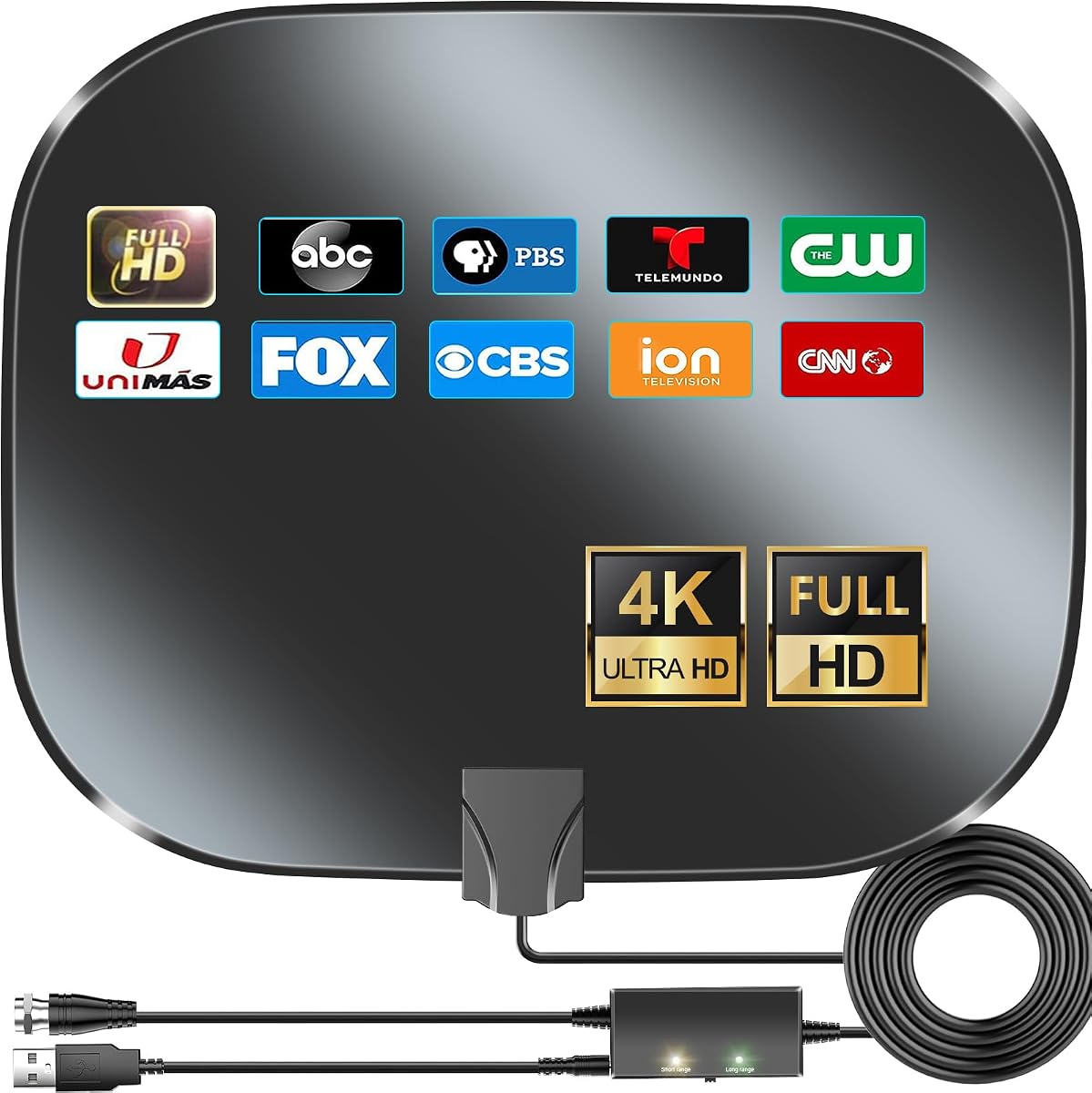
The DAANT TV Antenna Indoor Long Range is a straightforward indoor option with a 4.0 customer rating. It combines an upgraded Smart IC chip with a 16-foot coaxial cable, giving users enough length to move the antenna between a tabletop, wall, and window position without keeping it directly beside the television.
We may earn a commission when you buy through this link, at no additional cost to you.
Its standout quality is installation flexibility for an indoor design. The supplied cable uses a solid center conductor, dielectric insulation, three aluminum shielding layers, and a durable outer jacket. The antenna is designed to receive digital broadcasts including 4K, UHD, and 1080p HDTV signals where those formats are broadcast in the viewer's area.
The principal limitation is that it is intended only for indoor use. Thick walls, floors, metal objects, and other electronics can weaken signals, while the inability to mount it high above the home limits its usefulness in difficult fringe areas. It also does not support legacy analog televisions, although that is rarely a concern for current smart TV and HDTV buyers.
This is a sensible choice for renters, apartment residents, and users who want an uncomplicated indoor antenna with a useful amount of cable. Start with a window-facing placement, test both vertical and horizontal orientations, and rescan after each move. For buyers who want the fundamentals covered without a more complex installation, it offers a practical balance of simplicity and flexibility.
The same product is also included in the top picks because it provides a straightforward entry point for local over-the-air reception. Its signal chip, shielded cable, and placement tips make it more useful than a basic stick-style antenna, even though it cannot overcome every limitation imposed by indoor use.
The 16-foot coaxial lead is long enough to separate the antenna from the television and test several promising positions. Placement remains the most important part of setup, so this extra reach can matter more than another claimed range figure.
Installation involves connecting the coaxial plug to the TV's ANT/IN connector and running a channel scan. The manufacturer also recommends checking local tower information before setup so expectations reflect the stations actually available in the area.
We may earn a commission when you buy through this link, at no additional cost to you.
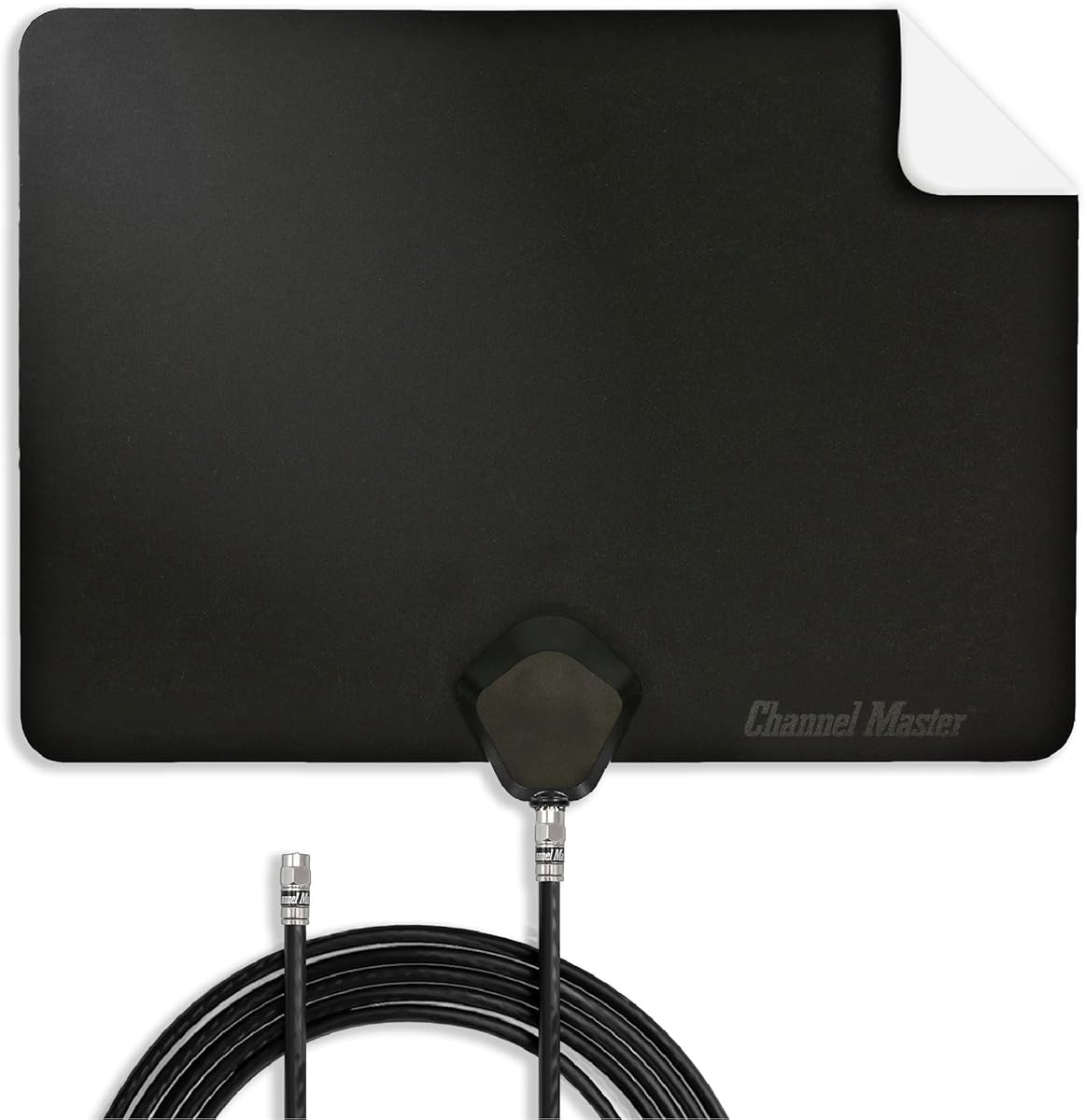
The Channel Master FLATenna has a 4.1 rating and offers a low-profile alternative to bulky amplified antennas. Its thin, lightweight, reversible black-and-white housing can blend into a variety of rooms, while its stated 35-mile range is positioned for practical urban and suburban reception.
We may earn a commission when you buy through this link, at no additional cost to you.
A major strength is its compatibility-focused design. It supports ATSC 3.0 NextGen TV and 4K broadcasts, and the included 12-foot professional-grade RG6 coaxial cable uses enhanced shielding to improve signal reliability. Local networks such as ABC, CBS, FOX, NBC, PBS, Univision, and Telemundo are available when broadcast coverage permits.
The shorter cable gives users less freedom to move the antenna than many competing products in this guide. Its indoor-only context also means that a window, wall, or high location is essential. Reverse mounting and the two-tone finish help with appearance, but neither changes the fundamental influence of walls, terrain, and interference on reception.
The FLATenna is most suitable for users who value a compact appearance, established manufacturer history, and broad digital television compatibility. It can serve as an attractive alternative to a conventional indoor antenna, particularly in a room where a larger housing would be intrusive. The included 12-foot lead should be planned carefully before installation.
Channel Master describes itself as a television antenna technology provider operating since 1949. That background does not guarantee reception in every location, but it adds useful context to a product designed for long-term indoor over-the-air viewing.
The flat, reversible housing is the FLATenna's defining visual feature. It can be placed on a tabletop, attached near a window, or mounted on a wall without looking like a traditional rooftop antenna indoors.
Support for ATSC 3.0 and 4K broadcasts makes this a practical option for modern tuner-equipped televisions. A NextGen-compatible tuner is still required to view ATSC 3.0 broadcasts, and actual station availability depends on local coverage.
We may earn a commission when you buy through this link, at no additional cost to you.
The TV Antenna for Local Channels, Digital Antenna for Smart TV Indoor earns a 4.7 rating, the highest numerical score among the listed products. It combines an 18-foot coaxial cable with an upgraded smart IC amplifier intended to strengthen weak signals and reduce cellular and radio-frequency interference.
We may earn a commission when you buy through this link, at no additional cost to you.
Its flexible installation is a major selling point. Although designed primarily for indoor use, the product can also be used outdoors, allowing buyers to move it toward a clearer signal path when apartment walls or household electronics prove obstructive. The 18-foot lead gives enough reach to place the antenna near a suitable window while keeping the television in a convenient location.
The product supports reception of local channels and advertises 4K and 8K HDR output. That does not mean every local station will be available in every format, since broadcast resolution and coverage remain controlled by the station and transmitter. The manufacturer clearly notes that reception varies with location, terrain, and weather, which is an important qualification for range claims.
This antenna is a strong general recommendation for viewers who need more placement flexibility than a compact indoor model offers. The amplifier may be particularly useful when a usable but imperfect signal is available. However, users should follow the instruction to read the manual, configure the television properly, and rescan channels after moving the antenna.
The combination of a strong rating, extended cable, and indoor-outdoor versatility makes it the most balanced choice in the list. It is especially attractive for renters and homeowners who cannot permanently mount an outdoor antenna but may want to experiment with placement as reception conditions change.
The smart IC amplifier is intended to improve weak signals and limit interference, but placement still controls the result. The 18-foot cable makes it possible to test a higher location or a window away from nearby devices without permanently repositioning the television.
Outdoor capability provides a useful fallback when indoor materials block signals. It should still be installed safely and in accordance with local guidance, particularly where weather exposure or property considerations are relevant.
We may earn a commission when you buy through this link, at no additional cost to you.
The Dual-Mode Indoor TV Antenna has a 4.2 rating and distinguishes itself with two selectable operating modes. Short-range mode is intended for locations within 35 miles of a broadcast tower, while long-range mode is designed for distances extending from 35 to 250 miles.
We may earn a commission when you buy through this link, at no additional cost to you.
The mode system gives users a concrete way to match amplification behavior to their location. An upgraded smart IC chip filters cellular and FM interference and is described as supporting 4K, UHD, and 1080p broadcast reception where available. The included 16.5-foot cable offers enough movement for placement near a window or on a higher wall.
Choosing the wrong mode can result in poor reception, and the product's own guidance recommends checking tower distance before scanning. Another limitation is its focus on UHF and high-VHF bands; some low-VHF channels numbered 2 through 6 may require another compatible antenna. The manufacturer also cautions that amplification is most useful where a reasonably strong signal already reaches the antenna.
This model suits buyers who want explicit distance-based controls rather than a simple on-off amplifier. It is particularly useful for suburban and rural households that know their approximate tower distance. Following the recommended sequence—check coverage, select the correct mode, place the antenna high, and rescan—will produce a more dependable setup than changing multiple random settings.
Its detailed troubleshooting guidance adds practical value. If channels are missing, the instructions recommend changing antenna position, switching modes, and rescanning, which reflects the reality that one fixed placement is not guaranteed to work for every home.
The short-range and long-range settings simplify one of the most important setup decisions. Checking local tower information first helps prevent the common mistake of applying maximum amplification when a lower setting would better suit the signal environment.
The lack of low-VHF support for channels 2 through 6 is clearly disclosed. Buyers who know those stations are essential should verify their broadcast bands or consider a separate low-VHF-compatible solution before installation.
We may earn a commission when you buy through this link, at no additional cost to you.
The Vansky Amplified Indoor Antenna has a 4.0 rating and offers a useful degree of control through its detachable signal amplifier. If a stable signal cannot be locked with the booster active, the manufacturer recommends removing it and scanning again to identify the better configuration.
We may earn a commission when you buy through this link, at no additional cost to you.
That flexibility matters because more amplification is not always better. A nearby transmitter can produce a signal that is strong enough to overload or interfere with the tuner, while a distant signal may benefit from added gain. The product supports 720p, 1080i, 1080p, 4K, and ATSC formats, depending on the television tuner and the broadcast signal.
Its 16.5-foot high-quality coaxial cable enables the indoor antenna to be placed on a window or wall rather than directly beside the television. The product covers both VHF and UHF bands, making it more broadly compatible than the dual-mode model that omits low-VHF stations. It is designed for indoor use with flame-retardant materials and corded electric power.
Reception ultimately depends on local broadcast coverage, topography, and obstacles such as thick walls or valleys. The manufacturer explicitly recommends checking tower maps before buying and rescanning after every movement. That guidance makes the antenna approachable for first-time users who know how to connect a TV but are unfamiliar with broadcast reception.
This model is best for users who want to compare amplified and unamplified results rather than leave the booster permanently engaged. It works particularly well for indoor homes where a window is available and the television is not directly beneath it. Buyers seeking a rooftop solution should consider a more purpose-built outdoor antenna instead.
The removable booster allows users to compare two configurations with a channel scan. This can help when signals are strong but unstable and may prevent unnecessary amplification from compounding interference.
Support for VHF and UHF makes this suitable for more local stations than designs limited to UHF and high-VHF. Nevertheless, the actual channel list remains controlled by the viewer's coverage area and the stations broadcasting in their region.
We may earn a commission when you buy through this link, at no additional cost to you.
The Tendodo Indoor/Outdoor Digital Antenna carries a 4.4 rating and combines a 33-foot coaxial cable with a dual-amplifier design. Its indoor-outdoor versatility and range of mounting options distinguish it from compact units intended only for placement beside a television.
We may earn a commission when you buy through this link, at no additional cost to you.
The supplied double-sided tape provides a renter-friendly way to attach the antenna to a window, wall, or smooth surface without drilling. Mounting brackets support attic or rooftop installation for users who can make a permanent exterior setup. The long cable also makes the antenna suitable for RVs and campers, where changing locations is common.
A smart chip and dual amplifiers are intended to improve weak signals and filter interference from cellular towers and radio frequencies. The weather-resistant, flame-retardant casing is designed for use on windows, balconies, patios, attics, or rooftops. Actual performance still depends on tower distance, obstructions, and interference, so the product's range language should not be interpreted as a guarantee.
Setup is described as a two-step process: connect the coaxial cable to ANT IN or CABLE IN and run a channel scan on a television with a built-in digital tuner. Older analog televisions require a digital set-top box. Rescanning after each adjustment is essential because even a small change in angle can affect which channels lock.
This antenna is an appealing option for renters, travelers, and households that want one product to move between several environments. It is less convenient than a small plug-and-play indoor antenna, but that trade-off buys valuable placement freedom. Buyers should select the mounting method that secures the unit safely without creating cable strain.
Adhesive mounting, brackets, and the 33-foot lead give this model more installation options than most indoor competitors. That makes it useful when the best reception point is far from the television or changes as the home is rearranged.
The removable, adhesive-based installation is particularly relevant to apartments, rentals, and recreational vehicles. Clean removal makes the antenna easier to reposition than a permanently mounted rooftop system.
We may earn a commission when you buy through this link, at no additional cost to you.
The Five Star HDTV Antenna is a substantial outdoor option with a 4.1 rating. Its upgraded Yagi design uses extended elements to receive VHF and UHF signals, while the included 40-foot RG6 coaxial cable gives installers considerable freedom to route the connection from a roof, attic, chimney, eave, or mast.
We may earn a commission when you buy through this link, at no additional cost to you.
The product is advertised for reception across long distances and supports 4K and ATSC 3.0 signals. It also states that the antenna can deliver VHF, UHF, and HD signals to multiple televisions when an appropriate splitter is used. The package includes the antenna parts, mounting bracket, J-pole, and an optional TV splitter.
A directional outdoor antenna can outperform compact indoor models because it is not restricted by the walls and ceiling around a television. Its disadvantage is installation effort. Users must assemble the elements, secure the unit, route a long cable safely, and orient the antenna toward transmitters. The stated maximum range depends on geography, terrain, obstructions, and signal strength.
This is a better fit for homeowners with difficult reception, rural locations, or access to a safe exterior mounting point than for apartment residents seeking a temporary indoor solution. The extensive included hardware helps, but appropriate tools and basic installation knowledge may still be needed. The antenna should also be mounted where it will not be exposed to unnecessary wind load or hazards.
For viewers who need a permanent, directional outdoor system, the Five Star provides more relevant cable length and mounting flexibility than the indoor products in this guide. Its advantages become clear when reception must be extracted from a weak indoor location.
Long Yagi elements can focus reception toward broadcast transmitters, a major advantage over indoor flat designs. Accurate aiming and a stable mount are important because movement or misalignment can change the result.
The bracket, J-pole, splitter option, and 40-foot RG6 cable support a more permanent installation. Buyers should verify safe attachment points and plan cable routing before assembly to avoid rework.
We may earn a commission when you buy through this link, at no additional cost to you.
The Indoor Outdoor 4K TV Antenna offers a combination of amplified reception and flexible placement. Its supplied information does not provide a customer rating, so this review does not assign one. The antenna includes a built-in high-gain amplifier and multi-layer shielded coaxial cable intended to reduce signal loss.
We may earn a commission when you buy through this link, at no additional cost to you.
Its installation options cover indoor tables as well as outdoor roofs, attics, and recreational vehicles. The product supports 4K UHD and 1080p HDTV broadcasts where available and works with smart TVs, HDTVs, and digital televisions. A standard connection to the ANT port followed by a channel scan makes the basic setup accessible.
The main uncertainty is cable length. Unlike many competing products, the supplied specification does not state an exact measurement, which makes it difficult to plan a room layout or exterior run before buying. The lack of a listed customer rating also means buyers have less visible performance feedback to consider.
The product's instructions recommend repositioning the antenna and rescanning whenever channels are missing or the count is low. That process is essential because orientation, nearby electronics, and building materials can influence results. It is most appropriate for buyers who value flexible mounting and know they can relocate the unit if the initial placement is weak.
Although its feature set overlaps with several better-documented models, this antenna remains a viable option for RV owners, renters seeking removable placement, and viewers who want one unit that can transition between indoor and outdoor environments. Checking the final package contents and cable length before ordering would be especially sensible.
The same unit can move from a tabletop to a window, attic, roof, or RV, reducing the need to maintain separate indoor and outdoor antennas. Placement should still follow safe mounting practices outdoors.
The integrated high-gain amplifier and shielded cable target signal loss and weak reception. As with any amplified antenna, channel rescanning and placement testing remain essential after every adjustment.
We may earn a commission when you buy through this link, at no additional cost to you.
The Televes Ellipse Mix 148883 is the most technically sophisticated antenna in this guide, pairing a 4.6 customer rating with automatic gain control, integrated interference filtering, and a directional triple-boom design. It is designed for attic or outdoor installation and targets weak High VHF and UHF signals in suburban, rural, and fringe areas.
We may earn a commission when you buy through this link, at no additional cost to you.
Its TForce preamplifier automatically adjusts amplification independently by band, using the listed 36.5 dBi for High VHF and 40 dBi for UHF. This band-specific approach aims to preserve stable output as conditions change, avoiding both inadequate gain and overload. Integrated FM, LTE, 4G, and 5G filters help reduce interference from nearby cellular and radio sources.
The curved triple-boom reflectors focus reception toward broadcast towers, improving signal quality while reducing multipath interference. Corrosion-resistant aluminum, stainless-steel hardware, and durable ABS plastics are designed for outdoor exposure. The package includes a UL-listed 12-volt dual-output power inserter and mast clamp, while the antenna can also operate passively if power is unavailable.
Installation demands more planning than a compact indoor model. It suits rooftop, wall, balcony, or attic positions and accommodates mast diameters from 0.78 to 2.4 inches. Directionality means careful aiming matters, and users should identify transmitter locations before mounting. Its NextGen TV readiness also requires an ATSC 3.0 tuner for the relevant broadcasts.
This is the premium recommendation for households prepared to mount a serious directional antenna. Its gain management and filtering are more nuanced than the simple booster switches found on many budget products. For viewers who cannot install an exterior unit, a long-cable indoor model will be more practical.
Automatic band-by-band gain control is the defining feature. It adjusts amplification as signal conditions fluctuate, which can help maintain a stable picture without applying maximum boost indiscriminately.
Integrated FM and cellular filtering is especially relevant near towers, base stations, and other interference sources. The filters reduce unwanted energy without requiring users to add separate external components.
The aluminum elements, stainless-steel hardware, and ABS components are intended to tolerate rain, humidity, and ultraviolet exposure. A stable, accurately aimed mount is essential for preserving the antenna's directional performance.
We may earn a commission when you buy through this link, at no additional cost to you.
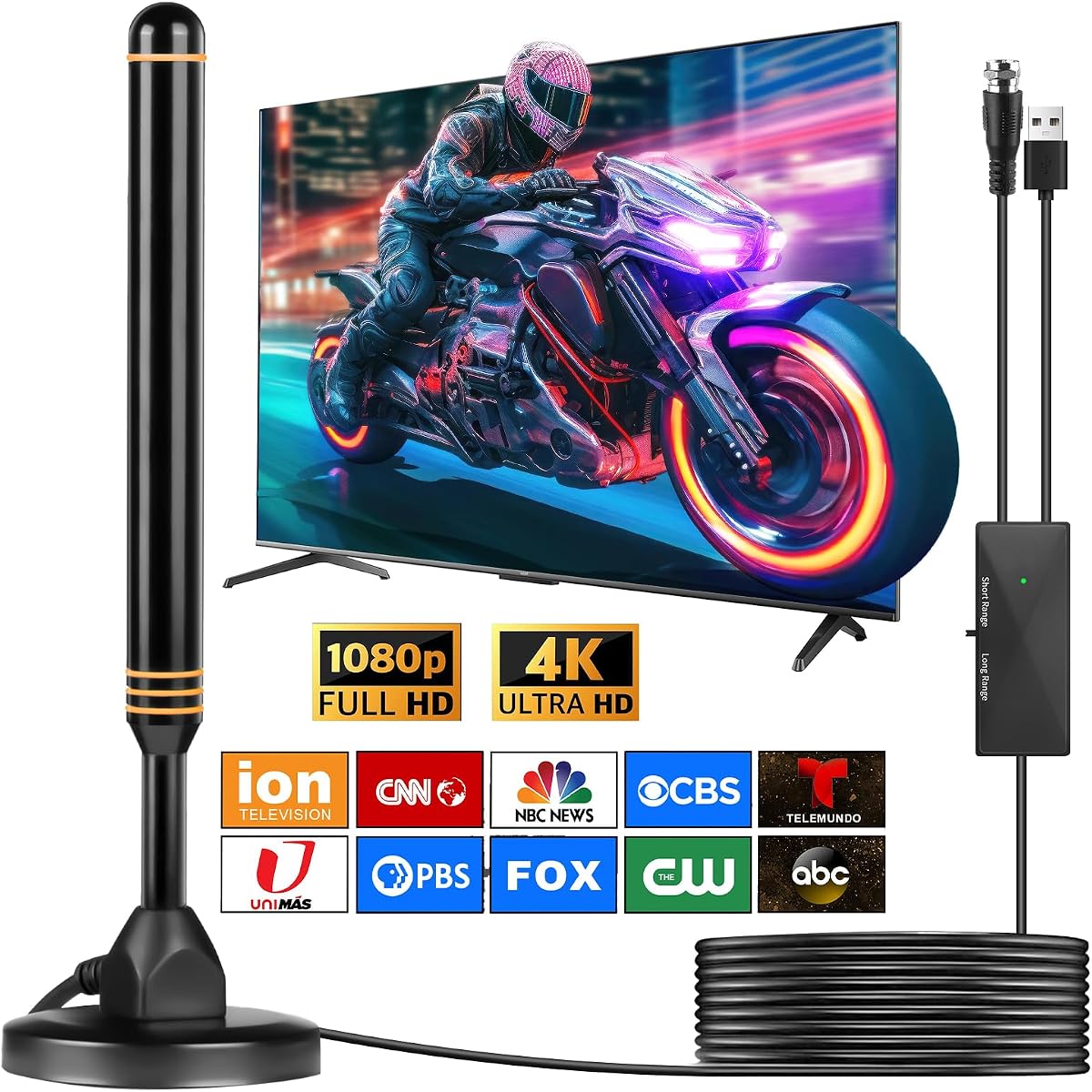
The Multicolored Indoor TV Antenna is a visually customizable option with no customer rating listed in the supplied data. It supports 4K and 1080p digital broadcasts, includes a 16.5-foot cable, and can be used indoors or outdoors. Interchangeable blue and orange rubber rings let the antenna fit a room's color scheme.
We may earn a commission when you buy through this link, at no additional cost to you.
The decoration rings have no electrical or reception function, but they make the product easier to integrate into a visible location. The antenna housing is made from flame-retardant double PC soft material rather than PVC, with the manufacturer citing moisture and lightning protection as part of its material benefits.
Installation requires attaching the magnetic base to the antenna linkage by removing the red rubber sleeve and securing the connection. The antenna can then sit on a table, attach to a wall or window, or be secured outdoors with nylon or screws. Setup continues with a connection to the TV's CABLE-ANT IN port and a channel scan.
Because this model lacks a listed customer rating, it should be evaluated primarily on its physical design and supplied specifications. The long cable supports placement testing, while indoor-outdoor flexibility is useful for renters or users who may move it. As with every antenna, the station list will depend on coverage and the chosen position.
This antenna is best for buyers who want a television accessory to blend into a colorful or visible setup rather than disappear completely. It offers credible baseline features, but those who need stronger interference filtering, automatic gain control, or a longer directional setup may prefer another model from the list.
The blue and orange rings are purely visual and do not improve range, filtering, or signal strength. Their benefit is personalization, allowing the antenna to coordinate with furniture, decor, or a visible mounting location.
The magnetic base supports tabletop use, while wall and window mounting options broaden the placement search. Buyers should follow the required base-assembly sequence and rescan channels after relocating the antenna.
We may earn a commission when you buy through this link, at no additional cost to you.
The right coaxial antenna is the one that can receive the stations available at your address, reject interference in your environment, and be installed safely where signals are strongest. Tower distance is only the starting point; terrain, walls, directional placement, tuner capability, and practical mounting requirements also shape the outcome.
Check the available stations and transmitter distances for your exact address before choosing an antenna. Indoor units are most practical near strong transmitters, while outdoor directional systems become more attractive in suburban, rural, hilly, or obstructed locations. A coverage map can reveal which channels use VHF, UHF, or lower VHF bands, helping you avoid a model that cannot receive an essential station. Remember that a map is a planning tool rather than a guarantee of reception.
Indoor antennas are convenient, discreet, and generally easier to install, but walls, floors, appliances, and metal can degrade reception. Indoor-outdoor models provide flexibility for renters, vehicles, and temporary installations. Permanent outdoor systems generally offer the best directional performance, although they require assembly, safe mounting, weather resistance, and suitable cable routing. Choose the environment you can realistically use rather than the one with the largest theoretical range.
Amplification can help preserve a weak signal, but it cannot create reception where no usable signal reaches the antenna. Strong interference can also worsen when excessive gain is applied. Automatic gain control is the most sophisticated approach because it adjusts amplification by band and signal conditions. Manual boosters are more affordable, yet they work best when users compare settings and rescan. Removable or selectable amplification gives buyers valuable control.
Cable length determines how far the antenna can be separated from the television. A lead of at least 12 to 18 feet makes it easier to reach a window or higher location, while longer runs suit outdoor mounts and RV setups. Quality and shielding matter too: RG6 is a common choice for longer installations because it minimizes loss and interference. Avoid unnecessary excess cable, and route it securely without sharp bends or strain.
A smart TV with a built-in ATSC tuner can usually connect directly to an antenna, while older analog sets require a compatible digital converter. VHF and UHF support covers most broadcast stations, but some units omit low-VHF channels 2 through 6. ATSC 3.0 compatibility is useful for NextGen TV, although the television must include the appropriate tuner. Verify both the antenna bands and the TV capabilities before buying.
Homes near cellular towers, radio transmitters, or reflective buildings may need a design that rejects unwanted signals. Dedicated FM and cellular filters provide more targeted protection than a general smart chip. Directional antennas focus energy toward transmitters and can reduce multipath interference, but they require accurate aiming. A flat or reversible indoor design may be easier to reposition, while a boom-style design generally requires a fixed mount.
Outdoor antennas need corrosion-resistant elements, durable hardware, and a stable mounting point. Check whether the package includes a bracket, mast clamp, J-pole, or power inserter, and determine whether additional tools are required. Adhesive mounts are convenient for temporary placement but may be less secure in exposed locations. Never attach an outdoor antenna where it could fall, contact power lines, or create a cable hazard.
Digital televisions generally detect changes after each channel scan, so repositioning an antenna requires a new scan to reveal the effect. Test near a window, at a higher elevation, and in both horizontal and vertical orientations. Move away from metal objects, thick walls, and electronics. A successful setup may require several small adjustments, so choose a design that is easy to move or that can be permanently aimed after testing.
Begin by locating the TV's ANT/IN or CABLE IN connector and connecting the coaxial plug firmly. Older analog televisions may require a digital set-top box with its own tuner. Before scanning, place the antenna near a window or higher up, point it toward the local transmitter area, and avoid nearby metal objects and electronics. Outdoor models should be assembled and mounted according to their instructions before the cable is connected.
Run the television's channel search after installation. If important stations are missing, move the antenna a small distance, change its orientation, and scan again. Test both short-range and long-range modes or powered and unpowered amplification when those options are available. For directional outdoor antennas, fine alignment may require several scans, and the supplied power inserter should be installed in the correct position within the cable run.
For care, inspect outdoor connections and mounting hardware periodically, especially after severe weather. Do not dismantle the antenna's sealed electronics, and keep the coaxial cable free from kinks, sharp bends, and excessive pulling. Clean removable indoor components with a dry or lightly damp cloth according to the manufacturer's instructions. When reception changes unexpectedly, rescan and inspect connections before assuming the antenna itself has failed.
The usable distance depends on the antenna, transmitter power, terrain, obstructions, interference, and television tuner. Product range figures are best treated as maximum or idealized claims rather than guarantees. Check the stations available at your address and compare them with the antenna's supported bands and installation type before buying.
No. Amplification can strengthen a weak but usable signal, but it cannot create a signal that never reaches the antenna. Excessive amplification can also overload a tuner or increase interference. Automatic gain control, removable boosters, and selectable modes are useful because they let the system adjust to local conditions.
Most current smart TVs include a built-in ATSC tuner and an ANT/IN connector designed for a standard coaxial antenna. Older analog televisions generally need a digital set-top box. Also confirm that the antenna supports the VHF or UHF bands used by local stations, particularly if you need channels 2 through 6.
Your television stores the results of its most recent channel scan. Moving or rotating the antenna changes signal strength and direction, so the receiver needs new information to identify available channels. Rescanning after every placement change is one of the simplest and most effective ways to optimize reception.
An outdoor antenna generally has access to stronger and less obstructed signals, making it preferable for weak coverage or challenging interiors. It also requires more installation work and may not be permitted on every rental property. Indoor or indoor-outdoor antennas are more convenient for apartments, renters, vehicles, and temporary setups.
Start near a window and place the antenna as high as practical, then test different orientations. Keep it away from metal objects, thick walls, computers, game systems, and other electronics. The longest cable that remains manageable is useful because the best indoor position may not be next to the television.
It matters only if your local broadcaster offers ATSC 3.0 NextGen TV and your television includes a compatible tuner. An ATSC 3.0-ready antenna cannot display those broadcasts on a television that lacks the necessary tuner. For current HDTV and 4K broadcasts, check the television's supported broadcast formats as well.
First confirm that the television has completed a channel scan and that the coaxial connector is secure. Move the antenna, change its orientation, and rescan. Try different amplifier settings, keep the unit away from electronics and metal, and check local coverage maps. For a fixed outdoor installation, verify that the antenna remains correctly aimed and securely mounted.
The DAANT Indoor Long Range is the best budget starting point for straightforward indoor reception, while the Amplified Smart TV Antenna stands out as the editor's choice because its 18-foot cable, smart amplifier, and indoor-outdoor flexibility offer an excellent balance. The Televes Ellipse Mix earns the premium recommendation for buyers who can install a carefully aimed outdoor system and want advanced gain control with integrated interference filtering.
Prioritize local coverage, usable broadcast bands, and a safe installation location before focusing on the largest range claim. A long cable, appropriate amplification, and effective filtering can improve results, but placement remains the decisive factor. Match the antenna to the home rather than assuming a more powerful-looking device will overcome every obstruction.
Finally, review the current product listing, included components, cable length, tuner requirements, and installation instructions before purchasing. Product configurations and manufacturer details can change, and confirming the latest information helps ensure that the selected coaxial antenna is compatible with your television and installation plan.