
Air Quality Monitor Indoor, 10-in-1
4.8Editor score
Ten real-time air readings
Color-coded air quality display
Bluetooth time calibration
Our Portable CO2 Meter guide compares ten models for accuracy, portability, displays, alerts, power options, and indoor air monitoring.
A portable CO2 meter helps reveal whether an enclosed room has enough fresh air for comfortable, productive use. The most useful models combine reliable sensing with a readable display, practical alerts, and the flexibility to move between bedrooms, offices, classrooms, vehicles, and other indoor spaces.
We compared the supplied specifications, measurement ranges, sensor types, power options, alert functions, displays, portability, and intended applications. The roundup includes dedicated CO2 meters, broader indoor air quality monitors, and two carbon monoxide detectors that should never be mistaken for CO2 instruments.
Each review explains what the product does well, where its limitations matter, and who is most likely to benefit from it. Ratings and availability can change, and product prices fluctuate, so readers should confirm the latest listing details and current cost before purchasing.
Choosing a portable CO2 meter starts with the environment you want to understand. A bedroom occupant may prioritize quiet operation and an easy-to-read display, while a classroom, office, or workshop may need alarms, calibration options, larger measurement ranges, or data logging. A broader indoor air quality monitor can add TVOC, formaldehyde, particulate readings, or AQI, but a dedicated CO2 meter often provides a more focused tool for checking ventilation.
Our comparison evaluates the ten listed products against the same practical criteria. We pay particular attention to NDIR versus multi-sensor designs, supported CO2 ranges, temperature and humidity measurements, battery life, charging or power requirements, alert behavior, and the ease of interpreting readings. This makes it possible to compare simple indoor monitors with professional handheld meters and multi-function air quality devices on a like-for-like basis.
The list reveals several distinct approaches. The top picks cover a broad indoor monitor, a focused portable NDIR detector, and a wireless monitor suited to longer-term tracking. Other entries emphasize exhaustive environmental readings, built-in alerts, rechargeable portability, wide measurement ranges, or low-cost multi-sensor functionality. As always, check current prices and listing details because costs and offers can change.
4.8Editor score

4.3Editor score

4.7Editor score
The table below compares all ten devices by sensor coverage, CO2 range, environmental readings, portability, power, and alerts, making it easier to identify the right monitor for indoor air checks, travel, professional surveys, or long-term ventilation tracking.



The Temtop CO2 Monitor is a focused indoor air meter designed to track carbon dioxide, temperature, and humidity in one compact device. Its supplied rating is 4.3, but its detailed NDIR specification is the most notable part of the package. The monitor covers 400–5000 ppm and includes temperature and humidity measurements, giving users enough context to decide when a room needs ventilation.
We may earn a commission when you buy through this link, at no additional cost to you.
Its stated accuracy is ±40 ppm plus 5% of the reading between 400 and 2500 ppm, with one-ppm resolution and a five-second refresh rate. Those figures make it more informative than a simple three-light indicator. Customizable settings can disable both audible alerts and display illumination, which is useful in bedrooms and other quiet spaces where repeated sounds or light could be distracting.
The main trade-off is its power model. Although the battery is described as lasting up to 70 days on standby, Temtop advises keeping the unit plugged in for real-time monitoring. That recommendation makes sense for continuous awareness but limits the benefit of the internal battery when someone wants a genuinely untethered installation. It also measures carbon dioxide rather than carbon monoxide, so buyers must not treat it as a life-safety CO alarm.
This is an appealing choice for homes, offices, schools, nurseries, and grow tents where someone wants a focused check of ventilation without paying for a large multi-sensor air quality console. Its slim design, mounting support, fast updates, and configurable alerts make it a versatile first choice. The best environment is one where continuous USB power is practical and a clear CO2 trend matters more than tracking formaldehyde, particulates, or TVOC.
The five-second refresh rate and one-ppm resolution make short-lived changes easier to see than with slower handheld devices. This is particularly helpful when someone opens a window, enters a crowded room, or wants to compare readings before and after ventilation.
Disabling alerts and display lighting gives the monitor a role in bedrooms, nurseries, and offices where uninterrupted rest or concentration matters. The same customization also lets users rely on visual readings without recurring sound.
We may earn a commission when you buy through this link, at no additional cost to you.
This handheld CO2 meter is aimed at people who need more than a basic room check. It carries a 4.4 rating and combines a 0–9999 ppm NDIR CO2 sensor with temperature, relative humidity, dew point, and wet bulb measurements. The broad range makes it relevant for indoor air surveys, offices, classrooms, factories, hospitals, hotels, and travel use.
We may earn a commission when you buy through this link, at no additional cost to you.
The standout feature is its measurement depth. CO2 accuracy is stated as ±50 ppm or ±5% of the reading from 0–2000 ppm and ±10% of the reading from 2000–9999 ppm. Temperature accuracy is ±0.6°C, while humidity accuracy is ±3% RH. Manual calibration for CO2 and humidity adds control for users familiar with field instruments, while the stable NDIR sensor supports dependable monitoring.
Power flexibility is good but not entirely self-contained. A battery is included, and the meter automatically stops using it when a 9V adapter is connected. The adapter itself is not included, so a buyer who expects one must obtain it separately. The handheld format and extra environmental calculations also make this less convenient for a minimalist bedroom than a compact dedicated monitor.
Choose this model for professional-style indoor air quality checks, especially when the expected concentration may exceed 5000 ppm or when dew point and wet bulb are important to the task. It is less compelling for a user who only wants a glance at bedroom air and no calibration. For that broader audience, the simpler models in this list may be easier to place and maintain.
The 0–9999 ppm span distinguishes this meter from many compact indoor devices. It offers useful headroom when assessing crowded or poorly ventilated spaces where readings may rise well above ordinary room conditions.
Dew point and wet bulb readings add value for people conducting more detailed IAQ surveys. They complement CO2, temperature, and humidity rather than replacing the primary focus on ventilation.
We may earn a commission when you buy through this link, at no additional cost to you.
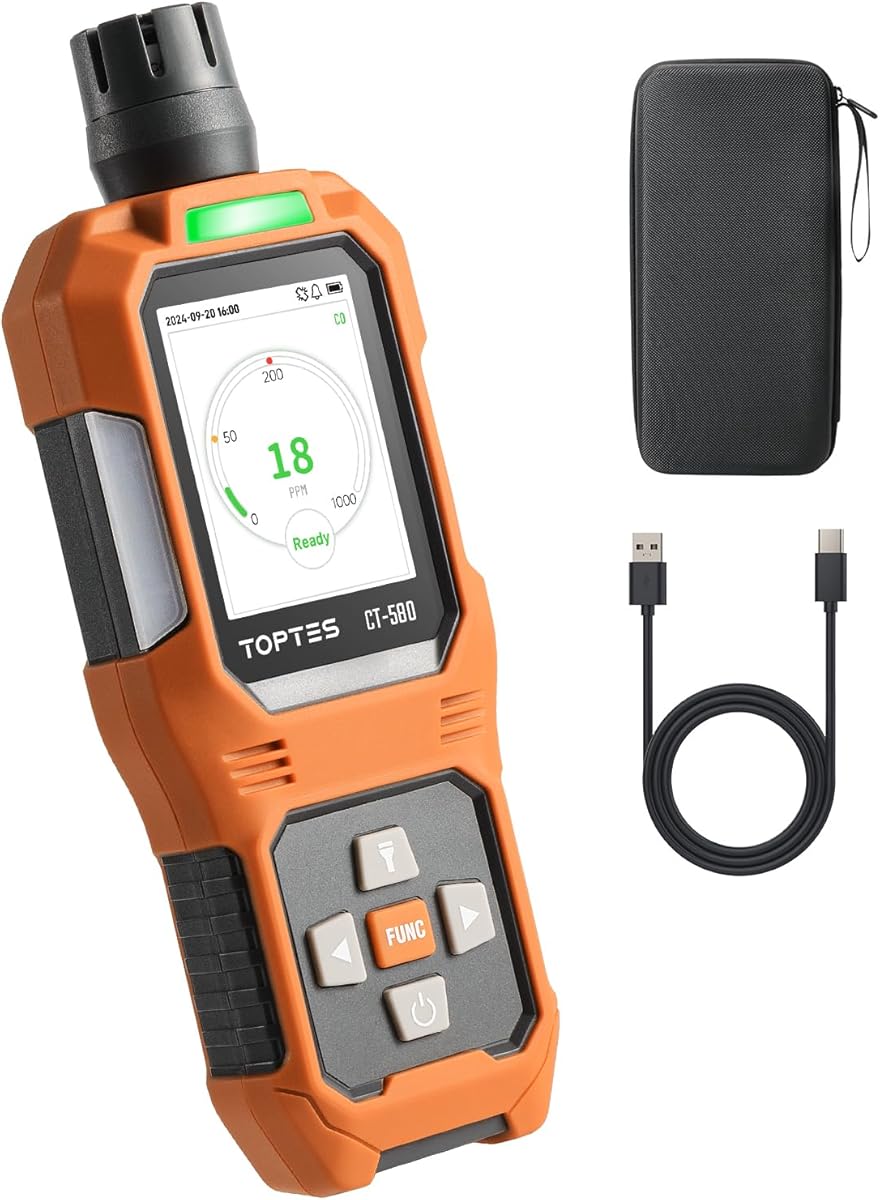
The TOPTES CT-580 is included because it is a portable gas meter, but it measures carbon monoxide rather than carbon dioxide. Its 4.5 rating, 0–1000 ppm range, and rechargeable design make it relevant to safety-focused searches, while its lack of CO2 sensing makes it the wrong tool for evaluating indoor ventilation.
We may earn a commission when you buy through this link, at no additional cost to you.
Its high-sensitivity DDS sensor is described as responding within 0.3 seconds, with two selectable alarm thresholds. When a threshold is reached, the indicator light, audible alarm, and vibration activate together. That multi-sensory warning system is useful in noisy or dark work environments where a sound alone might not be noticed, although it also requires the user to understand and configure the thresholds correctly.
The ABS housing, adjustable brightness, automatic screen-off, built-in flashlight, and USB-C charging support field use. A protective case and Type-C cable are included. The advanced menu supports alarm history and zero or standard gas calibration, but these options make the device more involved than a simple consumer indoor monitor and should not be treated as a substitute for listed residential CO alarms.
Buy the CT-580 for portable carbon monoxide inspection in camping, travel, industrial, or professional settings where a handheld CO meter is specifically needed. Do not buy it to measure CO2, judge room ventilation, or replace a home CO alarm. It earns its place as a safety and professional inspection instrument, but it answers a different question from the dedicated CO2 products in this roundup.
Combining audible, visual, and vibration warnings makes the detector easier to interpret in environments where the user may not hear a conventional alarm. This is a practical field feature rather than a benefit for checking indoor CO2.
USB-C charging, adjustable screen brightness, automatic screen-off, and a built-in flashlight support mobile inspections. The included protective case makes the unit easier to carry between jobs.
We may earn a commission when you buy through this link, at no additional cost to you.
The Klein Tools ET110 is another carbon monoxide instrument rather than a carbon dioxide meter, and that distinction is essential when choosing it. It has a 4.6 rating, a clearly defined 0–1000 ppm CO range, and a backlit display that shows both concentration and temperature in Fahrenheit or Celsius.
We may earn a commission when you buy through this link, at no additional cost to you.
The built-in short-term exposure limit alarm and dual alarm thresholds are the key features. Low alerts activate at 35 ppm and high alerts at 200 ppm, while both audible and visual warnings help ensure the user notices changing conditions. This fixed, easy-to-understand arrangement suits inspectors who need prompt CO warnings without navigating a complex menu.
Power is handled with four included AAA batteries, and the meter shuts off after 20 minutes of inactivity to conserve them. A carrying pouch is also included, reinforcing its role as a portable inspection tool. The limitation is equally straightforward: there is no CO2 sensing, and it should not be used to assess whether a room has adequate fresh air or to replace a certified home CO alarm.
The ET110 is best suited to contractors, inspectors, and users who need a straightforward portable CO meter with recognizable thresholds. Its high rating, protective alerts, simple display, and included accessories make it a credible specialist choice. It ranks well among the products here for portability, but only for carbon monoxide work; shoppers whose main goal is a portable CO2 meter should look elsewhere in the list.
The 35 ppm and 200 ppm alarms remove the need to interpret a complicated menu. This makes the device convenient for repeated checks where the primary goal is immediate notification of carbon monoxide exposure.
The included pouch protects the meter during transport, while the compact body and automatic power-off support routine job-site use. Display backlighting and dual-unit temperature readings improve readability in changing conditions.
We may earn a commission when you buy through this link, at no additional cost to you.
The Air Quality Monitor Indoor, 10-in-1 Portable Smart Real-Time CO2 Detector is the broadest environmental instrument in the list. It has a 4.8 rating and measures CO2, formaldehyde, TVOC, temperature, humidity, AQI, PM2.5, PM1.0, and PM10 in real time, with a clock as the tenth function.
We may earn a commission when you buy through this link, at no additional cost to you.
Its high-definition color screen changes according to air quality and displays average concentrations, giving users a quick visual overview. Dedicated electrochemical sensors are used for HCHO and TVOC, while a sensor array handles the broader set of readings. Smart calibration is designed to maintain stable output without frequent manual adjustments, although the absence of a published numerical accuracy specification makes interpretation less technical than on some dedicated CO2 meters.
Operation is mostly accessible: hold the power button to switch the device on or off, press once for Celsius or Fahrenheit, twice for sound, three times for calibration, and four times for screen sleep. Bluetooth connection to the MT13S sets the time; it is not described as a full remote monitoring system. The dense menu may feel less intuitive than a focused CO2 display, especially to a first-time user.
This is the best budget-oriented choice for a buyer who wants one compact device to check several common indoor concerns. It is well suited to bedrooms, living rooms, offices, cars, schools, hotels, basements, restaurants, campsites, and grow rooms. Choose it for breadth and a high rating, but choose a dedicated NDIR model when documented CO2 precision, narrow measurement focus, or professional calibration is the priority.
The combination of CO2, HCHO, TVOC, AQI, and three particle measurements is unusual in a compact portable format. It gives users a broad environmental snapshot rather than forcing separate devices for common indoor conditions.
The color-changing display makes a poor reading noticeable even from a distance. Average-value tracking and preset warning behavior add context without requiring continuous attention to a changing numeric display.
We may earn a commission when you buy through this link, at no additional cost to you.
The Aranet4 is the leading choice for long-term indoor air monitoring because it combines focused NDIR CO2 measurement with an unusually long stated battery life of up to four years. Its 4.7 rating reflects a well-rounded feature set, and the e-ink display keeps the prominent CO2 number easy to check without the visual busyness of a conventional color screen.
We may earn a commission when you buy through this link, at no additional cost to you.
Temperature, relative humidity, and atmospheric pressure are measured in real time. Color coding and an optional buzzer flag elevated CO2 levels, while the accompanying smartphone app can display and analyze up to 90 days of historical information through user-friendly graphs. That history is the major advantage for offices, schools, and home users who want to connect ventilation routines with changes over days or weeks.
The device is made in the European Union and uses NDIR technology for CO2 measurement, a sound choice for a product centered on reliable ventilation readings. The main trade-off is economic: it costs substantially more than entry-level multi-sensor monitors. The app also adds value rather than being essential, since the physical display remains the primary interface.
Choose Aranet4 when you want a monitor that can stay in place for long periods, provide a dependable CO2 snapshot, and reveal longer-term patterns. It is particularly compelling for a home office, meeting room, classroom, or bedroom where someone wants to test whether consistently high readings are resolved by better ventilation. For occasional quick checks, a less elaborate portable model may be sufficient.
The 90-day app history turns the monitor into more than a real-time display. Users can compare repeated room conditions, identify recurring peaks, and assess whether schedule or ventilation changes make a meaningful difference.
An e-ink display and power-efficient design support the stated four-year battery life. Wireless operation makes it easier to place the monitor at a representative breathing height without managing a cable or outlet.
We may earn a commission when you buy through this link, at no additional cost to you.
The AK3 8-in-1 Air Quality Monitor is designed for portable indoor checks, with a stated weight of just 4.8 ounces and a rechargeable battery. Its 4.5 rating reflects a balanced combination of CO2, HCHO, TVOC, AQI, temperature, humidity, time, and overall air quality status.
We may earn a commission when you buy through this link, at no additional cost to you.
A 30-second automatic test runs at startup and allows the sensors to stabilize before monitoring begins. The device then tracks conditions in real time using high-sensitivity sensors. The specifications do not publish a numerical CO2 accuracy range, so this model is better viewed as a convenient broad-spectrum indicator than a calibrated professional instrument.
Its strongest advantages are quietness and mobility. A double-click activates Silent Mode, while a one-button Celsius/Fahrenheit switch simplifies temperature interpretation. The built-in battery supports wireless checks, and Type-C power can maintain continuous monitoring. The trade-off is that the listing describes a long battery life without providing a specific runtime, which makes the exact duration difficult to compare with the Aranet4 or Temtop.
AK3 is well matched to bedrooms, nurseries, home offices, meeting rooms, vehicles, hotel rooms, and business trips. Choose it when a lightweight, rechargeable device with a quiet mode is more important than published calibration or accuracy details. It is also a practical choice after bringing new furniture into a room, when a user wants a quick combined look at CO2 and other common indoor indicators.
Silent Mode is especially useful at night or during meetings, where an audible warning could be disruptive. The display still communicates the monitored condition while reducing unnecessary noise.
The 30-second automatic test gives the sensor array time to stabilize before results are used. This startup routine helps reduce inconsistencies caused by changing conditions immediately after power-on.
We may earn a commission when you buy through this link, at no additional cost to you.
The INKBIRDPLUS PTH-10C is a small, dedicated CO2 monitor built around an NDIR sensor, a full-color LCD, and simple status lights. Its 3.7 rating is the lowest among the products here, which makes independent consideration important. Its appeal lies in compactness and straightforward ventilation feedback rather than broad multi-pollutant measurement.
We may earn a commission when you buy through this link, at no additional cost to you.
Three lights classify concentrations as good from 400–699 ppm, medium from 700–1499 ppm, and danger from 1499–5000 ppm. The display gives a more detailed visual presentation, while an audible alarm is triggered above 1500 ppm. Users can customize the alarm value, allowing the threshold to suit a particular room or routine, though the published category ranges should be used as guidance rather than a universal health standard.
The built-in 1000 mAh battery takes about three hours to recharge and provides roughly 72 hours of operation. A lanyard supports portable use, and the screen enters energy-saving ECO mode after five minutes without operation. Unlike the broader monitors, this device does not list temperature, humidity, TVOC, formaldehyde, or particle measurements, so its value is concentrated on CO2.
Choose PTH-10C for travel, office, or home checks where a small display, simple lights, and a rechargeable battery are the main priorities. It is a reasonable focused CO2 option, but the lower rating, less detailed accuracy specification, and limited measurement set make it less compelling than higher-rated dedicated alternatives. Buyers needing a stronger basis for professional air surveys should favor a model with published precision and calibration details.
The full-color LCD offers detailed numeric awareness, while three indicator lights make broad air status easy to recognize. Together, they serve users who want both quick classification and a closer look at the current measurement.
A three-hour recharge and stated 72-hour battery life make the device convenient to move between a home, hotel, or office. The included lanyard adds another simple carrying option.
We may earn a commission when you buy through this link, at no additional cost to you.
The Digital CO2 Monitor is a wide-range handheld instrument for checking carbon dioxide, temperature, and humidity. It has a 4.3 rating, uses an NDIR CO2 sensor, and covers 0–9999 ppm. That range gives it more capacity than many compact indoor monitors and supports use in offices, classrooms, factories, hospitals, hotels, grow rooms, and homes.
We may earn a commission when you buy through this link, at no additional cost to you.
The display shows CO2, temperature, and humidity simultaneously, and a backlight improves visibility. Audible and visual alarms activate when CO2 exceeds a user-selected threshold, allowing the warning level to be adjusted for a particular environment. Dew point and wet bulb values add professional context, but the screen has a more instrument-like density of information than a simple consumer display.
The stated CO2 accuracy is ±50 ppm or ±5% of the reading from 0–2000 ppm, followed by ±10% of the reading up to 9999 ppm. Humidity accuracy is ±3% RH. These figures are broadly similar to the other handheld NDIR model, although the product description uses less tidy plus-or-minus notation, so users should consult the manual for exact interpretation and calibration instructions.
This monitor is a good choice for users who want a broad range and several environmental values without moving to a multi-sensor particulate monitor. It is especially relevant to grow rooms, where CO2 and climate readings can help guide ventilation, and to shared workplaces where an adjustable threshold is convenient. It lacks wireless history and app-based analysis, so it works best for immediate checks rather than long-term pattern tracking.
Showing CO2, temperature, and humidity at the same time reduces the need to cycle through menus. Dew point and wet bulb readings make the unit more suitable for detailed environmental surveys.
A user-selected alarm level lets the monitor suit different rooms and routines. Combined audible and visual warnings make a high reading noticeable in both quiet and busy environments.
We may earn a commission when you buy through this link, at no additional cost to you.
The 8-in-1 Indoor Air Quality Monitor provides a broad but understandable set of readings: CO2, HCHO, TVOC, temperature, and humidity. Its 4.5 rating and color LCD make it a practical general-purpose option for checking common indoor conditions without navigating the dense menu of a ten-function device.
We may earn a commission when you buy through this link, at no additional cost to you.
Color-coded air quality levels and built-in indicators identify when CO2, HCHO, or TVOC readings reach preset levels. These visual reminders help users decide when additional ventilation may be useful. The display presents live values clearly, although the supplied specifications do not list numerical accuracy, sensor range, or calibration details for comparison with professional meters.
Its 1200 mAh rechargeable battery and Type-C charging make it practical to move between bedrooms, living rooms, home offices, kitchens, schools, hotels, cars, grow rooms, and other spaces. Unlike the Aranet4, it does not offer app-based history, and the description does not identify a connectivity feature. It is therefore best viewed as a portable real-time monitor rather than a long-term data logger.
This model suits buyers who want more than a CO2-only number and value simple color cues. It can help track whether a room's overall air condition changes after ventilation, cooking, new furnishings, or occupancy. For users who need published accuracy, a dedicated NDIR meter is the stronger choice; for those who prioritize a broad indoor snapshot with a rechargeable body, the 8-in-1 format is a sensible alternative.
Preset air quality levels and changing screen colors make concerning conditions easy to spot. This approach is approachable for households that may not know how to interpret every raw measurement.
The 1200 mAh internal battery and compact body make it easy to carry between the spaces that need attention. Type-C charging provides a familiar connection for routine top-ups.
We may earn a commission when you buy through this link, at no additional cost to you.
The right portable CO2 meter depends on whether you need a focused ventilation reading, a broad indoor air overview, or a professional survey tool. Sensor method, documented accuracy, display design, alerts, power, calibration, and intended environment should guide the decision.
CO2 and CO are different gases with different sources, health implications, and sensors. A CO2 meter helps indicate whether ventilation is keeping carbon dioxide accumulation in check. A CO meter instead detects carbon monoxide, which can come from combustion appliances, engines, generators, and other sources. Two products in this list, the TOPTES CT-580 and Klein Tools ET110, measure carbon monoxide and cannot be used to assess CO2 levels.
NDIR, or nondispersive infrared, sensing is specifically used by many dedicated CO2 meters in this roundup. It supports focused CO2 measurement and is appropriate when ventilation is the main question. Multi-sensor devices may also use electrochemical components for HCHO and TVOC, along with particle sensors and a broader processing system. These offer more environmental data, but they are not automatically more accurate for CO2 than a dedicated NDIR model.
A useful specification should state the CO2 range, the accuracy within that range, and any resolution or refresh rate. Several products claim 400–5000 ppm, while the handheld options extend to 9999 ppm. Accuracy may also change outside a specified band, as seen in the listed ±50 ppm or ±5% readings at lower levels and ±10% at higher levels. Devices without numerical accuracy details are harder to compare with laboratory-style or professional instruments.
The display should make the primary reading easy to interpret without constant supervision. Numeric screens suit trend tracking, while color-coded systems and indicator lights are helpful for quick checks from across a room. Audible alerts can warn of rising concentrations, but bedrooms, nurseries, and meeting spaces often benefit from silent mode or the ability to disable sound. A bright, backlit screen is also useful in dim rooms and work environments.
Power needs depend on how the monitor will be used. Continuous operation generally works best when a USB connection is available, while internal batteries are more convenient for short inspections and portable placement. The Aranet4 has the strongest stated longevity at up to four years, the Temtop lists 70 days on standby, and the INKBIRDPLUS lists about 72 hours. Some handheld meters accept a 9V adapter without including one, so confirm what is in the package before ordering.
A compact monitor is more likely to be used consistently if it can move easily between a bedroom, office, car, hotel, or grow room. The AK3 weighs 4.8 ounces, while the Temtop has a slim design and mounting accessories. Handheld models with carrying handles or pouches are better for guided surveys. Placement height also matters because readings can vary around occupants, direct air vents, windows, and sources such as candles or cooking.
Manual calibration is important for users who perform repeated comparisons, move devices between environments, or want consistent long-term results. The handheld NDIR meters offer manual CO2 calibration. The 10-in-1 device includes smart calibration, while the Aranet4 stands apart with an app that can analyze up to 90 days of historical data. If you need trends rather than a momentary number, history and exportable graphs can be more valuable than additional sensor categories.
Consider who will use the monitor and what action they hope to take. A family may want clear color cues and quiet operation in a bedroom. A teacher may need alarms, wider CO2 range, and the ability to move between classrooms. A grower may prioritize temperature, humidity, and a reliable NDIR reading. Professional inspectors may need calibration, wide ranges, dew point, wet bulb, and included carrying cases.
Begin by charging the device according to its manual and placing it in a stable position within the room. For the most representative result, keep it near the breathing area of the people exposed to the space, but avoid direct sunlight, vents, windows, heaters, cooking appliances, and other strong local sources. If using a multi-sensor monitor, allow the specified startup test to finish before making decisions from the displayed values.
Read the CO2 number together with temperature and humidity rather than treating it as the only indicator of indoor conditions. Record a baseline when the room has been recently ventilated, then compare it with readings during normal occupancy. If the level rises, increase outdoor-air supply by opening a suitable window or using a functioning ventilation system. Portable monitors are indicators and should not replace required building controls or professionally maintained safety equipment.
For accurate comparisons, keep the device in the same position and use the same operating mode each time. Clean the casing according to the instructions, keep openings unobstructed, and avoid moisture, dust, or solvents entering the sensor area. Use a stable surface or the supplied mount rather than handling the meter while taking readings. Recharge before long mobile use, update any paired app settings when available, and follow the manual's calibration schedule for professional measurements.
Outdoor air is commonly near 400 ppm, so readings around 400–700 ppm generally suggest good ventilation. A rise toward 700–1000 ppm often indicates that fresh air is becoming limited, while higher values deserve attention and improved ventilation. These are useful orientation ranges rather than universal health limits. Building type, occupancy, measurement location, and local guidance all affect interpretation, so use a sustained trend rather than one instantaneous reading.
Only if it specifically includes a carbon monoxide sensor. Most of the dedicated CO2 products in this guide do not detect CO, and the Temtop explicitly states that it cannot detect carbon monoxide. The TOPTES CT-580 and Klein Tools ET110 do measure CO, but they are not CO2 meters. Always verify the gas, range, and sensor type printed on the product and its manual before relying on a reading.
No. CO2 readings generally rise because people occupy a space without enough fresh air, and they can be used to guide ventilation decisions. A sudden high value should prompt confirmation and better airflow, but the reading alone does not establish a medical emergency. If someone experiences symptoms, leave the area and seek appropriate assistance. For suspected carbon monoxide exposure, use a proper CO alarm or CO meter and contact emergency services or a qualified professional.
Place it in the area you want to assess, ideally near the breathing zone of occupants and away from direct sunlight, air vents, open windows, heaters, and cooking sources. Keep its position consistent when comparing readings over time. A wall mount may work well in a permanently monitored room, while a handheld unit is more useful for checking several spaces. Give the device time to stabilize after moving it to a different environment.
A dedicated CO2 meter is usually easier to interpret and often better suited to checking ventilation. A multi-sensor monitor adds useful context by tracking HCHO, TVOC, particulates, AQI, temperature, and humidity in one device. That broader view is helpful in homes after new furniture or cooking, and in offices where users want an overall indoor air snapshot. It may be less suitable for professional CO2 measurement if numerical accuracy and calibration details are not published.
Check the displayed value against the manufacturer's instructions and consider the environment in which the device is used. Devices with manual calibration should be checked according to the manual, particularly after moving, exposure to unusual conditions, or questionable readings. A consumer monitor does not need daily adjustment if it is being used as a rough ventilation guide, but repeated professional comparisons call for consistent placement, controlled startup procedures, and documented calibration practices.
A CO2 monitor focuses on carbon dioxide concentration, which is especially useful as an indirect indicator of ventilation and occupancy. An AQI device combines multiple pollutants into a broader index that may include particulates, gases, and other components. The 10-in-1 and AK3 models combine CO2 with AQI, HCHO, TVOC, and other readings, while the Aranet4 is more focused on CO2 and environmental conditions.
It depends on the model and how you plan to use it. Battery operation is convenient for travel, spot checks, and moving between rooms. Continuous monitoring may produce more useful information when the meter is connected to power, and the Temtop specifically recommends plugging it in for real-time monitoring. Check the stated battery life and the manufacturer's guidance before deciding whether a cord compromises the placement you need.
The Air Quality Monitor Indoor, 10-in-1 stands out for its 4.8 rating and broad coverage of CO2, HCHO, TVOC, particulates, AQI, and climate readings. The Temtop offers a more focused NDIR approach with detailed accuracy, fast updates, and quiet controls, while the Aranet4 is the premium selection for wireless placement and 90 days of app-based history. Each serves a different need, from general household awareness to continuous ventilation tracking.
Prioritize the type of measurement and environment before comparing features. Choose a dedicated NDIR CO2 meter for ventilation questions, a broad indoor monitor for multiple pollutants, and a proper CO meter for carbon monoxide inspection. Within those categories, documented accuracy, calibration controls, quiet alerts, readable displays, power life, and the ability to place the device where it will be used consistently matter more than the number of readings on the box.
Finally, confirm the current product listing, included accessories, calibration instructions, and latest price before purchasing. Ratings and offers can change, and specifications are sometimes described differently by manufacturers. Reading the manual before relying on a new monitor will help ensure that the alerts, startup procedure, and placement are appropriate for the room and the decisions you plan to make.