
Superflex 3D Printer Resin
4.4Editor score
80A Shore hardness
100% elongation
Fast monochrome curing
Our expert guide compares the best flexible resin for 3D Printing options, covering hardness, elasticity, durability, precision, compatibility, and uses.
Flexible resin for 3D printing gives ordinary photopolymer models the stretch, rebound, and impact resistance associated with rubber or TPU. A useful formula should balance softness with strength while preserving surface detail, offering enough flexibility for gaskets, grips, cushions, articulated parts, wearable prototypes, and other repeatedly handled objects.
The products in this guide were compared using the supplied specifications, including Shore hardness, elongation, impact resistance, curing characteristics, precision, compatibility, and intended applications. The list covers genuinely elastic resins as well as tougher flexible formulations that bridge the gap between conventional rigid resin and soft rubber-like material.
Each pick highlights a different practical reason to consider it, from strong elasticity and rapid recovery to surface detail, low odor, and broad printer compatibility. Ratings reflect the supplied customer feedback, while specifications and product positioning can change, so readers should confirm the latest details and current prices before purchasing.
4.4Editor score
4.7Editor score
4.2Editor score
The table compares all ten flexible resin options by material character, hardness, elasticity, handling considerations, and practical applications, making it easier to identify the best match for prototypes, wearable parts, protective components, or flexible finished objects.



Superflex is an 80A Shore flexible resin with a 4.4 customer rating, combining rubberlike softness with enough strength for hard flexible prototypes. Its clear formula is aimed at users who want a convincing soft-touch result rather than the limited bending of standard brittle resin. The standout combination is 100% elongation at break, strong cushioning potential, and fast curing in compatible monochrome LCD printers.
We may earn a commission when you buy through this link, at no additional cost to you.
The supplied information highlights a 50-micron layer that can print in 1.7 seconds on a monochrome LCD machine. It also claims productivity gains of at least 40% for a 3D printing farm, making this product relevant to users producing batches of flexible parts. Its balanced softness and strength are particularly useful for cushions, damping elements, shock absorbers, grips, and prototypes intended to simulate rubber or TPU.
The trade-off is that its fastest advertised performance centers on monochrome LCD printers rather than every resin printer. Users should also account for normal photopolymer handling, including cleaning and full post-curing. The ISO 10993-5 statement applies specifically to properly cleaned and fully post-cured prints, so adequate finishing remains essential when biological-material suitability matters.
This is a compelling choice for makers who prioritize genuine flexibility, quick monochrome production, and a clearly stated elongation figure. It suits prototypes that need repeated bending or cushioning without moving to the most specialized industrial formulations. Among the products reviewed, Superflex offers one of the clearest combinations of elasticity, fast curing, and practical application guidance.
The stated 1.7-second curing time for a 50-micron layer can improve throughput on compatible monochrome LCD systems. That makes the resin attractive for repeated cushioning, damping, or prototype batches rather than isolated display pieces.
At 80A Shore and 100% elongation at break, the material is softer than conventional tough resin without becoming extremely delicate. This balance is useful for functional prototypes that must bend, compress, and return to shape.
We may earn a commission when you buy through this link, at no additional cost to you.
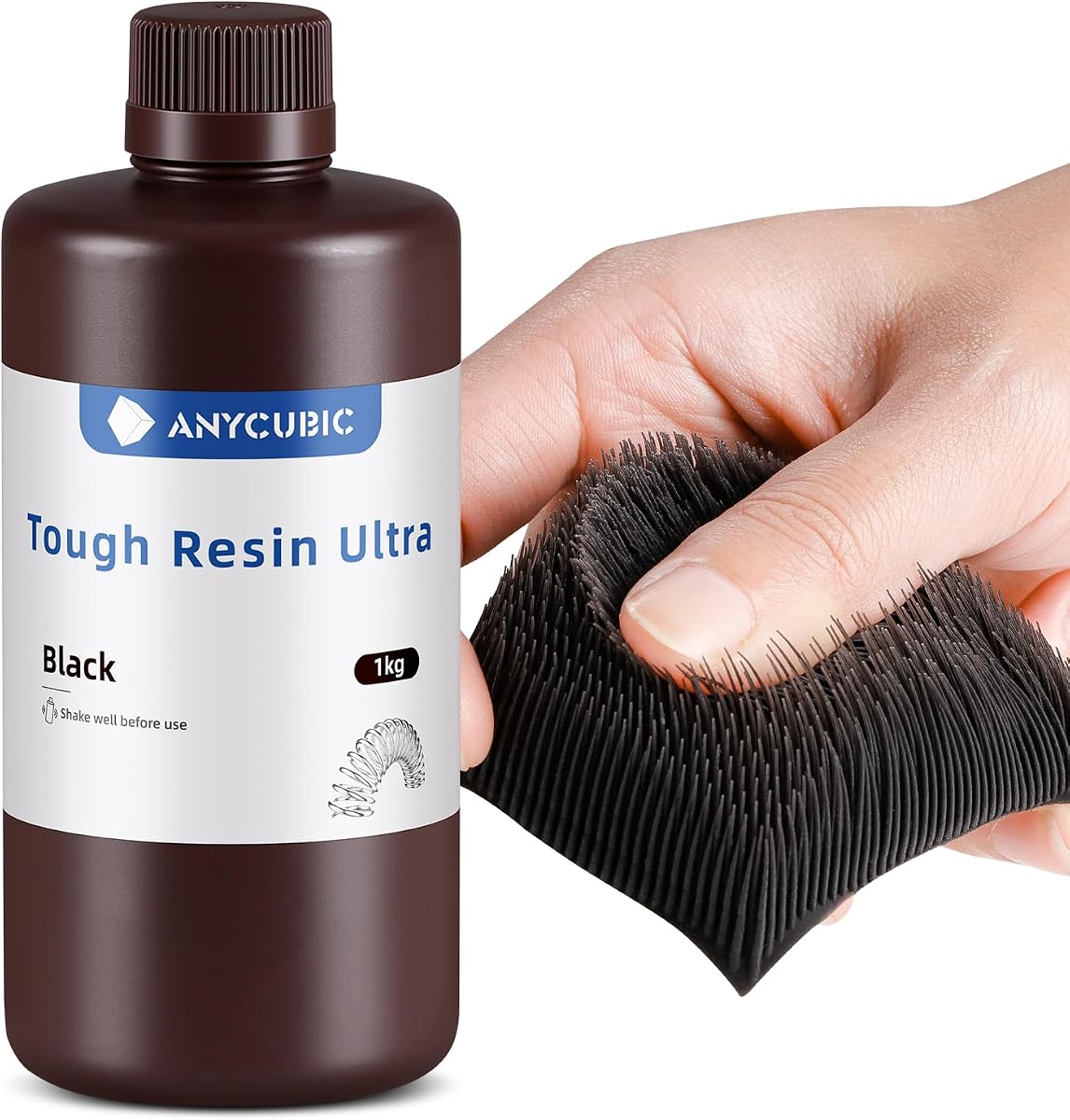
ANYCUBIC Ultra Tough Resin has a 4.7 rating and stands out for its combination of impact resistance, flexibility, and resilience. Unlike softer rubberlike formulations, it is designed to tolerate deformation and quickly return toward its original shape. That makes it a strong all-round choice for articulated figures, wearable models, protective components, and functional prototypes.
We may earn a commission when you buy through this link, at no additional cost to you.
The product data specifically emphasizes sharp hair-like textures, smooth movement between articulated parts, and a gentle skin sensation after curing. It can be printed directly or used as an additive to improve the toughness of other resins. Its resistance to brittleness, softening, and corrosion is also presented as useful in humid environments and across changing temperatures, although actual results will depend on the particular design and environment.
The primary compromise is that color mixing can alter the appearance of the final model, even though using the same color is described as having no effect. The resin is also positioned as tough and flexible rather than extremely soft. Buyers seeking very low Shore hardness should look elsewhere, while those wanting durable elasticity and easy blending have a more relevant choice.
This resin earns the Editor's Choice position because it handles several common needs without specializing too narrowly. It is a strong recommendation for articulated models, daily wearables, earphone covers, grip-like parts, and prototypes that see repeated handling. Its high rating, recovery behavior, and direct-or-additive versatility make it the most complete general-purpose option in this guide.
The formulation is explicitly suited to articulated parts and sharp hair-like details. That combination helps creators preserve movement and delicate visual features in the same print.
High elasticity, impact resistance, and rapid recovery make the resin more practical for worn or repeatedly handled objects. Its post-cured touch is also described as suitable for comfortable wearable prototypes.
We may earn a commission when you buy through this link, at no additional cost to you.
SUNLU Flexible Resin is a 70A Shore material with a 3.5 rating, offering softer behavior than most high-toughness options. The supplied title says 70A, while one bullet also displays 66A, so buyers should verify the exact specification with the seller. Its stated 135% elongation at break, impact resistance, and bendable character make it relevant for flexible prototypes and everyday soft components.
We may earn a commission when you buy through this link, at no additional cost to you.
The material is designed for 365–405nm curing and is listed as compatible with 99% of printers on the market, including LCD, DLP, and SLA systems. Other advantages include low shrinkage, resistance to weak acids and greases, a smooth finish after cleaning, and a relatively mild aromatic odor. The leak-proof bottle is designed to reduce damage during transportation.
Its lower rating indicates that the overall customer experience may be less consistent than that of the leading products in this list. The hardness-label inconsistency is another reason to check the packaging and seller information carefully. As with every photopolymer resin, achieving the advertised properties depends on suitable exposure, thorough cleaning, and complete curing.
This resin is best for users who want recognizable softness and elongation while retaining sufficient strength for drops and repeated bending. It may be especially useful in a mixed-printer workshop because of its broad stated wavelength compatibility. Users should confirm the printer's supported wavelengths and current material specifications before preparing a large batch.
A 70A Shore formulation is softer than conventional tough resin, while the claimed elongation and impact resistance help prevent a flexible print from becoming brittle. That balance suits prototypes that must bend without behaving like weak rubber.
The listed 365–405nm wavelength range supports LCD, DLP, and SLA printers. This broad compatibility is useful for creators who do not want to dedicate a single machine exclusively to flexible resin.
We may earn a commission when you buy through this link, at no additional cost to you.
Siraya Tech Tenacious Flex Black is a highly elastic resin with a 4.7 rating. It is described as significantly softer and more rubberlike than the classic Tenacious resin, with faster rebound and greater elasticity. Those qualities make it particularly interesting for soft grips, gaskets, shock absorbers, and other prototypes that need to be bent or compressed aggressively.
We may earn a commission when you buy through this link, at no additional cost to you.
Its elasticity allows the material to withstand extreme bending and compression while returning quickly to its original shape. The formulation also emphasizes high impact resistance, reducing the chance that accidental drops will create permanent deformation or cracks. Because the material is softer than the original Tenacious resin, it should be evaluated against the specific demands of the project rather than treated as a universal upgrade.
The product data notes that it may not suit every application associated with original Tenacious resin. In other words, maximum softness can come at the expense of some uses that demand the original material's particular balance. The 500g container also offers less capacity than the one-kilogram options in the guide, which may matter for production work.
Tenacious Flex Black is a strong choice for creators who prioritize rebound, bending, and a soft tactile result. It can also be mixed with other resins as an additive to improve impact resistance and flexibility, giving experienced users another way to tune behavior. Its high rating and clearly defined rubberlike positioning make it one of the most compelling dedicated flexible options.
The key advantage is the combination of softness, extreme bending tolerance, and rapid recovery. It is better suited to stretch-focused models than merely impact-resistant tough parts.
Mixing a small quantity with compatible resins can increase flexibility and impact resistance. This gives advanced users a way to tune a formula instead of relying exclusively on the standalone print.
We may earn a commission when you buy through this link, at no additional cost to you.
ANYCUBIC Tough Resin 2.0 Grey combines high toughness with enough flexibility for thin components. Its 4.6 rating reflects a strong balance of performance, and the upgraded formulation focuses on flexural strength, elongation, and reduced cracking. It is a practical choice for people who need more resilience than ordinary resin without committing to an extremely soft elastomer.
We may earn a commission when you buy through this link, at no additional cost to you.
The material is described as resisting peeling, cracking, and stress marks caused by cyclic vibration. Low shrinkage supports accurate dimensions, while the smooth surface and clear details make it useful for functional parts as well as display models. The formulation has a low-odor, non-irritating profile and is optimized for 365–405nm wavelengths across common LCD, DLP, and SLA printers.
The main limitation is that no specific Shore hardness appears in the supplied data. Users who need a known softness level, such as a particular Shore A value, should not assume this formulation matches the softest products. It also occupies a middle ground, so projects requiring pronounced rubberlike compression may be better served by a dedicated 55A or 70A resin.
This product is well suited to miniature components, thin parts, shells, industrial spare-part prototypes, jigs, and everyday maker projects that may experience handling stress. Its balance of detail, low shrinkage, and improved flexural performance makes it a flexible-resin adjacent choice for users who need durability as much as softness.
Improved flexural strength directly benefits small components that are vulnerable to snapping. The material is a sensible middle ground when a part must look precise but also survive handling.
Reduced curing shrinkage helps maintain dimensions and surface detail. The result is useful when models need to fit into assemblies or display crisp features.
We may earn a commission when you buy through this link, at no additional cost to you.
SUNLU High Toughness Resin has a 4.7 rating and focuses on structural durability rather than extreme softness. It is described as offering elongation five times higher than regular standard resin, with improved flexibility and bendability. That makes it a flexible tough resin for structural parts, solid models, and prototypes that should withstand regular use.
We may earn a commission when you buy through this link, at no additional cost to you.
Low viscosity and high flowability can shorten curing time and support easier model formation. The resin also has reduced volume shrinkage, which lowers the risk of distorted parts and cracking after washing or curing. Its low-odor formulation and easy cleaning with alcohol or ethanol improve workshop handling, while a stated compatibility with most LCD, DLP, and SLA resin printers broadens its appeal.
No Shore hardness value is given, so buyers cannot directly place it on a softness scale. It is also less obviously rubberlike than the 55A, 70A, 80A, or 90A products. Its principal value is that it bridges ordinary rigid resin and softer elastomers, offering greater bendability while preserving structural integrity and detail.
This resin is best for functional prototypes, solid components, and maker projects where impact and flexural resistance matter more than a soft-touch surface. Its high customer rating and favorable combination of flow, low shrinkage, and crack resistance make it a dependable all-around choice for compatible resin printers.
The low-viscosity formulation is intended to move smoothly during printing and support accurate model formation. Good flow can also make exposure settings easier to tune across different geometries.
Reduced shrinkage is especially valuable because dimensional changes can create stress that leads to cracking. The stated resistance to post-wash cracking improves the chance of preserving a successful print.
We may earn a commission when you buy through this link, at no additional cost to you.
ELEGOO Tough Resin is a 4.5-rated flexible tough material with a stated cured hardness of 84.7D. It bends without breaking easily, withstands tension and stress, and returns after deformation. This makes it appropriate for functional components, tools, fixtures, jigs, product casings, movable parts, and other objects where durability matters more than a soft surface.
We may earn a commission when you buy through this link, at no additional cost to you.
The product data highlights strong impact resistance and says the cured resin can be drilled without cracking. It also resists brittleness, softening, and corrosion in humid environments, while maintaining elasticity and flexibility across changing temperatures. These characteristics make it a practical structural option for workshop and industrial prototyping rather than a lifestyle wearable material.
A 84.7D Shore hardness is substantially firmer than the Shore A values used by the clearly soft rubberlike resins in this guide. Buyers looking for a cushiony feel or high compression may find it too rigid, even though it is more resilient than standard resin. The absence of a specific printer wavelength in the supplied information is another point to verify before ordering.
This resin is a good match for functional or engineering prototypes, hangers, fixtures, tool elements, articulated accessories, and end-use-style parts subject to impact. Its balance of flexural durability, environmental resistance, and low odor is especially valuable for creators who want tough behavior without moving to a fully soft elastomer.
The ability to drill the cured material without cracking is useful when a printed part must accept fasteners or be fitted into a larger assembly. This makes the resin more relevant to functional workshop projects.
Resistance to softening and corrosion supports use in damp environments. The material retains elasticity and flexibility, so it avoids the brittleness that can undermine conventional resin under changing conditions.
We may earn a commission when you buy through this link, at no additional cost to you.
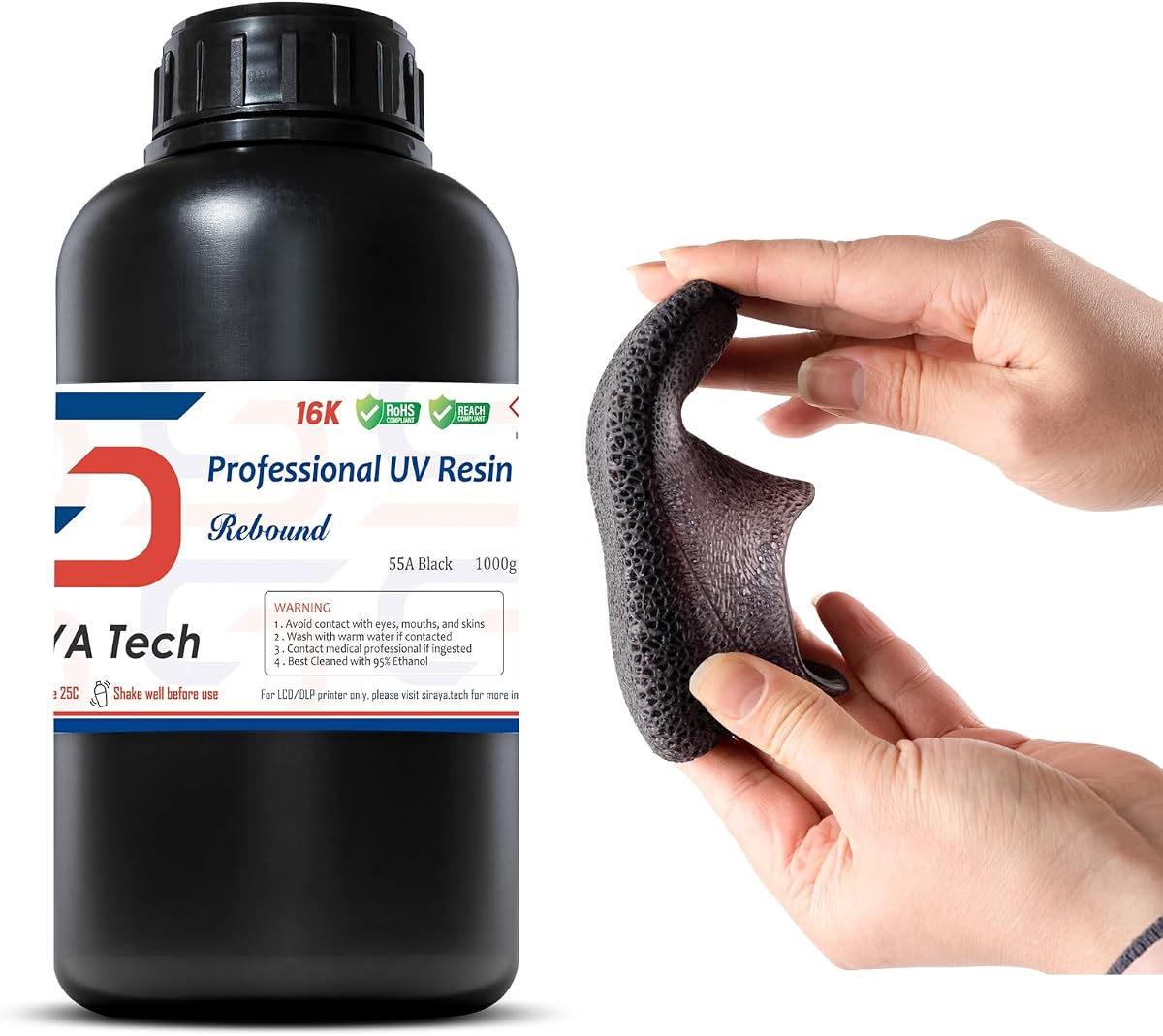
Siraya Tech Rebound 55A is the softest option in the guide by stated Shore hardness, with a 4.2 rating. Its 55A formulation is designed around fast rebound, making it useful for gaskets, seals, shock-absorbing components, personal protective equipment prototypes, and other models that repeatedly compress and recover.
We may earn a commission when you buy through this link, at no additional cost to you.
The resin is positioned as easier to process than elastomers requiring two-part mixing or complicated handling. It prints on standard 405nm LCD and DLP resin printers and can be cleaned using standard isopropyl alcohol methods. Compared with the harder flexible tough formulations, it offers a more pronounced rubberlike behavior and a softer surface for consumer-facing prototypes.
The supplied durability information is appropriately qualified: initial testing shows good resilience during compression cycles, while long-term performance testing is still ongoing. Buyers should therefore treat the material as promising but still developing for sustained applications. Very soft material can also be more difficult to preserve tiny details, and the product does not claim the same precision emphasis as some conventional tough resins.
Rebound 55A is the premium pick for projects that need softness and quick shape recovery more than a rigid, machined-looking finish. It is especially attractive to designers who want to prototype wearables, seals, cushions, and protective pieces without setting up an elaborate mixing process.
The 55A Shore rating and faster rebound distinguish this resin from merely bendable tough materials. It is a better fit for seals, cushions, and compression-response prototypes.
Because no A/B mixing is required, the resin reduces preparation steps. Standard LCD or DLP printers and familiar alcohol cleaning methods keep the workflow accessible to a wider range of users.
We may earn a commission when you buy through this link, at no additional cost to you.
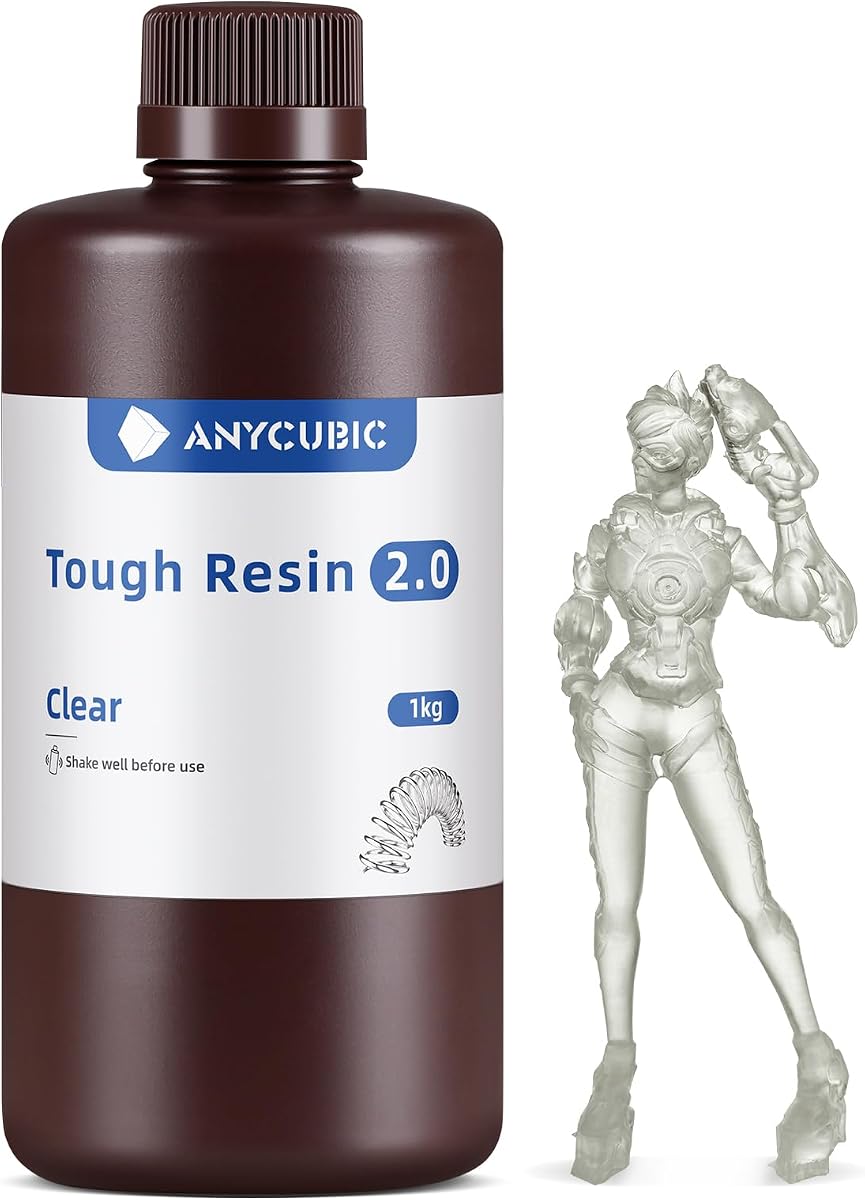
ANYCUBIC Tough Resin 2.0 Clear has a 4.6 rating and emphasizes precision, flexural strength, and elasticity. The upgraded formulation is designed to reduce breakage in delicate or thin models while resisting damage from cyclic vibration. This makes it useful when a functional part must preserve detail and withstand repeated mechanical movement.
We may earn a commission when you buy through this link, at no additional cost to you.
Low shrinkage is one of the central benefits, helping the printed model maintain its intended dimensions and surface definition. The material is designed for 365–405nm curing and is advertised for common LCD, DLP, and SLA resin printers, including systems with 4K, 8K, 12K, and 16K specifications. Its low-odor formulation is intended to make the printing environment more comfortable.
Clear resin can make it harder to see internal voids, layer transitions, or small finishing defects. This resin also remains a tough flexible material rather than an extremely soft Shore A elastomer. As a result, users expecting pronounced cushioning should look toward the 55A, 70A, or 80A options instead.
This clear formulation is a strong choice for detailed functional prototypes, thin components, vibration-exposed parts, and makers who value a clean transparent finish. It combines the visual appeal of clear resin with a more resilient mechanical profile than ordinary standard material.
High precision and low shrinkage support accurate dimensions and visible detail. The material is well suited to prototypes whose shape and assembly fit matter as much as their flexibility.
The formulation is designed to resist peeling, cracking, and stress marks caused by cyclic vibration. That makes it relevant to assemblies and parts expected to move or vibrate during use.
We may earn a commission when you buy through this link, at no additional cost to you.
FUNCECOL Flexible Tough Resin is a 90A Shore material with a 4.4 rating, positioned as a soft rubber or TPU-like option. It combines softness with enough strength for repeated folding, bending, cushioning, and shock absorption. Its emphasis on tear resistance distinguishes it from formulas that bend easily but remain vulnerable to ripping.
We may earn a commission when you buy through this link, at no additional cost to you.
The supplied information identifies gaskets, protective cases, toy tires, shoe soles, ergonomic grips, medical models, cosplay props, flexible toys, and wearables as potential uses. High elongation and impact durability are the main selling points, allowing parts to withstand recurring stress without simply snapping. The formula also promises crisp detail, low odor, and high precision.
A 90A Shore rating is on the firmer side of flexible rubber behavior. It should bend and flex but may not provide the same soft compression as 55A or 70A resin. The product data also advises good ventilation, which is sensible for handling UV-curing photopolymer in any workshop. Actual suitability for final wearable use should be evaluated independently from the printing claims.
This resin is a solid option for users who need a relatively firm flexible material with strong tear resistance. It is especially compelling for repeated-use grips, protective pieces, and gaskets where a softer 55A resin might deform too readily and a conventional tough resin might not flex enough.
The 90A formula is engineered to tolerate repeated folding while resisting cracks and rips. It offers a durable middle ground for functional components that see frequent contact.
The stated 405nm compatibility covers MSLA, DLP, and LCD workflows. High precision allows flexible parts to retain useful detail instead of appearing coarse or rounded.
We may earn a commission when you buy through this link, at no additional cost to you.
The right flexible resin depends on how soft the part must be, how far it will bend or compress, and whether it must survive drops, vibration, wear, heat, or repeated handling. Printer compatibility, ease of cleaning, and post-curing requirements are equally important because a technically flexible formula is only useful when it processes reliably in your workflow.
Choose softness according to the function of the model. Very soft resin is appropriate when high compression and a rubberlike feel are priorities, while a 70A to 90A material is better when the part must retain its shape, resist tearing, or carry a load. If Shore hardness is not listed, consider the intended behavior rather than assuming the product is equivalent to a specific elastomer.
A part that stretches once during a design demonstration has different requirements from a seal compressed every day. Compare both stretch capacity and recovery, and favor a material that maintains its behavior under repeated cycles rather than relying on a single elongation figure.
Look for a formula that addresses the type of stress your model will encounter. Drop resistance matters for portable prototypes, tear resistance matters for gaskets and grips, and flexural strength matters for thin parts or assemblies that repeatedly move.
Compatibility should be confirmed against both printer type and wavelength, not just the phrase resin printer. The resin may also require a different exposure profile from standard material, so treat it as a new material profile rather than assuming identical settings.
For character models, jewelry-inspired pieces, or small articulated features, prioritize detail retention. For gaskets, bumpers, and grip prototypes, prioritize softness and compression before pursuing the finest possible surface.
Choose a product that suits your available washing and curing equipment. Follow the manufacturer or seller instructions for cleaning time, alcohol concentration, wash cycles, and curing conditions, and allow adequate ventilation throughout the process.
Blending is useful for controlled experimentation, but it is not a shortcut to guaranteed properties. Test a small sample first, record the ratio, and evaluate curing, color, and flexibility before committing to a full model or production run.
Begin with the application and its most severe expected load, then optimize for appearance and processing. A comfortable prototype may need softer resin, while a functional component may be better served by a tough formulation that preserves edges and resists tearing.
Begin by confirming that your printer supports the resin's wavelength and handling requirements, then create a material profile using the supplier's recommended settings. Agitate and stir the bottle thoroughly before pouring, avoid introducing bubbles, and keep the vat and resin at a stable temperature. Start with a simple geometry to tune exposure and layer height before attempting a thin, highly detailed, or mechanically demanding model.
After printing, remove the part carefully and wash it using the cleaning method recommended for that formulation. Clean recessed areas thoroughly, allow the model to dry, inspect it for trapped uncured resin, and then complete the required UV post-curing. Incomplete washing or curing can produce a tacky surface, trapped stress, or a finish that does not reflect the material's advertised flexibility.
Cure parts away from direct light during storage, inspect them for cracks or torn corners before loading them into an assembly, and test the finished piece under realistic compression and bending. Clean the vat and print platform according to the resin supplier's instructions. Store the bottle tightly sealed, follow its stated shelf-life guidance, and use appropriate gloves, eye protection, and ventilation whenever handling uncured resin.
Flexible resin is a liquid photopolymer that cures under UV light, allowing fine detail and rapid production in many LCD, DLP, or SLA printers. TPU is a thermoplastic filament extruded layer by layer and generally requires a direct-extrusion setup. Flexible resin can reproduce small features effectively, but it also demands careful washing, curing, and ventilation.
No. Lower hardness can provide greater softness and compression, but it may also make a part easier to deform, tear, or damage. A firmer flexible formula can be more appropriate for thin components, repeated handling, and applications requiring shape retention. Choose the hardness based on the most demanding part you need to print.
Some products in this guide are specifically described as usable as additives. ANYCUBIC Ultra Tough Resin and Siraya Tech Tenacious Flex Black can improve toughness or flexibility when blended with compatible resins. Because the blend changes color, curing, and mechanical behavior, test a small sample and confirm the recommended ratio before mixing larger quantities.
A sticky surface often indicates that uncured resin remains in recesses or that post-curing was incomplete. Wash the model thoroughly, remove residue from supports and cavities, allow it to dry, and complete the prescribed curing cycle. Also review exposure settings, because insufficient layer curing can also contribute to a soft or inconsistent surface.
Several options explicitly support common LCD printers, including the SUNLU products, ANYCUBIC Tough Resin 2.0, Ultra Tough Resin, and Rebound 55A. Superflex is optimized for monochrome LCD systems and advertises especially fast curing there. Check the printer wavelength and follow the resin's own exposure profile rather than reusing a standard-resin profile unchanged.
Some product data makes skin-contact or biological-material claims, but those claims depend on correct processing and the intended use. Superflex states that properly cleaned and fully post-cured prints pass ISO 10993-5 testing, and Ultra Tough Resin describes a non-irritating post-cured skin sensation. Users should still review current documentation, avoid uncured resin, and confirm suitability for their specific application.
Keep the bottle tightly closed, clean, and away from direct light, following the supplier's storage instructions. Before later use, stir the resin again because pigments and other components may settle. A sealed, controlled environment helps preserve the material between prints and reduces the chance of contamination.
It can be appropriate for prototypes and selected functional applications, but it should not automatically be treated as a drop-in industrial rubber substitute. Compare compression, rebound, tear behavior, temperature tolerance, chemical resistance, and long-term fatigue against the actual service conditions. Create a representative test and validate the final design before relying on it for safety-critical or sustained production use.
The leading choice for broad, practical use is ANYCUBIC Ultra Tough Resin because it combines a 4.7 rating, impact resistance, elasticity, rapid recovery, fine-detail capability, and direct or blended use. Superflex is a compelling budget-oriented option for monochrome LCD users seeking 80A flexibility and 100% elongation, while Siraya Tech Rebound 55A stands out as the premium soft choice for rapid rebound and compressible prototypes.
Prioritize the mechanical requirement before the color or container size. Choose a 55A or 70A formula for soft compression, an 80A or 90A material for stronger rubberlike behavior, and a tough flexible resin for thin structural parts, vibration resistance, or repeated handling. Printer wavelength, exposure settings, cleaning, post-curing, and ventilation remain essential parts of obtaining the intended result.
Product formulations, ratings, availability, and prices can change, so check the current listing and seller documentation before buying. Compare the latest hardness specification, compatibility information, and application guidance with your specific model, and run a small test print before committing to a large batch.