
RØDE X Streamer X
3.8Editor score
Integrated four-channel audio interface
Dual USB-C computer connections
4K60 HDMI passthrough
Explore the best dual PC streaming setup capture cards, comparing PCIe and USB options for latency, passthrough, audio, and dual-computer workflows.
A dual PC streaming setup usually combines a gaming or content-creation computer with a second PC dedicated to broadcasting, encoding, chat, recording, or stream management. The capture card acts as the video bridge, so input resolution, passthrough behavior, audio routing, latency, and software compatibility can determine how smoothly the entire production chain works.
This guide compares ten capture cards designed for gaming, streaming, recording, conferencing, and related video workflows. We considered capture formats, maximum frame rates, HDMI passthrough, connection types, VRR and HDR support, audio features, operating-system compatibility, and suitability for one or two computer systems.
The recommendations range from compact USB devices to dedicated PCIe cards and an integrated audio interface, with each review highlighting the strongest use case and practical limitations. Product ratings reflect the supplied customer feedback, while prices and availability can change, so check current listings before purchasing.
3.8Editor score
4.5Editor score

4.4Editor score
The comparison below covers USB and PCIe capture solutions, emphasizing the specifications that matter most in a dual-computer workflow: input capabilities, passthrough, latency, audio routing, and platform compatibility.


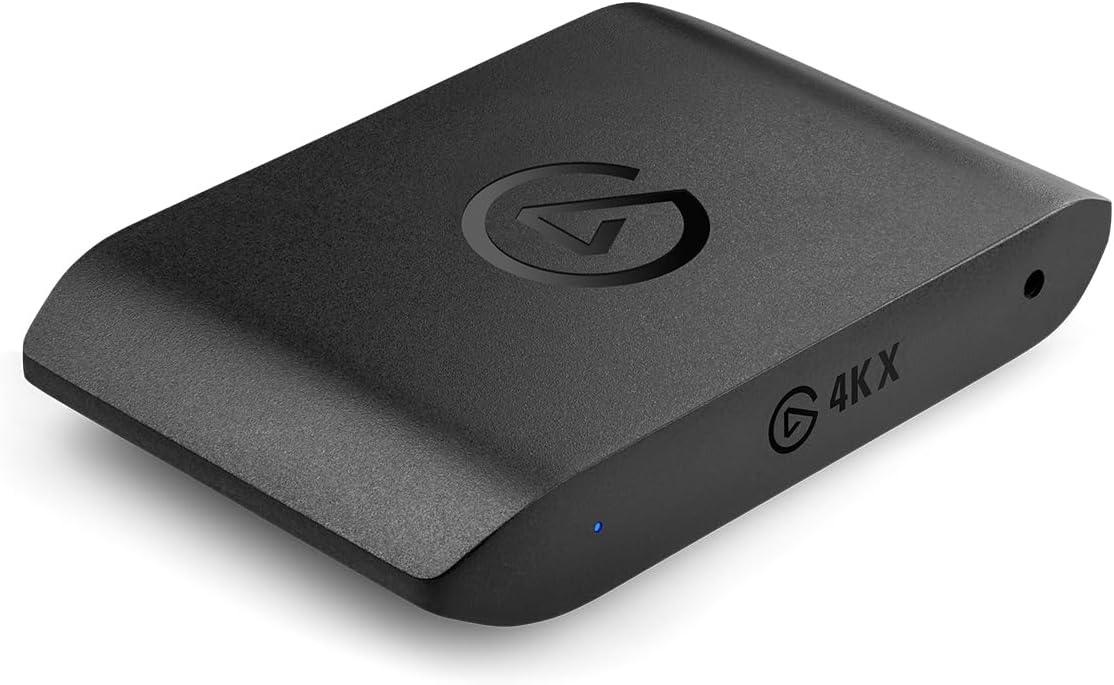
The Elgato 4K X combines a 4K144 capture capability with HDMI 2.1 input and output, giving it a strong balance of recording and gaming features. Its supplied customer rating is 4.5 out of 5. That combination makes it particularly interesting when one PC handles gameplay and another operates the broadcast, encoding, recording, or chat side of a production.
We may earn a commission when you buy through this link, at no additional cost to you.
The card is designed to work with major broadcasting and streaming applications, including OBS, Streamlabs, Twitch Studio, Restream, Zoom, and Teams. Its HDMI 2.1 path supports high frame rates, while VRR passthrough helps preserve smooth variable-refresh-rate gameplay. The USB 3.2 Gen 2 interface is also a meaningful consideration because the high capture modes depend on a robust data path between the capture hardware and streaming computer.
The main trade-off is that this is not positioned as a simple entry-level bridge. Creators must plan the cable arrangement, use a suitable USB controller port, and select input and encoding settings that the complete computer chain can support. A powerful graphics processor and carefully configured software are still necessary to realize the benefits of the headline capture modes.
It is a compelling recommendation for streamers who want detailed control over high-frame-rate capture and modern console or PC passthrough. In a dual PC setup, it can send the game or source feed to the broadcast PC while maintaining a separate passthrough path for local monitoring. It suits creators willing to configure advanced settings rather than buyers seeking a simple all-in-one audio solution.
Capture up to 4K at 144 frames per second, with HDMI 2.1 support for advanced source and passthrough configurations. This is valuable for creators recording fast motion and preserving detail beyond a standard 60-frame workflow.
Use the capture connection for the recording or streaming PC and HDMI passthrough for local viewing. Ultra-low-latency operation and VRR passthrough help maintain synchronization across gameplay, monitoring, and broadcast.
We may earn a commission when you buy through this link, at no additional cost to you.
This internal PCIe capture card directly addresses single and dual PC streaming arrangements, with 4K60 capture, 4K60 passthrough, and support for PS4, PS5, and Xbox sources. Its supplied rating is 4.3 out of 5. For creators building a permanent production system, installing the card inside the recording or streaming computer can provide a direct, dependable data path.
We may earn a commission when you buy through this link, at no additional cost to you.
Capture at native 4K60 when the source and the rest of the chain can support it, while 1080p recording is available at up to 240fps for high-motion content. Near-zero-latency passthrough is designed to keep local game viewing synchronized with the captured broadcast. The card also works with software such as OBS, Zoom, and Teams, giving it relevance beyond game streaming.
The principal compromise is installation. A PCIe card requires an open slot, appropriate system support, and a host computer with enough internal connectivity for the intended workflow. It is therefore less convenient than a USB device for mobile, temporary, or multi-location production. The stated lifetime warranty and 24-hour expert support also add reassurance for a permanently installed component.
Choose this card when the dual PC arrangement is fixed and the recording computer has room for internal expansion. It is particularly attractive to gamers who want 4K60 passthrough and 240fps recording without relying on a USB connection. Buyers who need portability, simple setup, or a capture interface that can move between machines should consider the external options instead.
Installing inside the streaming PC removes the need to move high-bandwidth video across a USB controller. That makes the card a logical fit for a permanent desk-based encoding or recording system.
The ability to record 1080p at 240fps gives creators more flexibility for fast action. The source, storage speed, encoder, and output settings must all be configured to handle the selected mode.
We may earn a commission when you buy through this link, at no additional cost to you.
The RØDE X Streamer X is the clearest dedicated option in this guide for a true two-computer workflow. It combines a 4K video capture path with a professional audio interface and two USB-C outputs, allowing one computer to provide the video feed while another handles the stream. Its supplied rating is 3.8 out of 5, so its specialized design deserves close attention before purchase.
We may earn a commission when you buy through this link, at no additional cost to you.
Video can be recorded at up to 4K30 or 1440p60 through HDMI, while real-time monitoring reaches 4K60 using passthrough. The high-quality Neutrik combo input accepts microphones or line-level devices and feeds them through RØDE's Revolution Preamp. This integration is a major advantage over basic cards that offer little more than an HDMI-to-USB conversion and a small 3.5mm jack.
The dual USB-C arrangement is the standout feature for dedicated dual PC production, but there are trade-offs. Its headline capture specification is 4K30 rather than the higher 4K60 capture rates offered by several alternatives. The lower supplied rating also makes the importance of checking recent customer feedback and exact workflow requirements especially relevant.
This model is ideal for streamers who need one box to handle video, microphone or line audio, wireless RØDE equipment, and a two-computer connection. It may be less suitable for a creator whose priority is only high-frame-rate 4K gameplay capture. For integrated professional audio and clear dual-PC operation, however, it offers a particularly coherent design.
The two USB-C outputs separate the source computer from the streaming computer. One machine can supply the visual feed while the other manages encoding, recording, and broadcast software.
The Neutrik combo input and Revolution Pream provide more refined microphone and line-level control than a typical 3.5mm accessory connection. It reduces the number of separate devices needed for commentary audio.
We may earn a commission when you buy through this link, at no additional cost to you.
The Elgato 4K Pro is an internal capture card aimed at creators who want 4K60 recording alongside up to 8K60 passthrough. Its supplied rating is 4.5 out of 5. This separates the local viewing experience from the recorded output, allowing modern high-resolution displays to receive a very high-bandwidth signal while the streaming PC receives a dedicated 4K60 feed.
We may earn a commission when you buy through this link, at no additional cost to you.
HDMI 2.1 input and output, VRR passthrough, and ultra-low-latency operation make it especially relevant to console and PC gaming. It supports common broadcasting tools including OBS, Streamlabs, Twitch Studio, Restream, Zoom, and Teams. For a permanent dual PC installation, the PCIe path can offer a clean, direct connection to the recording machine.
As with other high-end internal cards, the host system must be able to support the intended configuration. The 8K60 passthrough figure describes passthrough capability rather than 8K capture, and the source, display, cables, graphics output, and operating system must all align. Those requirements make the card less approachable for a first-time creator with limited hardware.
This is a strong recommendation for a sophisticated gaming production room where the recording PC is already powerful and expandable. It particularly appeals to users who value high-resolution local monitoring and VRR passthrough as much as the captured stream itself. Buyers who only need simple 1080p capture will find more affordable devices with fewer installation concerns.
The 8K60 passthrough path supports a high-end local display, while the capture output handles 4K60 recording. This separation is useful when a creator wants crisp local feedback without forcing the recording pipeline to match the display's full resolution.
VRR passthrough and HDMI 2.1 support address important requirements of modern consoles and gaming PCs. They also depend on source and display support, so compatibility should be verified before installation.
We may earn a commission when you buy through this link, at no additional cost to you.
The Rybozen capture card is a basic HDMI-to-USB solution for creators who value simplicity over advanced passthrough specifications. It captures up to 1080p and has a supplied rating of 4.3 out of 5. The device is automatically identified as a webcam, requires no external power or driver, and is designed to work quickly with Windows and macOS systems.
We may earn a commission when you buy through this link, at no additional cost to you.
Its input supports several HDMI source types, including consoles, PCs, cameras, DVDs, and set-top boxes. The stated input range covers 4K30 or 4K60Hz and 1080p at 120Hz or 144Hz, although the actual capture output is limited to 1080p. An HDMI loop-out provides a local monitoring path, and a 3.5mm TRS headset microphone input lets a creator add commentary.
The main limitation is its modest capture ceiling. It lacks the high-resolution and high-refresh-rate capabilities emphasized by more specialized cards, and the output is limited to 2K30. It also does not support 4K120 or 4K144 input. In a dual PC setup, its value lies in moving a standard-resolution feed between machines rather than operating a demanding 4K production pipeline.
This is a practical choice for straightforward streaming, classes, webcam-style capture, or a first dedicated broadcast PC. It is also easy to move between systems because it uses USB rather than an internal slot. For competitive gaming, 4K creators, or a permanent high-end rig, a more capable capture card is the better investment.
Automatic webcam recognition and plug-and-play operation remove several common installation barriers. A creator can connect the source, open streaming software, and begin configuring the device.
The 3.5mm TRS microphone input supports a headset microphone for game commentary. It is a convenient feature for basic streaming, although it does not offer the broader line-level and preamp control of a dedicated audio interface.
We may earn a commission when you buy through this link, at no additional cost to you.
The PORTTA DX20R combines 4K60 capture with unusually broad passthrough options, including 1080p at 240Hz and 2K at 120Hz. Its supplied customer rating is 4.2 out of 5. This makes it a flexible USB option for high-refresh gaming while retaining support for standard 4K60 workflows.
We may earn a commission when you buy through this link, at no additional cost to you.
VRR and HDR support improve its relevance for modern consoles and PC gaming. It can capture YUY2, NV12, and RGB24 formats, providing several choices for color and compression workflows. The device works with Windows, macOS, and Linux without driver installation, which is valuable for a two-PC setup where the same capture unit might be used across different operating systems.
The PORTTA CapHub utility adds controls for video settings, audio mixing, firmware, and EDID or VRR modes. This is both a strength and a complication. New users can begin without the utility, but advanced optimization is easier when the control panel is available. The smart display and ring-light control also requires understanding the physical button behavior to use effectively.
Choose the DX20R when a creator wants more high-refresh flexibility than a basic USB card without installing an internal PCIe device. It is well suited to a movable dual-PC workstation, particularly one that alternates between Windows and macOS. It may not satisfy a buyer who wants the most advanced 144fps capture or a fully integrated professional audio interface.
Capture at 4K60, 2K144, or 1080p240 according to the source and production needs. This range gives creators room to favor detail or frame rate as the game and recording format change.
Windows, macOS, and Linux support makes the device practical for a multi-machine production environment. The optional utility adds deeper control without making routine driver installation mandatory.
We may earn a commission when you buy through this link, at no additional cost to you.
The acer USB 3.0 HDMI Capture Card offers a straightforward route to separating a source from a streaming computer. It supports 4K HDMI input, 1080p60 passthrough, and YUY2 video, and it has a supplied rating of 4.4 out of 5. The result is a practical option for creators who want a simple and portable capture bridge.
We may earn a commission when you buy through this link, at no additional cost to you.
No additional drivers or external power are required, so it can be moved easily between a gaming PC and a broadcast PC. A built-in microphone input supports headset or microphone commentary without requiring another adapter. Its compatibility list includes OBS, XSplit, VLC, YouTube, Facebook, consoles, PCs, cameras, macOS, and Android, giving it useful flexibility for common production tasks.
The important limitation is that its strongest streaming-oriented output is 1080p60. It does not offer the 4K60 capture, high-refresh passthrough, advanced VRR support, or multi-computer USB outputs found in specialized cards. The YUY2 format can provide better color quality than MJPEG, but the final result still depends on source resolution, software settings, and the streaming destination.
This card is a strong recommendation for a first dual-PC arrangement focused on 1080p60 content. It also works for mobile recording, teaching, conferencing, and quick changes between machines. More demanding creators should look toward a higher-bandwidth model, but for standard streaming the acer combines useful features with an approachable setup.
USB power and driver-free operation make it easy to move the device to whichever computer is handling the current task. Its small size is useful for temporary production stations and events.
YUY2 can preserve more color information than compressed MJPEG output. That makes it a useful specification for creators who want reasonable image quality without moving to a more advanced capture card.
We may earn a commission when you buy through this link, at no additional cost to you.
The XIIXMASK USB 3.0 capture card supports 4K60 capture, 4K HDMI passthrough, and 1080p120 recording. Its supplied rating is 4.2 out of 5. It offers a stronger resolution ceiling than many entry-level USB devices and is compatible with a wide range of consoles, cameras, computers, and mobile operating systems.
We may earn a commission when you buy through this link, at no additional cost to you.
MJPEG, YUY2, NV12, and XRGB formats give creators several options within common streaming and recording software. A USB A-to-C connection supports Windows 7, 8, 10, and 11, macOS, Linux, Android 5.0 and later, and iPadOS 17 and later. The device is plug-and-play, needs no driver or external power, and works with OBS Studio, Streamlabs, VLC, PotPlayer, Zoom, YouTube, and Twitch.
The 3.5mm audio input and microphone output allow external commentary or ambient sound to be integrated into a recording. This is less refined than a professional combo input and preamp, but it covers many creator needs without a separate interface. The card also lacks dedicated dual-USB outputs, so a two-PC workflow depends on the capture connection and passthrough rather than separate computer links.
This is a good general-purpose option for 4K-capable USB capture, especially for creators who switch among Windows, macOS, and mobile systems. It is less specialized for dedicated dual-PC broadcast rooms but still provides the core tools needed to separate a source and stream it from another computer. Verify that the source and selected software support the exact format and frame rate.
MJPEG, YUY2, NV12, and XRGB support lets the capture card fit different recording and streaming pipelines. The best choice depends on the computer, software, desired image quality, and available processing bandwidth.
Support across desktop and mobile systems makes the card useful for creators who do not always work on the same computer. Its plug-and-play design reduces the setup time needed when the production station changes.
We may earn a commission when you buy through this link, at no additional cost to you.
The Osee GoStream M2 stands out for its two 4K60 HDMI inputs, allowing a camera, console, or other source to be connected alongside a second video source. Its supplied rating is 4.2 out of 5. The recorded output is 1080p60, but the ability to switch and arrange two inputs makes it useful for interviews, gameplay, demonstrations, and live events.
We may earn a commission when you buy through this link, at no additional cost to you.
A 1080p60 HDMI output can connect to a television or projector, while USB-C provides the computer connection. The device supports picture-in-picture and side-by-side layouts, including four PBP arrangements and four zoomable PIP designs. A 3.5mm port handles microphone and audio input or output, allowing commentary and other sound to be incorporated into the stream.
Its main limitation is that 1080p60 is the maximum recorded frame rate and resolution stated for the device. It also does not provide the separate dual USB-C computer outputs found in the RØDE X Streamer X, so it is not a complete substitute for that dedicated two-computer interface. Its strengths are source selection and visual layout rather than a fully integrated broadcast control surface.
Choose the GoStream M2 when a creator wants two video sources and flexible layouts in a portable unit. It is a natural fit for a live event that combines gameplay with a camera, or a presentation that needs source switching. For a conventional two-PC game-streaming chain, it can help, but a single high-bandwidth capture path and passthrough may be easier to manage.
The dual HDMI inputs make it possible to connect two separate devices without buying a second capture card. That is useful for camera-plus-game layouts, live demonstrations, and multi-source events.
Four PBP and four zoomable PIP arrangements give creators quick options for presenting two feeds. A front switch also allows changes between sources without navigating deeply through software controls.
We may earn a commission when you buy through this link, at no additional cost to you.
The AVerMedia GC575 Live Gamer 4K 2.1 is an internal PCIe capture card aimed at 4K60 gaming and recording. Its supplied rating is 4.3 out of 5. The stated platform support includes PS5, PS4 Pro, Xbox Series X/S, Xbox One X, and Nintendo Switch games, while the headline 4K60 capture target suits modern high-resolution broadcasts.
We may earn a commission when you buy through this link, at no additional cost to you.
HDMI 2.1 support is central to the card's appeal, and the supplied information also highlights ultra-low latency and refresh rates up to 240Hz. In a dual-PC installation, the PCIe connection can provide a direct path from the card to a dedicated recording or encoding system while the source remains on another machine.
The supplied product data is comparatively concise, so buyers should examine the current listing for detailed port, codec, passthrough, and host-system requirements. An internal card also brings installation constraints: the PC must have a suitable slot, adequate internal routing, and enough processing power to handle the selected resolution and frame rate. A physical console capture workflow may also require a separate source for the local display.
The GC575 is a strong option for a permanent gaming production system built around current consoles or a powerful PC. Its 4K60 target and modern HDMI interface provide a more advanced foundation than a basic 1080p USB card. Confirm the exact passthrough behavior and current specifications before purchase, especially if the rig depends on a specific dual-PC arrangement.
Support for current Xbox and PlayStation systems makes the card relevant to console-first channels. 4K60 capture supports a modern broadcast target, provided the source and streaming PC can deliver that mode.
Installing the card in a dedicated recording PC creates a stable production architecture. It avoids repeated USB reconnection and suits creators whose streaming station remains in one location.
We may earn a commission when you buy through this link, at no additional cost to you.
The right capture card depends on how the two computers divide their roles, the resolution and frame rate of your sources, and the amount of audio and monitoring control you need. Reviewing the signal path before buying prevents an expensive mismatch later.
Begin by deciding which computer produces the source image and which one broadcasts it. In a common gaming arrangement, the game PC sends video to a capture card connected to the streaming PC, while the capture card's passthrough output feeds a local display. A device with two separate computer outputs, such as the RØDE X Streamer X, can make this arrangement more explicit, while a standard USB card may require careful cable routing and software configuration.
Map every connection before ordering: source to capture card, capture card to streaming PC, passthrough to display, and microphone or line audio to the appropriate input. Check whether the output from the source and the input of the capture card share the same format. This prevents a mismatch in resolution, refresh rate, color format, or HDMI bandwidth.
A headline input rating does not always mean the card will record at that resolution and frame rate. The Rybozen card accepts several high-resolution input modes but captures at up to 1080p, whereas the Elgato 4K X, PORTTA DX20R, XIIXMASK USB 3.0, and several internal cards advertise 4K-class capture. For fast games, 1080p at 120 or 240fps may be more useful than 4K60, depending on the creator's priorities.
Consider the source, capture card, USB controller, graphics output, encoder, storage, and destination together. A 4K60 source can require more processing and bandwidth than a 1080p60 source, and some services impose their own limits. A creator should select a mode that the entire chain can sustain consistently rather than relying on the maximum printed on the box.
Passthrough sends the incoming image to a local display while the capture card separately provides a signal to the recording computer. This is central to a two-PC setup because it allows the streamer to see gameplay without sending an unnecessary display signal through the encoding machine. Low-latency claims indicate an effort to keep the local experience responsive, but total delay also depends on source devices, displays, software, and settings.
VRR passthrough is especially relevant for modern gaming, as it can preserve variable refresh rates between compatible source hardware and displays. HDR support adds another layer of compatibility that requires the source, card, and display to agree. Always verify the specific refresh rate, color mode, and resolution rather than assuming every HDMI 2.1 feature is supported in every configuration.
USB capture cards are convenient and portable, but they depend on the controller and host computer delivering enough bandwidth. USB 3.0 is common among the compact options in this guide, while the Elgato 4K X uses USB 3.2 Gen 2. The connection should ideally be on a rear motherboard port or a controller that does not share bandwidth with other devices. High-resolution, high-frame-rate capture can expose an otherwise adequate connection as a bottleneck.
PCIe cards provide a direct internal route and are often preferable for a permanent streaming station. The 4K Internal Capture Card, Elgato 4K Pro, and AVerMedia GC575 follow this approach. PCIe does not remove all performance constraints, however, because the graphics output, motherboard lanes, operating system, and encoder still have to support the selected workflow.
A capture image is only half of a broadcast, and the right audio path can be as important as the video path. Basic cards such as the Rybozen, acer, and XIIXMASK offer 3.5mm connections for a microphone, headset, or other analog source. The Osee adds input and output around its dual-input design, while the RØDE X Streamer X combines video with a professional audio interface, Neutrik combo input, and Revolution Preamp.
Decide whether commentary is coming from a USB microphone, analog headset, line-level music source, wireless system, or a separate mixer. Check the supported connector type and whether the card merely passes audio through or provides recording-grade preamp control. The RØDE unit also supports its wireless receiver, which can be useful for creators already invested in the RØDE ecosystem.
Capture cards expose their video to a computer through standardized formats, but the available choices can differ. The PORTTA DX20R supports YUY2, NV12, and RGB24, while the XIIXMASK supports MJPEG, YUY2, NV12, and XRGB. These options influence color quality, processing demands, and compatibility with a particular streaming application. A card that works correctly in one program may require different settings in another.
The listed devices support major platforms such as OBS, Streamlabs, VLC, Zoom, and XSplit, but a creator should verify the exact application and operating-system combination. The Rybozen and acer cards emphasize straightforward webcam-style recognition, while the PORTTA adds a utility for EDID, firmware, audio, and display management. More control can be useful, but it also creates more settings to understand.
A portable USB card is valuable if the streaming PC, source computer, or display arrangement changes regularly. The acer and Rybozen products emphasize plug-and-play operation, no external power, and broad device support. The Osee GoStream M2 adds two inputs and picture layouts while retaining a portable form, making it useful for events where a camera and console are both needed.
An internal card is less convenient to relocate but can be preferable for a permanent studio. Consider whether the PCIe card, cables, and host computer will remain together. Also think about physical port access, display placement, and whether you want to leave a local monitor connected to the source while the broadcast computer handles recording.
A capture card is only one part of a production system. The source must output the desired format, the streaming computer must process and encode it, storage must absorb the recording, and the upload must match the destination's requirements. High-frame-rate capture can be demanding even when the card itself supports it. A 4K workflow may require more graphics capacity, memory, storage throughput, and encoding headroom than a 1080p workflow.
For a dual-PC setup, separating capture and encoding tasks can make a modest source computer feel more responsive, but it also adds configuration complexity. Test the complete path with the intended software, monitor, cables, and settings. The goal is not simply to achieve a mode once; it is to maintain stable capture, audio synchronization, and dependable performance throughout a stream or recording session.
Begin by planning the signal path and identifying the source, streaming computer, local display, and audio equipment. Connect the source to the card's HDMI input, the card to the streaming computer through its specified USB or PCIe connection, and the card's passthrough output to the local display if needed. Before opening streaming software, confirm that the source is sending the intended resolution and refresh rate.
Install the card's software or utility if the model requires one, then select the correct HDMI input and output format. In OBS, Streamlabs, or another application, add the capture device as a video source and verify that the image is not cropped, stretched, or duplicated. Add the microphone or line audio separately if it is not embedded in the HDMI feed, then balance commentary, game audio, and any other sound in the audio mixer.
For ongoing care, keep the capture device and ventilation paths free from dust, avoid placing unnecessary strain on HDMI or USB cables, and use the supplied or manufacturer-recommended connections. Keep firmware and control software updated when updates are provided, review EDID or passthrough settings after changing displays, and run a short test recording before a major broadcast. This helps reveal dropped frames, audio delay, or resolution mismatches while there is still time to correct them.
Usually, one capture card is enough. The game or content source connects to the card, and the card sends the captured feed to the computer that handles broadcasting or recording. A card with dedicated dual-computer outputs, such as the RØDE X Streamer X, can make the arrangement especially clear, but a well-configured single-output card can also work. A second card is only necessary when you require two separate video sources or genuinely independent capture tasks.
PCIe is often the strongest choice for a fixed streaming station because the capture card connects directly inside the recording computer. USB is more convenient when the equipment needs to move or when an internal installation is impractical. The best USB option depends on its controller generation and the bandwidth required by the selected resolution, frame rate, and color format. A rear motherboard USB port or a dedicated controller may provide more consistent performance.
A modern capture card with low-latency operation is designed to keep delay to a minimum, but the total experience depends on the source, passthrough path, display, software, and settings. Local passthrough usually allows the creator to view the source without routing the display image through the encoding computer. If noticeable delay appears, check the input format, firmware, display mode, and whether the card and computer are operating at their intended settings.
It depends on the model. The Osee GoStream M2 has two HDMI inputs and supports picture-in-picture, picture-by-picture, and source switching. Most other cards in this guide present one primary HDMI source and use passthrough to feed a display. If your production needs a game and camera simultaneously, use a multi-input card or add another capture device, then arrange both feeds inside the streaming software.
Not necessarily. If the source's HDMI feed contains game or console audio, the capture card may pass it through to the computer. A separate microphone commentary track usually needs its own connection, such as a USB microphone, 3.5mm input, line input, or wireless receiver. The RØDE X Streamer X is notable for combining video capture with a more refined integrated audio interface and multiple connection options.
No. The appropriate resolution depends on the source, display, camera, platform, and editing needs. A 1080p60 workflow can be sufficient for many streams, while 4K capture offers more detail for high-resolution sources, editing, and archiving. A high-frame-rate 1080p mode may also be more valuable for fast gameplay than 4K at 60 frames. Choose the mode that the entire production chain can support reliably.
Confirm the capture card appears as a video source, select the input and output format, and verify that audio is reaching the application. Some devices also need a utility to update firmware, adjust EDID, or manage VRR and HDR modes. Test a short recording before going live, checking for dropped frames, duplicated video, cropping, and audio synchronization. A clean installation in the intended application is more reliable than changing several settings immediately before a broadcast.
Often not. A common arrangement uses one display for the game PC and another for streaming controls, chat, recording status, or a return feed. If the creator wants the local game image on a display, the capture card's passthrough output can send the source there independently. The best layout depends on available ports, monitor inputs, resolution requirements, and whether the creator wants to see the streaming software and gameplay simultaneously.
The Elgato 4K X is the strongest all-around recommendation for creators who prioritize high-frame-rate capture, HDMI 2.1, and modern passthrough features. The RØDE X Streamer X stands apart for a genuinely integrated dual-computer workflow with professional audio controls, while the RØDE design makes the RØDE X Streamer X the most natural choice for a dedicated two-PC production desk. For simpler needs, the acer USB 3.0 HDMI Capture Card provides a portable and approachable 1080p60 bridge.
Start with the architecture of your setup rather than the largest number on the product page. A dedicated two-computer system benefits from clearly separated video and computer connections, while a permanent recording station may favor PCIe bandwidth. Match the card's capture resolution, passthrough, audio inputs, and supported software to the source computer, encoder, display, and destination. This prevents an expensive card from becoming a bottleneck in an otherwise well-planned workflow.
Finally, verify the current product listing, recent customer feedback, included accessories, and host-system requirements before buying. Specifications and product availability can change, and prices fluctuate as well. Check the complete signal path with a short test recording so the chosen capture card supports the real workflow rather than only the most attractive headline feature.
